

















































What Are the Benefits of Generative AI?
Learn how Generative AI helps save time, boost creativity, lower costs, and give useful insights for work and content creation.

Generative AI is changing the way we use artificial intelligence. Unlike regular AI, which mainly looks for patterns or answers questions, generative AI can create completely new content—it can write articles, design images, compose music, or even generate computer code.
This technology isn’t just a futuristic idea anymore. Businesses, creators, and individuals around the world are already using it. It can save time, boost creativity, and help come up with new ideas, making it useful in many areas of work and life.
Introduction to Generative AI
Generative AI is a type of artificial intelligence that can make content from data. This content can be in the form of text, images, audio, video, or even software code. Essentially, it learns from existing information and uses that knowledge to produce something new.
Its importance is growing fast. Businesses are using it to improve efficiency, marketers are using it to create content faster, and creators are using it to explore new ideas. Even in everyday life, generative AI is becoming part of tools we use for writing, designing, and learning.
In this article, we will explore the main benefits of generative AI and how it can make a difference in work and creativity.
How Generative AI Works
Generative AI works through machine learning models. These models are trained on large sets of data. By learning patterns, styles, and structures from this data, the AI can then generate content that feels natural and useful.
Some well-known examples include:
-
GPT (Generative Pre-trained Transformer): Can write human-like text for blogs, emails, and social media posts.
-
DALL-E: Can create images from text descriptions, helping designers explore ideas quickly.
-
AI music tools: Can compose music tracks based on style or mood input.
Even without a technical background, it’s easy to understand what this means. Generative AI studies existing content and then creates new material that often seems human-made. It’s a tool that helps us create faster and explore more possibilities.
Key Benefits of Generative AI
a. Saving Time and Increasing Productivity
One of the biggest advantages of generative AI is saving time. Many tasks that used to take hours can now be done in minutes.
For example, a content writer can generate a draft for a blog post or social media update in just a few minutes. Designers can get multiple versions of a layout without starting from scratch. Developers can let AI handle repetitive coding tasks.
By automating these routine tasks, teams can focus on work that requires human judgment and creativity. This makes businesses more productive and efficient.
b. Boosting Creativity
Generative AI is also a tool for creativity. It can help people come up with new ideas and explore possibilities that they might not have thought of on their own.
Writers can overcome writer’s block by using AI to suggest sentences or ideas. Designers can try out multiple visual variations instantly. Even product developers can test prototypes in a virtual space before creating physical versions.
The AI doesn’t replace human creativity; it supports it. By handling repetitive or time-consuming tasks, it gives people more freedom to experiment and innovate.
c. Personalized Experiences
Today’s customers expect content and products that feel tailored to them. Generative AI can make this possible at scale.
For instance, e-commerce websites can create personalized product suggestions. Marketing emails can be customized for individual users. Streaming platforms can generate content recommendations based on what someone has watched before.
By helping businesses provide personalized experiences, generative AI improves engagement and satisfaction, all while reducing the manual effort required to do so.
d. Cost Reduction
Generative AI can also help save money. Creating high-quality content, designs, or reports usually requires specialized teams, which can be expensive. AI reduces the need for manual labor on repetitive tasks.
For example, a small business can create marketing content without hiring a large team. A larger company can optimize its resources, letting people focus on tasks that require human thinking. Over time, this leads to lower costs while keeping quality high.
e. Data Insights and Decision-Making
Generative AI can turn large amounts of data into useful insights. Instead of manually reviewing reports or survey responses, AI can summarize the information, highlight patterns, or even predict future trends.
For example, a business can use AI to generate market analysis reports or summarize customer feedback. This helps decision-makers act faster and make better-informed choices, which can improve strategies and outcomes across the organization.
f. Scalability
Another major benefit of generative AI is scalability. As a business grows, keeping up with content creation, customer interactions, or product design can be challenging. Generative AI allows organizations to scale these tasks without needing more staff.
A company can generate social media content for multiple platforms at the same time. Educational platforms can create thousands of personalized lessons for students. By making tasks scalable, AI helps organizations grow efficiently while maintaining quality.
g. Supporting Innovation
Generative AI encourages innovation by lowering the risk and cost of experimentation. Teams can try new content formats, design ideas, or product concepts without investing heavily upfront.
For instance, a fashion designer can test color patterns or fabric combinations virtually. Product developers can create multiple prototypes using AI simulations. This fosters a culture of innovation while minimizing wasted time, effort, and resources.
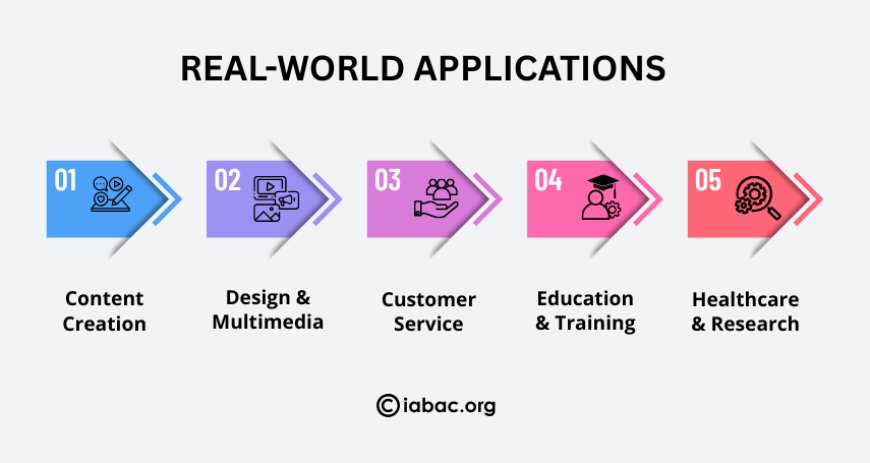
Real-World Applications
Generative AI is already being used in many industries:
-
Content Creation: Drafting articles, blogs, social media posts, video captions, and marketing material.
-
Design & Multimedia: Creating graphics, editing videos, exploring architecture or product designs.
-
Customer Service: Powering chatbots that provide instant responses and guidance.
-
Education & Training: Generating personalized learning materials and interactive simulations.
-
Healthcare & Research: Summarizing reports, analyzing data, and modeling experiments for drug discovery.
These examples show that generative AI is versatile and practical, saving time and improving efficiency across the board.
Challenges and Considerations
While generative AI is powerful, there are challenges to consider:
-
Accuracy and Bias: AI outputs depend on the data it has been trained on, so mistakes or biases can happen.
-
Ethical Concerns: Questions about authorship and ownership of AI-generated content are important.
-
Human Oversight: AI should support humans, not replace them. Review and refinement are necessary.
-
Legal Issues: Copyright and intellectual property rights for AI-generated content can be complex.
Awareness of these challenges is key to using generative AI responsibly.
Future Outlook
Generative AI is still evolving. As it becomes more sophisticated, it will integrate further into creative, business, and everyday tasks. The technology is expected to work alongside humans, enhancing productivity and creativity rather than replacing people.
Businesses and individuals who adopt AI thoughtfully will gain a competitive edge. Over time, tools will become more intuitive, understanding context, style, and user intent better than ever before.
Generative AI is changing the way we work, create, and make decisions. Its main benefits include:
-
Saving time and increasing productivity
-
Boosting creativity
-
Creating personalized experiences
-
Reducing costs
-
Providing useful insights from data
-
Helping businesses grow and innovate
While there are challenges like accuracy, ethics, and legal issues, using generative AI carefully can keep these risks under control. For businesses, marketers, educators, and creators, it’s a powerful tool to work smarter, be more creative, and produce more.
Starting to use generative AI today can open up new opportunities and help you make the most of what this technology can offer.