





















































What Is Generative AI? A Beginner's Guide with Real-World Examples (2026)
Learn what generative AI is, how it works, and see real examples with ChatGPT, Gemini & Midjourney. Plus: how to get IABAC-certified in AI in 2026.


You've used autocomplete on your phone. You might have chatted with ChatGPT, asked Google Gemini a question, or scrolled past stunning artwork made in Midjourney. But have you ever stopped to wonder: what's actually powering all of this?
The answer — in almost every case — is generative AI.
In 2026, generative AI isn't a futuristic concept anymore. It's writing your emails, designing marketing materials, powering customer support chatbots, and even helping doctors spot diseases earlier. Whether you're a student, a working professional, or a business owner, understanding what generative AI is — and what it can do — has become as essential as knowing how to use the internet.
This guide is designed for complete beginners. By the time you finish reading, you'll know exactly what generative AI is, how it works, which tools matter most, where it's being used across industries, and — if you want to take it further — how to get formally certified in it.
Let's start from the top.
1. What Is Generative AI?
Generative AI is a branch of artificial intelligence that creates new content — text, images, audio, video, or code — by learning patterns from vast amounts of existing data.
Think of the difference between a photocopier and a skilled author. A photocopier reproduces what already exists. A skilled author reads thousands of books, internalizes patterns of language and storytelling, then produces something entirely new. Generative AI works more like the author.
Traditional AI was mostly about prediction and classification. It could tell you whether an email was spam, flag a fraudulent transaction, or recommend the next song on your playlist. Generative AI goes a step further — it doesn't just analyze existing content, it produces new content on demand.
Quick comparison
Traditional AI: "Is this email spam? Yes or no."
Generative AI: "Write me a professional email declining this meeting."
This shift from predicting to creating is what makes generative AI such a big deal — and why it's reshaping entire industries.
2. How Generative AI Works — No PhD Required
You don't need to understand calculus to get the gist of how generative AI works. Here's the simplest explanation possible.
Large Language Models (LLMs)
Most text-based generative AI — including ChatGPT and Gemini — is powered by something called a Large Language Model, or LLM. Here's how it learns:
- It's fed enormous amounts of text data — think Wikipedia, books, websites, research papers, code repositories, and more.
- It learns statistical patterns: what words and ideas tend to follow other words and ideas.
- When you type a prompt, it predicts the most likely and useful response, one token (roughly one word) at a time.
Think of it like autocomplete on your phone — except it's been trained on the entire internet and can write a 2,000-word essay, not just finish a sentence.
The "large" in Large Language Model refers to the sheer scale: modern LLMs have billions — sometimes hundreds of billions — of parameters (internal settings that shape how they respond). The more parameters, generally the more nuanced and capable the model.
Diffusion Models (for Images)
Image-generating tools like Midjourney and DALL·E use a different approach called diffusion. The model learns by taking a real image, gradually adding random noise until it becomes unrecognizable static, and then learning to reverse that process — reconstructing the image from noise. Once trained, it can generate brand-new images from a text description by "conjuring" them out of noise.
Analogy
Imagine a sculptor who's studied thousands of statues being handed a block of marble and a description — "a roaring lion mid-leap." They can produce something that never existed before because they've internalized what lions look like, what marble can do, and what motion feels like. Diffusion models do something similar, in milliseconds.
3. Real-World Examples: ChatGPT, Gemini & Midjourney
Let's look at the tools you've probably heard about — and what each one actually does.
ChatGPT (OpenAI)
ChatGPT is the tool that put generative AI on the map for most people. Launched in late 2022 and rapidly updated through 2026, it's a conversational AI that can write, edit, summarize, analyze, code, brainstorm, and answer questions in natural language. As of 2026, ChatGPT receives nearly 5 billion visits per month, making it one of the most-visited sites on the internet.
Everyday uses include drafting emails, creating content outlines, debugging code, studying for exams, and building customer support workflows.
Google Gemini
Gemini is Google's multimodal AI, built to handle text, images, audio, and code — sometimes all at once. It's deeply integrated into Google Search (powering AI Overviews), Google Docs, Gmail, and Google Workspace. Unlike ChatGPT, which you access through a separate app, Gemini is increasingly woven into tools you already use every day.
If you've seen a summarized AI answer at the top of a Google Search result in 2026, that's Gemini at work.
Midjourney
Midjourney is a text-to-image AI that lets you describe a scene, a character, or a concept in plain English and get a photorealistic or artistic image in seconds. It's widely used in graphic design, advertising, game development, and content creation. The quality has advanced so rapidly that Midjourney images are now routinely used in commercial campaigns.
Here's a quick overview of the major tools in 2026:
|
Tool |
Category |
Best For |
Free Tier? |
|
ChatGPT |
Text / Chat |
Writing, coding, Q&A |
Yes |
|
Google Gemini |
Multimodal |
Search, Docs, Gmail |
Yes |
|
Midjourney |
Image |
Design, art, marketing |
Limited |
|
GitHub Copilot |
Code |
Software dev |
Yes (trial) |
|
ElevenLabs |
Audio / Voice |
Voiceovers, podcasts |
Yes |
|
Sora |
Video |
Short-form content |
Limited |
4. Types of Generative AI
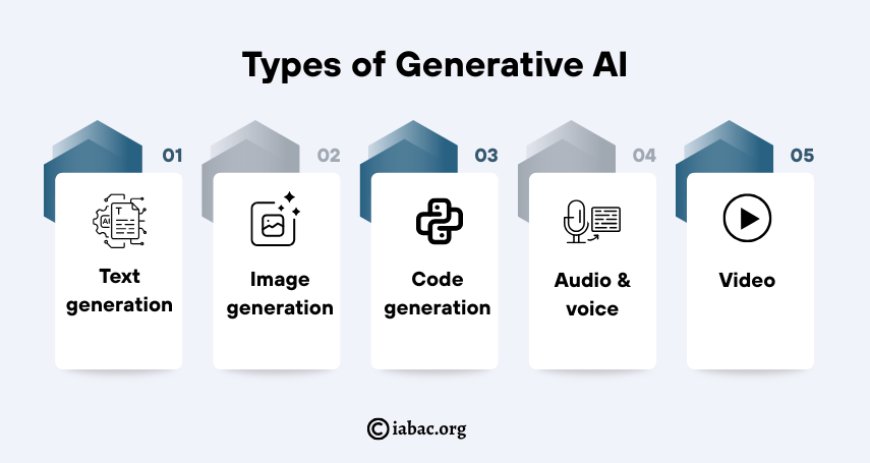
Generative AI isn't just about chatbots. It spans five major output categories:
-
Text generation: LLMs like ChatGPT, Claude, and Gemini. Used for writing, summarizing, customer support, legal drafting, and research.
-
Image generation: Tools like Midjourney, DALL·E, and Adobe Firefly. Used in marketing, game design, and advertising.
-
Code generation: GitHub Copilot, Claude Code, and Amazon CodeWhisperer. Used to write, debug, and document software.
-
Audio & voice: ElevenLabs, Suno, and Udio. Used for AI voiceovers, podcast production, and music generation.
-
Video: OpenAI Sora, Runway, and Pika. Used for short-form content creation, film prototyping, and social media.
This is what people mean when they talk about generative AI being "multimodal" — it's not limited to one type of output. The most advanced models can move between text, image, audio, and video in a single workflow.
5. Where Generative AI Is Being Used Right Now
Generative AI isn't just a Silicon Valley experiment. It's already embedded in industries you interact with every day.
Medical teams use generative AI to summarize dense research papers, draft patient discharge notes, and assist with imaging analysis. Companies like Microsoft (with Nuance DAX) are using it to reduce the documentation burden on doctors — letting physicians spend more time with patients and less time on paperwork.
Marketing & Advertising
Marketing teams use ChatGPT and Gemini to generate ad copy, email campaigns, social media posts, and blog drafts at scale. Midjourney and Adobe Firefly are replacing stock photo budgets for many companies. The result? Faster campaigns, lower production costs, and more personalized content.
Education
Platforms like Khan Academy and Duolingo have integrated generative AI to create personalized tutors that adapt to each student's pace. Teachers use it to generate quiz questions, lesson plans, and rubrics. Students (ideally) use it to get unstuck on difficult concepts rather than to cheat.
Finance
Banks and investment firms use generative AI to summarize earnings reports, generate client-facing portfolio updates, and flag anomalies in transaction data that might indicate fraud. Bloomberg has its own LLM trained specifically on financial data.
Software Development
GitHub Copilot, powered by OpenAI, now suggests entire code blocks as developers type — and studies suggest it can speed up coding tasks by up to 55%. Code review, test generation, and documentation are increasingly handled by AI assistants.
6. Benefits & Limitations — An Honest Look
Generative AI is genuinely powerful. But it also has real limitations, and understanding both is what separates informed users from enthusiastic skeptics.
What generative AI does well
-
Speed: it can produce a first draft in seconds that would take a human hours.
-
Scale: one team can create content, code, or designs at a volume that wasn't previously possible.
-
Creativity augmentation: it's an exceptional brainstorming partner, helping you break through creative blocks.
-
Accessibility: it democratizes skills — a non-designer can create a polished image, a non-coder can write basic scripts.
Where it falls short
-
Hallucinations: generative AI can confidently state false information. It doesn't "know" facts — it predicts text, and sometimes predicts wrongly.
-
Bias: models trained on human-generated data inherit human biases. Outputs can reflect and amplify existing prejudices if not carefully monitored.
-
Copyright and ownership: questions about who owns AI-generated content are still being resolved in courts around the world.
-
Energy usage: large AI models require significant computing power, raising questions about environmental impact.
The bottom line
Generative AI is powerful, but it still needs a human in the loop. Think of it as a very fast first draft — not a finished product. The best outcomes come from humans and AI working together, with humans providing judgment, context, and accountability.
7. How to Get Certified in Generative AI (IABAC)
Understanding generative AI is one thing. Being able to demonstrate that knowledge — with a recognized credential — is what sets you apart in a competitive job market.
Whether you're a marketing manager looking to lead AI adoption at your company, a developer wanting to specialize in AI-powered applications, or a student entering a job market that now expects AI literacy, a formal certification signals that you're serious.
Why IABAC?
The International Association of Business Analytics Certifications (IABAC) offers globally recognized AI and data certifications that are aligned with current industry standards. Their generative AI certification program covers:
- Foundations of large language models and generative AI
- Prompt engineering and AI workflow design
- Responsible AI — understanding bias, ethics, and governance
- Practical applications across marketing, healthcare, finance, and technology
- Hands-on projects using real tools like ChatGPT, Gemini, and Midjourney
The certification is structured for working professionals — you can complete it at your own pace, alongside your current job or studies.
Ready to become certified?
Explore the IABAC Generative AI Certification program — globally recognized, beginner-friendly, and built for the AI era.
Visit IABAC.org to learn more →
Generative AI is no longer a buzzword — it's the engine powering some of the most significant shifts in how we work, create, communicate, and solve problems.
In this guide, we covered what generative AI actually is (a system that creates new content by learning from existing data), how it works (through LLMs and diffusion models), the tools that matter most right now (ChatGPT, Gemini, Midjourney, and more), the industries it's already transforming, and its genuine strengths and honest limitations.
The people and organizations who thrive over the next decade won't be the ones who avoid AI — they'll be the ones who understand it well enough to use it wisely, lead teams through it, and build careers around it.
If you're ready to move from curious to certified, the IABAC Generative AI Certification is a practical, globally recognized next step. It's designed for exactly where you are right now — at the beginning — and built to take you somewhere that matters.
What's your take?
Which generative AI tool have you tried — or are most curious to explore? Let us know in the comments below.