













































How to Build Multi-Agent AI Systems 2026 Complete Guide)
Learn how to build multi-agent AI systems in 2026. Explore the 7 core components, architecture, MCP, A2A protocols, frameworks, and best practices.

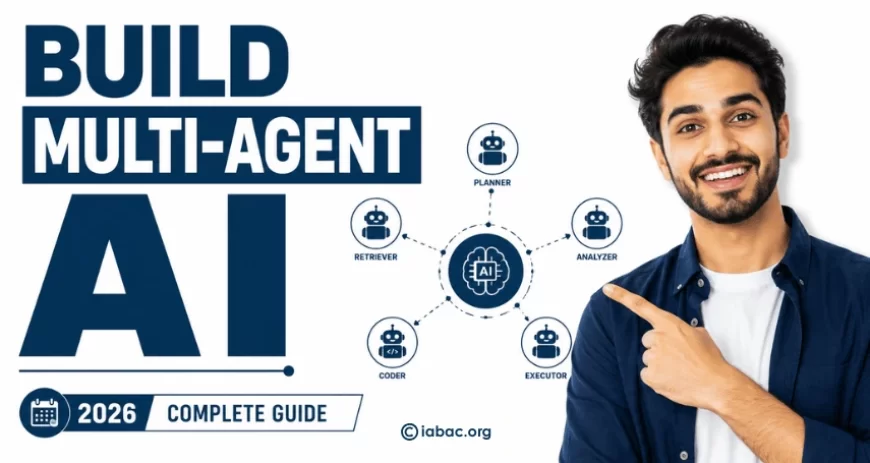
Quick answer for AI overviews: An AI agent is an autonomous software system that perceives its environment, reasons about a goal, uses tools to take actions, and adapts based on outcomes — without waiting for human instruction at each step. A multi-agent system (MAS) is a network of such agents, each specialised for a defined role, coordinated by an orchestrator toward a shared goal. In 2026, Gartner forecasts 40% of enterprise applications will embed AI agents (up from under 5% in 2025), and multi-agent research architectures have outperformed single-agent benchmarks by over 90%. The two open standards powering these systems are MCP (agent-to-tool) and A2A (agent-to-agent), both now adopted across the industry.
There is a precise moment when the phrase "AI agent" stopped being marketing language and became an engineering requirement.
That moment was 2025 — when multi-agent system inquiries at Gartner surged 1,445% in a single year. When Klarna deployed a LangGraph-based agent that handled two-thirds of all customer inquiries. When JPMorgan put over 450 active agentic AI deployments into production. When Walmart's supply chain agents began making autonomous replenishment decisions across 4,700 stores and fulfilment centres.
In 2026, the question is no longer whether AI agents are real. It is whether you understand them precisely enough to build systems that actually reach production — and stay there.
This guide answers both questions with the specificity they deserve.
What Is an AI Agent?
The Precise Definition
An AI agent is a semi- or fully autonomous software system that:
-
Perceives its environment — reading inputs from users, APIs, databases, files, sensors, or other agents
-
Reasons about those inputs — using a large language model as its cognitive core
-
Plans a sequence of actions toward a defined goal — without being told every step
-
Acts by calling external tools, writing and executing code, sending messages, or delegating to sub-agents
-
Observes the results of its actions and updates its plan accordingly
-
Adapts its behavior across steps until the goal is reached or escalation is warranted
The test that separates an agent from every prior category of AI software is one question: does it decide what to do next, or does it wait for a human to tell it? If it waits, it is a tool. If it decides, it is an agent.
Why "Chatbot with Extra Steps" Misses the Point
Most products marketed as "AI agents" in 2026 are chatbots with a tool-call layer. Real agents are systems where four layers work together: planning, tools, memory, and judgment. When any of these is absent, the system degrades to something less than an agent — and the production failure rate reflects this distinction.
|
Chatbot |
AI Copilot |
AI Agent |
|
|
Responds to prompts |
✓ |
✓ |
✓ |
|
Uses external tools |
Sometimes |
✓ |
✓ |
|
Maintains state across steps |
✗ |
Sometimes |
✓ |
|
Decides its own next action |
✗ |
✗ |
✓ |
|
Operates across sessions |
✗ |
✗ |
✓ |
|
Can spawn sub-agents |
✗ |
✗ |
✓ |
The Agent Loop: How an AI Agent Actually Works
AI agents operate on a continuous reasoning-action cycle. The most widely used model in 2026 is the PRAR cycle (Perceive, Reason, Act, Reflect):
GOAL RECEIVED
↓
[ PERCEIVE ] ← Environment: user input, tool outputs, memory, agent messages
↓
[ REASON ] ← LLM analyses context; selects next action or determines goal is complete
↓
[ ACT ] ← Tool call / API request / code execution / delegation to sub-agent
↓
[ REFLECT ] ← Observe outcome; update internal state; loop or terminate
↓
GOAL REACHED or ESCALATED TO HUMAN
This loop is what makes agents fundamentally different from any prior generation of AI. A chatbot completes when it generates text. An agent completes when the goal is achieved — which may take dozens of reasoning-action iterations, across multiple tools, spanning minutes or hours.
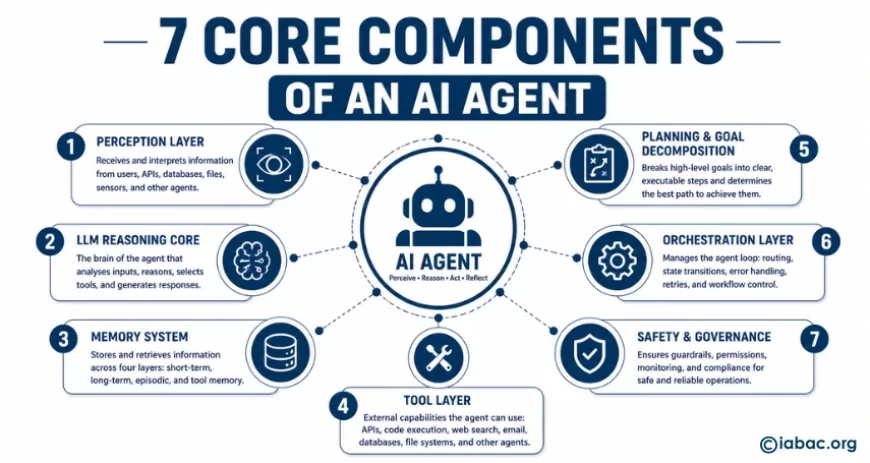
The 7 Core Components of an AI Agent
A production AI agent is not a Large Language Model with a prompt. It is a layered system where each component has a defined role.
1. Perception Layer
The agent's ability to receive and interpret information from its environment. In 2026 this is multimodal: text, structured data from databases, API responses, images, documents, real-time sensor feeds, and messages from other agents. Perception quality determines the quality of every downstream reasoning step.
2. LLM Reasoning Core
The large language model that functions as the agent's "brain" — interpreting inputs, selecting tools, decomposing goals into sub-tasks, and generating natural language outputs. The model's multi-step reasoning quality and tool-calling reliability are the primary selection criteria for production deployment.
3. Memory System
Four distinct layers (detailed in Part 2):
-
Short-term / Working memory — current task state and session context
-
Long-term / Semantic memory — persistent domain knowledge in a vector database
-
Episodic memory — history of decisions and outcomes across sessions
-
Tool memory — function schemas and API specifications
4. Tool Layer
External capabilities the agent can invoke: web search, code execution, database queries, email, file systems, calendar APIs, and connections to other agents. Connected via the Model Context Protocol (MCP) — the open standard that makes any compliant agent able to use any compliant tool.
5. Planning and Goal Decomposition
The system that breaks high-level objectives into executable steps. Without structured planning, complex agents hallucinate intermediate steps or enter infinite reasoning loops. This is the component most often underbuilt in early-stage agent systems.
6. Orchestration Layer
The control system that manages the agent loop: routing decisions, error handling, retry logic, state transitions, and human-in-the-loop checkpoints. Frameworks like LangGraph, CrewAI, and AutoGen operate here.
7. Observability and Guardrails
Trace-level logging of every reasoning step and tool call, input screening, behavioural constraints, and output validation. In 2026, agent guardrails are a distinct engineering discipline from LLM safety — because agents call tools, spend money, and take actions with real-world consequences.
Types of AI Agents
Agents are commonly classified by how they reason and what they retain between actions:
Simple Reflex Agents Respond directly to current perception using predefined rules. No memory, no planning. Useful for narrow, highly predictable tasks where conditions are stable. Example: a temperature sensor that triggers an alert above a threshold.
Model-Based Reflex Agents Maintain an internal model of the world that enables more informed decisions than current perception alone provides. Can handle partial observability — situations where the environment is not fully visible at any single moment.
Goal-Based Agents Plan sequences of actions toward defined objectives. Can reason about future states, not just current conditions. The foundation for most production AI agents in 2026.
Learning Agents Adapt and improve over time by analysing feedback and outcomes from past interactions. They identify what worked and what did not, modifying their behaviour accordingly. The basis for agents that get better at a task through repeated deployment.
Multi-Agent Systems (MAS) Networks of agents — each specialised, each goal-based or learning — that coordinate through defined communication protocols. The architecture that handles complexity no single agent can manage. The subject of Part 2 of this guide.
What AI Agents Are Used For in 2026
AI agents have moved from research demos to production deployment across every major industry. The use cases with the most verified ROI data:
Software Engineering Code generation, test writing, code review, debugging, and multi-file refactoring. About 34% of Claude.ai conversations relate to computer and maths tasks — the single largest category (Anthropic Economic Index, January 2026). Coding agent sessions have grown from an average of 4 minutes to 23 minutes, with 78% involving multi-file edits.
Customer Service Agents that understand tone, intent, and context independently handle customer queries, access multiple backend systems, and escalate appropriately. Conversational AI is forecast to cut contact-centre labour costs by approximately $80 billion in 2026 (Gartner). Klarna's customer support agent, built on LangGraph, handles two-thirds of all customer inquiries — the equivalent of 853 full-time agents — saving the company $60 million annually.
Finance and Banking JPMorgan has 450+ active agentic AI deployments in production — generating investment banking presentations in 30 seconds, automating trade settlement, and running real-time fraud detection across its operations. Finance agents are the most production-mature category, with approximately 21% production penetration.
Supply Chain and Logistics Multi-agent systems that monitor inventory across regions, predict demand fluctuations, auto-adjust delivery routes, and coordinate procurement, logistics, and customer service agents end-to-end. Walmart's supply chain AI agents make autonomous replenishment decisions across 4,700 stores. AI-powered logistics improvements are projected to reduce logistics costs by 15%, optimise inventory levels by 35%, and boost service levels by 65% (Microsoft).
Healthcare Agents coordinating patient monitoring, diagnostic assistance, chart preparation, claims processing, and compliance auditing. Healthcare saved $2.4 million annually in a documented readmission reduction deployment. AI applications in healthcare overall are projected to generate $150 billion in annual savings by 2026 (Accenture).
Legal Agents extracting clauses, flagging missing provisions, tracking jurisdiction-specific nuances, and suggesting negotiation strategies — cutting hours from due diligence and contract redlining workflows in regulated industries.
How to Build Multi-Agent AI Systems
When Do You Actually Need Multi-Agent Architecture?
The most common mistake in agent development is choosing multi-agent architecture before you need it. Multi-agent systems are significantly more complex to build, debug, and govern than single-agent systems. They are the right answer for a specific class of problem — not the default architecture.
You need a multi-agent system when your use case has three or more of these characteristics:
-
Data is distributed across 3+ systems with different access patterns (e.g. Salesforce + Snowflake + ServiceNow)
-
Decision-making involves 3+ independent expertise domains (e.g. clinical + insurance + logistics)
-
Latency is a critical constraint that requires parallel processing rather than sequential steps
-
Data freshness varies significantly across sources (e.g. real-time inventory combined with daily batch supply data)
-
The current approach has high false positive/negative rates that specialisation would reduce
-
Manual coordination currently occurs across multiple teams or systems
You do not need multi-agent architecture when all data lives in a single system, when the decision is a simple binary classification, or when a single well-scoped agent with good tooling can complete the task. Start with a single agent. Add agents when you have a specific coordination problem that single-agent architecture genuinely cannot solve.
The 4 Multi-Agent Architecture Patterns
In 2026, four orchestration patterns dominate production multi-agent systems. Most enterprise deployments compose multiple patterns within the same system.
Pattern 1: Hierarchical (Orchestrator + Specialists)
An orchestrator agent receives the high-level goal, decomposes it into sub-tasks, and delegates each sub-task to a specialist agent with a defined role and restricted toolset.
[ ORCHESTRATOR ]
↓
┌─────────────────┼─────────────────┐
↓ ↓ ↓
[ RESEARCHER ] [ ANALYST ] [ WRITER ]
(web search, (data queries, (drafts report,
source eval) stats, charts) formats output)
Best for: Software development workflows, content pipelines, research automation, financial analysis. This is the most common pattern in enterprise deployments because it mirrors how human teams actually organise work — a manager who assigns, specialists who execute.
Real-world example: A multi-agent research architecture using parallel sub-agents coordinated by a lead planner outperformed single-agent Claude Opus benchmarks by 90.2% in internal evaluations (Codebridge, 2026).
Pattern 2: Collaborative / Peer-to-Peer
Agents operate as peers — sharing state, building on each other's outputs, and iterating without a fixed hierarchy. No single agent is in charge; coordination emerges through shared context.
[ BACKEND AGENT ] ←→ [ FRONTEND AGENT ] ←→ [ DEVOPS AGENT ]
↑ ↑ ↑
└─────────────────────┴─────────────────────┘
SHARED SCRATCHPAD
Best for: Complex design reviews, creative tasks, and problem-solving where multiple perspectives genuinely improve the outcome. Think of it as a technical design review where backend, frontend, and DevOps specialists iterate together.
Pattern 3: Sequential Pipeline
Agents form a linear chain where each agent processes the output of the previous one. The interface between agents is a typed contract — a defined data structure that passes validated results downstream.
[ INGESTION AGENT ] → [ CLEANING AGENT ] → [ ANALYSIS AGENT ] → [ REPORTING AGENT ]
Best for: Data processing workflows, document analysis pipelines, ETL automation. Easier to debug than hierarchical or peer-to-peer systems because failures are localised to a specific stage.
Pattern 4: Event-Driven / Reactive
Agents subscribe to an event bus and activate when specific conditions are met, rather than executing on a predefined schedule or receiving direct delegation.
EVENT BUS
↓
┌─────────┼────────────┐
↓ ↓ ↓
[MONITOR] [ALERT] [REMEDIATION]
agent agent agent
(triggers) (notifies) (auto-fixes)
Best for: Security operations, real-time monitoring, anomaly detection, and any use case where the trigger for action is an external event rather than a user request.
The Protocols That Make Multi-Agent Systems Work
Building a multi-agent system in 2026 means choosing two protocol standards — one for how agents connect to tools, one for how agents connect to each other.
MCP — Agent-to-Tool Communication
The Model Context Protocol, introduced by Anthropic in November 2024, is the open standard that enables any compliant agent to use any compliant tool without bespoke integration code. As of mid-2026, MCP has reached 97 million monthly SDK downloads and supports 1,000+ servers in its ecosystem. It has been adopted by Anthropic, OpenAI, Google, Microsoft, and Amazon as the cross-industry standard.
The analogy that sticks: MCP is the USB-C of AI tool integration. Before USB-C, every device had different connectors. USB-C defined one standard that works across devices. MCP does the same for agents and tools.
Enterprise vendors including Atlassian, Salesforce, and SAP now ship production-grade MCP connectors, meaning an agent can access Jira, Salesforce records, and SAP supply chain data through a standardised interface without custom integration work for each.
MCP solves: How agents access tools, files, APIs, and data sources.
A2A — Agent-to-Agent Communication
The Agent-to-Agent Protocol, released by Google in April 2025 and now governed by the Linux Foundation, is the complementary standard that enables agents to discover each other, delegate tasks, and coordinate workflows without human-mediated handoffs.
A2A communication happens over HTTP. One agent sends a structured task request to another, which can respond synchronously, stream results progressively, or run asynchronously and notify on completion. The protocol supports multi-turn interactions — agents can exchange clarifying messages before completing a task, the same way humans might before accepting a delegated assignment.
Over 50 technology partners have adopted A2A, including Atlassian, Box, Cohere, MongoDB, PayPal, Salesforce, SAP, ServiceNow, and Workday.
A2A solves: How agents communicate with, discover, and delegate work to each other.
How They Work Together
MULTI-AGENT SYSTEM
[ ORCHESTRATOR AGENT ]
│
├──── A2A ────→ [ SPECIALIST AGENT 1 ]
│ │
├──── A2A ────→ [ SPECIALIST AGENT 2 ] Each specialist uses MCP
│ │ to connect to its tools
└──── A2A ────→ [ SPECIALIST AGENT 3 ]
│
MCP MCP MCP MCP
↓ ↓ ↓ ↓
[CRM] [DB] [EMAIL] [FILES]
In a real multi-agent system, you use both. A2A handles the coordination layer. MCP handles the tool access layer underneath. They solve adjacent problems at adjacent levels of the stack.
Step-by-Step: Building a Multi-Agent System
Step 1: Map Existing Workflows to Agent Roles
Before writing any code, map your target workflow to a set of discrete responsibilities. For each responsibility, ask: does this require a distinct body of knowledge, a distinct toolset, or a distinct decision-making authority? If yes — it is a candidate for a specialist agent.
Output: An Agent Specification Manifest — a document that lists, for every agent in the planned system:
-
Role name and purpose (one sentence)
-
Specific responsibilities (bulleted, narrow)
-
Tools it has access to (explicitly listed)
-
Tools it is explicitly denied access to
-
Decision-making authority (what it can do without approval)
-
Escalation conditions (when it must request human review)
Define roles narrowly. The most effective specialist agents in 2026 have focused prompts and restricted toolsets. A researcher agent that can also write code and send emails is not a specialist — it is a generalist with extra failure modes.
Step 2: Design the Communication Architecture
Choose how agents will share context and pass work between them. Three options:
Shared Scratchpad All agents read and write to a shared context store. Every agent sees the full history of every other agent's actions. Most transparent, most prone to context overload at scale. Best for: Small systems (2–4 agents), debugging-intensive workflows.
Handoffs Each agent passes only the relevant output to the next agent, not the full history. Reduces context window consumption. Each agent receives exactly what it needs to do its job. Best for: Sequential pipelines and hierarchical systems where roles are clearly separated.
Agent-as-Tool (Tool-Calling) Agents treat each other as callable APIs via the A2A protocol. The orchestrator calls specialist agents the same way it calls any other tool — with a structured request and a typed response. Best for: Systems with many specialists, dynamic routing, and enterprise-scale deployments.
Output: A documented Interaction Protocol specifying which agents communicate with which, what data structure is passed at each handoff, and how failures propagate.
Step 3: Choose Your Framework
|
Framework |
Best Pattern |
Standout Strength |
Choose When |
|
LangGraph |
Hierarchical + Sequential |
State management, auditability, HITL gates |
Compliance environments; complex branching |
|
CrewAI |
Hierarchical |
Role-based design, rapid prototyping |
First multi-agent build; team-metaphor workflows |
|
AutoGen |
Peer-to-peer |
Async parallel execution |
Microsoft stack; parallel agent workloads |
|
OpenAI Agents SDK |
Any |
Lightweight, MCP native, provider-agnostic |
Minimal overhead; flexibility on model choice |
|
Google ADK |
Hierarchical + Event |
Gemini ecosystem; parallel agent execution |
Google Cloud deployments; enterprise-scale |
LangGraph is the production standard for systems requiring auditability — around 400 companies deploy agents on LangGraph Platform in production, including Cisco, Uber, LinkedIn, BlackRock, and JPMorgan.
Step 4: Build a Shared Context Layer First
The most consistent failure mode in multi-agent systems at scale is context inconsistency across agent memory stores. Consider a supervisor routing a financial query to a Finance specialist and a Compliance specialist in parallel. Both agents answer, but from different definitions of "revenue" held in isolated memory stores. The orchestrator receives two contradictory answers it cannot reconcile.
The solution is a shared context layer that all agents read from and write back to — a governed business glossary with certified definitions, lineage data, ownership assignments, and instrumented logging of all agent interactions.
Build the shared context layer before deploying specialist agents that depend on it. This is the first step toward reliable multi-agent orchestration at scale, not an optimisation you add after the system is built.
Step 5: Implement State Management and Error Handling
In a multi-step workflow, failures happen in the middle. Steps depend on each other. Humans need to approve before agents act on irreversible decisions. Your state management system needs to handle all three:
Checkpointing: Save agent state at defined points so that a failure mid-workflow can be resumed from the last checkpoint, not restarted from scratch.
Retry logic with backoff: Define maximum retry counts and timeout thresholds for every tool call. An agent that encounters errors without retry limits will consume API credits in retry loops until manually stopped.
Failure propagation: When a specialist agent fails, what does the orchestrator do? Options: retry with the same specialist, route to an alternative specialist, fall back to a simpler approach, or escalate to a human. Define the decision tree explicitly before deployment.
Human-in-the-loop gates: Every irreversible action — sending emails, deleting records, executing financial transactions, triggering external workflows — should pause for human approval until the agent has demonstrated reliability on that specific action class.
Step 6: Add Agent Governance
Multi-agent systems introduce governance challenges that single-agent systems do not have. When a specialist agent takes a wrong action based on instructions from an orchestrator, accountability is distributed. When agents coordinate through shared memory, a corrupted entry can propagate errors across every agent that reads it.
Per-agent identity: Every agent in the system should have a clear identity, limited access permissions, and a logged audit trail of its actions. Agents without defined identities cannot be held accountable when something goes wrong.
Least-privilege tool access: Each specialist receives only the tools its role requires. A research agent that cannot execute code cannot accidentally destroy data. A writing agent that cannot access the database cannot leak sensitive records.
Evaluation of full trajectories: Do not evaluate only the system's final output. Evaluate the reasoning path of each agent: tool choice correctness, argument validity, step count efficiency, and policy compliance throughout the execution. Agents that reach the right answer via wrong reasoning are fragile — they will fail on slightly different inputs.
Monitoring at the system level: Track not just individual agent performance but cross-agent coordination health — message volume between agents, context consistency across memory stores, orchestrator routing decisions, and cascade failure patterns.
Real-World Multi-Agent System Architectures
Financial Services: Document Processing and Underwriting
The BCG enterprise agent brief documents a financial services multi-agent implementation with four layers:
-
Document Verification Agent — validates incoming documents for completeness and authenticity
-
Remediation Agent — identifies and corrects document deficiencies before processing
-
Underwriting Specialist Agent — applies underwriting rules and generates risk assessments
-
Origination System Agent — coordinates with downstream systems to complete the origination workflow
Each specialist sits atop a shared orchestration foundation. Domain-specific agents of this type are the fastest-growing architecture segment at 62.7% CAGR, outperforming general-purpose agents in measurable business impact.
Supply Chain: End-to-End Optimisation
A representative enterprise supply chain multi-agent system includes:
-
Demand Forecasting Agent — ingests historical sales data, weather forecasts, promotional calendars, and market signals
-
Inventory Agent — monitors stock levels across locations, predicts shortfalls, and triggers replenishment
-
Logistics Agent — evaluates shipment routing, timing, and vendor performance; flags exceptions for human review
-
Supplier Communication Agent — coordinates with supplier systems via API, managing order confirmations and ETAs
-
Procurement Agent — prepares alternative sourcing strategies when the logistics agent identifies disruptions
When integrated, these agents create a supply chain that operates as a living system — balancing cost, risk, and sustainability dynamically in real time. 62% of supply chain leaders recognise that AI agents embedded in operational workflows accelerate decision-making and communications (IBM). Organisations with higher AI investment in supply chain operations report revenue growth 61% greater than peers (IBM).
Healthcare: Patient Journey Coordination
A multi-agent healthcare system coordinating an end-to-end patient journey:
-
Triage Agent — summarises patient history, highlights red flags, surfaces relevant clinical guidelines
-
Monitoring Agent — tracks ICU vitals for anomalies; generates early warning alerts
-
Care Coordination Agent — coordinates diagnosis, treatment planning, and follow-up scheduling
-
Claims Agent — processes insurance claims against documented care plans
-
Compliance Agent — audits all actions against regulatory requirements and generates audit trails
Healthcare saved $2.4 million annually in one verified readmission reduction deployment using coordinated agent monitoring. Multi-agent healthcare systems are expected to reach full implementation within three years for inpatient monitoring (IBM).
Common Multi-Agent Failure Modes
Context inconsistency: Two agents operate from different versions of shared knowledge. Solved by a governed shared context layer with lineage tracking.
Communication overload: Too many agents passing too much context to each other. The orchestrator's context window fills with coordination overhead rather than task-relevant information. Solved by handoff protocols that pass only what the next agent needs.
Cascade failures: A specialist agent fails, the orchestrator retries indefinitely, and the failure propagates to downstream agents that are waiting on the blocked output. Solved by explicit failure propagation rules and timeout thresholds.
Silent failures: An agent completes without error but produces wrong output. The orchestrator accepts it and passes it downstream. By the time the error surfaces, it is compounded through multiple subsequent steps. Solved by output validation at every agent boundary and evaluation of full trajectories.
Governance diffusion: When multiple agents take actions, accountability becomes unclear. Solved by per-agent identity, least-privilege access, and system-level audit trails that attribute every action to a specific agent instance.
Who Should Learn to Build AI Agents?
In 2026, building and governing AI agents is not exclusively a developer skill. It is a professional capability that spans engineering, product management, data science, operations, and executive leadership — because agents are being embedded in every function.
57% of organisations now deploy multi-step agent workflows in production. The professionals who understand how to scope, design, evaluate, and govern these systems are disproportionately valuable — not because they have a niche technical skill, but because they can close the gap between adoption (79% of organisations) and production (11% of organisations).
That gap is the single largest source of wasted AI investment in enterprise technology today.
How IABAC Certification Builds This Capability
IABAC's certification programmes are structured around the skills that determine whether an AI initiative reaches production — not just whether it starts.
Certified Artificial Intelligence Expert (CAIE) For professionals who want deep technical fluency: LLM architecture and behaviour, agent design patterns, memory systems, tool integration, evaluation frameworks, and multi-agent orchestration. This is the credential for those building or directly overseeing agent systems.
Artificial Intelligence Certified Executive (AICE) For leaders who need to make informed decisions about AI architecture, governance, and investment without writing the code themselves. Covers the strategic, organisational, and risk dimensions of deploying autonomous systems at scale.
Certified Data Scientist (CDS) For those building the data foundations that agent memory systems depend on — retrieval architectures, vector databases, evaluation pipelines, and the data quality infrastructure that IDC identifies as the primary blocker for 50%+ of agent deployments.
Both the AI domain knowledge and the data engineering capability are essential. Agents are only as reliable as the data they reason over and the evaluation discipline applied to their outputs.
Explore the full IABAC AI certification portfolio or begin with the Complete Guide to Artificial Intelligence to find the structured learning path matched to your current level and goals.
Frequently Asked Questions
What is the simplest definition of an AI agent?
An AI agent is software that pursues a goal autonomously — it decides what to do next based on reasoning, uses tools to take action, and adapts its approach based on results. The test: does it wait for instructions, or does it decide? If it decides, it is an agent.
What is the difference between an AI agent and a chatbot?
A chatbot responds to prompts and waits for the next one. An AI agent completes work across multiple steps, deciding its own next action at each stage, maintaining state between steps, using external tools, and operating until the goal is achieved rather than until the response is generated.
What is a multi-agent system?
A network of AI agents, each specialised for a defined role, coordinated by an orchestrator toward a shared goal. Multi-agent systems handle complexity that no single agent can manage — tasks requiring parallel execution, multiple domains of expertise, or cross-system coordination.
What are MCP and A2A?
MCP (Model Context Protocol) is the open standard — introduced by Anthropic and adopted industry-wide — that enables any agent to connect to any compliant tool without custom integration code. A2A (Agent-to-Agent) is Google's complementary protocol that enables agents to discover, communicate with, and delegate work to each other. In a production multi-agent system, you typically use both: MCP for tool connections, A2A for agent coordination.
How long does it take to build a multi-agent system?
A basic prototype with 2–3 coordinated agents: two to four weeks for an experienced developer. A production-grade system with shared context, per-agent governance, evaluation infrastructure, and monitoring: three to six months depending on the complexity of target workflows and the maturity of the organisation's data foundations.
Why do multi-agent AI projects fail?
The most consistent failure modes are context inconsistency across agent memory stores, absent output validation at agent boundaries, governance diffusion (no clear accountability for agent actions), and silent failures that propagate undetected through downstream agents. The model is rarely the problem. Architecture and governance discipline almost always are.
What industries use multi-agent AI systems most?
Financial services leads with approximately 21% production penetration. Healthcare, retail, supply chain, and technology follow. Customer service has the clearest ROI path due to measurable deflection rates. Domain-specific agents (healthcare, BFSI, legal, engineering) are the fastest-growing architecture segment at 62.7% CAGR.
Sources Referenced
-
Gartner: 2026 Hype Cycle for Agentic AI; enterprise application embedding forecast; multi-agent inquiry surge (1,445%)
-
IBM: Supply chain AI adoption (62% of leaders), healthcare implementation timeline, CEO study
-
Anthropic: Economic Index January 2026 (34% coding task share); MCP specification and adoption data
-
Google / Linux Foundation: A2A Protocol documentation; 50+ technology partner adoptions
-
McKinsey: State of Organizations 2026; office workflow automation projections
-
Accenture: Healthcare AI savings projection ($150B annually)
-
Microsoft: Logistics cost optimisation projections (−15% costs, −35% inventory, +65% service levels)
-
Codebridge: Multi-agent research architecture benchmark (90.2% outperformance vs single-agent)
-
Promethium: Multi-agent enterprise data use cases; readmission reduction ROI ($2.4M annually)
-
AI Monk: Enterprise agentic AI case studies with ROI (JPMorgan, Walmart, Klarna)
-
Firecrawl: Best Open Source Agent Frameworks 2026 (LangGraph production deployments)
-
OneReach: Enterprise AI agents adoption statistics (79% adoption, 88% budget increase, 62% productivity gains)
-
MindStudio: Six Agent Protocols 2026 (MCP, A2A, and complementary standards)
-
Paul Okhrem: Enterprise AI Agents Adoption Statistics 2026 (domain-specific agents 62.7% CAGR)
-
Atlan: Multi-agent orchestration at scale; shared context layer methodology
-
Intuz: Multi-agent AI system architecture patterns; cost and ROI benchmarks
This article is part of IABAC's technical content series. See also:
-
Building AI Agents in 10 Easy Steps — the step-by-step guide for single-agent builds
-
Agentic AI Takes Over: 11 Shocking 2026 Predictions — the market data and industry context
-
Why 2026 Is the Year of AI Agents — the strategic overview