


















































Year of AI Agents (2026): What Really Changed — And What's Coming Next
AI agents hit $12B in 2026 and are reshaping how enterprises operate. Discover the real shift from chatbots to autonomous systems — and get IABAC-certified to lead it.

There is a moment in every technological revolution when the idea stops being an idea.
When demos turn into deployments, experiments become products, and boardrooms stop asking “should we?” and start asking “how fast?”
For artificial intelligence, that moment has arrived. 2026 is being called the year of AI agents because businesses are moving beyond experimentation and deploying AI systems that don’t just respond, but act, decide, and execute.
These AI agents are already reshaping how companies operate, scale, and compete.
From Answering to Acting
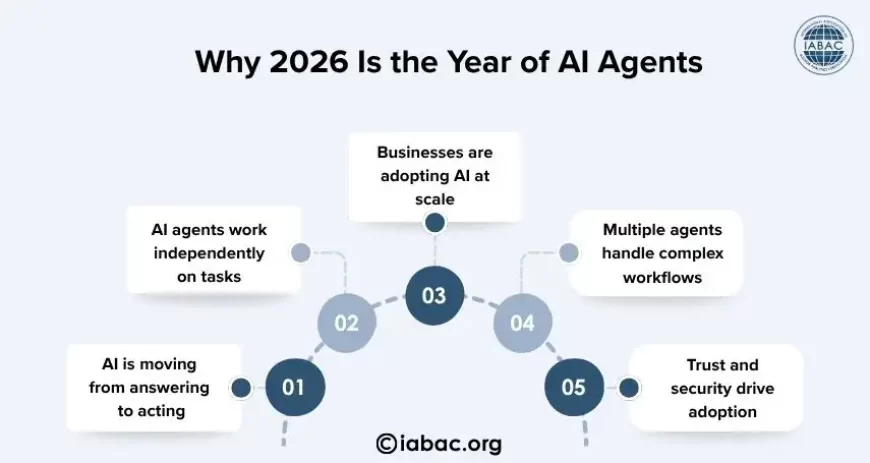
For most of its modern life, AI has been a very sophisticated question-answering machine. You typed something in, and it typed something back. The interaction was one-time, the model had no memory, and the person was always in charge of what happened next. That time is coming to an end.
AI agents are fundamentally different. Rather than responding to a single prompt, an agent pursues a goal. It
-
Plans, Reasons,
-
Uses tools, browses the web,
-
Writes and executes code, sends emails
-
Coordinates with other agents,
All without needing a human to hold its hand through each step. The shift is not merely technical; it is philosophical. We have moved from AI as an instrument to AI as a participant.
This change marks the start of a new era in how people and technology connect. In the past, AI was used to solve problems on demand. In 2026, AI will be able to work with humans to make decisions and carry out tasks while humans set the strategy.
The numbers reflect this transformation with unusual clarity. According to research, the global AI agents market has hit $12.06 billion in 2026, up from $7.63 billion just a year prior. And analysts project this figure will balloon to $50.31 billion by 2030, representing a 45.8% compound annual growth rate.
The Long Road to This Moment
It would be a mistake to treat 2026 as an overnight phenomenon. The intellectual foundations of agentic AI go back decades, to early research in autonomous systems, reinforcement learning, and multi-agent simulations. “What changed was not the idea but the infrastructure." Large language models gave agents a reasoning engine sophisticated enough to handle open-ended goals. Tool-use APIs gave them hands. Faster, cheaper compute gave them scale. These advancements are part of a broader ecosystem of artificial intelligence applications and technologies that continue to shape how modern AI systems are built and deployed.
In 2023 and 2024, researchers and startups built proofs-of-concept with memorable names:
-
AutoGPT
-
BabyAGI
-
Devin
that demonstrated what autonomous AI might look like. They were impressive and brittle in roughly equal measure. Agents would hallucinate, loop endlessly, or achieve goals in unexpected and often unhelpful ways. The technology was real; the reliability was not.
The period from 2023 to 2025 was essential groundwork:
Large language models became good enough at reasoning to support genuine goal-directed behavior, and the tooling around them, like APIs, protocols, and orchestration frameworks, matured enough for production use.
“2026 is not a revolution; it is a harvest.”
Multi-Agent Systems: The Microservices Revolution of AI
One of the most significant architectural shifts underlying the agentic moment is the move from single, all-purpose AI assistants toward networks of specialized agents working in concert.
According to analysts, this is AI's "microservices revolution," which is similar to how monolithic software applications were replaced by modular, distributed architectures in the 2010s.
Rather than asking one model to do everything, leading organizations are now deploying "orchestrator" agents that coordinate specialists.
-
A researcher agent gathers information.
-
A coder agent implements solutions.
-
An analyst agent validates results.
-
A governance agent monitors for policy violations.
The whole becomes more capable than any individual part.
Industries from healthcare to financial services are building agent networks to tackle workflows too complex for any single model to manage.
-
In healthcare, multi-agent systems are coordinating patient monitoring, diagnostics, treatment planning, and hospital operations, each agent focused on a domain, all working toward shared clinical goals.
-
In financial services, agent networks are handling fraud detection, regulatory compliance, customer service triage, and portfolio analysis in parallel.
“The value is not just speed; it is depth."
Agents can hold context, consult each other, and catch errors that a single sequential workflow would miss.
The Enterprise Has Entered the building
For AI agents to earn the label "year-defining," they need to matter to the people who run organizations, not just the people who build them. That case is now being made with hard numbers.
Many enterprises are already running AI agents in real operations, and this number has nearly doubled compared to last year. Meanwhile, according to NVIDIA, 86% of organizations are increasing their AI budgets in 2026.
The supply chain is one of the areas where the impact of agentic AI is clearly visible.
Companies are using AI agents to help them run their businesses more smoothly, respond to problems more quickly, and rely less on people to do things.
These systems improve forecasting accuracy, helping businesses manage supplies more efficiently and avoid unnecessary costs.
The results are already visible in real-world deployments, where companies are seeing smoother operations and better decision-making across their supply chains.
Customer service reflects a similar transformation.
AI agents today can understand tone, intent, and context, allowing them to handle a large portion of customer interactions independently.
This reduces the workload on human teams while maintaining consistent service quality.
For organizations managing high volumes of customer queries, this shift is significantly improving efficiency and operational scalability.
The Trust Problem and Why It Matters More Than the Technology
"The single biggest risk in the agentic era is not capability; it is trust." As AI agents gain the ability to act on behalf of users and organizations, questions of identity, accountability, and security become a reality rather than theoretical.
As organizations rely on agents to help with tasks and decision-making, every agent needs the same security protections we extend to humans. Each agent should have a
-
Clear identity,
-
Limited access permissions,
-
Managed data outputs, and
-
Protection from external attacks.
Without these safeguards, agents do not just become assets; they become attack surfaces.
The concern is not hypothetical. An agent with broad system access, minimal oversight, and a compromised instruction set could gain access to sensitive data, execute unauthorized transactions, or introduce vulnerabilities into critical infrastructure.
The industry has coined a phrase for the failure mode: "double agents," AI systems that carry unchecked risk because their security architecture was an afterthought.
Deep Research, Multimodal Perception, and the Shape of Things to Come
Beyond workflow automation, two categories of agentic capability are drawing particular attention in 2026: deep research agents and multimodal perception agents.
Deep research agents:
AI systems that autonomously gather data, evaluate sources, cross-verify facts, and generate analytical insights without human intervention are beginning to transform knowledge-intensive industries.
-
In finance, they monitor regulatory changes, forecast market trends, and synthesize thousands of academic papers into actionable intelligence.
-
In defense and security, they provide continuous threat landscape monitoring at a speed and breadth no human analyst team could match.
-
In pharmaceutical research, they accelerate the literature review process from months to hours.
Multimodal AI:
Models that can see, hear, and act in the world much more like a person, connecting language, vision, and action. The short-term goal is to create digital workers that can do a lot of different things, like interpreting complicated healthcare cases, using visual interfaces, and processing information from cameras, sensors, and documents in the same way they do with text. This, along with IoT integration and early partnerships with robotics, makes it likely that agents will work in the real world as well as the digital one.
What This Means for the People Inside These Organizations
Any honest account of the agentic moment must grapple with what it means for the humans whose work is being automated.
The World Economic Forum’s Future of Jobs Report 2025 projects that 92 million jobs may be displaced by 2030, while 170 million new roles will be created, resulting in a net gain of roughly 78 million positions.
But as every labor economist will point out, net gains at the global level do not distribute evenly across sectors, geographies, or skill profiles.
The optimistic framing, embraced by many in the AI‑enabled enterprise, is that AI agents allow small teams to punch far above their weight. A three‑person operation, with agents handling data analysis, content generation, and customer personalization, can compete with organizations ten times its size. Individuals who learn to direct, evaluate, and collaborate with AI agents will find their advantage and their value multiplied. This capability is often built through structured learning paths such as an artificial intelligence certification that prepares professionals to work alongside intelligent systems.
The Harvest Has Begun
2026 is being called the year of AI agents because the right conditions have aligned. Models are capable, infrastructure and governance frameworks have matured, and enterprise confidence has shifted from experimentation to real commitment. Results across supply chains, customer service, research, and software development are strong enough to justify continued investment.
This shift will not be without challenges. Governance may lag in some organizations, risks will surface, and certain implementations will fail, offering important lessons for those adapting early.
But the direction is clear. The era of AI as a sophisticated autocomplete tool is ending. The era of AI as a participant, one that plans, acts, coordinates, and delivers, has arrived. The organizations, teams, and individuals who internalize this shift early will not merely adopt a new technology. They will acquire a capability multiplier unlike anything available to previous generations of knowledge workers.
The agents are in the building. The only question now is what you ask them to do.