

























































What Are the Most Asked Data Engineer Interview Questions Today?
Prepare for data engineer interviews with key questions on SQL ETL pipelines big data tools and system design to improve problem solving and technical readiness


There comes a moment when you sit in front of your screen, looking at a job role for a data engineer, and a small doubt appears:
Am I really ready for this interview?
It’s a common feeling.
Interviews today are not just about remembering answers. They are about how clearly you think, how you solve problems, and how you explain your ideas in a simple way.
Many people study hard but still feel stuck during interviews. Not because they don’t know the subject, but because they are not used to real-world questions. This blog will help you understand the most common Data Engineer Interview Questions, along with clear explanations and examples. The goal is simple—to make you feel more prepared and confident.
Why Data Engineering Interviews Feel Different Today
Companies now expect more than basic knowledge. They want people who can handle real situations.
Instead of asking: What is SQL?
They ask: How would you handle millions of records every day?
This shift is important.
It means you need to:
- Understand concepts clearly
- Apply them in real situations
- Explain your thinking step by step
Most Asked Data Engineer Interview Questions (With Simple Answers)
Let’s go through the important ones.
1. What Is Data Engineering?
Answer: Data engineering is about building systems that collect, store, and prepare data so it can be used later.
In simple words:
- Data engineers organize data
- Others use it to make decisions
Example: Think about a food delivery app.
- Orders are placed
- Data is stored
- Reports are created
All the background work is handled by data engineers.
2. What Is ETL? Explain With Example
Answer:
ETL stands for:
- Extract
- Transform
- Load
Example:
A company collects data from:
- Website
- Mobile app
- Payment systems
Steps:
- Extract → Collect data
- Transform → Clean and organize it
- Load → Store it in a system
This process helps in making data usable.
3. Difference Between Data Engineer and Data Scientist
Answer:
|
Role |
Work |
|
Data Engineer |
Builds and manages data systems |
|
Data Scientist |
Studies data and finds patterns |
Simple idea:
One prepares the data.
The other uses it.
4. What Is a Data Pipeline?
Answer: A data pipeline moves data from one place to another.
Example: User action → Data collected → Processed → Stored → Used for reports
Good pipelines should be:
- Fast
- Reliable
- Easy to scale
5. SQL Question With Example
Question: Find the second-highest salary.
Answer:

This checks how well you understand SQL and logic.
6. What Is Normalization?
Answer: Normalization means organizing data to avoid repetition.
Example: Instead of storing the same customer details many times, store it once and link it.
Benefits:
- Saves space
- Keeps data clean
7. What Is Big Data?
Answer: Big data means very large amounts of data that normal systems cannot handle easily.
It includes:
- Large size
- Fast updates
- Different types of data
A big data engineer works with systems that can handle this.
8. What Are Hadoop and Spark?
Answer: These are tools used to manage and process large data.
|
Hadoop → Stores data |
|
Spark → Processes data quickly |
They are widely used in large-scale systems.
9. What Is Partitioning?
Answer: Partitioning means dividing data into smaller parts.
Example: Instead of one large dataset:
- Split by date
- Split by region
This improves performance.
10. What Is a Data Warehouse?
Answer: A data warehouse stores large amounts of structured data.
It is used for:
- Reports
- Analysis
- Business decisions
11. How Would You Design a Data Pipeline for a Large Application?
Answer: This question checks how you think step by step.
Example Scenario: A food delivery app receives millions of orders daily.
Simple Approach:
|
Data Collection → |
Capture data from app (orders, users, payments) |
|
Data Storage → |
Store raw data in a database or cloud storage |
|
Processing → |
Clean and transform the data |
|
Pipeline Setup → |
Move data regularly (batch or real-time) |
|
Final Storage → |
Store in a data warehouse for reporting |
Important Points to Mention:
- Handle large data volume
- Ensure data accuracy
- Make system scalable
A Simple Example With Numbers
Let’s say a company wants to estimate user growth.
Formula:
Users = Base Users + (Growth × Days)
If:
- Base Users = 1000
- Growth = 50
- Days = 10
Then:
Users = 1000 + (50 × 10) = 1500
This is a simple way to understand how data helps in prediction.
Behavioral Questions You Should Expect
Not all questions are technical.
Examples:
- Tell me about a problem you solved
- How do you handle missing data?
- Explain a project you worked on
Tip: Answer in a simple structure:
- Situation
- What you did
- Result
Common Mistakes to Avoid
Many people make small mistakes that affect their performance.
Avoid:
- Giving only theory
- Not explaining your thinking
- Ignoring basic topics
- Not practicing real questions
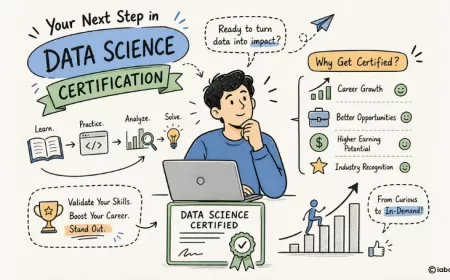
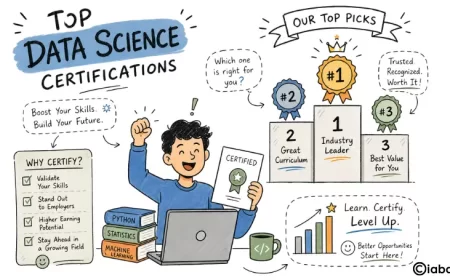
Why Certifications Can Help
Many learners ask if certifications are useful.
The answer is yes—if they focus on real skills.
Data Science Certifications and Data Engineer Certifications can:
- Show your knowledge
- Build confidence
- Improve job chances
A Certified data engineer often has better chances in interviews.
Why Learning New Skills Matters
Technology keeps changing. Skills that were useful before may not be enough today.
Roles like:
- data engineer
- big data engineer
- data engineers
are in high demand.
Learning new skills helps you stay ready for new opportunities.
How IABAC Can Support You
If you are planning to build a career in this area, choosing the right learning path is important.
IABAC helps learners:
- Learn practical skills
- Prepare for interviews
- Get certified
- Build confidence
You can check your level here:
https://iabac.org/eligibility
This test helps you understand where you stand before moving forward.
The Real Interview Feeling
Let’s be honest.
Before an interview:
- You feel nervous
- You question your preparation
- You hope for simple questions
Then comes a question like:
“Explain how you would build a data pipeline.”
If you understand the concept, you explain clearly.
If not, you struggle.
That moment shows the difference between memorizing and understanding.
How to Prepare Step by Step
Step 1: Learn Basics
- SQL
- Data concepts
Step 2: Practice Questions
Focus on common Data Engineer Interview Questions
Step 3: Work on Projects
- Build small systems
- Practice with real data
Step 4: Get Certified
Choose a good data engineer certification
Step 5: Practice Speaking
Explain answers clearly
So, what are the most asked Data Engineer Interview Questions today? They are simple in idea but require a clear understanding. Interviews are not about perfect answers. They are about showing how you think and solve problems.
Take your time. Practice regularly. Keep improving. If you are serious about building a career in this area, start taking small steps today. Check your current level, improve your skills, and move forward with confidence.
Start your journey with IABAC today.