


















































Top Generative AI Examples Across Industries
Explore generative AI examples across industries, including healthcare, finance, and media, with real-world use cases and practical business applications.

Generative AI is changing how work gets done across industries, and you can see it in everything from content creation to product design. Instead of spending hours on repetitive tasks, teams are using AI to generate ideas, automate workflows, and make faster decisions. What makes this shift interesting is how quickly it is moving from experimentation to real business impact. Whether it is healthcare, marketing, finance, or manufacturing, organizations are finding practical ways to use generative AI in their daily operations. Understanding where and how it is applied can help you stay relevant and build stronger careers in this evolving space.
What Is Generative AI
Generative AI is a type of artificial intelligence that can create new content based on the data it has learned from. Instead of just analyzing information, it can generate text, images, audio, code, and even simulations that feel similar to what humans create.
This makes it useful for handling tasks that usually need time, effort, and creativity. It can quickly produce multiple ideas or solutions, helping teams work faster and make better decisions.
Key characteristics include:
-
Creates human-like text, images, and designs
-
Learns from large amounts of data to generate new outputs
-
Supports both creative tasks and data-based work
-
Can be used across different industries and business functions
-
Helps improve productivity by reducing manual work
Generative AI can be used in many areas, making it a flexible and valuable tool for businesses and professionals.
Types of Generative AI
Generative AI includes different types of models designed to create specific outputs across industries. Each type focuses on a particular format, enabling businesses to apply Artificial intelligence in multiple ways depending on their needs.
Some common types include:
-
Text Generation Models: Used for creating blogs, emails, reports, chat responses, and documentation with human-like language
-
Image Generation Models: Used for designing visuals, product mockups, advertisements, and creative assets
-
Audio and Speech Generation: Used for voice assistants, audio narration, dubbing, and accessibility solutions
-
Video Generation Models: Used for creating and editing videos, animations, and short-form content automatically
-
Code Generation Models: Used by developers to write code, debug errors, and improve software development efficiency
These types of generative AI are widely used across industries to automate both creative and technical tasks.
Generative AI Examples Across Industries
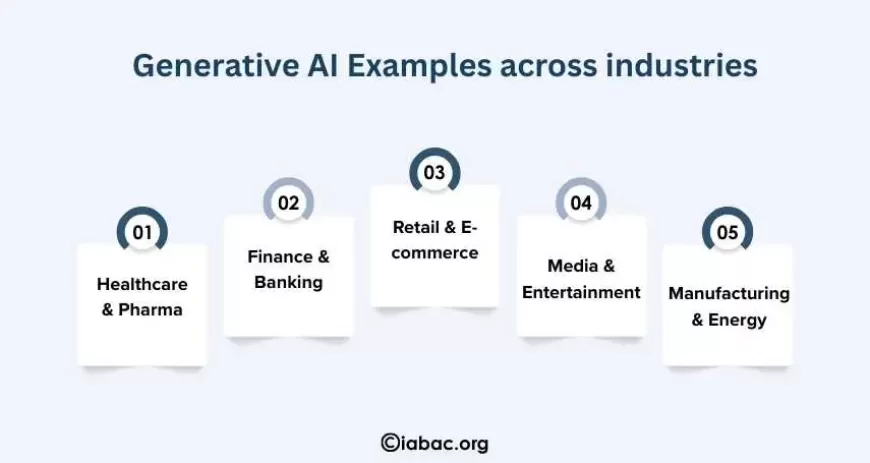
Generative AI is applied differently across industries depending on business needs. Below are key generative ai examples across industries that highlight real-world use cases and applications.
Healthcare & Pharma
Healthcare organizations are using generative AI to improve patient care, research, and operational efficiency.
-
Drug Discovery: Generative AI helps simulate molecular structures and interactions to identify potential drug candidates faster. It reduces research time and supports more efficient development of new treatments.
-
Clinical Documentation: AI systems extract key information from patient-physician conversations to generate accurate medical records. This reduces administrative workload and allows healthcare professionals to focus more on patient care.
-
Medical Imaging: Generative AI analyzes medical images such as X-rays and MRIs to detect patterns and identify diseases early. It supports faster diagnosis and improves accuracy in clinical decision-making.
These applications help reduce time in research and improve diagnostic accuracy.
Finance & Banking
Financial institutions are leveraging generative AI to enhance security, personalization, and compliance.
-
Fraud Detection: Generative AI creates and analyzes synthetic data to identify unusual patterns and detect fraudulent activities. It helps financial institutions respond faster and reduce potential risks.
-
Personalized Banking: AI-powered systems provide tailored financial recommendations based on individual user behavior and preferences. This improves customer experience by offering more relevant insights and services.
-
Regulatory Reporting: Generative AI automates the creation of compliance reports by analyzing financial data and regulatory requirements. It helps organizations maintain accuracy while reducing manual effort and time.
These use cases improve decision-making and reduce risks in financial operations.
Retail & E-commerce
Retail businesses are using generative AI to enhance customer experience and optimize marketing strategies.
-
Virtual Try-On: Generative AI enables augmented reality experiences where customers can visualize products like clothing or accessories before purchasing. This improves confidence in buying decisions and enhances the online shopping experience.
-
Content Generation: AI systems create product descriptions, marketing copy, and personalized campaigns at scale. This helps businesses maintain consistency while reducing the time required for content creation.
-
Trend Prediction: Generative AI analyzes market data, customer behavior, and historical trends to forecast future demand. This supports better inventory planning and helps brands stay aligned with changing consumer preferences.
These applications help businesses create more engaging and personalized shopping experiences.
Media & Entertainment
The media industry is using generative AI to accelerate content production and improve creativity.
-
Video Generation: Generative AI creates and edits video content automatically, including highlights, animations, and short-form videos. It helps reduce production time while maintaining quality and consistency.
-
Marketing Copy: AI tools generate advertising content, social media posts, and campaign messaging based on audience insights. This enables faster content creation and improves engagement through personalized communication.
These capabilities allow faster content creation while maintaining quality and consistency.
Manufacturing & Energy
Manufacturing and energy sectors are using generative AI to improve efficiency and reduce operational costs.
-
Preventive Maintenance: Generative AI analyzes equipment and sensor data to identify patterns that indicate potential failures. This helps organizations take action early and reduce downtime and maintenance costs.
-
Process Optimization: AI systems evaluate operational data to identify inefficiencies and improve workflows. This leads to better resource utilization, reduced costs, and more efficient production processes.
These use cases support smarter operations and reduce downtime.
Professional Services & Tech
Generative AI is also transforming technical and service-based industries.
-
Coding Assistance: Generative AI helps developers write code, suggest improvements, and identify errors during development. This speeds up the coding process and improves overall productivity.
-
Legal/Real Estate: AI automates tasks like drafting legal documents and generating property descriptions. This reduces manual effort while improving accuracy and efficiency in professional workflows.
These applications improve productivity and reduce manual workload.
How Generative AI Is Creating New Career Opportunities
As generative AI continues to expand across industries, it is also reshaping career paths. Organizations are looking for professionals who can understand both the technical and business aspects of AI implementation.
Professionals who can work with AI tools, interpret outputs, and align them with business goals are highly valued.
Key career opportunities include:
-
AI specialists who design and implement generative models
-
Data professionals who manage and prepare data for AI systems
-
Marketing professionals using AI for campaign optimization
-
Business analysts interpreting AI-generated insights
-
Product managers overseeing AI-driven solutions
Building expertise in generative AI helps professionals stay aligned with industry demands and contribute effectively to AI-driven initiatives.
Skills Required to Work with Generative AI
Working with generative AI requires a combination of technical understanding and practical application skills. Professionals who can effectively use AI tools and align them with business goals are in high demand.
Key skills include:
-
Prompt engineering to generate accurate and relevant outputs from AI systems
-
Basic understanding of AI models and how generative systems function
-
Data handling and analytical thinking to work with AI-generated insights
-
Problem-solving skills to apply AI in real-world business scenarios
-
Familiarity with generative AI tools used for content, design, and automation
Developing these skills helps professionals build strong careers and adapt to evolving industry requirements.
Challenges in Implementing Generative AI
While generative AI offers significant advantages, organizations also face challenges during implementation. Understanding these challenges is important for ensuring successful adoption.
Generative AI systems require high-quality data, proper governance, and continuous monitoring to deliver reliable outcomes. Without these, results may not align with business expectations.
Common challenges include:
-
Ensuring data quality and availability for training models
-
Managing ethical concerns and bias in AI outputs
-
Maintaining data security and compliance standards
-
Integrating AI systems with existing business processes
-
Balancing automation with human oversight
Organizations that address these challenges effectively can maximize the benefits of generative AI while minimizing risks.
Future Scope of Generative AI Across Industries
Generative AI is expected to play an even larger role in shaping industries in the coming years. As technology evolves, its applications will expand beyond current use cases, enabling more advanced automation and decision-making capabilities.
Businesses will continue to invest in AI-driven solutions to stay competitive and improve operational efficiency. This will further increase the demand for professionals with generative AI expertise.
Key trends shaping the future include:
-
Increased adoption of AI-driven automation across business functions
-
Growth of personalized customer experiences powered by AI
-
Integration of generative AI with other technologies like IoT and cloud computing
-
Expansion of AI applications in research and development
-
Greater focus on ethical AI and responsible implementation
Generative AI is becoming a core part of digital transformation strategies, making it essential for professionals to understand its impact and applications.
As industries continue to integrate intelligent systems into their core operations, the role of generative AI will keep expanding in practical and measurable ways. Businesses that adopt it thoughtfully can improve efficiency, enhance innovation, and stay competitive. For professionals, building relevant skills and understanding real-world applications will be essential to grow and succeed in AI-driven careers.