























































Context Window: The Memory Behind How LLMs "Think"
A context window sets the limit on how much information an AI model can process at once. Learn how it works, supports RAG, and shapes AI response accuracy.


AI models can hold a conversation, read a document, or write code, but only within certain limits. Those limits come from something called a context window. It shapes how much a model can process before it starts to lose track of details.
Anyone using AI tools regularly, whether for writing, coding, or research, runs into this limit at some point.
Knowing how it works helps you use these tools better and avoid frustrating gaps in long conversations.
This blog breaks down what a context window really means and why it matters.
What Is a Context Window?
A context window is the amount of text an AI model can process at one time. Think of it as the model's short-term memory. It holds your questions, the model's answers, and any extra information added during a conversation.
The context window is measured in tokens, not words or sentences. A token can be a whole word, part of a word, or even a single character. When the amount of text goes beyond the context window size, older parts get cut off or summarized so the model can keep working.
Some key points about context windows:
- They store the full conversation, not just the current message
- They include system instructions that guide the AI's behavior
- They also hold any documents, images, or code shared during the chat
- Once the limit is reached, older content may be dropped or shortened
How Large Language Models Use Context to Generate Responses
A large language model does not "understand" language the way people do. It predicts the next word based on patterns learned during training, combined with everything sitting inside its context window at that moment.
When you send a message, the model looks at:
- Your current question
- Earlier parts of the conversation
- Any files, code, or instructions you added
- Background system prompts set by the AI provider
The model uses a method called self-attention. This lets it check how each word or token relates to every other token in the context window. It helps the model figure out which parts of the text matter most for the current answer.
The larger the context window, the more information the model can weigh before it responds. But more space does not always mean a better answer. If the model has too much text to sort through, it can lose track of small but important details.
Understanding Tokens and Context Length
Tokens are the building blocks AI models are used to read and write text. A token is not the same as a word. Sometimes one word equals one token. Other times, a single word breaks into two or three tokens, especially for longer or less common words.
For example:
- The word "cat" is usually one token
- The word "unbelievable" might break into two or three tokens
- Punctuation marks and spaces can also count as tokens
A rough rule is that 100 tokens equal about 75 words in English. This ratio changes depending on the language. Some languages need more tokens to express the same sentence compared to English.
Context length refers to the total number of tokens a model can hold at once, including both the input you give it and the output it generates. If a model has a context length of 200,000 tokens, that covers your entire message history, any documents you upload, and the model's response, all combined.
Types of Information Inside a Context Window
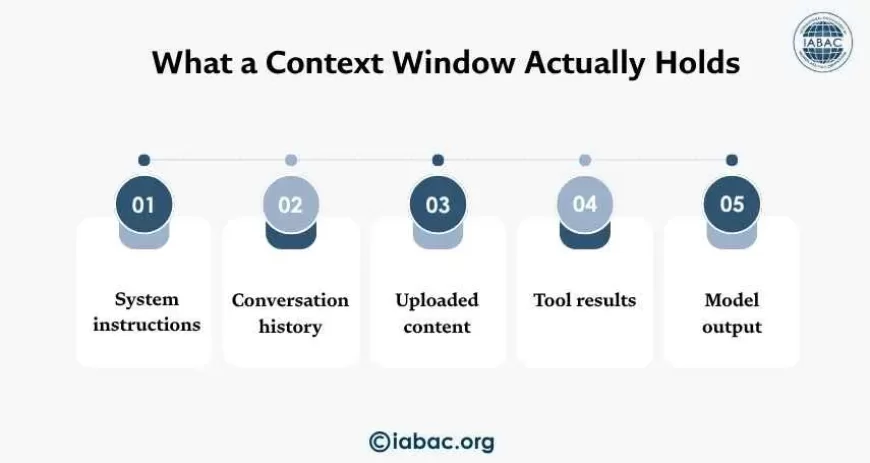
A context window is not just filled with your chat messages. Several types of information share that same space:
- System instructions: Hidden guidelines that shape how the model should behave, often invisible to the user
- Conversation history: Every message exchanged so far in the current chat
- Uploaded content: Documents, spreadsheets, images, or code files shared during the session
- Tool results: Data returned from searches, calculators, or other connected tools
- Model output: The response the AI is currently generating, which also counts toward the total
All of these pieces compete for the same limited space. A long document or a detailed system prompt can use up a large share of the context window, leaving less room for the actual conversation.
Why Large Language Models Depend on Context Windows
Large language models are trained once on a huge amount of data, but that training becomes fixed after a certain point in time. The context window is what allows the model to work with fresh, specific, and personal information during an actual conversation.
Without a context window:
- The model could not follow multi-step conversations
- It will not read or summarize a document you upload
- Not remember what you said two messages ago
- It could not use extra tools or data sources effectively
In short, the context window bridges the gap between what a model already knows from training and what it needs to know right now to give a useful answer.
Context Window vs Context Engineering
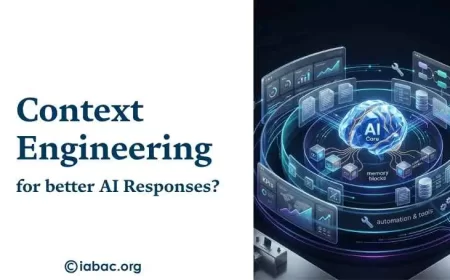
Context engineering is a broader idea. It focuses on managing everything placed inside the context window, not just the wording of a single question.
Context engineering includes the following:
- Deciding what background information to include
- Removing unnecessary details to save space
- Organizing information so the model can find what matters
- Updating the content as a conversation grows longer
The context window is the container. Context engineering is the practice of deciding what goes into that container and how it is arranged.
Context Window vs Retrieval-Augmented Generation (RAG)
Retrieval-augmented generation, or RAG, is a technique that pulls relevant information from an outside source, like a database or a set of documents, and adds it to the model's context window before generating a response.
Here is the difference:
- Context window: The space where information sits while the model works
- RAG: A method for finding and adding the right information into that space
RAG helps when a model needs facts beyond its training data or beyond what fits directly in a normal conversation. Instead of loading an entire library into the context window, RAG finds only the most relevant pieces and inserts them when needed. This makes better use of limited context space.
Context Window vs AI Memory
People often confuse context windows with memory, but they work differently.
A context window holds information only for the current session. Once the conversation ends, that content usually disappears.
AI memory refers to systems built to store facts, preferences, or details across multiple sessions so the model can recall them later without needing the full conversation repeated each time.
Some AI tools now combine both. They use a context window for the active conversation and a separate memory system to store key facts for future conversations. This combination gives a more personal experience without needing an unlimited context window.
Limitations of Context Windows
Bigger is not always better when it comes to context windows. There are real limits and tradeoffs to consider.
- Cost: Larger context windows need more computing power, which raises the cost of running each request
- Speed: Processing more tokens takes more time, so responses can become slower
- Accuracy drop: Models sometimes struggle to use information placed in the middle of a very long context, a problem researchers call "lost in the middle."
- Security risk: Longer context windows can create a larger surface for someone to try to manipulate the model with harmful instructions
These limitations mean teams must balance how much context they include with how well the model can actually use it.
How to Optimize Context Windows for Better AI Performance
You do not need the biggest context window to get the best result. Using the available space wisely matters more than the raw size.
Some practical ways to optimize context use:
- Remove repeated or unnecessary information before sending it to the model
- Break large documents into smaller, focused sections
- Place the most important details near the start or end of the input, since models handle those positions better
- Use retrieval methods to pull in only relevant data instead of loading everything at once
- Summarize older parts of a long conversation instead of keeping every message
These steps help the model focus on what matters and reduce the chance of losing accuracy in long inputs.
Business Applications of Large Context Windows
Large context windows open up practical uses across many industries. Companies now use them for tasks that were difficult or impossible with smaller models.
- Legal work: Reviewing full contracts or case files in a single pass
- Software development: Reading and debugging entire codebases at once
- Customer support: Keeping full ticket history and product manuals available during a chat
- Content and marketing: Analyzing long reports, transcripts, or customer reviews for insights
- Healthcare: Processing detailed patient records or research documents together
Larger context windows reduce the need for extra tools that break information into small pieces. This can save time and lower the amount of manual work needed to prepare data for AI systems.
Future Trends in Context Window Technology
Context windows are likely to keep growing, but size alone will not be the only focus going forward.
Expected directions include:
- Better methods to help models use information placed anywhere in the context, not just the start or end
- More efficient ways to compress or summarize older content automatically
- Tighter integration between context windows and long-term memory systems
- Improved security measures to reduce risks that come with longer inputs
- Wider use of context management techniques, like automatic compaction, to handle very long tasks without losing accuracy
As these tools mature, the gap between a model's raw context size and its real-world usefulness should continue to shrink.
A context window shapes how well an AI model understands and responds to you. It affects accuracy, cost, and what tasks a model can handle. As this technology grows, understanding it helps you use AI tools more effectively. If you want to know more about context windows and want to learn more about AI, an artificial intelligence certification can help you to strengthen your knowledge and stay ready for what comes next in AI.