



















































Generative AI Models: Types, How They Work in 2026
Learn all types of generative AI models, how they work, real-world use cases, and which model to master for a high-paying AI career in 2026.

By 2026, over 80% of enterprises are deploying generative AI — yet most professionals still cannot explain how these models actually work.
Generative AI models are AI systems trained on large datasets to create entirely new content — text, images, video, code, and audio — by learning patterns and generating original outputs from user prompts. Unlike traditional AI that classifies or predicts, generative AI creates.
Whether you are a student exploring artificial intelligence, a working professional looking to upskill, or a career switcher targeting high-paying AI roles in India and globally — this guide gives you everything you need to understand generative AI models from the ground up.
In this guide, you will learn:
- What generative AI models are and how they work
- The 6 main types with real-world examples
- Top models dominating the industry in 2026
- Use cases across healthcare, finance, marketing, and more
- Which model to master based on your career goal
- How to build a certified AI career in India and globally
1. What Are Generative AI Models?
A generative AI model is a machine learning system trained on massive datasets to learn the underlying patterns, structures, and probability distributions of data. Once trained, it can generate entirely new, original content — such as a paragraph, a painting, a line of code, or a piece of music — that did not exist before.
The key word is generate. This separates them from traditional AI models that simply classify inputs (spam vs not spam) or make predictions (will this customer churn?). Generative AI models produce.
What can generative AI create?
-
Text — articles, emails, summaries, code, poetry
-
Images — artwork, product photos, medical scans
-
Video — animations, synthetic footage, training simulations
-
Audio — voiceovers, music, sound effects
-
Code — scripts, applications, debugging suggestions
-
3D Models — product designs, virtual environments
Market Insight: The Generative AI market is projected to reach $283.37 billion by 2034 at a CAGR of 34.6% (Grand View Research, 2024)
Generative AI vs Traditional AI — Key Differences
|
Dimension |
Traditional AI |
Generative AI |
|
Primary Goal |
Classify or predict |
Create new content |
|
Output Type |
Labels, scores, decisions |
Text, images, code, audio |
|
Learning Style |
Supervised learning |
Self-supervised / Unsupervised |
|
Training Data |
Labelled datasets |
Massive unlabelled datasets |
|
Examples |
Spam filter, fraud detection |
ChatGPT, DALL·E, Gemini |
2. How Do Generative AI Models Work?
Understanding how generative AI works does not require a PhD — just a clear mental model of the four-step process that every generative model follows.
-
Step 1: Training on Massive Datasets — The model is fed billions of examples: text from the internet, millions of images, lines of code, audio clips. This is where it learns.
-
Step 2: Learning Probability Distributions — Instead of memorising data, the model learns the statistical patterns and relationships within it. It learns what words typically follow other words, what visual features define a cat, what code patterns solve common problems.
-
Step 3: Inference (Generating Output) — When you enter a prompt, the model uses what it has learned to generate a statistically likely, contextually appropriate response. It does not copy — it creates.
-
Step 4: Refinement through Fine-tuning — Models are then refined on specific datasets and through human feedback (RLHF — Reinforcement Learning from Human Feedback) to improve accuracy, safety, and relevance.
Simple Analogy: Think of a generative AI model as a student who reads millions of books across every subject — then sits an exam and writes completely original answers. It has not memorised answers. It has learned how to think.
Key technical terms explained simply:
-
Parameters — internal variables the model adjusts during training. GPT-4 has an estimated 1.8 trillion parameters.
-
Tokens — chunks of text the model processes. One token ≈ 0.75 words.
-
Inference — the process of generating output from a trained model.
-
Fine-tuning — adapting a pre-trained model to a specific task or domain.
-
RLHF — human feedback used to align model outputs with real-world expectations.
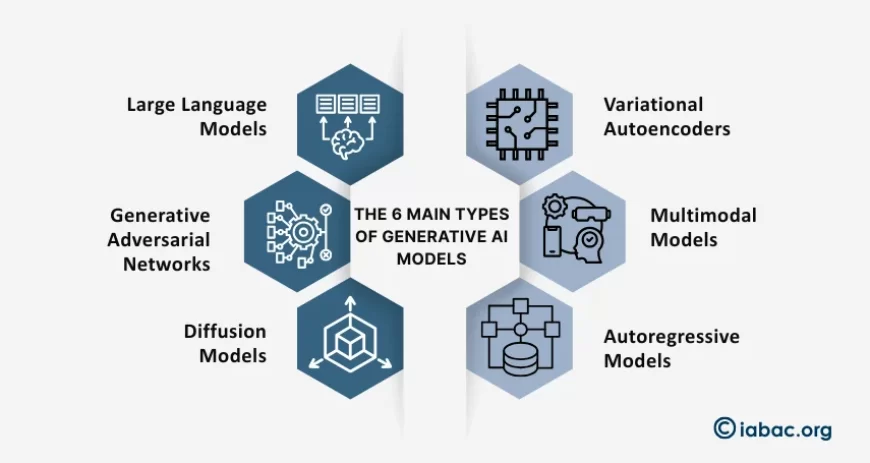
3. The 6 Main Types of Generative AI Models
Not all generative AI models work the same way. Each type uses a different architecture optimised for specific outputs and use cases. Here are the six main types you must understand in 2026.
3.1 Large Language Models (LLMs)
LLMs are the most widely known type of generative AI model. They are built on the Transformer architecture, which uses a mechanism called self-attention to understand the context of every word in relation to every other word in a sequence.
In practice: when you type a prompt into ChatGPT, the model tokenises your input, assigns attention weights to each token, and predicts the most likely next token — one at a time — until it generates a complete response.
-
Examples: GPT-4 / GPT-5 (OpenAI), Claude (Anthropic), Gemini (Google), LLaMA (Meta), Mistral
-
Best for: Text generation, coding, reasoning, summarisation, translation, chatbots
-
Used by: Enterprises, developers, content teams, customer support
Why LLMs matter: GitHub Copilot and similar LLM-powered tools now generate 40–50% of code written in professional environments — transforming software development permanently.
3.2 Generative Adversarial Networks (GANs)
GANs consist of two neural networks competing against each other in what is effectively a creative arms race. The Generator tries to create content realistic enough to fool the Discriminator. The Discriminator tries to identify fake content. As they train together, the Generator becomes increasingly skilled at producing realistic outputs.
Think of it like an art forger (Generator) and an art detective (Discriminator). The forger improves until even the detective cannot tell the difference.
-
Examples: StyleGAN, NVIDIA PoE-GAN, CycleGAN
-
Best for: Image synthesis, deepfake generation, synthetic data creation, style transfer
-
Limitation: Training instability — the two networks can fall out of balance
3.3 Diffusion Models
Diffusion models work in two stages. First, during training, they systematically add random noise to images until the image becomes unrecognisable. Then the model learns to reverse this process — denoising step by step — to reconstruct the original. Once trained, the model can generate new images by starting from pure noise and denoising towards a target prompt.
This is why DALL·E 3 and Stable Diffusion can take a text description like 'a golden retriever surfing at sunset' and produce a photorealistic image.
-
Examples: Stable Diffusion, DALL·E 3 (OpenAI), Sora (video), Imagen (Google)
-
Best for: High-quality image generation, text-to-image, text-to-video
-
Advantage over GANs: More stable training, finer-grained control over output quality
3.4 Variational Autoencoders (VAEs)
VAEs learn a compressed representation of data through two components. The Encoder compresses input data into a compact latent space representation, capturing its essential features. The Decoder then reconstructs or generates new data from this compressed representation, introducing slight variations to create novel outputs.
-
Examples: Custom enterprise VAE models, drug discovery tools
-
Best for: Image reconstruction, anomaly detection, structured data generation, medical research
-
Limitation: Outputs can appear blurrier compared to GANs or diffusion models
-
Unique strength: Highly controllable and interpretable latent representations
3.5 Multimodal Models
Multimodal models can process and generate across multiple data types simultaneously — text, images, audio, and video — in a single model. They represent the direction the entire AI industry is moving in 2026.
When you upload an image to ChatGPT and ask a question about it, or use Gemini to analyse a PDF and then generate a summary with charts — that is multimodal AI in action.
-
Examples: GPT-4o (OpenAI), Gemini 1.5 Pro (Google), Claude 3.5 (Anthropic)
-
Best for: Cross-modal enterprise tasks, AI assistants, complex reasoning
-
Why this matters: Multimodal is rapidly becoming the default model type for enterprise deployment
3.6 Autoregressive Models
Autoregressive models generate output one element at a time, where each new element is predicted based on all previous elements. This sequential generation approach is foundational to early language models and remains highly effective for audio and structured sequence generation.
-
Examples: WaveNet (audio), PixelCNN (images), early GPT models (text), Code Llama
-
Best for: Audio generation, music composition, time-series data, code completion
-
Note: Modern LLMs are technically a form of autoregressive model built on transformer architecture
Master Comparison Table — All 6 Types at a Glance
|
Model Type |
Architecture |
Output |
Top Tool |
Best For |
|
LLMs |
Transformer |
Text, Code |
GPT-4/5, Claude |
Language tasks |
|
GANs |
Dual Neural Net |
Images, Video |
StyleGAN |
Synthetic media |
|
Diffusion |
Noise reversal |
Images, Video |
DALL·E 3, Sora |
Visual creation |
|
VAEs |
Encoder-Decoder |
Images, Data |
Custom models |
Drug discovery |
|
Multimodal |
Hybrid Transformer |
Text+Image+Audio |
GPT-4o, Gemini |
Cross-modal AI |
|
Autoregressive |
Sequential |
Audio, Code |
WaveNet |
Audio & sequences |
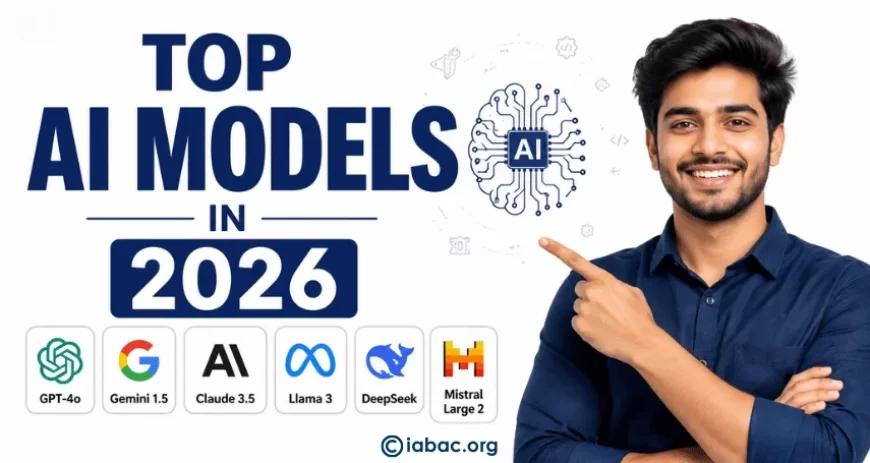
4. Top Generative AI Models to Know in 2026
Beyond the architecture types, here are the specific models dominating industries and hiring conversations in 2026. Understanding these by name, strength, and use case is essential for any AI professional.
|
Model |
Creator |
Type |
Best If You Want To... |
|
GPT-4o / GPT-5 |
OpenAI |
Multimodal LLM |
Build versatile AI apps with text, code & vision |
|
Gemini 1.5 Pro |
|
Multimodal LLM |
Work within the Google ecosystem at scale |
|
Claude 3.5 |
Anthropic |
Safety-focused LLM |
Process long documents with safety guardrails |
|
LLaMA 3 |
Meta |
Open-source LLM |
Customise and deploy AI on your own infrastructure |
|
Stable Diffusion |
Stability AI |
Diffusion |
Generate and fine-tune open-source images |
|
DALL·E 3 |
OpenAI |
Diffusion |
Create high-quality images from text prompts |
|
Sora |
OpenAI |
Diffusion (Video) |
Generate realistic video from text descriptions |
|
Mistral |
Mistral AI |
Efficient LLM |
Deploy cost-effective AI on limited hardware |
5. Real-World Use Cases by Industry
Generative AI models are already transforming operations across every major sector. Here is where they are creating the most impact — and where the hiring demand is strongest.
|
Industry |
Use Case |
Model / Tool Used |
|
Healthcare |
Medical imaging analysis, drug discovery, surgical simulation |
Diffusion models, VAEs |
|
Finance |
Risk modelling, fraud detection, report generation |
LLMs, GANs |
|
Marketing |
Personalised content, ad copy, A/B test variants |
GPT-4, Gemini |
|
Education |
AI tutors, quiz generation, personalised learning paths |
LLMs |
|
Manufacturing |
Product design optimisation, defect detection |
GANs, Multimodal |
|
Software Dev |
Code generation, debugging, documentation |
GitHub Copilot, GPT-4 |
|
Legal |
Contract review, summarisation, compliance checks |
Claude, LLMs |
|
Media & Creative |
Script writing, image generation, video production |
Sora, DALL·E 3 |
Case Study Highlights
-
Coca-Cola: Deployed Midjourney and GPT-4 to produce localised marketing assets for 200+ global markets — reducing campaign production from 6–8 weeks to days, with a 28% improvement in engagement metrics.
-
Mayo Clinic + Google Health: Used diffusion-based AI models to analyse medical images, detecting cancer at earlier stages with higher accuracy than human radiologists in complex cases.
6. Ethics and Responsible Use of Generative AI
Ethics is the section that IBM, GeeksforGeeks, and upGrad all skip. That is a mistake — and a significant opportunity gap for AI professionals who understand governance.
Every organisation deploying generative AI in 2026 faces real ethical obligations. Here are the key issues every certified AI professional must understand:
-
Hallucinations: Hallucinations — Generative AI models can produce confident-sounding false information. This is called hallucination. Critical decisions must never rely on unverified AI output.
-
Bias: Bias in Training Data — Models learn from human-generated data, which contains historical biases. If not addressed, AI systems can perpetuate or amplify discrimination in hiring, lending, and healthcare.
-
Copyright & IP: Copyright and IP — Who owns AI-generated content? Laws are still evolving globally. Professionals must understand the IP implications of using generative AI commercially.
-
Deepfakes: Deepfake Misuse — GAN-generated synthetic media can be weaponised for misinformation, fraud, and impersonation. Detection and governance skills are in high demand.
-
EU AI Act: EU AI Act (2024) — The world's first comprehensive AI regulation classifies AI systems by risk level and imposes compliance obligations on high-risk applications.
-
India: India's AI Policy — India's National AI Strategy (INDIAAI) and emerging governance frameworks are creating compliance requirements for AI deployment across sectors.
Career insight: Professionals who combine generative AI technical skills with AI ethics and governance knowledge command significantly higher salaries and are prioritised for leadership roles.
7. Which Generative AI Model Should You Master in 2026?
This is the question that actually matters for your career — and it is the one no competitor article answers. Here is a clear decision framework based on your professional goal.
|
Your Career Goal |
Model to Focus On |
Why It Matters |
|
NLP / Chatbot developer |
LLMs (GPT, Claude, LLaMA) |
Language is the core enterprise skill in 2026 |
|
Creative AI / Design |
Diffusion (Stable Diffusion, DALL·E) |
Image and video generation is the fastest-growing sector |
|
Enterprise AI roles |
Multimodal (Gemini, GPT-4o) |
Cross-modal is the enterprise standard |
|
Open-source / Startup |
LLaMA 3, Mistral |
Flexible, cost-effective, self-hostable |
|
Research / Academia |
VAEs, GANs, Diffusion |
Architecture-level understanding is required |
|
AI Product Management |
All types — conceptual depth |
Product managers need breadth, not just depth |
India Hiring Context — What Companies Are Looking For
India is one of the fastest-growing markets for generative AI talent. Here is what the current hiring landscape looks like for Indian professionals:
|
Role |
Core Skill Required |
Salary Range (India) |
|
AI Engineer |
LLMs, model fine-tuning, RAG |
₹12L – ₹35L |
|
Prompt Engineer |
Prompt design, LLM evaluation |
₹8L – ₹20L |
|
ML Engineer |
Model training, deployment, MLOps |
₹15L – ₹40L |
|
AI Product Manager |
AI strategy, cross-functional leadership |
₹18L – ₹45L |
|
Data Scientist (AI) |
Statistical modelling + Gen AI |
₹10L – ₹30L |
|
AI Ethics Analyst |
Governance, risk, compliance |
₹12L – ₹28L |
Top Companies Hiring Gen AI Talent in India (2026)
• TCS, Infosys, Wipro, HCL — enterprise AI implementation at scale
• Google India, Microsoft India, Amazon India — cloud AI services and products
• Flipkart, Swiggy, Meesho — product AI, recommendation systems, chatbots
• Startups — Sarvam AI, Krutrim, Ola AI — building India-first generative AI
Not sure where to start? IABAC's Generative AI Certification is globally recognised across 170+ countries and is designed for both freshers and working professionals. Explore Certification at iabac.org →
8. How to Build a Generative AI Career in 2026
A clear 4-step roadmap that takes you from beginner to certified AI professional — whether you are a fresh graduate or a mid-career professional looking to transition.
- Build AI / ML Fundamentals — Understand what AI is, how machine learning works, and the basic mathematics behind neural networks. You do not need a degree — structured learning and a recognised foundation certification are enough.
- Learn One Model Type Deeply — For most professionals, start with LLMs. They have the widest job market, the most accessible tools, and the lowest barrier to entry. Once you have depth in one area, expanding to others is faster.
- Build Hands-On Projects — Theory alone will not land you a job. Build a RAG-powered chatbot, a text-to-image pipeline, or an AI content generation tool. Document your projects on GitHub and LinkedIn.
- Get Certified + Build Your Portfolio — A globally recognised certification validates your skills to employers worldwide. Pair it with a strong portfolio and you will stand out in even the most competitive job markets.
Recommended Learning Path for Indian Professionals
|
Stage |
Focus |
IABAC Resource |
|
Foundation |
What is AI, ML basics, data literacy |
IABAC AI Fundamentals Certification |
|
Intermediate |
LLMs, prompt engineering, model selection |
IABAC Generative AI Certification |
|
Advanced |
Fine-tuning, RAG, agentic AI, MLOps |
IABAC AI Specialist Track |
|
Leadership |
AI strategy, ethics, governance |
9. The Future of Generative AI Models
Generative AI is evolving faster than any technology in history. Here is what the landscape looks like heading into 2027 and beyond — and why understanding these trends gives you a competitive edge today.
- Reasoning AI: Reasoning Models on the Rise — Models are moving beyond generation to multi-step problem solving. OpenAI's o1 and o3, and similar reasoning-optimised models, can solve complex scientific and mathematical problems that earlier LLMs could not.
- Agentic AI: Agentic AI Becoming Mainstream — AI models are evolving from answering questions to taking actions autonomously — browsing the web, writing and executing code, booking appointments, and managing workflows with minimal human input.
- Edge AI: On-Device AI — Smaller, more efficient models like Mistral and Apple's on-device models are bringing generative AI to smartphones and edge devices — no internet required, with full data privacy.
- Multimodal Default: Multimodal as Default — By 2027, text-only models will be considered limited. Multimodal capability — understanding and generating across text, vision, and audio simultaneously — will be the baseline expectation.
- Regulation: Regulation Shaping Model Design — The EU AI Act, India's emerging AI governance framework, and similar global regulations are making compliance skills as valuable as technical skills for AI professionals.
- India: India's AI Opportunity — With a $500B digital economy target and the government's INDIAAI mission, India is positioned as one of the world's leading generative AI markets. Certified Indian AI professionals are in global demand.
Frequently Asked Questions
These questions directly match the 'People Also Ask' queries currently appearing on Google for this topic.
Q1: What are generative AI models?
Generative AI models are AI systems trained on large datasets to create new content — including text, images, video, audio, and code — by learning patterns and generating original outputs from user prompts. They create rather than classify.
Q2: What are the main types of generative AI models?
The six main types are: Large Language Models (LLMs), Generative Adversarial Networks (GANs), Diffusion Models, Variational Autoencoders (VAEs), Multimodal Models, and Autoregressive Models. Each uses a different architecture optimised for specific outputs.
Q3: How is generative AI different from traditional AI?
Traditional AI classifies existing data or makes predictions based on patterns — for example, detecting spam or forecasting sales. Generative AI creates entirely new content that did not previously exist, such as a written article, a generated image, or original code.
Q4: What are the top 3 generative AI models in 2026?
GPT-4o / GPT-5 (OpenAI), Gemini 1.5 Pro (Google), and Claude 3.5 (Anthropic) are the top three large language models in 2026 for text and reasoning. For image generation, Stable Diffusion and DALL·E 3 lead the field.
Q5: Which generative AI model is best for beginners?
Large Language Models like ChatGPT (GPT-4) are the most beginner-friendly. They require no coding to start, have the widest range of real-world applications, and have the largest job market for new AI professionals.
Q6: Is a generative AI certification worth it in 2026?
Yes. With enterprise AI adoption exceeding 80%, globally recognised certifications validate your skills to employers worldwide. IABAC's Generative AI certification is recognised across 170+ countries and is designed for both freshers and working professionals in India and globally.
Q7: What is the difference between LLMs and diffusion models?
LLMs generate text and code using transformer architecture and self-attention mechanisms. Diffusion models generate images and video by learning to reverse a noise-adding process. They serve different output types — LLMs for language, diffusion for visuals — and are often used together in multimodal systems.
Generative AI is not a single technology — it is a rich ecosystem of model architectures, each designed for a specific type of creative output. LLMs power the language revolution. Diffusion models are transforming visual creation. GANs and VAEs serve specialised research and data needs. Multimodal models are unifying them all.
The professionals who will lead the AI economy of 2026 and beyond are not those who simply use AI tools — they are the ones who understand how these models work, know which to apply for which problem, and can prove their expertise with recognised credentials.
Understanding generative AI models is no longer a nice-to-have skill. In 2026, it is a career essential.
Ready to validate your Generative AI skills? IABAC's globally recognised Generative AI Certification is designed for working professionals and freshers alike. Recognised in 170+ countries | Job-ready curriculum | India & global market aligned Start Your Certification Journey at iabac.org →