





















































What Are Diffusion Models in Generative AI?
Learn how diffusion models power AI image generation, from noise-to-image creation and text prompts to real-world applications, benefits, and limits.

Type "an astronaut riding a horse on the moon, oil painting style" into Midjourney and within seconds you get a detailed, atmospheric image — lit correctly, textured convincingly, rendered in a style that took painters years to master. No photographer staged it. No artist painted it. A diffusion model built it, pixel by pixel, from noise.
If you've ever wondered what's actually happening under the hood when DALL-E, Stable Diffusion, or Adobe Firefly generate images from your words — this guide breaks it down clearly. No unnecessary math, no academic fog. Just a solid, honest explanation of one of the most impactful technologies in AI right now.
What Is a Diffusion Model?
A diffusion model is a type of generative AI that creates new data — images, audio, video, or even molecular structures — by learning to reverse a carefully designed destruction process.
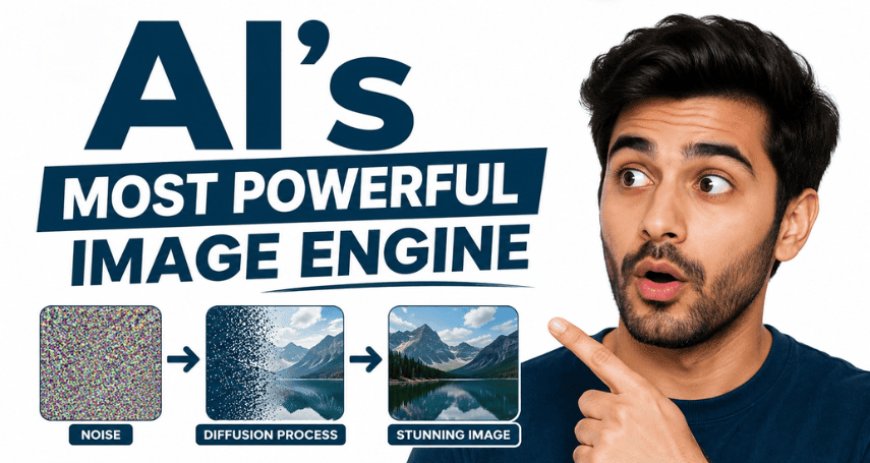
Here's the core idea: the model trains on real data (millions of photographs, for example). During training, it observes what happens when you gradually add random noise to those images — step by step — until nothing recognizable remains. Just static. Then it learns to run that process backwards: starting from noise, it figures out how to reconstruct something realistic.
Once trained, the model can start from completely random noise — no image at all — and walk backward through hundreds of denoising steps to generate something entirely new.
In plain terms: Diffusion models learn to create by learning to destroy — then doing it in reverse.
That's the whole idea. Everything else is an implementation detail.
How Diffusion Models Actually Work
There are two phases to understand: the forward process (what happens during training) and the reverse process (what happens during generation).
The Forward Process: Controlled Destruction
Picture a crystal-clear photograph of a mountain. Now imagine sprinkling a faint layer of visual static over it — barely noticeable. Add a little more. And more. After roughly 1,000 small steps of adding Gaussian noise (a specific type of mathematically defined randomness), the mountain photo has become completely unrecognizable. Pure white noise.
This is called the forward diffusion process. The model doesn't learn anything here — it's just watching data get systematically destroyed in a controlled, predictable way. The reason this is useful: we now know exactly what noise was added at each step.
The Reverse Process: Learning to Rebuild
This is where learning happens. A neural network — typically a U-Net architecture — is trained on one job: look at a slightly noisy image and predict what noise was added at that specific step.
Do that prediction 1,000 times in reverse, and you've rebuilt a coherent image from scratch. More importantly, if you start from pure noise and run the denoising steps, you produce a brand new image that looks like it came from the same distribution as the training data.
This is what "generating an image" means in practice: controlled denoising of random noise, guided by learned prediction.
The training objective is clean and consistent — just estimating noise — which makes diffusion models far more stable than other approaches. No game theory, no competing networks. Just one well-defined task done billions of times.
Speeding It Up: From 1,000 Steps to 20
Early diffusion models were slow — generating one image meant running the denoising network 1,000 times sequentially. Techniques like DDIM (Denoising Diffusion Implicit Models) cut this to 20–50 steps with minimal quality loss.
Latent diffusion (the method behind Stable Diffusion) takes efficiency further: instead of working directly in pixel space, it first compresses images into a smaller mathematical representation, runs the diffusion process in that compressed "latent" space, then decodes the result back into pixels at the very end. That's why you can run Stable Diffusion on a consumer GPU — the heavy work happens in a compressed space, not across every individual pixel.
The Role of Text: How Prompts Become Images
A raw diffusion model generates random images — you have no say in what appears. Text conditioning is what changed everything.
Your prompt is first converted into numerical form using a model like CLIP — a system trained on hundreds of millions of image-text pairs to understand what words and images share in meaning. These text embeddings are then fed into the U-Net at every denoising step through cross-attention layers, which let the generation process continuously ask: does what I'm building match this description?
The result: when you type "a rainy evening in a Tokyo bookshop, soft lighting, film photography style", the model isn't searching a database. It's constructing something new that sits at the statistical intersection of rainy settings, Tokyo aesthetics, bookshop interiors, and film grain — because all of those associations were encoded during training.
This is also why prompt engineering became its own skill. The model's interpretation is statistical — certain words and phrases activate visual patterns more strongly than others. Learning to write prompts well is essentially learning to speak the model's language.
Diffusion Models vs. GANs vs. VAEs: A Clear Comparison
Before diffusion models took over, the two dominant approaches to generative AI were GANs (Generative Adversarial Networks) and VAEs (Variational Autoencoders). Here's how all three stack up:
|
Feature |
Diffusion Models |
GANs |
VAEs |
|
Training stability |
High — single consistent objective |
Low — adversarial instability, mode collapse risk |
Medium — stable but limited |
|
Output quality |
Very high fidelity |
High but inconsistent |
Lower — often blurry |
|
Output diversity |
Excellent |
Limited (mode collapse) |
Good |
|
Generation speed |
Slower (multiple steps) |
Fast (one forward pass) |
Fast |
|
Training complexity |
Moderate |
High |
Low |
|
Best used for |
Images, audio, video, molecules |
Portrait/face generation |
Representation learning |
|
Real examples |
Stable Diffusion, DALL-E, Imagen |
StyleGAN, BigGAN |
Original DALL-E |
The short version: GANs produce sharp outputs fast but are notoriously difficult to train — they suffer from "mode collapse," where the generator gets stuck producing similar-looking results. VAEs are easier to train but produce softer, less detailed outputs. Diffusion models trade generation speed for quality and diversity — a tradeoff that's proven worth it for most applications.
Real-World Applications Beyond Image Generation
Most articles stop at "they make AI art." But diffusion models are being actively deployed across industries in ways that go far beyond creative tools.
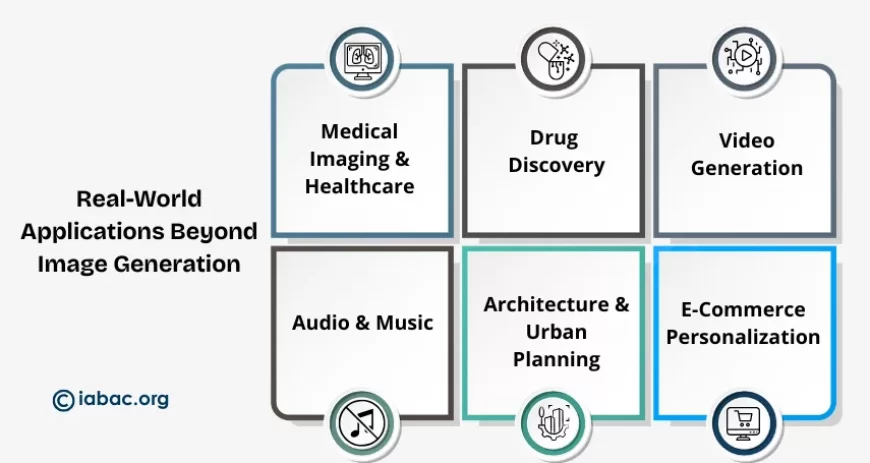
Medical Imaging & Healthcare
Hospitals are using diffusion models to denoise MRI and CT scans — recovering clearer images from noisier raw data. Separately, platforms like Synthefy are generating synthetic patient records using diffusion principles, letting researchers train diagnostic AI on rare conditions without needing thousands of real patient cases. This is particularly valuable for rare diseases where real-world data is scarce.
Drug Discovery
This may be the most consequential application of diffusion models in the long run. Systems like DiffDock use diffusion principles to simulate how drug molecules physically bind to protein targets — a step that traditionally required expensive wet-lab experiments. By treating molecular structures the same way image models treat pixels, these systems can propose novel drug candidates that fit specific biological pockets. What once took months in a laboratory can now be explored computationally in days.
Video Generation
As of 2026, multimodal AI systems — combining text, graphics, audio, and video generation — have become the standard architecture. Models like DALL-E 3 and Sora demonstrate this integration, improved further by hybrid designs using latent diffusion models and implicit neural representations, with control frameworks like ControlNet refining synchronization across data types. Temporal coherence remains the hard problem: not just do individual frames look good, but do they flow naturally as a sequence?
Audio & Music
Latent diffusion principles have been applied to spectrograms (visual representations of sound waves), producing models that generate music, sound effects, and speech from text prompts. Tools like Stable Audio and AudioLDM treat sound generation the same way image models treat pixels — compress, denoise, decode.
Architecture & Urban Planning
Urban development projects are beginning to use diffusion-based simulations to model city layouts, test traffic flow scenarios, and visualize infrastructure changes before any physical work begins — saving significant planning costs.
E-Commerce Personalization
E-commerce platforms are experimenting with diffusion-driven real-time personalization at scale, enabling hyper-customized shopping experiences for millions of users simultaneously.
Limitations: What Diffusion Models Still Struggle With
Honest coverage matters. Here are the real friction points people run into in practice:
Counting and spatial precision. Ask for exactly six candles on a birthday cake and you'll likely get five or seven. Diffusion models struggle with precise counting and exact spatial relationships — the statistics of "exactly six" don't imprint as clearly as the overall visual feel of "birthday cake."
Text within images. Signs, labels, and speech bubbles in AI-generated images often come out garbled — the model learned the visual texture of text without understanding its symbolic content. This is one of the most visible failure modes.
Generation speed. Even with DDIM and latent diffusion, generating a high-quality image requires multiple sequential denoising steps. GANs produce an output in a single forward pass. For real-time or on-device applications, this remains a meaningful gap — though it's narrowing.
Training cost. Building a production-quality diffusion model from scratch still requires substantial compute. This shapes who can develop new foundation models, even as inference costs have dropped significantly.
Bias from training data. These models are statistical mirrors of their training sets. If training data over-represents certain demographics, aesthetics, or cultural contexts, the outputs will reflect that. Researchers are actively working on mitigation, but this isn't a solved problem.
Where Diffusion Models Stand in 2026
The pace of development has been relentless. A few things that define the landscape right now:
Multimodal systems are now the norm. By 2026, multimodal AI models that seamlessly understand and generate content across text, image, audio, and video have become standard, rather than experimental. Diffusion models are a core engine inside these unified architectures — generating the visual and audio components while language models handle reasoning and text.
Open-source has democratized access. Generative AI is now more accessible due to the growing number of open-source frameworks in 2026, including Stable Diffusion WebUI and Hugging Face Transformers, with fine-tuning APIs and plug-and-play modules enabling quick prototyping. What required a research team two years ago can now be run locally.
Edge deployment is happening. Compressed, efficient diffusion models are being designed to run on smartphones and consumer devices — not just cloud servers. The push toward smaller-but-capable models means real-time generative AI on mobile hardware is moving from demonstration to production.
Scientific use cases are maturing. While creative tools generate most of the headlines, diffusion models in drug discovery, protein design, and materials science are quietly becoming standard tools in research pipelines. The same noise-to-structure principles that generate a portrait can generate a novel molecular structure no chemist has ever synthesized.
Diffusion models are not magic. They're an elegant application of a counterintuitive idea: teach a system to destroy data in a controlled, predictable way, and it will learn — as a direct consequence — how to create it.
That insight has unlocked realistic image synthesis, professional audio generation, drug discovery acceleration, and medical imaging enhancement. And because the technique is general — applicable anywhere you have complex data and enough examples of it — the ceiling on where diffusion models apply is still far from visible.
In 2026, diffusion is no longer an emerging technique. It's infrastructure. It's inside the tools designers use, the platforms researchers depend on, and the models being deployed at the edge. Understanding how it works isn't just interesting — it's increasingly useful background knowledge for anyone building with or around modern AI.