






















































Why Multimodal AI Is the Next Big Frontier in Generative AI?
Multimodal AI is redefining what generative AI can do by processing text, images, audio, and video together to deliver smarter, more human-like outputs.

Generative AI has already changed the way we create content, write code, and automate tasks. But for all its impressive capabilities, most generative AI systems have been working with one hand tied behind their back. They read text. They generate text. And that has been largely it.
That is changing fast.
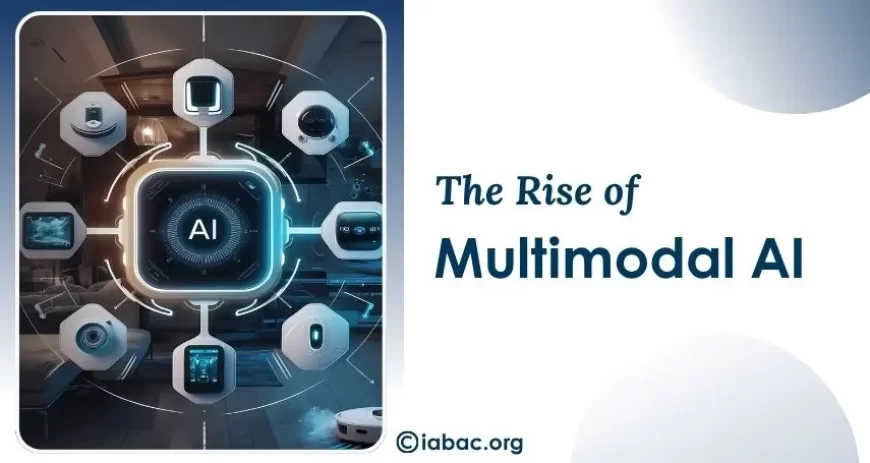
Multimodal AI is the next evolution in artificial intelligence, and it is not just an upgrade. It is a fundamental rethinking of how machines understand and interact with the world. Instead of processing one type of data at a time, it can take in text, images, audio, video, and even sensor data simultaneously, just like a human being does.
This shift is significant. It moves AI from being a tool that reads and writes to one that sees, hears, interprets, and responds across every format of information we produce. But before understanding what it can do, it helps to understand what it actually is.
What Is Multimodal AI?
Before we get into why multimodal AI is such a big deal, it helps to understand what it actually is.
Traditional AI models are unimodal.
- A language model processes text.
- An image recognition model processes images.
- An audio model processes sound.
Each model is trained on one type of data and operates within that lane. This model of AI breaks those lanes entirely.
A multimodal AI model can receive a question typed in text, look at an image attached to that question, listen to an audio file, and generate a response that accounts for all of it at once. It connects meaning across different data types rather than treating them as separate inputs.
Some of the most prominent examples in action include
- GPT-5.5 from OpenAI
- Gemini from Google
- Claude from Anthropic
These models can handle text, images, and, in some cases, audio and video within a single interaction.
This is not only a technical novelty. It is the closest AI has come to copying the way human thinking really happens.
The Limitations of Single-Modal Generative AI
To appreciate why multimodal AI matters so much, it is worth looking at what single-modal generative AI cannot do.
When you interact with a text-only language model, you are limited to describing everything in words.
- If you want the model to help you with a design problem, you have to describe the design.
- If you want it to analyze a chart, you have to transcribe the data.
- If you want it to understand a video, you are out of luck entirely.
This creates friction. Real-world problems rarely come packaged in a single format. A doctor reviewing a patient does not just read notes. A marketing team does not just work with written briefs. A teacher does not just use textbooks. Information in the real world is rich, layered, and multi-format.
Single-modal AI forces users to translate their complex, multi-format reality into text before the AI can help. That translation process is slow, imperfect, and often loses important context.
Multimodal AI removes that translation layer. You bring your problem in its natural form, and the AI works with it directly.
Why Multimodal AI Is the True Frontier of Generative AI
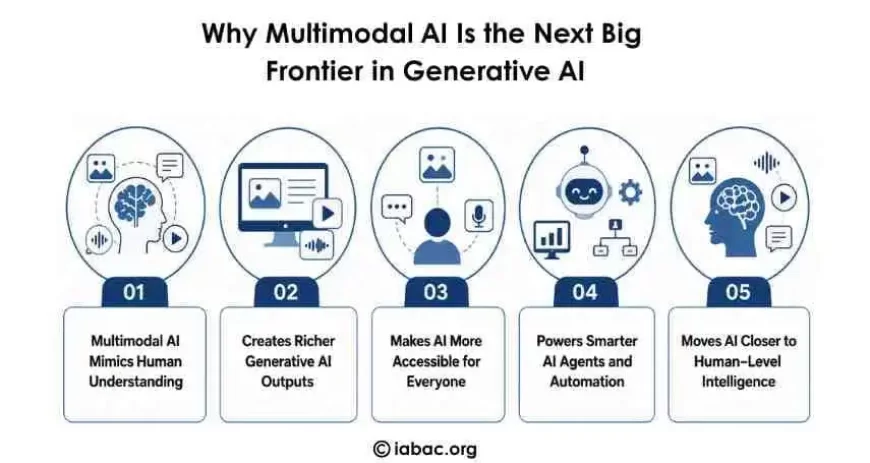
1. It Mirrors Human Perception
Humans do not experience the world in one format. We read words, see images, hear sounds, and feel textures all at once. Our brains constantly integrate these signals to build understanding.
Multimodal AI is the first class of AI systems that attempts to replicate this integrated perception at scale. When a multimodal model looks at a photograph of a broken machine part and reads the maintenance log alongside it, it is doing something remarkably close to what a human technician would do.
This alignment with human cognition is not just philosophically interesting. It makes multimodal AI dramatically more useful in real-world applications where information comes in mixed formats.
2. It Dramatically Expands What Generative AI Can Create
Generative AI built on text alone can produce articles, code, emails, and reports. That is genuinely valuable. But this technology unlocks a much wider creative and functional space.
Multimodal generative AI can take a rough sketch and generate a polished design.
- It can take a product photo and write a product description. It can analyze a video and produce a detailed written summary.
- It can listen to a customer service call and generate structured feedback reports.
The output possibilities are not just wider. They are exponentially more aligned with what businesses and creators actually need.
3. It Makes AI Accessible to More People
Text-based AI still requires a certain level of written communication skill to use effectively. Knowing how to write a good prompt matters. This creates a subtle but real barrier to entry.
Multimodal AI lowers that barrier considerably.
- A user who struggles to describe a problem in words can simply take a photo of it.
- A person who finds it difficult to articulate a design idea can sketch it on paper and upload it.
- A non-native speaker can combine visuals and text to communicate more clearly than they could with text alone.
By accepting input in the format that is most natural to the user, multimodal AI makes generative technology more inclusive and more practical across a wider range of users.
4. It Powers More Intelligent AI Agents
One of the biggest trends in AI right now is the rise of AI agents, systems that do not just answer questions but take actions, complete workflows, and operate autonomously over longer periods.
Multimodal AI is a critical enabler of truly capable agents. An AI agent that can only process text will always be limited in what tasks it can handle. An agent that can see a screen, read a document, hear an instruction, and take action based on all of that together is a fundamentally more powerful system.
Vision-language models are already being used to build agents that can navigate user interfaces, interpret dashboards, and respond to visual data in real time. This is the foundation of what many researchers call embodied AI, systems that can operate in physical or digital environments with real perceptual awareness.
5. It Brings Generative AI Closer to General Intelligence
The long-term goal of much AI research is artificial general intelligence, a system that can understand and perform any intellectual task that a human can. While that goal remains distant, multimodal AI is a meaningful step in that direction.
Understanding the world requires integrating information across many formats. A system that can only read text has a fundamentally limited worldview. A system that can process images, audio, video, and text together, and reason across all of them, is operating at a level of environmental awareness that text-only systems simply cannot reach.
This technology does not make AGI inevitable, but it closes a gap that single-modal systems leave wide open.
Real-World Applications Already Taking Shape
Multimodal AI is not a future promise. It is already being deployed across industries in ways that are producing real, measurable results. Here are some of the most significant examples happening right now.
1. Healthcare: Google DeepMind's Med-Gemini and AI Co-Clinician
One of the most compelling real-world applications of multimodal AI is happening in healthcare. Google Research and Google DeepMind developed Med-Gemini, a family of multimodal AI models specifically built for clinical and medical use.
It processes text, medical images, genomic data, and electronic health records to support diagnosis, treatment planning, and clinical decision-making. It scored 91.1% on the MedQA benchmark, which tests U.S. medical licensing exam-style questions, outperforming GPT-4's performance at the time of its 2024 release.
Taking this further, Google DeepMind introduced the AI Co-Clinician, tested in a randomized simulation study with physicians from Harvard and Stanford.
The system used live audio and video to engage with patients, simulating telemedical calls where the AI could support diagnosis and management under expert supervision. It demonstrated capabilities beyond text-only systems, including guiding patients through complex physical examinations in real time.
2. Accessibility: Be My Eyes and GPT-4
Be My Eyes, an app that supports people who are blind or have low vision, launched Virtual Volunteer, the first-ever digital visual assistant powered by OpenAI's GPT-4. The tool was built to provide an unprecedented level of accessibility to the 253 million people worldwide who are blind or have low vision.
The new version of the app was the first to integrate GPT-4's multimodal capability, allowing users to send images to an AI-powered virtual volunteer that could answer any question about the image and provide instantaneous visual assistance for a wide variety of everyday tasks.
Users described it as life-changing, with the tool helping them read labels, identify objects, navigate maps, and operate unfamiliar equipment, all through a single photograph sent from their phone.
3. Education: Khan Academy's Khanmigo
In education, multimodal AI is already inside classrooms at scale. In the 2024-25 academic year, Khan Academy's AI tutor Khanmigo saw usage jump from 40,000 to 700,000 K-12 students, with projections to surpass one million in 2025-26.
At Enid High School in Oklahoma, which was one of the pilot schools, high school educators used Khanmigo for geometry. After one semester, there were no students failing in that class.
The platform uses AI to monitor each student's progress in real time, identify learning gaps, and guide students toward answers rather than simply providing them, making it a genuinely instructional tool rather than a shortcut.
4. Manufacturing: Multimodal Quality Control on Assembly Lines
In manufacturing, multimodal AI combines computer vision, sound analysis, and sensor data to identify production defects in real time. Cameras capture visual flaws such as scratches, dents, and misalignments, while acoustic sensors detect abnormal sounds in machinery. The AI correlates both data streams to determine whether a part is faulty or needs rework.
This kind of cross-modal processing represents a major step forward from traditional visual inspection systems, which could only flag what a camera could see. By combining what a machine looks like with what it sounds like, multimodal AI catches problems that single-sensor systems routinely miss.
5. Market Growth Reflecting Real Adoption
The deployment of multimodal AI across these sectors is reflected in the numbers. The multimodal AI market was valued at $2.51 billion in 2025 and is projected to reach $42.38 billion by 2034, growing at a compound annual growth rate of 36.92%, according to Precedence Research. That level of growth is not driven by speculation. It reflects genuine, active deployment across healthcare, education, manufacturing, and customer experience at an accelerating pace.
The Technical Challenges That Still Exist
It is important to be honest about the fact that multimodal AI, for all its promise, is still a developing technology with real limitations.
Alignment Across Modalities
It’s still technically difficult to make a model really understand the connection between an image and a text prompt instead of just processing them in parallel. There are times when multimodal models are able to misinterpret visual context or fail to associate visual and textual information properly.
Computational Cost
These multi-modal models need way more compute than single-modal models to handle multiple data types simultaneously. This makes multimodal AI more expensive to run at scale and less accessible to smaller companies and developers with limited budgets.
Data Quality and Bias
Training multimodal models requires large, high-quality datasets that pair different types of information. These datasets are harder to collect and curate than text-only datasets, and the biases present in visual data can compound the biases that already exist in language models.
Evaluation and Benchmarking
Measuring how well a multimodal AI performs is genuinely hard. Unlike text-based models where outputs can be evaluated against reference answers, multimodal outputs involve complex, subjective judgments about how well the model integrated multiple types of input. The field is still developing robust evaluation frameworks.
These challenges are real, but they are also solvable. The pace of research in this space is fast, and many of these limitations are already being addressed by leading AI labs.
What This Means for the Future of Work
The way people work is already shifting because of AI, but multimodal AI takes that shift to a completely different level. It is not just about automating repetitive tasks anymore. It is about giving every professional, regardless of their role or industry, a tool that understands their work in the format it actually exists in.
1. Richer Inputs Mean Smarter Workflows
Workers will no longer need to translate their real-world problems into text before AI can help. A field engineer can photograph a faulty component and get instant diagnostic support. A designer can upload a rough sketch and receive structured feedback. The input becomes as natural as the work itself.
2. Cross-Functional Collaboration Gets Faster
These systems can bridge communication gaps between teams that work in different formats. A product team sharing visual prototypes, a finance team working with data reports, and a marketing team producing video content can all interact with the same AI system without needing to convert their work into a common format first.
The result is faster decision-making, fewer bottlenecks, and less time spent reformatting information just to get a useful answer from a tool.
3. New Roles Will Emerge Around Multimodal Systems
Just as the internet created jobs that did not exist before, this technology will create entirely new professional roles. Multimodal prompt strategists, AI output reviewers across formats, and cross-modal data curators are the kinds of positions that will become increasingly relevant as organizations build workflows around these systems.
4. Repetitive Multi-Format Tasks Will Be Automated
Many jobs today involve taking information from one format and converting it into another. Transcribing meeting recordings, summarizing visual reports, captioning video content, and extracting data from scanned documents are all tasks that it can handle with far greater speed and consistency than manual processes allow.
This does not eliminate jobs wholesale, but it does free up professionals to focus on higher-order thinking, creative problem-solving, and work that genuinely requires human judgment.
5. Accessibility at Work Becomes a Real Possibility
Multimodal AI has the potential to make workplaces more inclusive. Employees with different communication styles, language backgrounds, or accessibility needs can interact with AI systems using the format that works best for them, whether that is voice, image, text, or a combination of all three.
The future of work shaped by this model AI is not one where humans are replaced. It is one where the gap between how humans naturally work and what AI can support finally starts to close.
The Road Ahead
Multimodal AI is moving fast. In the last two years alone, we have gone from systems that could barely handle an image alongside a text prompt to models that can process video, audio, images, and text in a single conversational turn.
The next few years will likely bring this model of AI that is faster, cheaper, more accurate, and available in more products and platforms. We will see it embedded in operating systems, productivity tools, creative software, and industrial equipment.
The question is not whether multimodal AI will become the dominant paradigm in generative AI. That trajectory is already clear. The question is how quickly it will get there and who will be ready when it does.
Readiness starts with understanding. Those who want to stay ahead of this shift are already investing in structured learning through certifications around AI systems, including multimodal architecture and applications.
Generative AI has already proven its value. But single-modal systems are only showing us part of what is possible. Multimodal AI represents the full picture.
By processing the world the way humans actually experience it, across text, images, audio, video, and beyond, it unlocks a level of understanding, creativity, and practical usefulness that changes what AI can be.
It is not just the next feature in generative AI. It is the next frontier.
And that frontier is already here.