













































What Is the Basic Foundation of Data Science?
Learn the basic foundation of data science, including statistics, programming, data analysis, and machine learning fundamentals.

Data is everywhere. It’s in your phone, your search history, your fitness tracker, your online shopping habits, and even in the way cities manage traffic. But raw data alone is like a messy room—it exists, but it’s not useful until someone organizes it, understands it, and turns it into something meaningful. That “someone” is data science.
The Foundations of Data Science are what separate random numbers from powerful decisions. Without strong basics, even the most advanced tools feel like trying to build a skyscraper on sand. And if you're just starting your journey, understanding these foundations is not optional—it’s essential. This blog is your introduction to data science, built carefully for a worldwide audience, with clarity, structure, and just enough humor to keep things human.
What Is Data Science? Understanding Data Science from the Ground Up
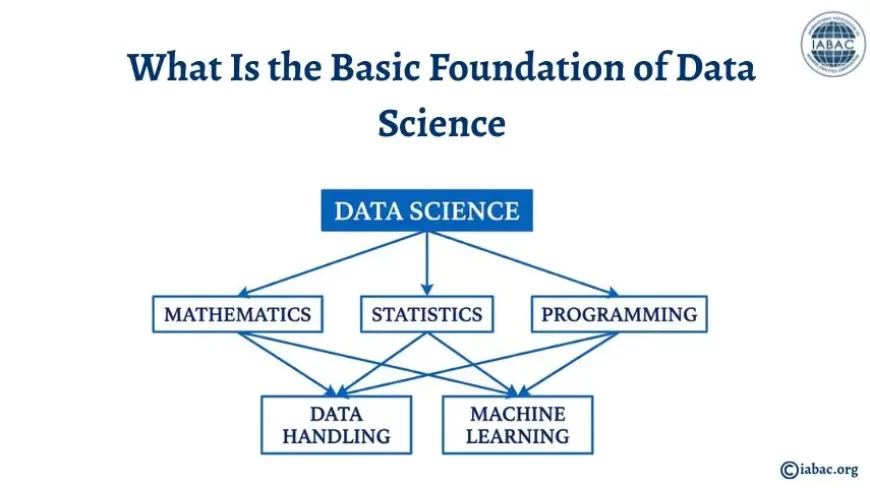
At its core, data science is the process of extracting knowledge and insights from data using a combination of:
- Mathematics
- Statistics
- Programming
- Domain knowledge
Think of it this way:
Data science is like detective work, except instead of fingerprints and clues, you work with datasets and patterns.
The Core Foundations of Data Science
To truly understand the foundations of data science, you need to break it into key pillars. Each one plays a crucial role in building your expertise.
1. Mathematics: The Language of Data Science
Mathematics is the silent engine behind datascience. Without it, models would be guesses rather than predictions.
Key Areas:
- Linear Algebra
- Calculus
- Probability
For example, probability helps answer questions like:
“What are the chances a customer will buy this product?”
2. Statistics: The Brain of Data Science
Statistics transforms raw data into insights.
Key Concepts:
- Mean, Median, Mode
- Variance and Standard Deviation
- Hypothesis Testing
Here’s a simple statistical formula:
Mean (Average) = Sum of all values / Number of values
But in real-world data science projects, statistics goes far beyond averages—it helps validate decisions.
3. Programming: The Hands of Data Science
You can understand data, but without programming, you can’t manipulate it.
Popular Languages:
- Python
- R
Example (Python):
import pandas as pd
data = pd.read_csv("data.csv")
print(data.head())
This simple code reads data and displays it—your first step into a data to data transformation journey.
4. Data Handling: From Raw Data to Meaningful Data
Data rarely comes clean. It’s messy, incomplete, and sometimes confusing.
Steps in Data Handling:
- Data Collection
- Data Cleaning
- Data Transformation
5. Machine Learning: The Decision Maker in Data Science
Machine learning allows systems to learn from data.
Types:
- Supervised Learning
- Unsupervised Learning
Example:
Predicting house prices based on past data.
Data Science Roadmap: How to Start Learning Data Science
A structured data science roadmap is critical. Without it, learners often feel lost.
Step-by-Step Path:
- Learn Basic Mathematics
- Understand Statistics
- Start Programming
- Work with Data
- Learn Machine Learning
- Build Projects
Sample Data Science Project Flow
Here’s how a typical data science project works:
Problem → Data Collection → Cleaning → Analysis → Model → Insights
Data Science Syllabus: What You Should Learn
A complete Data Science program typically includes the following core areas:
1. Python Programming
Python is the foundation of modern data science because of its simplicity and powerful libraries.
You should learn:
- Basics of Python (variables, loops, functions, data types)
- Data structures (lists, dictionaries, sets, tuples)
- Libraries like:
- NumPy (numerical computing)
- Pandas (data manipulation)
- Matplotlib & Seaborn (visualization)
- File handling (CSV, Excel, JSON)
- Working with APIs and web data
- Introduction to Jupyter Notebook
Goal: Be able to clean, manipulate, and analyze data efficiently.
2. Statistics & Mathematics
Statistics helps you understand data patterns and make data-driven decisions.
Key topics:
- Descriptive statistics (mean, median, mode, variance)
- Probability theory
- Distributions (normal, binomial, Poisson)
- Hypothesis testing (p-values, confidence intervals)
- Correlation vs causation
- Regression basics
Goal: Understand what the data is saying and how reliable it is.
3. Machine Learning
Machine Learning is the core of predictive analytics in Data Science.
You should learn:
- Supervised learning (Linear Regression, Logistic Regression)
- Unsupervised learning (Clustering, K-Means)
- Decision Trees and Random Forests
- Model evaluation techniques (accuracy, precision, recall)
- Overfitting and underfitting
- Feature engineering
- Introduction to deep learning (basic neural networks)
Goal: Build models that can predict outcomes from data.
4. Data Visualization
Data visualization helps convert complex data into easy-to-understand insights.
Tools & skills:
- Matplotlib (basic plots, charts)
- Seaborn (advanced statistical visualizations)
- Power BI or Tableau (business dashboards)
- Creating:
- Bar charts
- Line graphs
- Heatmaps
- Scatter plots
- Storytelling with data
Goal: Communicate insights clearly to business teams.
5.Big Data Tools
Big data tools are used when datasets become too large for traditional systems.
Important tools:
- Hadoop ecosystem (HDFS, MapReduce)
- Spark (fast data processing)
- Hive (data querying)
- Kafka (real-time data streaming basics)
- Cloud platforms (AWS, Azure, Google Cloud basics)
Goal: Handle large-scale and real-time data efficiently.
Why Data Science Foundations Are Important
Skipping basics is like trying to run before learning to walk.
Without strong foundations of data science:
- Models fail
- Insights become misleading
- Decisions go wrong
Courses for Data Science: Choosing the Right Path
There are many courses for data science, but not all are equal.
A good course should include:
- Hands-on projects
- Real-world datasets
- Industry-relevant tools
Platforms like the IABAC certification page (https://iabac.org/certifications) provide structured Data Science Certification paths that align with industry needs.
Data Science Certification: Why It Matters
A data science certification proves your skills.
Benefits:
- Better job opportunities
- Industry recognition
- Structured learning
Many learners pursue Certifications for Data Science to validate their knowledge globally.
Mathematical Insight: Simple Linear Regression
Here’s a basic model used in data science:
genui{"math_block_widget_always_prefetch_v2":{"content":"y = mx + b"}}
This equation helps predict values based on trends.
Data Science in Everyday Life
You might not notice it, but data science is everywhere:
- Movie recommendations
- Navigation apps
- Online shopping suggestions
Common Challenges in Learning Data Science
Learning introduction to data science can feel overwhelming.
Common struggles:
- Too many tools
- Confusing concepts
- Lack of direction
But here’s the truth:
Every expert once stared at a dataset and thought, “What is this chaos?”
Tips to Master Data Science Foundations
- Focus on basics first
- Practice regularly
- Build projects
- Learn from mistakes
Future of Data Science
The demand for data science professionals is growing rapidly.
1. Increased Adoption Across Industries
Data science is no longer limited to tech companies. It is now widely used across multiple sectors:
- Healthcare – disease prediction, medical imaging, drug discovery
- Finance – fraud detection, risk analysis, algorithmic trading
- Retail & E-commerce – recommendation systems, customer behavior analysis
- Manufacturing – predictive maintenance, quality control
- Education – personalized learning systems
Even major tech companies like Google and Amazon rely heavily on data science to improve search results, recommendations, logistics, and user experience.
This widespread adoption ensures continuous job growth in the field.
2. Rising Demand for Skilled Professionals
The demand for data science professionals is increasing faster than supply. Companies are actively looking for experts in:
- Data analysis and interpretation
- Machine learning model building
- Data engineering and pipeline development
- AI model deployment and monitoring
Roles like Data Scientist, Data Analyst, Machine Learning Engineer, and MLOps Engineer are among the most in-demand globally.
Skilled professionals are expected to remain highly valuable in the job market for the next decade.
3. Expansion of AI-Driven Solutions
Artificial Intelligence is becoming deeply connected with data science.
Key developments include:
- Automated machine learning (AutoML)
- Generative AI models
- Real-time predictive systems
- AI-powered decision-making tools
Companies are using AI not just for analysis, but also for automation and intelligent decision-making.
Data science is evolving from “analysis-focused” to “AI-powered decision systems.”
4. Growth of Cloud & Big Data Technologies
Modern data science relies heavily on scalable infrastructure:
- Cloud platforms (AWS, Azure, Google Cloud)
- Big data frameworks like Spark and Hadoop
- Real-time data processing systems
These technologies allow companies to process massive datasets efficiently and in real time.
This trend is making data science faster, more scalable, and more accessible.
5. Shift Toward Automation & MLOps
The future is not just about building models—it’s about managing them efficiently.
Emerging areas include:
- MLOps (Machine Learning Operations)
- Model monitoring and automation
- Continuous integration and deployment of ML systems
This shift ensures models stay accurate and useful in real-world environments.
6. Long-Term Career Outlook
Data science is expected to remain a core profession in the digital economy. Future professionals will need to combine:
- Programming skills
- Statistical thinking
- Business understanding
- AI knowledge
Those who continuously upgrade their skills will see strong long-term career growth.
Building Strong Foundations in Data Science
The foundations of data science are not just technical—they are transformational.
They teach you:
- How to think logically
- How to solve problems
- How to make data-driven decisions
Whether you're exploring Data Science Courses, planning your data science roadmap, or pursuing a Data Science Certification, remember this:
Strong foundations don’t just help you start—they help you grow.
And while the journey may feel complex at times, it’s also one of the most rewarding paths you can take.
Your Data Science Journey Starts Here
If you’re just beginning your introduction to data science, focus on building your basics.
Explore structured courses for data science, work on real-world data science projects, and consider professional Certifications for Data Science from trusted platforms like IABAC.
Because in the end, data is not just numbers.
It’s stories waiting to be told.
And you? You’re the storyteller.