







































Can an AI System Control the Human Body?
Can an AI system control the human body? Learn how the Human Operator AI system uses EMS and motion guidance to move hands through physical interaction.

There is a certain kind of news about artificial intelligence that stops you mid-scroll. Not headlines. Not hype. Just something real that we once only saw in science fiction movies.
Just six students. Forty-eight hours. And a system that moved a human hand without the human consciously deciding to move it.
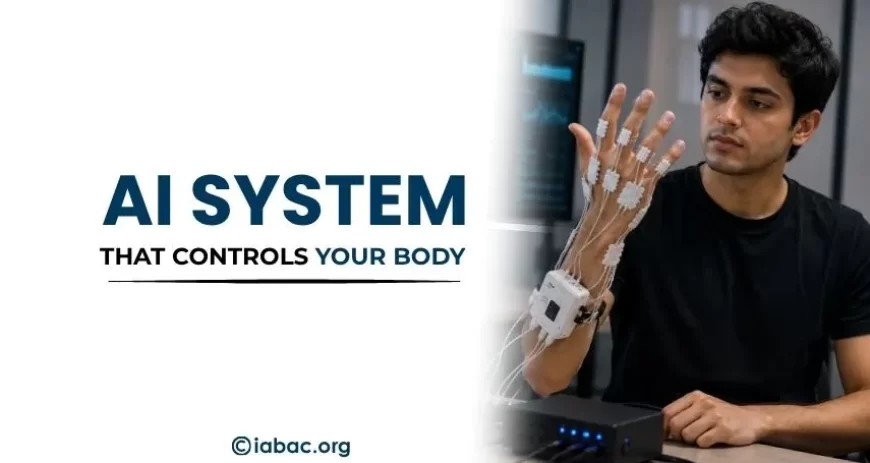
At MIT Hard Mode 2026, a six-person team built an AI system called Human Operator that can temporarily move your hand for you. It won first place at the hackathon. It works right now. And it raises a question that most of us assumed belonged to the distant future: can an AI system control the human body?
Yes, it can control. Let's see about it.
What is a human operator?
Human Operator is a human augmentation tool. It allows AI to briefly take control of your hand to help you do something you are trying to do, one of the most hands-on AI applications we have seen outside a research lab.
The user speaks about the goal. The system helps the body achieve it. That is the entire idea.
It is not an override. It is not involuntary. The person using it remains completely in charge of what they want to accomplish. Think of it less like a puppeteer and more like a physiotherapist, one who does not tell you how to move but physically guides you through the movement you already want to make.
How the AI System Controls the Body
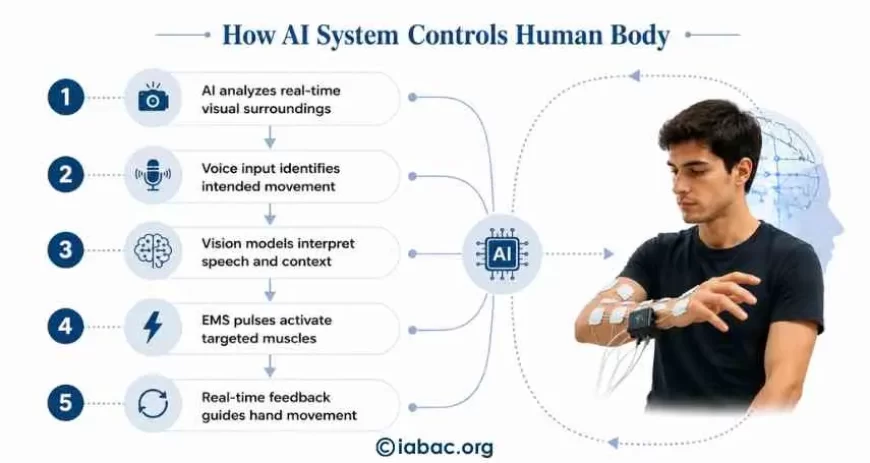
The human operator is not built around a single clever trick. It combines three separate technologies into one real-time loop that runs continuously from the moment you speak to the moment your hand moves:
-
A head-mounted camera capturing everything the user sees
-
Voice input processed through a vision-language model
-
Electrical muscle stimulation delivering the movement directly to the body
The camera does not simply record the scene; it understands it. It knows whether you are looking at a piano keyboard, a door handle, or another person's extended hand, and that understanding shapes every decision that follows.
Your voice is processed through Anthropic's Claude API at the same time. The model takes what you said and what the camera has seen and reasons about what movement you actually want. This is not a keyword lookup. It is active reasoning about intent, informed by both your words and your visual context simultaneously.
That reasoning then becomes a physical instruction. The system delivers it through:
-
Small electrical currents through electrodes placed on the skin
-
Precise, calibrated pulses that contract specific muscles
-
Guided movement of the hand and wrist through exactly what you asked for
The hand moves. The AI system moved it. And the entire loop vision, voice, reasoning, and stimulation happens with no perceptible delay between intention and execution.
What It Can Do Today
In its current prototype form, Human Operator has demonstrated three capabilities that together tell a bigger story than any one of them does alone:
-
Piano melody guidance — AI guides a short sequence of finger movements to play a simple melody, not showing the user where to press but physically placing the fingers there
-
Real-time gesture execution — voice and visual context are turned into a guided hand action in real time, with a waving gesture produced step by step through muscle stimulation
-
Learned hand gestures — small EMS pulses sequence the fingers into specific positions, demonstrating that the system can handle multi-step, position-dependent physical tasks
On the surface, modest. Look closer, and these three demonstrations carry an extraordinary amount of conceptual weight.
Every physical skill humans learn, whether playing an instrument, performing surgery, or assembling fine components, passes through a stage where instruction stops being sufficient. You cannot read your way to playing piano. You cannot watch your way to steady hands in an operating room.
The body has to experience the movement, encode it, and repeat it until it becomes unconscious and reliable. What a human operator does is collapse the distance between being told how to move and actually moving correctly. It does not show you the right finger position. It puts your finger there. That is a fundamentally different act, and its implications extend far beyond the demo footage.
"Human Operator does not show you how to move. It moves you. That distinction is the entire ballgame."
Where This AI System Goes Next
A hackathon prototype built in 48 hours is not a finished product. But it does not need to be. Prototypes prove what is possible and what a human operator proves is worth paying attention to across three areas:
-
Restoring Movement After Injury: The hardest challenge after a stroke or spinal injury is not the will to move; it is the broken connection between that will and the muscles. A system that delivers the correct movement directly, in response to spoken intent, does not just assist recovery; it changes what recovery can look like
-
Disability: An estimated 1.3 billion people globally experience a significant disability today, many involving fine motor impairment. A system like this can help them with hand movement, speak what they want to do, and have their hand guided through it. At home. Without a hospital visit. Without surgery.
The market reflects where this is heading. The neurotechnology market is estimated at $15.77 billion in 2025 and is expected to reach $29.74 billion by 2030.
Human Operator is a prototype, not a product. But the trajectory it reflects is exactly where that growth is pointed.
What if This AI System Goes Wrong?
Any honest account of a technology that moves the human body without conscious motor initiation has to sit with its complications. Not to slow down the science, but because the questions are real and the time to ask them is before the technology is widespread, not after.
Data privacy in this context is not the same as data privacy on a social media platform. When an AI system reads your physical environment and guides your movements, it generates an intimate, continuous record of your body in action, your patterns, your hesitations, and your physical response to different stimuli.
The regulatory frameworks that govern health data in most countries were not designed with this level of bodily intimacy in mind, and they will need to be.
Failure modes deserve equally serious attention. Consider what a system failure means across different contexts:
-
A rehabilitation patient mid-session loses guidance at a critical moment of movement retraining
-
A person with motor impairment, depending on the system for a daily task, finds it unresponsive
-
An incorrect EMS pulse sequence produces a movement that reinforces the wrong physical pattern rather than the right one
Software fails. Hardware fails. The reliability standards required for AI systems that interface directly with human physiology are categorically different from those applied to consumer software, and they do not yet exist in adequate form.
Security carries the most serious long-term implications of all. A cyberattack on a database is serious. A compromised system delivering electrical pulses to a human body is a different category of threat entirely. When a person's physical function depends on a system, that system is critical infrastructure and needs the security architecture to match.
"The risk is not that AI will take over the body. The risk is that we will build the technology before we build the rules."
What This Means If You Work in AI
The engineering stack behind Human Operator reflects a deliberate choice about where AI sits in the interaction. Most consumer AI systems stop at text, voice, or screen output. The human operator goes a layer deeper, into motion itself.
For AI professionals, this is a masterclass in multimodal integration done purposefully. The system connects disciplines that have historically developed in parallel:
-
Computer vision — interpreting the physical environment in real time with contextual understanding
-
Large language model reasoning — translating spoken intent into precise physical instruction using the Claude API
-
Hardware actuation — delivering that instruction as a physical output directly on the human body
-
Closed-loop feedback — all three layers informing each other simultaneously, with no sequential delay
The Territory Still Belongs to Us
Somewhere in the story of modern technology, we decided AI lived on screens. That it was something you looked at, typed into, and closed when you were done with it. Human Operator, built in 48 hours by six people with a camera, some electrodes, and an API, quietly closes that chapter.
Physical intelligence is here. Embodied AI is no longer a research concept. Technology that does not just think alongside us but moves with us is real, and it was built over a weekend.
The body has always been the most intimate frontier of human experience. For the whole of technological history, it remained ours and ours alone. We just handed AI a map. The territory still belongs to us. But for the first time, we are not the only ones who know the terrain.
AI technology is evolving faster than most of us can keep up with. Systems like human operators are not the finish line; they are an early signal of where things are headed. If this excites you, or if you want to understand, work with, or build systems like this, getting certified in AI is one of the most direct ways to start. The knowledge you gain will not just help you follow what is coming. It will help you shape it.
Here are the reference links for this blog:
India Today:
Knowledge Action Portal on NCDs:
https://www.knowledge-action-portal.com/en/content/global-report-health-equity-persons-disabilities
Mordar Intelligence:
https://www.mordorintelligence.com/industry-reports/neurotechnology-market