

















































Evolution of Artificial Intelligence and its impact
Evolution of artificial intelligence from early theories to generative systems, highlighting breakthroughs, ethics, regulation, and future impact on careers


You’ve probably had a moment where a machine surprised you. A playlist that felt too accurate. A map that rerouted you before you even noticed traffic. A sentence written by software that sounded almost human. Those moments spark a quiet question: how did we get here?
The evolution of artificial intelligence is filled with bold ideas, failed experiments, and renewed hope that reshaped how people work and think. Behind every breakthrough lies human curiosity, persistence, and the desire to build something smarter.
This journey reflects years of trial, imagination, and the steady push to turn possibility into something practical and deeply impactful.
Early Concepts and Theoretical Foundations (1940s–1950s)
Artificial intelligence has its origins in an era when computers were smaller than modern smartphones and occupied entire rooms. Researchers began asking a bold question: Can machines think like humans?
These early ideas were shaped by:
-
Human neurology and how neurons transmit signals
-
Mathematical logic and problem-solving
-
Early computing machines developed during World War II
In 1950, Alan Turing published a paper that changed everything. Instead of debating what intelligence means, he asked whether a machine could behave in a way indistinguishable from a human. This idea later became the Turing Test and remains influential even today.
A few years later, in 1956, John McCarthy gathered researchers at the Dartmouth Workshop and gave this field a name: Artificial Intelligence. That moment turned scattered ideas into a formal scientific discipline.
Key milestones from this era:
-
The first conversations about thinking machines
-
Early neural network concepts inspired by the brain
-
Artificial intelligence becoming an academic field
This period planted the seed. The vision was bold, even optimistic, but reality would soon slow things down.
Symbolic AI and Logic-Based Systems (1950s–1970s)
The earliest practical systems of artificial intelligence were built on rules and logic. The belief was simple: if human reasoning follows rules, then machines could follow those same rules.
Researchers created systems that:
-
Used symbols to represent knowledge
-
Solved math problems and logical puzzles
-
Played early versions of games like chess
This phase, often called symbolic AI, worked well in controlled environments. But real life isn’t controlled. It’s messy, unpredictable, and full of gray areas.
Limitations quickly appeared:
-
Systems broke when rules changed
-
Every piece of knowledge had to be manually added
-
Machines struggled with ambiguity and context
Symbolic AI showed promise, but it also revealed a major truth: intelligence isn’t just about rules. It’s about learning.
Expert Systems and the First AI Winter (1970s–1980s)
As artificial intelligence matured, researchers focused on expert systems programs designed to copy the decision-making ability of human specialists. These systems were used in areas like
-
Medical diagnosis
-
Engineering design
-
Financial decision-making
Expert systems relied on thousands of “if–then” rules. At first, they impressed organizations and attracted major investment. But maintaining them became a nightmare.
Challenges included:
-
High development and maintenance costs
-
Difficulty updating rules
-
Poor performance outside narrow use cases
As expectations outpaced results, funding dried up. This period became known as the AI winter, when interest in artificial intelligence sharply declined.
Yet this setback wasn’t failure; it was a lesson. Researchers realized machines needed the ability to learn from data, not just follow instructions.
Transition to Machine Learning and Data-Driven AI (1990s–2000s)
The revival of artificial intelligence came with a powerful shift: machine learning. Instead of programming every rule, researchers began teaching machines to learn patterns from data.
This shift was fueled by:
-
The explosion of digital data
-
Faster and cheaper computing power
-
Advances in statistical modeling
Machine learning introduced approaches such as:
-
Supervised learning, where models learn from labeled data
-
Unsupervised learning, where systems find patterns on their own
A defining moment came in 1997 when IBM’s Deep Blue defeated world chess champion Garry Kasparov. It wasn’t just a chess victory; it was proof that data-driven artificial intelligence could outperform humans in complex tasks.
During this era, artificial intelligence began making real-world progress in:
-
Computer vision
-
Search and recommendation systems
AI was back and stronger than before.
Reinforcement Learning and Autonomous Decision Systems
Another major breakthrough came with reinforcement learning, a method where machines learn by trial and error. Instead of being told what’s right or wrong, systems receive rewards or penalties based on their actions.
This approach became especially powerful for:
-
Robotics
-
Game-playing systems
-
Autonomous decision-making
One of the most famous examples is AlphaGo, which defeated the world champion in the complex game of Go. It learned strategies humans had never considered.
Reinforcement learning helped artificial intelligence:
-
Make long-term decisions
-
Adapt to changing environments
-
Move closer to autonomy
This marked a shift toward AI systems that don’t just respond but act.
Deep Learning, Neural Networks, and the Big Data Explosion (2010s)
The 2010s were a turning point for artificial intelligence. Deep learning changed what machines could do.
Deep neural networks modeled loosely after the human brain allowed systems to:
-
Recognize images with high accuracy
-
Understand spoken language
-
Translate text between languages
What made this possible?
-
Massive datasets
-
GPUs and AI accelerators
-
Improved training techniques
According to Stanford’s AI Index Report, deep learning reduced image recognition error rates by over 90% in just a decade.
Artificial intelligence became part of everyday life:
-
Voice assistants
-
Facial recognition
-
Recommendation engines
This era also triggered massive growth in AI-focused careers, reshaping how people think about work and skills.
AI Infrastructure, Cloud Computing, and Model Scaling
Behind every modern AI system is powerful infrastructure. Cloud computing transformed artificial intelligence from something only labs could build into something anyone could access.
Key developments included:
-
Cloud platforms enabling scalable AI infrastructure
-
TPUs and specialized hardware for faster model training
-
Distributed systems handling massive workloads
Another major shift was the rise of foundation models large models trained once and adapted for many tasks. These models improved rapidly as they scaled.
Researchers observed that:
-
Larger models often perform better
-
More data leads to stronger generalization
This scaling effect pushed artificial intelligence into a new league.
Generative AI, Transformers, and Large Language Models (2020s–Present)
Today’s artificial intelligence feels different because it creates. Generative AI can write, design, code, and even compose music.
At the heart of this shift are transformers, a model architecture that understands context across entire sequences of data. This led to large language models like GPT and BERT.
Generative AI is now used for:
-
Writing content and emails
-
Building software faster
-
Customer support and chatbots
Many systems also use human-in-the-loop approaches, where people guide and refine AI output, improving accuracy and trust.
According to McKinsey, generative AI could add $4.4 trillion annually to the global economy.
Artificial intelligence has become a creative partner, not just a tool.
Real-World Applications Across Industries
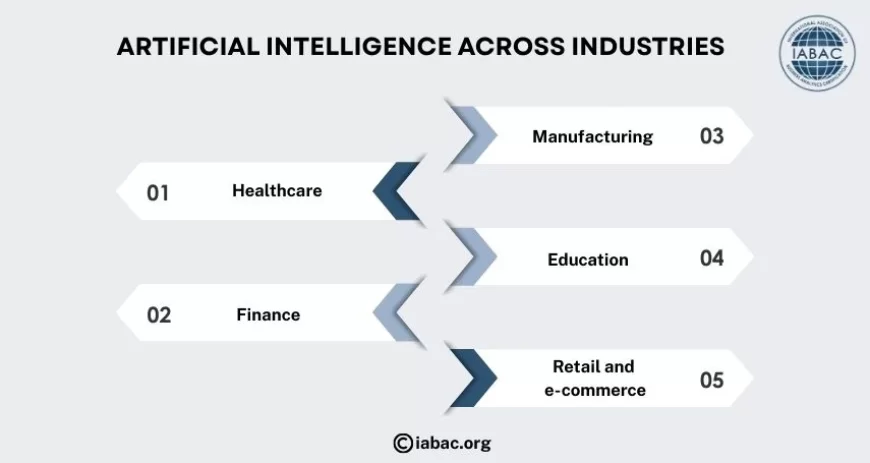
Artificial intelligence now touches nearly every industry.
Examples include:
-
AI in healthcare: medical imaging, diagnostics, drug discovery
-
AI in finance: fraud detection, credit scoring, risk analysis
-
AI in manufacturing: predictive maintenance and quality control
-
AI in education: personalized learning paths
-
AI in retail and e-commerce: personalized recommendations, demand forecasting, dynamic pricing, customer support
Predictive analytics helps organizations make smarter decisions faster, reducing costs and improving outcomes.
Ethics, Bias, and Responsible AI Development
As artificial intelligence grows more powerful, responsibility matters more than ever.
Key concerns include:
-
AI bias caused by uneven data
-
Lack of transparency in complex models
-
Privacy and data governance
Responsible AI focuses on:
-
Fairness and accountability
-
Explainable AI (XAI)
-
Human oversight in critical systems
Trust is the foundation of long-term AI adoption.
Regulation, Governance, and the Global AI Landscape
Governments worldwide are shaping how artificial intelligence is developed and used.
Current focus areas include:
-
AI regulation and compliance
-
National AI strategies
-
AI safety and governance
The global AI race involves major players like the U.S., China, and the EU. Balancing innovation with public interest is now a global priority.
Artificial General Intelligence and Future Directions
Most AI today is narrow AI, built for specific tasks. The long-term goal is Artificial General Intelligence (AGI) systems that can reason, learn, and adapt across domains.
Future research focuses on:
-
Autonomous agents
-
Long-term planning
-
Alignment with human values
Artificial intelligence continues evolving toward systems that are more context-aware, creative, and autonomous.
This journey from theory to everyday reality shows that artificial intelligence is not just a technology. It’s a reflection of human ambition, curiosity, and responsibility. And its evolution is still unfolding, shaping the future of work, innovation, and careers for generations to come.