
























































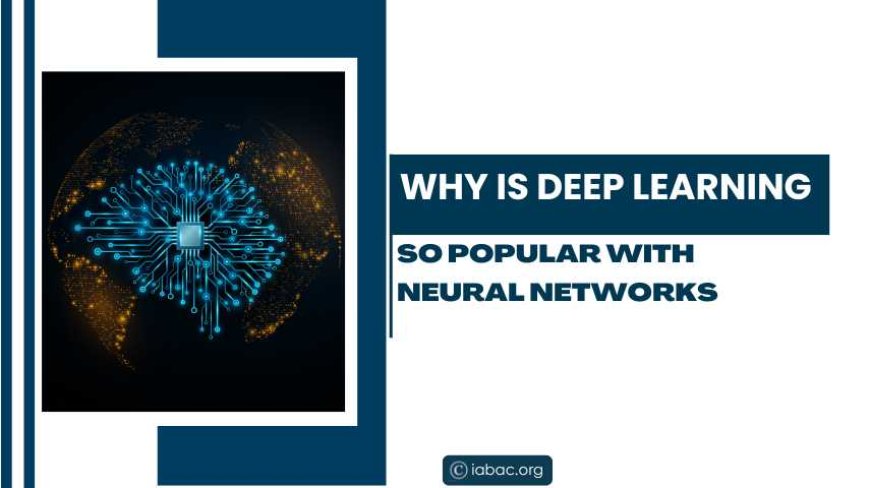
Why Is Deep Learning So Popular With Neural Networks
Deep learning works so well with neural networks because it handles complex patterns, large datasets, and layered learning that boosts accuracy.

Think about the last hour of your life.
You unlocked your phone using your face.
You scrolled social media and saw posts that felt “perfectly timed.”
You searched something on Google and got exactly what you needed.
You opened YouTube and suddenly lost 20 minutes watching suggested videos.
None of this is luck.
This is machine learning quietly working in the background, learning from your behavior, improving with every click, and adjusting itself without you ever noticing.
For students, machine learning may sound like a complex topic full of math and coding. But in reality, it’s already part of your daily routine. This blog will help you understand what machine learning really means in daily use, how neural networks and deep learning power modern AI, and why learning these concepts can shape your future career.
We’ll also answer common student questions like:
- What is a neural network and deep learning?
- Is ChatGPT a neural network?
- What is the difference between ANN and DNN?
- What are the four layers of a neural network?
Let’s begin from the very basics.
What Is Machine Learning in Simple Words?
Machine learning is a part of Artificial Intelligence where computers learn from data instead of following fixed rules.
Instead of telling a machine:
“If this happens, do this”
We tell it:
“Here are many examples. Learn the pattern yourself.”
The more data the machine sees, the better it becomes.
Imagine preparing for exams.
At first, you solve practice questions and make many mistakes.
Over time, you notice patterns:
- Certain questions repeat
- Some topics carry more weight
- Some mistakes happen again and again
You improve by learning from experience.
That’s exactly how machine learning works.
Machine Learning Meaning in Daily Use
Machine learning is not limited to research labs or tech companies. It is deeply woven into everyday life.
Where You See Machine Learning Every Day
- Smartphones: Face unlock, voice assistants, keyboard suggestions
- Social Media: Feed ranking, friend suggestions, ad targeting
- Online Shopping: Product recommendations, price predictions
- Streaming Platforms: Movie and music suggestions
- Emails: Spam filtering and priority inbox
- Navigation Apps: Route optimization and traffic prediction
All of this is powered by trained models that improve over time using data.
Machine Learning and Artificial Intelligence: Are They the Same?
Not exactly.
Artificial Intelligence (AI)
AI is the bigger concept. It refers to machines that can perform tasks that usually require human intelligence, such as reasoning, decision-making, and problem-solving.
Machine Learning (ML)
Machine learning is a subset of AI. It focuses on teaching machines to learn from data.
Deep Learning
Deep learning is a subset of machine learning that uses neural networks with many layers.
So the relationship looks like this:
Artificial Intelligence → Machine Learning → Deep Learning
This is why neural networks and deep learning are considered the backbone of modern AI.
What Is a Neural Network?
A neural network is a computer system inspired by the human brain.
Just like the brain has neurons that pass signals, a neural network has artificial neurons that pass numbers.
Each neuron:
- Receives input
- Processes it
- Sends output to the next neuron
Over time, the network learns which connections are important and which are not.
Why Neural Networks Matter
Neural networks allow machines to:
- Recognize images
- Understand speech
- Translate languages
- Detect patterns humans might miss
They are the foundation of deep learning, modern AI tools, and intelligent systems.
What Is Deep Learning?
Deep learning is a type of machine learning that uses deep neural networks.
The word “deep” simply means:
The neural network has many hidden layers.
Each layer learns something different.
For example:
- First layer learns edges in an image
- Second layer learns shapes
- Third layer learns objects
- Final layer makes predictions
This layered learning makes deep learning extremely powerful.
Neural Networks and Deep Learning: Why They Work So Well
Traditional algorithms follow rules.
Neural networks learn patterns.
Deep learning systems:
- Improve automatically
- Handle large datasets
- Adapt to complex problems
- Perform well with images, text, audio, and video
That’s why technologies like self-driving cars, medical image analysis, and language models depend heavily on neural networks and deep learning.
Is ChatGPT a Neural Network?
Yes, ChatGPT is powered by a neural network.
More specifically, ChatGPT is built using a deep neural network trained on massive amounts of text data.
How ChatGPT Learns
ChatGPT learned by:
- Reading huge volumes of text
- Understanding word relationships
- Predicting the next word in a sentence
- Adjusting itself using feedback
This training process is pure deep learning.
When you talk to ChatGPT, you are interacting with a trained neural network that understands language patterns, not emotions or consciousness.
What Is ANN (Artificial Neural Network)?
An Artificial Neural Network (ANN) is a foundational model in the field of machine learning, inspired by the way biological neurons in the human brain process information. It is one of the earliest and simplest forms of neural networks and serves as the building block for more advanced architectures such as Deep Neural Networks (DNNs) and Convolutional Neural Networks (CNNs).
Structure of an ANN
A typical ANN is composed of three main types of layers:
- Input Layer
- This is the first layer of the network.
- It receives raw input data (features) from the dataset.
- Each neuron in this layer represents one input feature and simply passes the data forward without performing computations.
- Hidden Layer
- Located between the input and output layers.
- It performs the core computations of the network using weighted connections, bias terms, and activation functions (such as ReLU, sigmoid, or tanh).
- In a basic ANN, there is usually only one hidden layer, which is sufficient for solving relatively simple problems.
- Output Layer
- This is the final layer of the network.
- It produces the final prediction or decision of the model.
- The number of neurons depends on the task (e.g., one neuron for binary classification, multiple neurons for multi-class classification or regression outputs).
How an ANN Works
- Data flows forward from the input layer to the output layer (forward propagation).
- The network learns by adjusting weights and biases using a learning algorithm such as backpropagation, which minimizes prediction error through optimization techniques like gradient descent.
Use Cases of ANN
ANNs are well-suited for simpler and well-structured problems, especially when the dataset size is small to moderate. Common applications include:
- Basic classification tasks (e.g., spam detection, binary decision-making)
- Simple prediction problems (e.g., sales forecasting, trend estimation)
- Pattern recognition with limited data (e.g., basic image or signal patterns)
What Is DNN (Deep Neural Network)?
A Deep Neural Network (DNN) is an advanced form of ANN.
The key difference:
DNN has multiple hidden layers.
More layers = deeper learning.
DNNs are used for:
- Image recognition
- Speech recognition
- Natural language processing
- Complex decision-making
Difference Between ANN and DNN
|
Feature |
ANN |
DNN |
|
Hidden Layers |
One or few |
Many |
|
Learning Power |
Limited |
High |
|
Complexity |
Simple |
Advanced |
|
Data Requirement |
Small |
Large |
|
Performance |
Moderate |
High |
In short:
- ANN is the foundation
- DNN is the upgraded version
What Are the 4 Layers of a Neural Network?
Neural networks are built using different types of layers. The four commonly discussed layers are:

1. Input Layer
This is where data enters the network.
Examples:
- Image pixels
- Text tokens
- Numerical values
2. Hidden Layers
These layers process information and extract features.
Deep learning models may have dozens or hundreds of hidden layers.
3. Output Layer
This layer gives the final result.
Examples:
- Yes / No
- Category labels
- Predicted values
4. Specialized Layers
Depending on the task, networks use:
- Convolutional layers (for images)
- Recurrent layers (for sequences)
- Dense layers (for classification)
Each layer adds intelligence to the model.
Types of Machine Learning You Should Know
Supervised Learning
- Uses labeled data
- Example: Email spam detection
Unsupervised Learning
- Uses unlabeled data
- Example: Customer segmentation
Reinforcement Learning
- Learns through rewards and penalties
- Example: Game-playing AI
These learning methods are essential in data science, AI tools, and algorithm training.
Why Students Should Learn Machine Learning Now
Machine learning is not just for programmers.
It is useful for:
- Engineers
- Business students
- Analysts
- Researchers
- Entrepreneurs
Understanding ML helps students:
- Think analytically
- Work with data
- Build intelligent solutions
- Improve career opportunities
Role of Certifications in Machine Learning Careers
Learning on your own is good. Proving your skills is better.
This is where Artificial Intelligence Certification programs matter.
Certifications help students:
- Gain structured knowledge
- Learn industry-relevant skills
- Build confidence
- Improve job readiness
Why Choose Certified Machine Learning Associate?
The Certified Machine Learning Associate credential is designed for beginners and students.
It focuses on:
- Machine learning fundamentals
- Neural networks and deep learning
- Model building and evaluation
- Real-world problem solving
This certification acts as a strong foundation for advanced AI roles.
Machine Learning as a Career Path
Machine learning opens doors to roles such as:
- Machine Learning Associate
- Data Analyst
- AI Engineer
- Business Intelligence Professional
- Automation Analyst
With the right skills and certification, students can move confidently into the AI industry.
Machine learning is no longer a future concept.
It is already shaping how we study, shop, communicate, and make decisions.
From neural networks and deep learning to tools like ChatGPT, AI is becoming more human-like in how it learns and adapts. For students, understanding machine learning is not about becoming a coding expert overnight. It’s about building awareness, curiosity, and skills that will stay relevant for years. And with structured learning paths like Artificial Intelligence Certification and Certified Machine Learning Associate, the journey becomes clearer, smoother, and more rewarding.
The machines are learning every day.