














































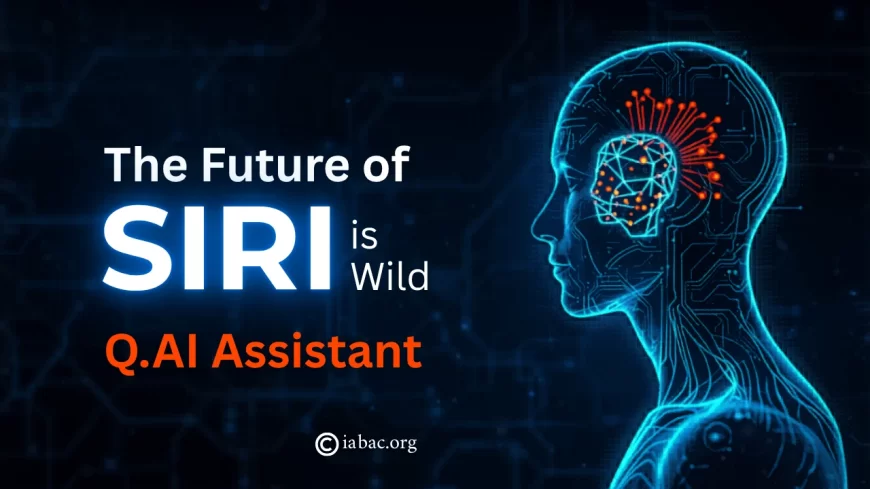
The Future of Siri Is Wild Q.AI Assistant Is Coming
Q.AI Assistant is reshaping the future of Siri with silent speech and generative AI. Discover what's coming — and the AI certifications that can help you ride this wave.

The AI Assistant You Never Saw Coming
The Q.AI assistant is not a concept from a science fiction film. It is a real, $2 billion acquisition Apple made in early 2026 — and it could completely change how humans interact with machines forever.
For years, Siri has been the punchline of the AI assistant world. It could set timers, play songs, and answer basic questions. But ask it to do anything remotely complex — summarise your week, book a table, or understand what you actually meant — and it fell apart instantly.
That era is ending. Apple is rebuilding Siri from the ground up, powered by Google's Gemini AI models, a brand-new chatbot interface, third-party AI support, and the crown jewel of this transformation — Q.AI, an Israeli startup whose technology can read your facial movements and understand what you want to say without you making a single sound.
This blog breaks down exactly what Q.AI assistant technology is, why it matters in 2026, and most importantly — what skills and certifications you need to be ready for the AI-powered world it is helping to create.
What Is the Q.AI Assistant? A Plain-English Explanation
Let's start simple. Q.AI is an artificial intelligence startup founded in Tel Aviv in 2022. Apple acquired it in February 2026 for approximately $2 billion — the company's second-largest acquisition in history, behind only the $3 billion Beats purchase in 2014.
The technology Q.AI has developed is called silent speech recognition. Here is what that means in plain English.
When you speak, your facial muscles move. Your lips, jaw, and the tiny muscles in your cheeks all shift in very specific, predictable patterns for each word. Q.AI built an AI system that uses a device's camera to detect those micro-movements — movements so small that the average person cannot notice them — and translates them into words and commands.
The result? You can communicate with your device without saying anything out loud. You simply mouth the words, and the AI understands you.
This is not voice recognition. It does not need a microphone. It does not record your voice. It watches your face, silently, and reads your intent. That is a completely new category of human-computer interaction — and Apple now owns it exclusively.
Why Does This Matter in 2026?
The World Economic Forum's 2025 Future of Jobs Report listed AI and machine learning specialists among the fastest-growing roles globally through 2027, with demand outpacing supply by nearly 3 to 1. NASSCOM estimates that over 1.2 million AI-related roles in India alone will go unfilled by 2026 due to a shortage of verified talent.
Against that backdrop, the Q.AI assistant is not just a cool product feature. It represents a fundamental shift in the direction AI development is heading — away from isolated chatbots and toward ambient, integrated, always-available AI that understands humans on a deeper level.
This shift creates real career implications. Every industry that uses Apple devices — which is almost every industry — will eventually need professionals who understand how to work with, deploy, govern, and build on AI systems like the one Q.AI is helping to create.
The people who build those skills now, before everyone else catches on, will have an enormous advantage.
The Story So Far: How Siri Got Here
To understand where Siri is going, it helps to understand how badly it missed the mark.
2011: Apple launches Siri on the iPhone 4S. It is the world's first mainstream AI voice assistant. People are genuinely amazed.
2022: OpenAI launches ChatGPT. Suddenly, the entire world can see what a truly conversational AI looks like. Siri, by comparison, seems almost comically limited.
2024: Apple launches Apple Intelligence — its first real attempt at modern AI. Internal reviews are mixed. Apple quietly pulls its own Siri advertisements after users point out that features shown in the ads do not actually work reliably yet.
2025: Apple officially delays the advanced Siri upgrade. Consistency problems in internal testing mean it is not ready. New AI leadership is brought in — Amar Subramanya, formerly of Google and Microsoft, is named VP of AI. A major internal reorganisation begins.
January 2026: Apple and Google announce a formal multi-year deal. Google's Gemini AI models will power the next generation of Apple Foundation Models — the AI brain behind Siri. The deal costs Apple approximately $1 billion per year. Tim Cook publicly confirms: "We expect to release it this year."
February 2026: Apple acquires Q.AI for $2 billion. Apple's SVP of Hardware Technologies, Johny Srouji, calls the company "a remarkable company that is pioneering new and creative ways to use imaging and machine learning."
May 2026: Ahead of WWDC 26, Bloomberg reports that the conference logo — featuring a glowing "26" — is a deliberate hint at a completely redesigned Siri with a new standalone app, chatbot interface, Dynamic Island integration, and multi-agent support across third-party apps.
The dots connect clearly. Apple is not releasing a slightly improved Siri. It is releasing a fundamentally different product.
How the Q.AI Assistant Changes Everything: 5 Real-World Scenarios
Understanding why silent speech technology matters is easiest when you picture it in everyday life.
Scenario 1: In a Business Meeting You are presenting to a client and need to pull up a file without disrupting the flow of the room. You simply mouth "open Q3 report" at your phone sitting on the table. Siri opens it, silently, without interrupting a single word being spoken. No "Hey Siri." No awkward pause. No embarrassment.
Scenario 2: On Public Transport You are on the Mumbai Metro at rush hour. The carriage is packed. You need to send a message to your manager, but speaking out loud feels intrusive and private. You mouth the message. It is sent. Nobody around you noticed a thing.
Scenario 3: Accessibility and Inclusion For people who are non-verbal, have ALS, have speech impairments, or have conditions that affect vocal ability, this technology is not a convenience. It is a lifeline. Silent speech recognition could give millions of people an entirely new way to interact with technology independently.
Scenario 4: Apple Vision Pro and Smart Glasses The most obvious hardware application. Smart glasses need an input method that does not require hand gestures or voice commands in social settings. Silent speech is exactly that. You look at something, mouth a question, and the answer appears in your lens. No one around you is any the wiser.
Scenario 5: Privacy-First AI Interaction Every current AI assistant uses a microphone — which means it is always, at some level, listening for its wake word. Q.AI's camera-based approach removes that dependency entirely. Your voice is never captured. The privacy model of the product changes from the ground up.
The New Siri vs. The Old Siri: A Side-by-Side Comparison
|
Feature |
Old Siri |
New Siri with Q.AI Assistant (2026) |
|
Input method |
Voice only |
Voice + text + silent speech (camera-based) |
|
Conversational memory |
No — forgets context instantly |
Yes — persistent personal context across sessions |
|
Multi-step task handling |
One command at a time |
Chains actions across multiple apps seamlessly |
|
Third-party AI models |
Apple-only |
User-selectable: ChatGPT, Gemini, Claude, and more |
|
Interface |
Small overlay popup |
Standalone app + chatbot UI + Dynamic Island glow |
|
AI agent support |
None |
Full support for third-party AI agents via Extensions |
|
Personal context awareness |
Minimal |
Deep: reads calendar, habits, emails, documents |
|
Microphone dependency |
Always-on mic required |
Optional — camera-based silent speech available |
|
Privacy model |
Voice-captured |
Potentially mic-free, camera-based interpretation |
The difference is not incremental. It is generational.
What Is Apple's "Extensions" Framework — And Why It Changes the Game
Alongside Q.AI and the Gemini partnership, Apple is building a feature called Extensions for iOS 27. This is arguably as significant as silent speech technology, and it gets far less attention.
Extensions is a framework that allows users to install AI models from third-party apps and use them directly inside Siri, Apple's Writing Tools, and Image Playground. In simple terms: you will be able to choose which AI brain powers Siri for a given task.
Want to use Claude for writing? Gemini for research? ChatGPT for creative brainstorming? In iOS 27, you may be able to switch between them inside the same Siri interface.
This is Apple doing something it almost never does: opening its most important product to external competition on its own platform. The reason is strategic. Rather than trying to build the world's best AI model — a race it is currently losing — Apple is positioning itself as the platform layer through which the world's best AI models are delivered to 2 billion devices.
It is the App Store model, applied to artificial intelligence. And it means that whoever wins the AI model race, Apple wins too.
Why This Creates a Career Opportunity Right Now
Here is the question that matters most for anyone reading this: what does all of this mean for your career?
The short answer is this. Every business that uses Apple hardware — from healthcare clinics to law firms to retail chains to manufacturing plants — will eventually interact with AI systems built on this new Siri layer. Every developer building iOS apps will need to understand how to work with AI agents and the Extensions framework. Every manager making decisions about technology investment will need to understand what conversational AI can and cannot do.
The professionals who understand how AI assistants work, how they are built, how they are governed, and how they drive business decisions will be in extraordinary demand over the next three to five years.
That is not speculation. It is the direct consequence of 2 billion devices becoming significantly more intelligent by the end of 2026.
Who Should Be Preparing for the AI Assistant Era?
This is not a question with a single right answer. The AI assistant revolution touches almost every profession.
You should be building AI skills right now if you are:
A software developer or engineer who wants to build on top of Apple's new AI platform and the Extensions framework.
A product manager or business analyst who needs to evaluate, commission, or govern AI-powered features in your company's roadmap.
A marketing or content professional whose workflow will be fundamentally changed by AI writing tools, Siri integrations, and generative content capabilities.
A healthcare, finance, legal, or operations professional whose industry is about to face serious pressure to adopt AI-assisted workflows — and who needs to understand what that means before it is forced upon them.
A student or recent graduate in any technical or business field who wants to enter the job market with verifiable AI credentials at a time when employers are actively struggling to find them.
A career switcher from any background who sees the writing on the wall and wants to position themselves in a field that is not going to shrink.
The honest truth is that understanding AI — not just using it as a tool, but genuinely understanding how it works, what it can do, and how to deploy it responsibly — is becoming a baseline professional skill. The question is not really whether you need it. The question is whether you get there before or after everyone else.
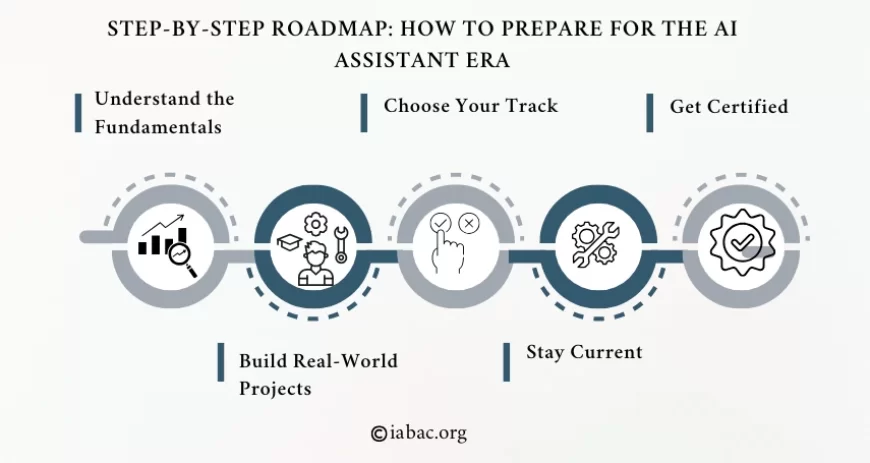
Step-by-Step Roadmap: How to Prepare for the AI Assistant Era
Step 1: Understand the Fundamentals (Weeks 1 to 4) Start with AI literacy. Learn what machine learning is, how large language models work, and what differentiates different types of AI systems. You do not need to write code to understand these concepts. There are excellent certification programmes designed specifically for non-technical learners.
Step 2: Choose Your Track (Week 4 to 6) Decide whether you are approaching AI from a technical angle (building things), an analytical angle (using data to drive decisions), or a leadership angle (governing and commissioning AI projects). Each track has a different learning path and a different set of ideal certifications.
Step 3: Get Certified (Months 2 to 4) A structured, globally recognised certification is the fastest way to build credibility with employers and clients. It signals that your knowledge has been assessed against an objective standard — not just self-reported on a LinkedIn profile. This is where IABAC certifications are particularly valuable.
Step 4: Build Real-World Projects (Months 4 to 6) Apply what you have learned to a real problem in your current or target industry. Build a portfolio. Document your process. Demonstrating applied knowledge is worth more than any certificate on its own — but the certificate gets you in the door.
Step 5: Stay Current (Ongoing) AI moves faster than any other technology sector in history. IABAC's Continuing Professional Development (CPD) programme is designed specifically to help certified professionals stay aligned with the latest developments in the field — including exactly the kind of shifts that Q.AI assistant technology represents.
IABAC AI Certifications: Which One Is Right for You?
IABAC — the International Association of Business Analytics Certifications — is a globally recognised credentialing body operating across 140+ countries. Its certifications are built on the Edison Data Science Framework, a project initiated by the European Commission to align professional AI and data science skills with real-world industry requirements.
IABAC does not offer training itself. It sets the standard, runs the assessments, and issues globally verifiable digital credentials. That makes its certifications genuinely vendor-neutral — they travel with you across employers, industries, and geographies.
Here is a comparison of IABAC's most relevant AI certifications for professionals looking to ride the Q.AI assistant and generative AI wave:
|
Certification |
Best For |
Technical Level |
Focus Area |
Prior Experience Needed |
|
AI Foundation Certification |
Absolute beginners, non-tech professionals |
Low |
AI concepts, use cases, ethics |
None |
|
Certified AI Expert (CAIE) |
Technical professionals, engineers |
High |
ML, deep learning, AI deployment |
Programming background helpful |
|
AI For Business Leaders |
Managers, executives, strategy teams |
Low to Medium |
AI strategy, governance, ROI |
None |
|
Data Science & ML Certification |
Analysts, aspiring data scientists |
Medium to High |
Full data science pipeline, ML models |
Some data background helpful |
|
Business Analytics Certification |
Business analysts, operations professionals |
Medium |
Analytics, AI-augmented decision-making |
Business experience helpful |
|
Certified Data Scientist (CDS) ⭐ |
Career switchers, ambitious learners |
Medium to High |
Complete data science and AI lifecycle |
None required — structured path provided |
Top Recommendation: Certified Data Scientist (CDS)
For most readers of this blog — especially those motivated by the AI assistant revolution and looking for a career-defining credential — the IABAC Certified Data Scientist (CDS) is the strongest choice.
Here is why. It covers the complete AI and data science pipeline: statistics, machine learning, Python programming, model evaluation, deployment, and business applications. It is structured as a learning path from foundation to professional level, meaning you do not need a prior technical background to start.
Over 30,000 professionals have already earned the CDS globally. It is assessed against the EDISON European Commission framework — one of the most rigorous global standards in the field. And it opens doors to the roles most directly impacted by the generative AI and AI assistant revolution: data scientist, ML engineer, AI analyst, AI product specialist, and more.
If you are serious about building AI skills that are recognised by employers across 140+ countries, this is where to start.
Explore IABAC Data Science and AI Certifications → iabac.org
Apple's Strategic Play — And What It Tells Us About the Industry
One more thing worth understanding clearly. Apple is not just building a better Siri. It is making a statement about where the entire AI industry is heading.
Every other major tech company — Google, Microsoft, Meta, Amazon — is investing hundreds of billions of dollars building bigger and bigger AI models. Apple is doing something different. It is building the platform layer that all those models sit inside. It is owning the user interface, the hardware integration, and the distribution channel for AI on two billion devices.
Q.AI's silent speech technology is the hardware moat that makes this strategy defensible. You cannot replicate silent speech recognition without both the camera hardware and the specialised AI software working in perfect coordination. Only Apple can do that across its full product ecosystem — iPhone, Apple Watch, AirPods, Vision Pro, and whatever smart glasses may eventually follow.
This is a long-term play. The full impact of Q.AI assistant technology will not be visible in 2026. It will unfold over five to ten years as the technology matures, as developers build on top of the Extensions framework, and as users gradually shift from speaking to their devices to silently communicating with them.
But the direction is clear. And the careers and skills that this direction demands are already becoming visible.
The Q.AI Assistant Is a Signal — Are You Reading It?
The Q.AI assistant is not just an interesting product story. It is a signal about where AI is going and what the world will expect from its workforce.
Apple has spent $3 billion in less than six months — between its Gemini deal and the Q.AI acquisition — betting that conversational, contextual, ambient AI is the next major computing platform. Siri is being rebuilt from the ground up to be the interface through which that platform reaches 2 billion people.
The professionals who understand how these systems work, how they are built, how they are governed, and how they create business value will be the professionals most in demand in the next decade.
The Q.AI assistant era is arriving whether you are ready for it or not. The only question is which side of the skills gap you want to be on.
Not sure which IABAC certification fits your background? Browse the full IABAC certification catalogue at iabac.org
Quick-Action Checklist: Your 6-Step Plan to Be AI-Ready in 2026
-
Understand the basics — Learn what generative AI, large language models, and AI assistants actually are at a fundamental level
-
Follow the Siri story — Watch WWDC 26 in June 2026 for Apple's official reveal of the new Siri and Q.AI assistant capabilities
-
Identify your AI track — Technical, analytical, or leadership? Choose the path that matches your current role and target career
-
Select your IABAC certification — For most learners, the Certified Data Scientist (CDS) or Certified AI Expert is the right entry point
-
Build a project portfolio — Apply your skills to a real problem. Document your results. Make your knowledge visible to employers
-
Enrol in IABAC's CPD programme — Stay current as the Q.AI assistant era unfolds and the AI landscape continues to evolve rapidly
Reference Links