



















































How to Become a Business Analyst in the Year of AI Agents
Thinking of becoming a business analyst in the year of AI agents? Here's how to build the right skills, work with AI agents, and stand out in the job market

You're sitting in a meeting, and someone from leadership says, "We want to use AI agents to automate our entire onboarding process." Everyone nods. Nobody asks what that actually means.
And somewhere in that room, there's a person quietly thinking, "Okay, but what does the business actually need, and how do we make this work?"
That person is the business analyst. And right now, that role has never been more important or more misunderstood.
The rise of AI agents has changed what organizations expect from their BAs. It's not just about gathering requirements and drawing process maps anymore. You're now expected to understand how AI fits into business workflows, where it adds value, and critically, where it doesn't.
If you're looking to break into business analysis or level up your existing career, here's exactly what that path looks like in a world being reshaped by AI agents.
First, Let's Clear Something Up
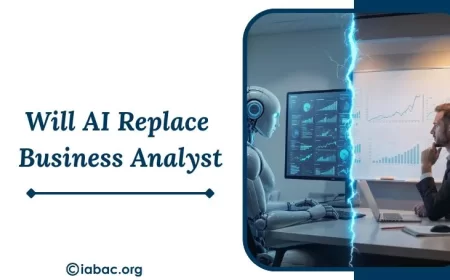
A lot of people assume AI agents are here to replace business analysts. That's not what's happening. In fact, AI agents have made the business analyst role more valuable.
Here's why.
AI agents are powerful, but they're not magic.
They make mistakes.
They hallucinate.
They work beautifully in structured environments and fall apart in ambiguous ones.
Someone needs to define those environments, set the guardrails, identify the failure points, and translate business goals into specifications that actually work. That someone is a business analyst.
And in the year of AI agents, that role has become more important than it has ever been.
The difference is that today's BA needs to understand what AI agents are capable of before they can do any of that well.
You might have got the doubt that "What Does a Business Analyst Do in the AI Era?"
A business analyst in the AI era helps organizations identify where AI agents can improve workflows, automate processes, support decision-making, and solve business problems while ensuring those systems align with real business goals, operational needs, and human oversight.
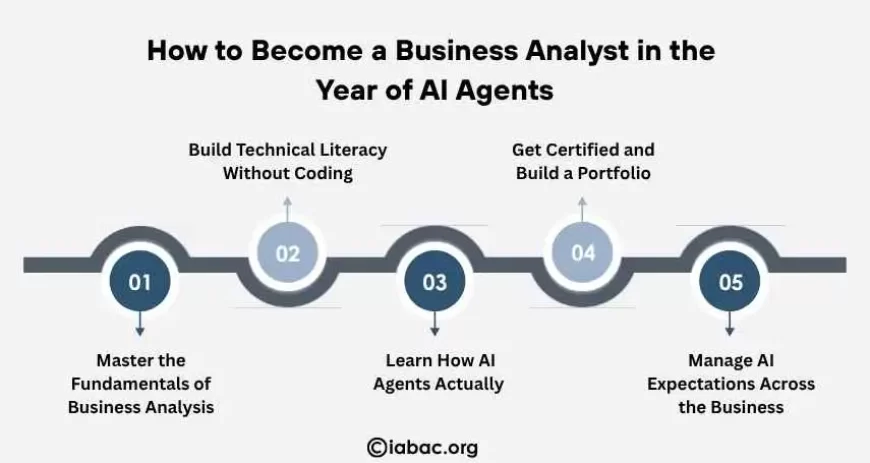
Step 1: Get the Fundamentals Right First
Many aspiring BAs skip this step because they are eager to dive right into AI. Avoid doing so. The fundamentals are what make everything else possible.
Here's what you need to build first:
- Requirements elicitation: The ability to sit with a stakeholder, ask the right questions, and walk away with a clear picture of what they actually need (which is often different from what they initially asked for)
- Process mapping: Using frameworks like BPMN (Business Process Model and Notation) to visually document how work flows and where friction exists
- User story writing: Especially in agile teams, writing tight, testable user stories with clear acceptance criteria is a skill that pays dividends across every kind of project
- Stakeholder communication: You'll regularly be the bridge between executives who think in business outcomes and engineers who think in system constraints. Being comfortable in both conversations is non-negotiable
Step 2: Build Technical Literacy
You don't need to write code. But you do need to understand how systems talk to each other, where data comes from, and what happens when an AI model gets it wrong.
Think of it this way. When a doctor prescribes medication, they don't need to know how to synthesize it in a lab. But they absolutely need to understand what it does, what the side effects are, and when it's the wrong choice. Technical literacy for a business analyst works the same way.
What this looks like in practice:
- Understanding APIs well enough to ask the right questions when systems need to be integrated
- Basic SQL so you can query a database and validate data without waiting on a developer
- Knowing the difference between a large language model, a rule-based automation, and an AI agent (these are not the same thing, and mixing them up in a meeting signals that you're out of your depth)
- Being able to read a system architecture diagram and understand the implications of the design choices being made
None of this requires a computer science degree. A few focused online courses and some deliberate reading will get you further than you might expect.
Step 3: Understand AI Agents Specifically
This is the part that separates a good business analyst from a great one right now. AI agents are not just a trend. They are becoming the core building blocks of enterprise software, and BAs who understand them are already being handed more responsibility and more interesting problems.
What you actually need to know:
- Agentic workflows: How a task gets broken into reasoning steps that an AI agent can work through autonomously
Tool use: How agents interact with external systems like CRMs, email platforms, databases, and browsers - Human-in-the-loop design: This is huge. Knowing when to insert a human checkpoint into an agentic process, and how to design that handoff cleanly, is a critical Business Analyst skill right now
- Failure modes: AI agents can be confidently wrong. A Business Analyst who doesn't build requirements that account for validation and fallback mechanisms is setting a project up for failure
- Prompt structure basics: Not writing production prompts, but understanding why specificity matters when instructing an AI system, and how vague instructions produce unpredictable results
The best way to internalize this? Use AI agents yourself. Set up a simple no-code workflow using a tool like Make or Zapier with an AI step. Watch where it breaks down.
Pay attention to the moments where ambiguity causes it to go off track. That experience will make you dramatically better at writing requirements for AI-powered systems.
Step 4: Get Certified, But Be Strategic About It
Certifications matter in this field, but they matter more when they are paired with real skills and portfolio work. Think of them as a signal, not a substitute.
When choosing a certification, look for programs that cover:
- Core business analytics frameworks and methodology
- AI fundamentals and how they apply to business contexts
- Practical skills like requirements gathering, stakeholder management, and process mapping
- Recognition from employers in your target industry or region
One thing worth saying clearly: a certification without a portfolio is a weak application. A portfolio without a certification can still get you an interview. Prioritize accordingly.
Step 5: Build a Portfolio That Actually Shows What You Can Do
Hiring managers don't just want to read about your skills. They want to see them applied. A strong BA portfolio should show that you can handle both traditional business analyst work and the newer expectations that come with AI-era projects.
What belongs in your portfolio:
- A business requirements document for a real or realistic project
- A process map showing current-state and future-state workflows, ideally one where AI or automation plays a role in the future state
- A set of user stories for an AI-powered feature, complete with edge cases and acceptance criteria
- A case study where you identified a problem, analyzed it, and proposed a structured solution
- Any documentation from actual collaborative work with developers, data teams, or product managers
You don't need a corporate job to build this. Volunteer for a nonprofit, take on a small freelance project, or build something based on a publicly available dataset and a company case study you find interesting. The work is what matters, not where it came from.
Step 6: Know Which Industries Are Moving Fastest
AI agents aren't being adopted at the same pace everywhere. Targeting the right industries early in your career can dramatically accelerate your growth.
Where BA demand is strongest right now:
- Financial services: Fraud detection, loan processing, compliance monitoring, and customer service automation are all active deployment areas
- Healthcare: Clinical documentation, prior authorization workflows, and patient routing are seeing significant AI investment
- Retail and e-commerce: Personalization, supply chain optimization, and AI-powered customer support are mainstream
- Technology companies: Any company building AI products needs Business analysts who can bridge product, engineering, and business stakeholders
- Consulting: Firms helping clients navigate AI transformation need BAs who can assess organizational readiness and design realistic implementation roadmaps
Tailor your resume and portfolio language to the industry you're targeting. The underlying skills are the same, but the vocabulary, the context, and the examples you lead with should feel native to that space.
Step 7: Learn to Manage AI Expectations Like a Pro
Here's something nobody talks about enough. One of the most valuable things a business analyst can do right now is help stakeholders think clearly about AI. Most people either wildly overestimate what AI agents can do or are skeptical to the point of missing real opportunities. Both extremes cause problems.
What this skill looks like in practice:
- When a leader says, "Let's automate everything with AI," you know how to redirect that energy toward a specific, achievable use case without killing the enthusiasm
- You can explain why an AI agent needs human review at certain decision points, in plain language, without condescension
- You surface assumptions early, because AI projects rest heavily on assumptions about data quality, availability, and volume, and unexamined assumptions are where projects go wrong
- You can run a productive workshop with a mixed audience of executives, engineers, and operations staff, helping them identify where AI agents could genuinely add value and how to prioritize
This is where your soft skills and your domain expertise come together. The BA who can do this well is rare, and organizations know it.
Step 8: Stay Sharp Without Burning Out on Every New Tool
The AI space moves fast. New frameworks, new agent platforms, and new capabilities show up constantly. The trap is trying to keep up with everything, which usually means building depth in nothing.
A sustainable approach:
- Follow two or three trusted sources rather than trying to read everything.
- Set aside dedicated learning time each month rather than trying to absorb things passively on the side
- Join a community of practice. LinkedIn groups for BAs, and Slack communities focused on AI and product management are genuinely useful
- Study real AI agent deployments in your industry. What worked, what didn't, and why. That kind of applied analysis is worth more than reading ten trend pieces
You don't need to be the person who knows every new tool. You need to be the person who can evaluate new developments with good judgment and apply them selectively. That's a much more sustainable and valuable position to be in.
The Skills That AI Will Never Replace
Let's be direct about this. No matter how capable AI agents become, these things will always be yours to bring:
- Critical thinking: AI can synthesize information fast, but deciding whether a business direction is actually wise is still a human responsibility
- Curiosity: The best BAs are genuinely interested in how things work and why they break. That curiosity is what makes you good at finding the real problem behind the stated one
- Empathy: Understanding what a stakeholder actually needs, not just what they're asking for, requires seeing from their perspective. AI can't do that for you
- Clear communication: Writing requirements that leave no room for misinterpretation, facilitating a meeting where everyone leaves aligned, and presenting findings to a skeptical audience. These are human intelligence, and they matter enormously
AI changes the context in which these skills get applied. It doesn't make them less necessary.
What Hiring Managers Are Actually Looking For
Job descriptions have shifted noticeably over the past year. Here's what tends to stand out to hiring managers right now:
- Experience working alongside data or engineering teams on AI or automation projects
- Familiarity with agile methodologies and how AI development fits into sprint-based cycles
- Demonstrated ability to write requirements for systems that produce probabilistic or non-deterministic outputs
- Awareness of responsible AI principles, including fairness, explainability, and data privacy
- Comfort with ambiguity, because AI projects carry more uncertainty than traditional software projects, and the BA needs to be a steady presence in that uncertainty
If you can point to concrete examples of each in an interview, you're ahead of the vast majority of candidates in the room.
So, Where Do You Start?
If you're reading this wondering where to actually begin, here's the honest answer: start with the fundamentals, not the AI. Build your requirements skills, your process mapping, and your stakeholder communication. Get comfortable in those before layering in the AI fluency.
Then spend real time with AI agents. Not just reading about them. Using them. Breaking them. Understanding where they shine and where they fall apart. That hands-on experience will inform everything else you do as a BA in this space.
The business analyst who invests in understanding AI agents, not as a curiosity but as a core part of their professional domain, will do more interesting work, carry more influence, and build a career in business analytics that ages well regardless of how the technology continues to evolve. The role isn't changing. It's expanding. And that's a genuinely exciting place to be.