


















































Will Data Science Be Replaced by AI in the Near Future?
Understand future career opportunities through Masters in Data Science, Data Science Classes, and Data Science Certifications.

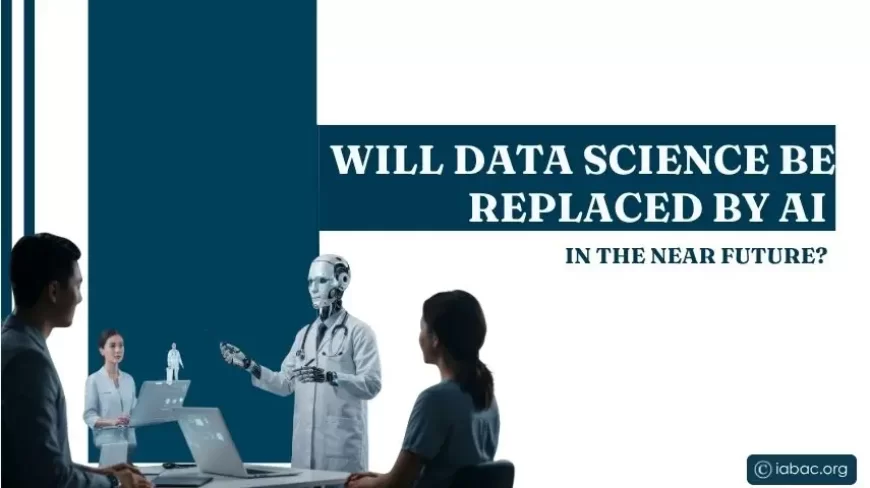
The question will data science be replaced by ai has become one of the most searched topics in the tech world. I’ve seen beginners panic, professionals overthink, and businesses assume machines will suddenly start making perfect decisions without human supervision.
Let me be very clear from the start:
AI is not here to replace data science. It is here to reshape it.
And honestly, the relationship between Data Science and Artificial Intelligence is not competition—it is collaboration. Like a brilliant assistant who can type faster than you but still needs you to decide what story the data is telling.
Understanding the Relationship: AI vs Data Science
To understand the future, we must first understand the present.
What Data Science Really Does
Data Science is the discipline of extracting insights from raw data using statistics, programming, and domain knowledge. It involves:
- Cleaning messy datasets (yes, the infamous “data to data transformation chaos”)
- Building predictive models
- Interpreting results for business decisions
- Designing data science projects for real-world problems
In simple terms:
Data Science answers: “What is happening and why?”
What AI Does
Artificial Intelligence (AI) focuses on building systems that mimic human intelligence. It includes:
- Machine learning models
- Deep learning systems
- Automation of repetitive cognitive tasks
- Prediction and decision-making systems
AI answers:
“What should happen next?”
The Overlap: Artificial Intelligence and Data Science Working Together
The truth is, AI is built on data science foundations. Without data, AI is just a very confident guesser with no evidence.
So instead of replacement, what we see is:
Artificial intelligence and data science = One ecosystem, two layers of intelligence
Why AI Will NOT Replace Data Science
Let’s break this down in a realistic way.
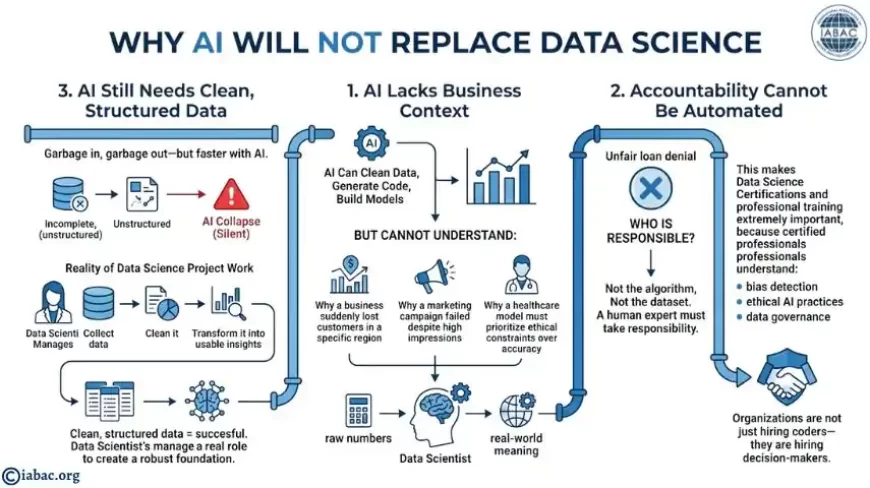
1. AI Lacks Business Context
AI can clean data, generate code, and even build models.
But it cannot understand:
- Why a business suddenly lost customers in a specific region
- Why a marketing campaign failed despite high impressions
- Why a healthcare model must prioritize ethical constraints over accuracy
This is where data scientists step in.
They act like translators between:
- raw numbers
- and real-world meaning
2. Accountability Cannot Be Automated
Imagine an AI model denies a loan unfairly due to bias.
Who is responsible?
Not the algorithm.
Not the dataset.
A human expert must take responsibility.
This makes Data Science Certifications and professional training extremely important, because certified professionals understand:
- bias detection
- ethical AI practices
- data governance
Organizations are not just hiring coders—they are hiring decision-makers.
3. AI Still Needs Clean, Structured Data
There is a saying in the industry:
“Garbage in, garbage out—but faster with AI.”
Even the most advanced models fail if data is:
- incomplete
- inconsistent
- unstructured
And this is where the reality of data science project work begins:
- collecting data
- cleaning it
- transforming it into usable insights
Without this step, AI collapses silently.
How AI Is Changing Data Science (Not Replacing It)
Now here’s the interesting part: AI is not removing jobs—it is reshaping them.
1. Increased Productivity
Today’s data scientist uses AI like:
- A coding assistant
- A debugging partner
- A research helper
Tasks that once took hours now take minutes.
Example:
- Writing SQL queries
- Generating Python boilerplate
- Running exploratory data analysis
This is not a replacement—it is acceleration.
2. Shift Toward Strategy and Storytelling
Earlier, data scientists spent 70% of their time cleaning data.
Now AI handles much of that.
So professionals are shifting toward:
- interpreting results
- communicating insights
- designing business strategies
Because at the end of the day:
Data without storytelling is just numbers on a screen.
3. AI Tool Competency Is the New Normal
Just like Excel became a basic skill in the 2000s, AI tools are becoming standard in datascience workflows.
Today’s professionals are expected to:
- integrate AI APIs
- automate pipelines
- build hybrid models
Example: AI + Data Science in Action
Let’s take a simple data science project example:
Scenario: E-commerce Sales Prediction
A company wants to predict future sales.
|
Step 1: Data Collection
|
AI helps:
|
|
Step 3: Data Scientist Role The data scientist:
|
Step 4: Business Insight Result:
|
Now AI did the heavy lifting, but the meaning came from human intelligence.
AI Impact on Data Science Workflow
Below is a conceptual representation of how AI is changing effort distribution:
Time Spent in Workflow (%)
Old Model:
- Data Cleaning: 70%
- Model Building: 20%
- Insights: 10%
With AI:
- Data Cleaning: 30%
- Model Building: 35%
- Insights: 35%
Notice the shift: Humans now spend more time thinking, less time fixing.
What Will Actually Change?
Instead of disappearance, we are seeing evolution.
Future Data Scientist Roles:
- AI-Augmented Analyst
- Machine Learning Strategist
- Data Ethics Specialist
- AI Systems Interpreter
Key Trend: “Human-in-the-Loop Intelligence”
Even advanced AI systems still require humans to:
- verify outputs
- correct bias
- define objectives
AI does not think why—it only computes how.
Why Learning Data Science Is Still a Smart Career Move
If you are wondering whether to invest time in this field, here is the truth:
Demand Is Growing, Not Shrinking
According to global industry trends:
- Data generation is increasing exponentially
- AI adoption is expanding across industries
- Companies need professionals who understand both
This creates a strong demand for Data Science Certifications that validate skills.
Role of Certification and Structured Learning
Organizations like IABAC play an important role in structured learning pathways.
You can explore structured programs here:
These certifications help learners:
- build practical skills
- understand AI + data science integration
- work on real-world projects
- prepare for global roles
AI vs Data Science: A Simple Analogy
Think of it like this:
- AI = a high-speed car engine
- Data Science = the driver who decides the destination
Without the driver, speed is meaningless.
Without the engine, movement is slow.
Together, they create impact.
Common Mistakes People Make
Some people think AI means a machine can do everything on its own. That is not true.
AI is strong, but it still depends on:
- good data
- clear goals
- human review
- proper use
Without those things, the output can be weak or even harmful.
The Future of Data Science
So what comes next for data science?
Looking ahead, data science is expected to evolve into a much faster, more intelligent, and highly automated field. With the rapid advancement of artificial intelligence and machine learning systems, a large portion of repetitive and time-consuming tasks—such as data cleaning, basic feature engineering, and routine model tuning—will increasingly be handled by AI-powered tools.
This shift will significantly change the role of a data scientist. Instead of spending most of their time on manual technical work, data scientists will focus more on higher-level thinking. Their responsibilities will move toward problem framing, strategic decision-making, interpreting model outputs, and translating insights into real business value. In other words, the role will become less about “doing everything manually” and more about guiding intelligent systems and making the right decisions based on their outputs. Importantly, this does not mean the field of data science will shrink or disappear. In fact, it is likely to expand further as more industries adopt data-driven and AI-enabled systems. The demand for professionals who can understand data, work alongside AI tools, and apply insights effectively will continue to grow.
However, the nature of skills required will change. Data scientists who actively learn how to use AI tools, automation platforms, and modern machine learning frameworks will become far more effective and competitive. On the other hand, those who rely only on traditional methods without adapting may find their skill set becoming less relevant over time. The key takeaway is simple: this transformation is not something to fear, but something to adapt to. The future belongs to professionals who can collaborate with AI, think critically, and focus on solving meaningful problems rather than just processing data.
Challenges Ahead (Realistic Perspective)
Even with AI support, challenges remain:
- Data privacy concerns
- Ethical AI usage
- Model bias
- Skill gap in workforce
- Over-reliance on automation
These challenges ensure that human expertise remains essential.
The Honest Answer to the Big Question
So, will data science be replaced by AI in the near future?
The answer is simple:
No. But data scientists who don’t use AI might be replaced by those who do.
The future belongs to professionals who understand both:
- the logic of data
- and the intelligence of machines
AI is not the end of Data Science.
It is the beginning of a smarter version of it.
And in this evolving world of Data Science and Artificial Intelligence, the most valuable skill is not coding alone—it is thinking with machines, not like them.
If data used to be a raw ingredient, and data science was the recipe, then AI is now the kitchen assistant that speeds everything up—but the chef is still human. And for anyone stepping into this field today, especially through structured learning paths like Data Science Certifications, the opportunity is not shrinking.
It is expanding faster than ever.