


















































Can a Business Analyst Be Replaced by AI?
Can AI replace business analysts? Learn how AI is changing business analysis, what it can automate, and why human expertise remains essential for businesses.

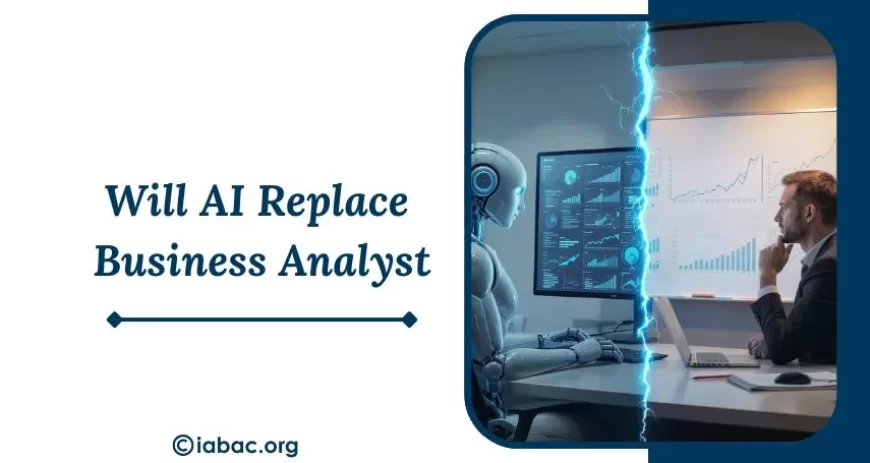
Can a Business Analyst Be Replaced by AI? The answer is no, but with a condition.
AI cannot replace a business analyst who brings strategic thinking, stakeholder judgment, and domain expertise to the table.
What AI can replace is the version of a business analyst who spends most of their time on manual data pulls, basic reporting, and boilerplate documentation.
That distinction matters enormously. AI is reshaping the mechanics of business analysis, not the profession itself.
The analysts who understand this shift, adapt their skill set accordingly, and position themselves above the automation layer will find this an era of opportunity, not obsolescence.
What AI Can Actually Do in Business Analysis
Before making any claim about replacement, it is worth being precise about AI's current capabilities within the business analysis function.
AI excels at three categories of tasks in this space:
- Data processing at scale: AI can ingest, clean, and structure datasets that would take a human analyst weeks to handle manually.
- Pattern recognition: Machine learning models identify correlations, anomalies, and trends across large structured datasets with remarkable accuracy.
- Report generation: Natural language generation tools can now produce first-draft reports, dashboards, and summaries from raw data inputs.
- Repetitive documentation: AI can auto-generate process flows, use case templates, and requirement drafts from existing documentation or meeting transcripts.
These are real capabilities. They are already deployed in enterprise environments. Tools like Microsoft Copilot, Tableau AI, and various LLM-integrated platforms are actively reducing the time analysts spend on mechanical work.
That is not a minor development. It is significant. But it is also the starting point of the analysis, not the conclusion.
What AI Cannot Do: The Hard Limits
Here is where the replacement narrative runs into structural problems. AI operates within the boundaries of the data and instructions it is given.
Business analysis, at its core, is about operating outside those boundaries.
- Asking questions the data has not been asked yet
- Challenging assumptions the business has not examined
- Translating ambiguous human intent into structured solutions
AI cannot navigate organizational politics:
A business analyst working on a digital transformation project is not just mapping processes. They are managing stakeholders with competing priorities, reading unspoken resistance in a leadership meeting, and knowing when to push back on a sponsor who is asking for the wrong thing. No model handles that.
AI cannot exercise contextual judgment:
When a requirements document technically satisfies every stated criterion but would create a poor user experience in practice, a skilled analyst catches that. AI does not have the contextual business intelligence to flag what was never articulated as a risk.
AI cannot build trust:
A business analyst's effectiveness inside an organization is built on credibility, relationships, and earned authority. That is a human variable. Stakeholders share sensitive concerns with analysts they trust. They do not confide strategic anxieties to a chatbot.
AI cannot own accountability:
When a solution recommendation turns out to be wrong, someone has to answer for it, revise the approach, and rebuild stakeholder confidence. AI generates outputs. It does not carry responsibility.
The Real Threat: Complacency, Not AI
If AI is not replacing business analysts, what is the actual risk? The answer is straightforward: business analysts who refuse to evolve will be replaced not by AI, but by other business analysts who know how to use AI.
This is a critical distinction. The market is not shrinking the business analyst role. It is raising the floor of what the role requires. Analysts who are spending the majority of their time on tasks that AI now handles faster, such as manual data extraction, basic reporting, and boilerplate documentation, are in a genuinely precarious position. Not because AI is taking their job, but because their current skill set is delivering less value relative to someone who can do all of that with AI tools and then bring strategic thinking on top of it.
The professionals at risk are those who see AI as a threat to resist rather than a tool to master.
How Business Analysis Is Actually Changing
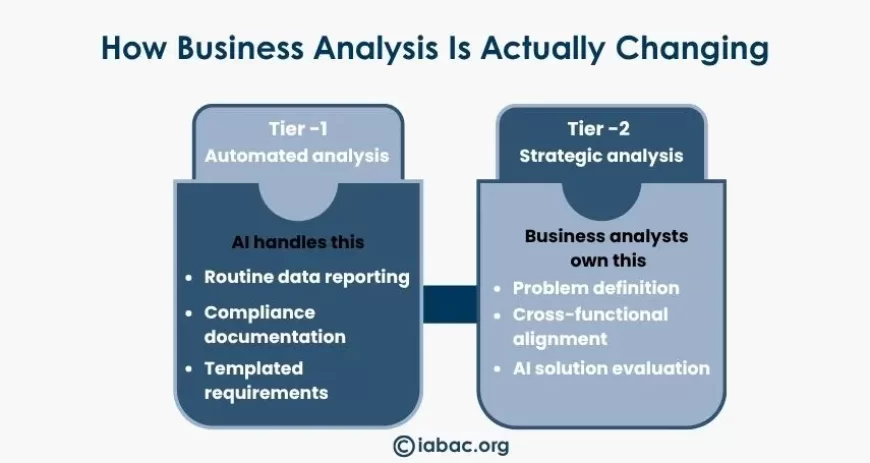
The business analyst role is not disappearing. It is bifurcating. Organizations are moving toward two distinct kinds of business analysis work, and AI is the reason.
Tier 1—Automated Analysis: Routine data reporting, standard KPI dashboards, compliance documentation, and templated requirements are increasingly handled by AI-assisted workflows. Organizations that used to need five analysts for this work now need two, with the other three redeployed.
Tier 2—Strategic Analysis: This is where the growth is.
- Defining the right problem before any data is pulled.
- Facilitating alignment between business units with fundamentally different agendas.
- Evaluating whether a proposed AI solution actually solves the business problem it is supposed to solve.
- Designing change management strategies for technology adoption.
This work is expanding precisely because AI is accelerating how quickly organizations can act on decisions, which means the quality of the decision-making upstream has become more consequential, not less.
Business analysts who position themselves in Tier 2 are not competing with AI. They are directing it.
Skills That Make a Business Analyst AI-Proof
The question to ask is not "Will AI replace me?" The better question is, "What makes my contribution irreplaceable?"
Here are the capabilities that separate high-value business analysts from those at risk:
Stakeholder management and facilitation: Running workshops, managing conflict, building consensus, and navigating organizational hierarchy are deeply human skills. Improving these puts an analyst beyond what any automation can replicate.
- Strategic problem framing: The ability to define the right problem before any analysis begins is arguably the highest-value activity in business analysis. Most organizations are solving the wrong problem with extraordinary precision. Analysts who can reframe business challenges are genuinely rare.
- AI fluency: Understanding how AI systems work well enough to evaluate their outputs critically, identify their failure modes, and design workflows that use them appropriately is a rapidly growing advantage. This does not mean writing code. It means being analytically literate about machine learning outputs.
- Business domain depth: Deep knowledge of a specific industry healthcare, financial services, logistics, retail is not something an AI generalizes well without customization. Analysts with genuine domain expertise bring contextual judgment that AI tools cannot supply from a prompt.
- Data storytelling: Generating an insight is not the same as making it actionable. Translating analytical output into narratives that drive decisions in a boardroom, across cultures, and under time pressure is a human communication skill with enormous organizational value.
Industries Where Business Analysts Are More Valuable Than Ever
The AI displacement narrative assumes a uniform impact across industries. The reality is more nuanced. In several sectors, AI is actively creating demand for business analysts rather than reducing it.
Banking and Financial Services
According to Statista, banking institutions invested $31.3 billion in AI in 2024, up from $20.65 billion the previous year. That scale of investment does not translate into outcomes without human oversight.
Models flagging fraud, evaluating credit risk, and monitoring compliance still require analysts to define thresholds, interpret outputs, and satisfy regulators.
According to Alkami Technology, 87% of financial leaders believe AI will improve banking, which means the analyst role is shifting toward AI governance and model evaluation, not disappearing.
Healthcare
According to Blue Prism, 86% of healthcare organizations are already extensively using AI, with the global healthcare AI market projected to exceed $120 billion by 2028. Yet patient outcomes, compliance mandates, and ethical accountability make every AI deployment a business analysis project in its own right.
E-commerce and Retail
89% of retail and CPG companies are actively using or testing AI, according to McKinsey.
McKinsey's own research estimates Gen AI is poised to unlock between $240 billion to $390 billion in economic value for retailers, equivalent to a margin increase of 1.2 to 1.9 percentage points.
Capturing that value requires analysts who can evaluate whether an AI-driven personalization or pricing system is actually moving business outcomes, not just generating activity on a dashboard.
The Collaborative Model: Human + AI as the New Standard
The most accurate framing for the future of business analysis is not human versus AI. It is human and AI as a working model, where the value each brings is clearly defined.
AI handles data volume, processing speed, pattern identification, draft generation, and standardized documentation.
Business analysts handle problem definition, stakeholder alignment, ethical evaluation, contextual judgment, strategic recommendation, and accountability.
Organizations that deploy this model well are already seeing the results. Analysts are producing higher-quality work, faster. They are freed from mechanical tasks and can invest more time in the decisions that actually drive business outcomes. The role is becoming more strategic, more visible, and, in many organizations, more senior.
The business analyst who understands this collaboration model and actively builds skills on the human side of it is not competing with AI. They are making AI more valuable by directing it well.
What This Means for Aspiring Business Analysts
If you are entering the business analysis field, the AI landscape should not deter you. It should inform how you build your career from the start.
- Do not build your career on being good at tasks AI already does better. Build it on the judgment, communication, and strategic capabilities that AI cannot supply.
- Invest in structured learning. Frameworks, methodologies, and certified competency signals matter more in an AI-enabled market, not less.
- Get AI-fluent early. Understanding how to use AI tools in an analytical workflow and how to critically evaluate their outputs is becoming a baseline professional expectation, not a specialty.
- Choose a domain. Generalist skills are at greater risk of commoditization. Deep industry knowledge, combined with analytical capability, is a combination that remains highly differentiated.
The question "can a business analyst be replaced by AI?" has a clear answer: not the ones who understand what business analysis actually is.
AI is an extraordinarily powerful tool for the mechanical and computational layers of analysis. It is not capable of the judgment, relationship-building, strategic framing, and accountability that define the value a skilled business analyst delivers at the organizational level.
The profession is changing. The floor is rising. The analysts who will thrive are those who see AI as a capability multiplier and invest in the human skills that sit above it.
For business analysts committed to staying ahead of that curve, structured certification and continuous professional development are not optional. They are the foundation of a career that AI cannot replace.
Advance your business analysis career with business analytics certifications built for professionals who want to lead in an AI-enabled environment.