


























































What Does a Business Intelligence Analyst Do That Saves Companies Millions?
What does a business intelligence analyst actually do? From churn prevention to supply chain savings, here's how they protect and grow companies' revenue.


Every business sits on a goldmine of data. Sales records, customer behavior, operational logs, and financial transactions never stop accumulating.
But raw data on its own does not make anyone richer, faster, or smarter. What changes everything is what happens to that data next.
That is where the business intelligence analyst comes in.
This is the professional who takes the chaos of numbers and turns it into something leadership can actually use.
Not just reports. Not just dashboards. Real clarity about what is working, what is failing, and where the next opportunity is hiding before anyone else sees it.
Business intelligence has evolved from a back-office reporting function into one of the most strategically important capabilities a company can build. And while the tools keep advancing, the stakes have never been higher.
Companies that know how to act on their data are pulling ahead, and the gap between them and everyone else keeps widening. The business intelligence analyst is the reason why.
The Core Role: Turning Raw Data Into Decisions
The primary job of a business intelligence analyst is deceptively simple: take disorganized, siloed data and make it legible to decision-makers.
Think of all the information a company generates every day sales numbers, customer records, costs, transactions, and supply chain logs. It piles up fast and means very little on its own. The BI analyst takes that raw data, cleans it up, and turns it into clear insights that executives and managers can actually act on.
To do this, a BI analyst typically works across three areas:
-
Data pipelines: setting up and maintaining the systems that collect and organize raw data from across the business
-
Reporting frameworks: building structured reports that give leadership a consistent, reliable view of performance
-
Visualizations: turning complex data into charts, dashboards, and visual summaries that are easy to read and act on
Without this foundation, companies are left making expensive decisions based on gut instinct rather than facts. This is not a minor operational role.
For those planning to build expertise in this area, understanding the structured learning path and certification options can make the transition much faster.
According to Gartner, poor data quality costs organizations at least $12.9 million per year on average, which is why having a skilled analyst to manage data quality and generate insights is a financial necessity, not a luxury.
A BI analyst's daily toolkit typically includes SQL for querying databases, visualization tools like Tableau, Power BI, or Looker, and often Python or R for more advanced analysis.
Identifying Waste Before It Becomes a Crisis
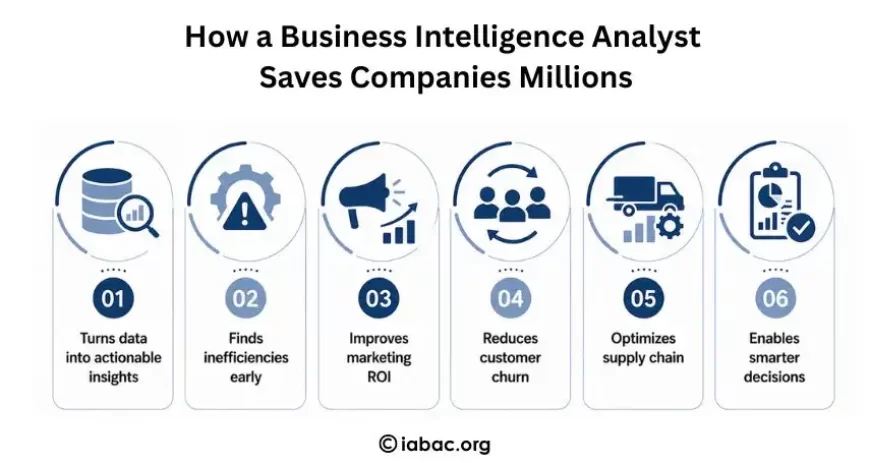
One of the most direct ways a BI analyst saves a company money is by catching problems before they get expensive. When there is no clear view of the data, issues tend to go unnoticed for months
A skilled BI analyst builds dashboards and automated reports that surface these issues in near real-time.
Consider a retail company with hundreds of SKUs (stock keeping units) across dozens of store locations. Without centralized data analysis, it might take a quarterly review to discover that a product category has been underperforming in specific regions.
By then, the company had ordered excess inventory, missed the chance to promote alternatives, and eroded its margin.
A BI analyst, by contrast, can configure alerts that flag drops in sell-through rates week over week, giving operations teams weeks of lead time to respond.
When processes are automated, it means fewer errors and less duplication of effort. When users spend less time on manual, tedious tasks, they can turn their attention to more creative or value-added work that has the potential to create more revenue for the business.
Optimizing Marketing Spend
Marketing budgets are among the most carefully monitored line items in any company and for good reason.
They are often large, and the relationship between spending and outcomes is hard to measure. BI analysts bring clarity to this relationship by connecting marketing activity data to actual revenue outcomes.
Through attribution modeling, a BI analyst maps which touchpoints in the customer journey are actually driving conversions.
This often reveals something uncomfortable about where the budget is really going. Businesses regularly discover through this kind of analysis that they have been:
-
Overspending on paid channels that generate clicks but not customers
-
Underinvesting in organic or email efforts that quietly drive more loyal, high-value customers
-
Funding campaigns that look good on vanity metrics but contribute little to actual revenue
According to McKinsey, intensive users of customer analytics are 23 times more likely to clearly outperform their competitors in terms of new customer acquisition, and nine times more likely to surpass them in customer loyalty.
Once these gaps are visible, BI analysts build dashboards that connect marketing spend directly to customer lifetime value, conversion rate, and revenue attribution.
With this in place, marketing leaders no longer have to guess where to put their budget; the data tells them.
The result is a marketing function that gets smarter with every campaign, continuously reallocating spend toward what works and away from what doesn't.
Customer Retention and Churn Analysis
Acquiring a new customer costs significantly more than retaining an existing one; this is one of the most well-established truths in business.
According to ExpressAnalytics, acquiring a new customer costs 5x as much as retaining an existing one, and the average business loses 20–30% of customers annually in competitive industries.
BI analysts contribute directly to retention by building churn prediction models and behavioral analyses that help companies intervene before a customer walks out the door. By analyzing
-
Historical data on customers who churned
-
their purchase frequency
-
support ticket history
-
engagement patterns
-
product usage data
A BI Analyst can build a profile of "at-risk" customers and identify current customers who match that profile.
Supply Chain and Inventory Optimization
For companies that deal with physical goods, inventory is one of the largest balance sheet items and one of the most problematic when managed without proper data. Overstocking ties up capital and incurs carrying costs. Understocking leads to stockouts, missed sales, and frustrated customers.
The scale of waste here is enormous. Businesses lose nearly $1.1 trillion annually due to poor inventory practices, with the average firm carrying about 30% excess stock.
BI analysts work with procurement, logistics, and sales data to build demand forecasting models that help companies stock the right amount of the right product at the right time.
The result is leaner inventory, fewer stockouts, and significant savings in working capital that can be redeployed into growth.
Beyond inventory levels, BI analysts can also identify supplier performance issues costing money through delayed shipments, quality failures, or missed deadlines.
By tracking and reporting on vendor metrics consistently, they give procurement teams the data they need to renegotiate contracts, diversify suppliers, or flag problems before they disrupt operations
Pricing Intelligence and Revenue Optimization
Pricing is one of the most important decisions any business makes, yet many companies still base it on intuition rather than data, leaving real money on the table.
BI analysts fix this by analyzing price elasticity across
-
products
-
regions
-
customer segments
helping companies charge smarter rather than just cheaper. They also track competitor pricing trends, giving leadership early warning when a rival moves aggressively on price so the response is strategic rather than reactive.
Small, data-informed pricing adjustments that are invisible to customers can add up to significant gains on the bottom line, gains that simply would not exist without someone systematically looking for them.
Financial Reporting and Anomaly Detection
BI Analysts also play a critical role in financial governance by building automated reporting pipelines that catch errors, anomalies, and potential fraud before they escalate.
A company processing thousands of transactions per day has a limited ability to manually audit individual entries. But a BI Analyst can build monitoring rules that flag activity that is
-
statistically unusual duplicate payments
-
vendors without matching purchase orders
-
expense claims that go beyond normal ranges
-
revenue numbers
that stray from forecasts in ways that need to be looked at.
Strategic Planning and Scenario Modeling
Beyond day-to-day operational analysis, BI analysts contribute to longer-term strategic planning by building models that help leadership evaluate different business scenarios like
-
What happens to profitability if a new market is entered?
-
What's the expected ROI of investing in a new product line versus expanding distribution?
-
How does a change in raw material costs flow through the P&L under different volume assumptions?
These questions require not just data but also structured analytical frameworks and models that allow executives to
-
test assumptions,
-
stress-test projections
-
build confidence in big decisions
The BI Analyst builds and maintains these models, ensuring they're connected to live data and updated regularly so that planning exercises reflect current business reality.
How Companies Get Smarter With Every Decision
The financial wins get most of the attention. But a BI analyst's most lasting impact is often on how a company thinks.
When a company builds strong BI capability, it doesn't just generate analyses; it gradually shifts how decisions are made across the entire organization.
-
Teams that previously relied on intuition start asking for data before committing.
-
Leaders who received quarterly reports start reviewing weekly dashboards and asking sharper questions.
But implementing the technology is only half the battle. The human layer of analysts who know how to extract, interpret, and communicate insight is what separates companies that get real value from their data from those that don't.
Over time, this shift compounds. Organizations that build their culture around data become measurably better at
-
allocating resources
-
responding to change
-
growing profitably
not because of any single insight but because every decision is slightly better informed than it would have been otherwise.
A single BI analyst can be the catalyst for this transformation by consistently delivering analysis that helps people make better decisions and by demonstrating, over and over, that the data almost always has something important to say.
For professionals aiming to be part of this shift, understanding the skills, career path, and certification options becomes essential.
A business intelligence analyst is not a behind-the-scenes number cruncher. They are a strategic asset whose work touches every corner of the business, from marketing and operations to finance and strategic planning.
They find the waste nobody knew was there, the customers about to leave, and the pricing opportunities hiding in plain sight.
The savings rarely come from one dramatic finding. They come from dozens of smaller improvements that build up over time into a real financial impact. For those looking to build this kind of impact professionally, a business analytics certification is one of the most direct ways to develop the skills companies are actively hiring for.
Companies that invest in BI capabilities don't just cut costs; they build the foundation for consistently better decisions. And the ones that understand this are the ones that consistently outperform their peers.