



















































What Does an AI Business Analyst Do?
Explore the 6 core responsibilities and essential skills of an AI business analyst. Learn how this fast-growing role prevents digital transformation failures

The rise of artificial intelligence has reshaped virtually every corner of the modern enterprise, and the business analyst (BA) role is no exception. Traditional BAs once relied heavily on spreadsheets, manual interviews, and intuition to decode organizational problems.
Today, a new breed of professional has emerged: the AI Business Analyst.
This role sits at the intersection of strategic thinking and technological fluency. It is quickly becoming one of the most sought-after positions for companies navigating digital transformation.
But what exactly does an AI business analyst do? The answer is both broader and more nuanced than most people expect.
The Evolution: From Traditional BA to AI Business Analyst
Before unpacking the AI-specific dimension, it helps to understand the baseline role. A traditional business analyst bridges the gap between business stakeholders and technical teams.
They gather requirements, map processes, identify inefficiencies, and translate organizational needs into actionable solutions. They are the interpreters of the enterprise.
An AI business analyst does all of this, but with a significant modern twist.
Their domain extends far beyond conventional IT systems and legacy processes. They work specifically with artificial intelligence solutions, machine learning (ML) models, generative AI architectures, predictive analytics platforms, and intelligent automation.
Their primary job is to ensure that AI initiatives actually solve real business problems, rather than becoming expensive technology experiments that gather dust.
6 Core Responsibilities of an AI Business Analyst
While the day-to-day tasks can vary widely depending on the industry, the core function of the role always centers on bridging execution with strategy. Here are the six primary responsibilities that define the modern AI business analyst:
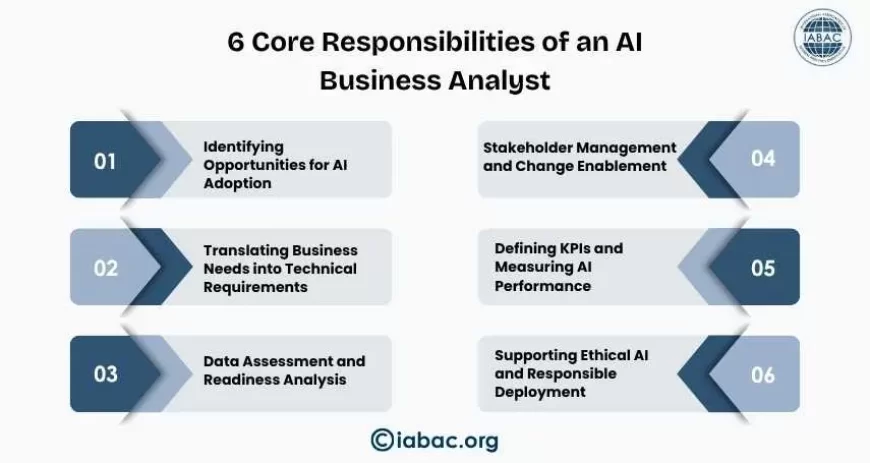
1. Identifying Opportunities for AI Adoption
One of the most valuable things an AI BA does is look at an organization with fresh eyes and ask, "Where could AI genuinely add value here?" This is harder than it sounds. Amid massive AI hype, organizations frequently overinvest in complex solutions looking for problems or dismiss legitimate opportunities out of skepticism.
Key activities include:
- Discovery Sessions: Conducting workshops with department heads to uncover operational bottlenecks.
- Workflow Audits: Reviewing processes to identify repetitive, data-rich, or pattern-dependent tasks suited for AI.
- Practical Triaging: Distinguishing between tasks that are genuinely AI-suitable and those better handled by simpler automation or human judgment.
- Use-Case Prioritization: Documenting and ranking AI initiatives based on technical feasibility and business ROI.
The noise is broken by the AI business analyst. No matter how advanced the underlying technology is, a poorly scoped AI project is nearly certain to fail. This scoping work is fundamental.
2. Translating Business Needs into Technical Requirements
Once an AI opportunity is validated, the analyst becomes a translator. Business stakeholders speak in financial outcomes and user experiences. Data scientists and engineers speak in algorithms, features, tokens, and evaluation metrics.
This translation work involves:
- Decomposing Objectives: Turning high-level business goals into precise data requirements that engineering teams can execute.
- Defining Success Quantitatively: Establishing what a model's output must look like for end-users to trust and act on it.
- Scoping Constraints: Flagging regulatory, ethical, and operational boundaries early in the design phase.
An AI BA does not need to code machine learning models. However, they must understand how they work well enough to spot unrealistic expectations and identify pitfalls before they become costly mistakes.
3. Data Assessment and Readiness Analysis
AI runs on data. A significant portion of an AI business analyst's time is spent evaluating whether an organization's data is actually ready to power the proposed solutions. Many AI projects fail not because of bad algorithms, but because of bad data.
A thorough data readiness assessment covers:
- Availability: Is the necessary data being collected at all?
- Structure: Is it stored in an accessible format suitable for training a model?
- Quality: Is the data clean, consistent, and complete?
- Bias & Gaps: Are there historical gaps or skewed metrics that could compromise predictions?
- Governance: Are appropriate data privacy and compliance frameworks in place?
The analyst does not do the data engineering themselves, but they assess readiness, document gaps, and work with data teams to understand what infrastructure investments are needed before proceeding.
4. Stakeholder Management and Change Enablement
Introducing AI into a workforce is never purely a technical exercise; it is a profound change management challenge. Employees worry about job displacement, managers remain skeptical of algorithmic decisions, and legal teams worry about data leaks.
The AI business analyst navigates this friction by:
- Plain-Language Translation: Explaining complex AI concepts (like LLM hallucinations or confidence scores) without technical jargon.
- Governance Mapping: Helping develop AI safety frameworks that build internal trust without strangling innovation.
- Upskilling Collaboration: Working alongside HR teams to design training pipelines so human workers can seamlessly complement new AI systems.
This stakeholder work is time-consuming and often underappreciated, but it is frequently the difference between an AI project that gets adopted and one that gets quietly abandoned.
5. Defining KPIs and Measuring AI Performance
How do you know if an AI solution is working? A model might perform beautifully on a test dataset during development and still fail to deliver business value in production.
The AI business analyst is responsible for:
- Hybrid Metrics: Blending technical metrics (accuracy, precision, recall) with business metrics (revenue impact, time saved, customer satisfaction).
- Continuous Monitoring: Designing evaluation frameworks to ensure the AI solution delivers on its original financial promise over time.
- Managing Model Drift: Flagging when an AI's performance begins to degrade due to changing real-world data, ensuring retraining happens before business impact occurs.
AI models are not set-and-forget solutions. Ongoing measurement is what separates successful AI deployments from technology investments that quietly stop working.
6. Supporting Ethical AI and Responsible Deployment
As AI systems increasingly influence critical decisions like loan approvals, hiring screenings, and medical workflows, the ethical dimensions of tech have moved from philosophical debate to practical business risk. Regulatory frameworks like the EU AI Act and global data privacy laws require strict compliance.
The AI business analyst supports responsible AI by:
- Bias Detection: Proactively identifying potential sources of bias in training data.
- Auditability: Documenting model behavior to support corporate transparency and legal compliance.
- Regulatory Alignment: Ensuring all workflows respect boundaries set by GDPR, local data protection acts, and industry-specific privacy laws.
Organizations that treat ethics as an afterthought expose themselves to significant reputational, regulatory, and legal risk.
The Essential AI BA Skill Set
An effective AI business analyst is not simply a traditional BA who attended a weekend webinar. The role demands a distinctive, layered combination of technical and soft skills:
- Analytical Thinking: The ability to deconstruct complex, ambiguous business problems into structured components that can be solved via data or automation.
- Technical Literacy: A strong conceptual understanding of supervised vs. unsupervised learning, model overfitting, and the trade-offs between model interpretability and raw performance.
- Communication & Storytelling: Translating complex technical concepts into clear narratives, compelling visualizations, and concrete business recommendations for non-technical leaders.
- Domain Expertise: Deep understanding of a specific industry (healthcare, finance, or retail) to identify opportunities outsiders would miss and anticipate sector-specific deployment challenges.
- Curiosity & Adaptability: A genuine commitment to continuous learning in a landscape where knowledge becomes obsolete quickly, paired with intellectual humility.
No single skill is sufficient on its own. The analyst who is technically fluent but cannot communicate will be ignored. The one who communicates brilliantly but lacks domain depth will miss what matters most. The combination is what creates real impact.
How the Role Is Evolving
The AI business analyst role is itself being transformed by the technology it exists to apply. Generative AI tools are beginning to automate portions of requirements gathering, document analysis, and stakeholder communication. This does not make the human analyst redundant; quite the opposite.
Key shifts shaping the future include:
- A Shift to Strategic Judgment: As AI takes on routine analytical tasks, human value-add shifts further toward judgment, creativity, ethics, and strategic thinking.
- New Architectures, New Challenges: Large language models have created entirely new categories of AI projects like conversational AI and autonomous agents, each bringing new analytical hurdles.
- Managing AI Portfolios: Organizations managing portfolios of AI solutions across multiple functions need leaders to maintain coherence, ensure integration, and align strategy.
- Upward Mobility: The role is becoming more senior, rapidly evolving toward titles like AI Strategy Lead or Head of Intelligent Automation.
Why the Role Matters More Than Ever
There is a persistent myth that AI projects fail because of insufficient technology. The evidence consistently points in the opposite direction.
The real reasons AI projects fail are:
- Misalignment: Disconnects between what the technology can do and what the business actually needs.
- Answering the Wrong Questions: Data science teams building incredibly accurate models for problems that don't drive business value.
- Poor Adoption: End-users who cannot, or will not, adopt the solutions built for them.
- False ROI: AI investments that generate press releases but fail to yield measurable results.
The AI business analyst is the professional whose job it is to prevent all of these failures. They are the connective tissue of the AI enterprise, the person who ensures that smart technology translates into real organizational value.
As artificial intelligence moves from a competitive advantage to a business necessity, the professionals who can navigate its complexity with both technical credibility and strategic clarity will become indispensable. The AI business analyst is the foundation of how smart organizations will build, deploy, and manage intelligent systems for decades to come.
Frequently Asked Questions (FAQ)
Do I need to know how to code to be an AI business analyst?
No, coding proficiency is not required. Your primary value lies in technical literacy, structural thinking, and translation. You must understand how algorithms work, data limitations, and architectural constraints, but the data science and engineering teams handle the actual coding.
How does an AI business analyst differ from a data analyst?
A data analyst focuses on querying historical data, building dashboards, and uncovering past business trends. An AI business analyst looks forward, determining how predictive models, generative AI, and machine learning can optimize workflows and solve future business problems.
What is the average salary for an AI business analyst?
Salaries typically range higher than traditional analyst roles due to the specialized skills required. While exact figures depend on location and industry, mid-level roles generally range between $95,000 and $130,000 annually, with senior AI strategy leads commanding significantly more.
Which tools should an AI business analyst learn?
Focus on three core buckets: data visualization tools like Power BI or Tableau; basic data structuring skills like SQL; and AI collaboration tools. Understanding how to prompt and utilize platforms like ChatGPT, Claude, and specialized data tools like Julius AI is essential.
Can a traditional business analyst transition into an AI role?
Yes, and it is a highly viable career path. Transitioning requires building technical data literacy, learning Agile methodologies specifically tailored for machine learning lifecycles, and shifting focus toward ethical compliance and data quality assessment.
The AI Business Analyst is no longer a luxury for forward-thinking tech companies. They are the ultimate steering force behind successful enterprise survival. By focusing on data readiness, clear translation, and ethical deployment, these professionals ensure that artificial intelligence delivers tangible business value rather than just technical novelty.
As the line between business strategy and artificial intelligence completely disappears, professionals who can bridge both worlds will hold the keys to the future. For those looking to build expertise in this evolving field, earning a business analyst certification can help validate industry-relevant skills and strengthen professional credibility. For organizations looking to survive the next wave of digital transformation, this role is no longer optional; it is a competitive necessity.