























































Top Business Analytics Skills for Success
Learn the top business analytics skills employers value from data analysis and Agile methods to AI-assisted analytics, decision-making and communication skills.


The business analyst role has changed more in the last three years than it did in the previous decade. AI tools, Agile environments, cloud-based platforms, and increasing pressure on data governance have all reshaped what organizations expect from analytics professionals.
Business analytics skills now demand a deeper combination from requirements gathering and process modeling to stakeholder influence and AI-assisted analytics. Whether you are starting your BA career or looking to sharpen an existing one, understanding this full skillset is the starting point for everything that follows.
What Are Business Analytics Skills?
Business analytics skills are the combination of technical knowledge, business understanding, and interpersonal abilities that allow professionals to turn data into decisions. These skills cover everything from querying databases and building dashboards to gathering requirements from stakeholders and modeling business processes.
The role of a business analyst sits at the intersection of data, technology, and strategy. Core functions include:
- Data collection: Gathering data from operational databases, sales records, CRM systems, customer interactions, and other business sources.
- Data Processing: Cleaning, validating, and structuring raw data to prepare it for analysis.
- Data Analysis: Applying statistical techniques and analytical methods to identify patterns, trends, correlations, and anomalies
- Data Visualization: Presenting insights through dashboards, reports, and visualizations to support decision-making.
- Requirements Documentation: Capturing, analyzing, and documenting business needs, objectives, and solution requirements.
- Process Modeling: Mapping current and future business processes to identify inefficiencies, gaps, and improvement opportunities.
Key Business Analytics Skills
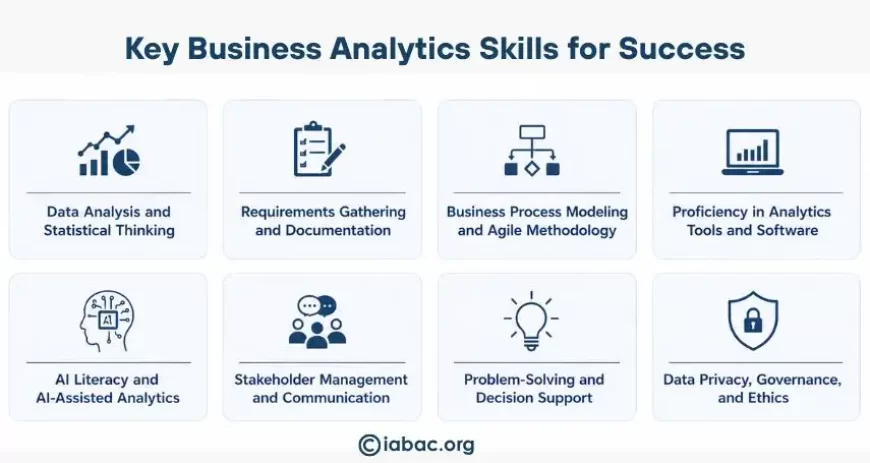
1. Data Analysis and Statistical Thinking
The foundation of every business analyst's work is the ability to interpret data accurately and draw conclusions that hold up under scrutiny. This goes beyond running basic reports; it requires structured analytical reasoning.
Core capabilities include:
- Statistical Analysis: Applying mathematical methods to data to measure patterns, test assumptions, and support accurate business decisions
- Descriptive Analytics: Understanding what happened and identifying contributing factors
- Predictive Analytics: Using historical patterns to forecast future outcomes
- Data Mining: Extracting meaningful patterns from large datasets using machine learning techniques
Strong statistical thinking separates analysts who describe data from those who extract business value from it.
2. Requirements Gathering and Documentation
This is one of the most critical and often underemphasized business analytics skills. A business analyst's primary responsibility in many organizations is to translate what the business needs into clear, structured requirements that technical teams can execute on.
This skill involves:
- Elicitation Techniques: Conducting interviews, workshops, surveys, and observation sessions to gather business needs
- Use Case Development: Documenting functional requirements through structured use cases and user stories
- Business Requirements Documents (BRDs): Writing formal documentation that defines project scope, objectives, and stakeholder expectations
- Functional Specifications: Translating business requirements into detailed functional specs for development teams
Poor requirements gathering is one of the leading causes of project failure. Analysts who master this skill become indispensable to both business and technology teams.
3. Business Process Modeling and Agile Methodology
Modern business analysts are expected to map, analyze, and improve business processes, not just report on data outputs. Understanding how work flows through an organization is fundamental to identifying where inefficiencies exist and where data-driven improvements can be applied.
Key areas include:
- BPMN (Business Process Model and Notation): The standard framework for visually mapping business workflows
- Process Gap Analysis: Identifying the difference between current state and desired future state
- Agile and Scrum: Most BA roles today operate within Agile environments, requiring familiarity with sprint cycles, backlog grooming, and iterative delivery
- Six Sigma Fundamentals: For process improvement initiatives, understanding defect reduction and quality frameworks adds significant value
Analysts who understand process modeling can move beyond data reporting and actively drive operational improvements.
4. Proficiency in Analytics Tools and Software
Business analysts work with a range of tools depending on the complexity and nature of their tasks. Proficiency in the right tools directly impacts both the quality and speed of analysis.
Commonly used tools include:
- Excel: Still essential for quick data handling, pivot tables, and basic modeling.
- SQL: For querying and managing relational databases, a non-negotiable skill for any analyst working with structured data
- Python and R: For advanced statistical computing, automation, and building custom analytics solutions
- Tableau and Power BI: For building interactive data visualizations and executive dashboards
- Cloud-Based BI Platforms: Familiarity with tools like Google Looker, AWS QuickSight, or Azure Synapse is increasingly expected as organizations migrate to cloud infrastructure
- API Basics: Understanding how data moves between systems through APIs is becoming a baseline expectation, particularly in tech-adjacent BA roles
The ability to select the right tool for the right problem rather than defaulting to one familiar tool is what defines a capable analyst in practice.
5. AI Literacy and AI-Assisted Analytics
This is the skill that most distinguishes the business analyst from their counterpart five years ago. AI directly impacts how business analysts work, what tools they use, and what decisions they support.
Key areas of AI literacy for business analysts include:
- Prompt Engineering Basics: Working with AI assistants and large language models to accelerate data summarization, report generation, and insight extraction
- AI-Assisted Analytics: Using AI-powered features within tools like Power BI and Tableau to surface anomalies, generate forecasts, and automate routine analysis
- Understanding Model Outputs: Being able to interpret and communicate the outputs of machine learning models to non-technical stakeholders without misrepresenting confidence or uncertainty
Analysts who combine traditional analytical skills with working AI literacy will hold a clear advantage in the job market through 2026 and beyond.
6. Stakeholder Management and Communication
The business analyst role is fundamentally a bridging role connecting technical teams with business decision-makers. This makes stakeholder management one of the most practically important business analytics skills in the entire skill set.
This involves:
- Stakeholder Mapping: Identifying all parties affected by a project or decision and understanding their priorities and influence
- Active Listening: Drawing out unstated needs and business concerns during discovery conversations
- Data Storytelling: Framing data findings within a narrative that resonates with decision-makers who do not have analytical backgrounds
- Conflict Resolution: Managing competing priorities between departments or between technical constraints and business expectations
- Concise Reporting: Writing summaries that lead with the key finding and strip out unnecessary technical detail
Analysts who manage stakeholder relationships well consistently earn more trust, more project ownership, and faster career progression.
7. Problem-Solving and Decision Support
Business analytics exists to solve real business problems. Analysts need to go beyond presenting data they need to translate findings into structured recommendations that leadership can act on.
Core problem-solving skills include:
- Root Cause Analysis: Tracing problems back to their source rather than addressing surface symptoms
- Identifying the Right KPIs: Knowing which metrics genuinely reflect business health versus vanity metrics that look good on dashboards
- Scenario Modeling: Comparing strategic options using data to assess risk, cost, and opportunity
- Decision Framing: Structuring a recommendation in a way that makes the trade-offs clear for decision-makers
This skill separates analysts who are data reporters from those who are genuine strategic partners to leadership.
8. Data Privacy, Governance, and Ethics
As data use expands, so does the accountability that comes with it. Business analysts are often the first professionals to define how data is collected, stored, and used within a project.
Key responsibilities include:
Regulatory Compliance: Working within frameworks like GDPR and India's Digital Personal Data Protection (DPDP) Act
Data Accuracy and Quality: Ensuring datasets are clean, current, and representative before conclusions are drawn
Bias Awareness: Recognizing where data collection or interpretation may reflect systemic bias and flagging it before it influences decisions
Data Governance Frameworks: Understanding how organizations classify, manage, and protect data assets
Analysts who take data governance seriously build credibility with both their organizations and external stakeholders.
Why These Skills Matter for Career Growth
The demand for analytics professionals in India and globally continues to grow sharply. Here is why developing this full skillset directly impacts career trajectory:
- Higher Employability: Organizations across sectors prioritize candidates who demonstrate both technical and strategic analytical thinking
- Faster Promotions: Professionals who manage stakeholders well and communicate insights clearly move into senior roles faster
- Cross-Industry Relevance: These skills transfer across finance, healthcare, e-commerce, logistics, and consulting without starting from scratch
- AI Resilience: As automation handles routine reporting, analysts with judgment, communication, and strategic skills become more valuable, not less
- Competitive Differentiation: In any role, being the person who backs recommendations with solid, well-communicated analysis makes you indispensable
How to Build and Validate These Skills
Building business analytics skills requires more than just watching tutorials or completing short courses. The professionals who develop these skills effectively combine three things: structured learning, hands-on practice, and formal validation that employers can verify.
- Structured Learning: Follow a curriculum that covers both technical and business-facing skills systematically rather than picking up isolated topics at random. A structured program ensures you build skills in the right sequence and do not develop gaps in foundational areas.
- Hands-On Practice: Apply skills on real or simulated business problems. Working with actual datasets, building dashboards, writing BRDs, and participating in Agile projects builds the practical judgment that classroom learning alone cannot give you.
- Certification: Self-learning has value, but it carries no verifiable signal to employers. A certification from a globally recognized body validates your competency against an industry standard and gives hiring managers a reliable benchmark to evaluate you against.
- Continuous Upskilling: Business analytics is not a static field. Tools evolve, methodologies shift, and AI is actively changing how analysts work. Professionals who treat skill development as an ongoing habit rather than a one-time effort stay relevant as the role continues to evolve.
The combination of practical experience and formal certification is consistently what separates candidates who get shortlisted from those who do not.
Compared to just three years ago, the range of business analytics skills has expanded in 2026. The expected toolkit of a modern BA includes technical proficiency, process expertise, stakeholder influence, and AI awareness.
The professionals who invest in building these skills systematically and validate them through credible business analytics certifications are consistently the ones who lead analytics functions, influence business strategy, and remain relevant as the role continues to evolve.