





























































How Business Analyst Training Builds Practical Skills
See how business analyst training builds skills in data analysis, stakeholder communication, and problem-solving that support careers in business analytics.


When people first hear about business analyst training, they often assume it focuses mainly on theory frameworks, concepts, and documentation methods. In reality, the most valuable aspect of business analyst training is how it builds practical skills that professionals use in real business environments.
Organizations increasingly prioritize analysts who can interpret data, communicate clearly with stakeholders, and translate business problems into workable solutions. This shift has made structured training an important step for anyone preparing for roles in business analytics.
The difference between theoretical understanding and practical capability becomes very clear once individuals begin working on real projects. Training programs that emphasize real-world scenarios help individuals build the mindset and skill set required to handle business challenges effectively.
Understanding How Business Analysts Work in Real Organizations
One of the first things training helps people understand is what the day-to-day work of a business analyst actually looks like. Many beginners imagine the role as purely technical or purely business-focused, but in reality it sits somewhere in the middle.
Business analysts spend a significant amount of time connecting different teams within an organization. They speak with stakeholders to understand business objectives, work with technical teams to translate requirements into systems, and analyze operational data to identify improvement opportunities.
Training programs recreate these situations through exercises and case studies. Participants learn how to ask the right questions, document business needs clearly, and identify the gap between a business problem and the solution that addresses it.
This early exposure helps learners move beyond theory and begin thinking like analysts who are responsible for improving business operations.
Developing Analytical Thinking Through Practice
Analytical thinking is the foundation of effective business analysis. In real projects, analysts constantly evaluate information, identify patterns, and interpret insights that guide decision-making.
Training programs strengthen this ability through structured exercises. Participants are often given business scenarios where they must analyze available information and determine the root cause of a problem.
For example, a training case study might involve declining sales performance, operational delays, or inefficient workflows. Instead of immediately proposing solutions, learners first examine the available data and business context.
Through this process, they practice several important analytical skills:
-
Breaking complex problems into smaller components
-
Identifying patterns in business data
-
Recognizing relationships between different operational factors
-
Evaluating potential solutions logically
Over time, these exercises help individuals develop the habit of approaching business challenges methodically rather than relying on assumptions.
Learning to Analyze Business Processes
Another practical skill that training develops is the ability to analyze business processes. Every organization relies on structured workflows that guide daily operations. When these processes become inefficient, the entire organization feels the impact.
Business analyst training introduces techniques that help professionals study how work moves through an organization. Learners practice mapping workflows to visualize how tasks flow between departments and systems.
Process analysis exercises typically involve identifying areas where delays occur, where communication breaks down, or where redundant steps reduce efficiency.
Through these activities, learners develop the ability to:
-
Examine how departments interact within a workflow
-
Identify operational bottlenecks
-
Recognize unnecessary steps that slow down processes
-
Suggest improvements that streamline operations
Understanding business processes at this level prepares analysts to recommend improvements that have a measurable impact on efficiency and productivity.
Building Confidence in Working with Data
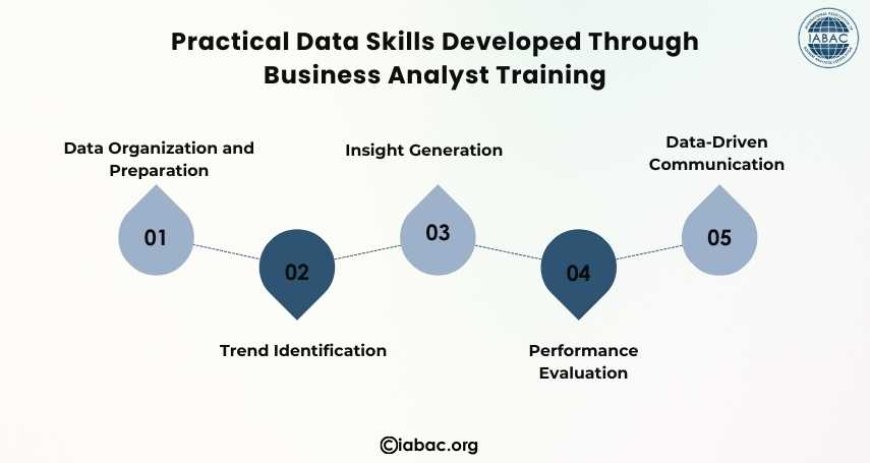
Modern business decisions rely heavily on data. For analysts, the ability to interpret data accurately is essential. Training environments provide opportunities to practice this skill before entering professional roles.
Participants often work with datasets representing business performance, operational metrics, or customer behavior. Instead of simply reviewing numbers, learners focus on interpreting what the data actually indicates about business performance.
Practical training exercises help professionals understand how to:
-
Organize and interpret business data
-
Identify trends and performance patterns
-
Translate numbers into actionable insights
-
Present findings in ways that support decision-making
This experience helps individuals become comfortable working with data, which is an essential capability in roles related to business analysis, business intelligence, and operational strategy.
Improving Communication with Stakeholders
One skill that is sometimes underestimated in business analysis is communication. Analysts frequently act as the connection between technical teams and business stakeholders, which means they must translate ideas clearly in both directions.
Training programs place significant emphasis on this aspect of the role. Participants practice conducting stakeholder discussions, gathering requirements, and presenting findings in structured formats.
During these exercises, learners develop communication habits that are essential in professional environments, including
-
Asking focused questions that clarify business needs
-
Summarizing complex discussions into clear requirements
-
Presenting insights in ways that support decision-making
-
Facilitating discussions between technical and business teams
From my perspective, this skill is often what separates good analysts from exceptional ones. The ability to communicate clearly ensures that projects move forward with shared understanding across teams.
Practicing Structured Requirements Gathering
Requirements gathering is one of the most practical aspects of business analysis. Before any project begins, organizations must understand exactly what they want to achieve.
Training programs introduce structured techniques that analysts use to collect and document requirements effectively. Learners practice interacting with stakeholders to identify expectations, business goals, and system requirements.
These exercises often involve several common approaches:
-
Conducting stakeholder interviews
-
Facilitating workshops to collect input from multiple teams
-
Reviewing existing documentation and workflows
-
Observing operational processes to identify needs
By practicing these techniques in training environments, learners begin to understand how to gather information in a way that supports successful project execution.
Strengthening Problem-Solving Skills
In real business environments, analysts rarely encounter simple problems. Most challenges involve multiple factors such as operational constraints, technology limitations, and stakeholder expectations.
Business analyst training introduces structured problem-solving frameworks that help professionals evaluate challenges systematically.
Participants often work through case studies that require them to analyze a business problem, identify potential causes, and evaluate possible solutions. These exercises encourage learners to think critically and assess the impact of different decisions.
Through this process, they learn how to:
-
Identify root causes behind business challenges
-
Compare alternative solutions objectively
-
Evaluate risks associated with proposed changes
-
Support recommendations with logical reasoning
Developing this structured approach to problem-solving helps analysts provide solutions that are both practical and aligned with organizational goals.
Gaining Familiarity with Business Analysis Tools
Technology plays an important role in modern business analysis. Analysts often rely on tools that help them visualize data, document workflows, and present insights effectively.
Training programs introduce learners to commonly used analytical and reporting tools so they can become comfortable working with technology.
Practical exercises may involve creating dashboards, generating reports, or visualizing trends using charts and graphs. These activities help professionals understand how technology supports business decision-making.
More importantly, hands-on practice builds confidence. Instead of learning tools only in theory, participants gain experience using them in situations that resemble real business tasks.
Experiencing Realistic Business Scenarios
Exposure to real-world business scenarios is one of the most beneficial parts of training. Rather than focusing solely on conceptual frameworks, effective programs recreate the types of challenges analysts face in professional environments.
Participants may work on simulated projects where they must gather requirements, analyze data, and present recommendations to stakeholders.
These exercises help individuals develop practical abilities such as:
-
Managing project discussions
-
Coordinating with multiple teams
-
Presenting insights clearly
-
Making recommendations supported by analysis
From experience, these simulations are often where learners gain the most confidence. By practicing these tasks in a structured environment, they become better prepared to handle similar situations in their careers.
Strengthening Decision-Making Capabilities
Business analysts frequently contribute to strategic decisions within organizations. Their insights help leaders determine which opportunities to pursue and which risks to avoid.
Training programs strengthen decision-making skills by encouraging participants to evaluate information carefully before making recommendations.
Learners analyze data, examine possible outcomes, and consider the impact of different strategies. Through this process, they develop the ability to support decisions with evidence and structured reasoning.
Over time, this capability becomes one of the most valuable contributions analysts bring to organizations.
Building Skills That Support Long-Term Careers
The practical skills developed through business analyst training prepare professionals for a variety of career opportunities. Organizations across industries rely on analysts who can evaluate business operations, interpret data, and support strategic planning.
Individuals who develop these capabilities often move into roles such as:
-
Business Analyst
-
Data Analyst
-
Business Intelligence Analyst
-
Product Analyst
-
Operations Analyst
Each of these roles requires the ability to interpret business needs, analyze data, and contribute to decision-making processes.
The practical training environment helps professionals build these capabilities gradually, ensuring they are prepared for the expectations of modern organizations.
By strengthening analytical thinking, communication, problem-solving, and data interpretation, training programs prepare professionals to operate confidently within complex business environments. Many professionals build these capabilities through structured learning paths such as a Business Analyst Certification, which focuses on applying analytical methods, requirements gathering, and business problem-solving in real-world scenarios.
For anyone preparing to enter or grow within business analysis roles, the practical skills developed during training often become the foundation for long-term careers in business strategy, data analysis, and organizational improvement.