


















































ChatGPT Artificial Intelligence: A Complete Technical Deep Dive
ChatGPT AI explained through its technology, training methods, real uses, limits, ethics, and future trends to help users understand how modern AI works.


Artificial intelligence (AI) has existed for decades, but the world witnessed a dramatic shift when ChatGPT entered the mainstream. For the first time, millions of people interacted with an AI system that could understand questions, write content, explain concepts, generate code, and communicate in a human-like manner. What seemed like science fiction became part of daily life.
This explores why ChatGPT’s artificial intelligence is so special. We will go into how it works, the technology behind it, how it was trained, why it became globally popular, and how businesses and individuals can use it. You'll also find real-world case studies, limitations, ethical concerns, and future predictions for 2025–2030.
Welcome to your complete, technical-yet-simple deep dive into ChatGPT Artificial Intelligence.
What Is Artificial Intelligence?
Artificial intelligence refers to machines that can perform tasks that usually require human intelligence—such as learning, reasoning, problem-solving, language understanding, or pattern recognition.
AI can be divided into:
Narrow AI
-
Designed for a specific task
-
Example: ChatGPT, recommendation systems, face recognition
General AI (AGI)
-
Human-level intelligence
-
Can understand and learn any task
-
Still not achieved today
ChatGPT falls under Narrow AI, but due to its advanced language capabilities, it often feels like interacting with a human.
What Is ChatGPT?
ChatGPT is a conversational AI system created by OpenAI. It uses a family of models known as GPT (Generative Pre-trained Transformer). These models are designed to understand text, generate responses, and perform complex reasoning tasks.
ChatGPT can:
-
Answer questions
-
Summarize information
-
Generate essays, blogs, scripts
-
Write computer code
-
Provide tutoring
-
Assist businesses
-
Analyze data
-
Hold natural conversations
ChatGPT isn't programmed with specific answers—it learns patterns from data and predicts meaningful, context-aware responses.
History & Evolution of ChatGPT (GPT-1 to GPT-5)
ChatGPT’s capabilities grew through several major model upgrades:
GPT-1 (2018)
-
117M parameters
-
Early research model
-
Proved transformers could understand language patterns
GPT-2 (2019)
-
1.5B parameters
-
Generated coherent long-form text
-
Initially withheld due to “misuse potential”
GPT-3 (2020)
-
175B parameters
-
Breakthrough in zero-shot and few-shot learning
-
Basis for early ChatGPT models
GPT-3.5 (2022)
-
Optimized for chat
-
Released as ChatGPT (Nov 2022)
-
Went viral instantly
GPT-4 (2023)
-
Better reasoning, safety, accuracy
-
Multimodal: understood text + images
GPT-5 Family (2024–2025)
-
More human-like reasoning
-
Expanded memory
-
Higher accuracy
-
Context windows over 100K tokens
-
Better safety alignment
-
Used across industries
Each generation made ChatGPT smarter, safer, and more capable.
How ChatGPT Was Trained (Pre-Training, Fine-Tuning, RLHF)
ChatGPT becomes intelligent through several stages of training:
1. Pre-Training
ChatGPT learns by analyzing gigantic amounts of text. It doesn’t memorize—it predicts patterns.
During pre-training, the model is given a sentence with missing words and learns to predict the next token (word or part of a word).
Example:
“The capital of France is ___.”
It sees thousands of variations of similar sentences and learns the logic.
-
Books
-
Websites
-
Research papers
-
Articles
-
Code
-
Public knowledge
It learns grammar, facts, logic, reasoning patterns, and relationships between words.
This teaches the model how language works.
2. Fine-Tuning
Once the model has broad knowledge, it still doesn’t behave like an assistant.
Fine-tuning transforms the raw model into something that feels helpful, polite, structured, and friendly.
How Fine-Tuning Works
Human trainers:
-
Write example conversations
-
Demonstrate correct answers
-
Provide structured question–answer pairs
-
Show the model how to refuse harmful or unsafe requests politely
-
Train the model on “how to behave.”
What is adjusted during fine-tuning?
-
Tone
-
Formality
-
Helpfulness
-
Stability
-
Logical consistency
-
Safety instructions
-
Formatting (step-by-step answers, bullet points, clarity)
Types of improvements added
-
How to ask clarifying questions
-
How to explain concepts in simple terms
-
How to follow instructions step-by-step
-
How to give creative suggestions
-
How to maintain polite, respectful responses
Example of Before vs After Fine-Tuning
Before fine-tuning:
User: “Explain gravity.”
Model: “Gravity is the attraction.”
After fine-tuning:
User: “Explain gravity.”
Model: “Gravity is a fundamental force that pulls objects toward each other. For example, it keeps planets in orbit and keeps you on the ground…”
Fine-tuning makes answers understandable, structured, and useful.
3. Reinforcement Learning from Human Feedback (RLHF)
One of ChatGPT’s greatest strengths.
Humans rate the model’s answers by:
-
Accuracy
-
Usefulness
-
Safety
-
Tone
The system is trained to produce responses that humans prefer.
This is why ChatGPT sounds helpful, natural, and thoughtful.
How ChatGPT Works: The Technology Behind It
1. Transformers: The Core Framework That Powers ChatGPT
Transformers are the foundation of ChatGPT.
They give the model the ability to understand language at scale.
What Transformers Actually Do
Transformers allow ChatGPT to:
-
Read an entire sentence or paragraph all at once
-
Compare every word with every other word
-
Understand subtle connections in meaning
-
Respond based on full context rather than single lines
Why This Matters
Earlier AI models read text one word at a time, which made them slow and forgetful.
Transformers analyze everything together, making ChatGPT:
-
Faster
-
More accurate
-
Better at long answers
-
Better at understanding complex prompts
Where Transformers help the most
-
Long conversations
-
Multi-step reasoning
-
Detailed explanations
-
Following instructions
Transformers are the reason ChatGPT feels more intelligent than older chatbots.
2. Neural Networks: Billions of Neurons Working Like a Digital Brain
ChatGPT is powered by billions of artificial neurons, arranged in many layers.
These neurons don’t “think” like humans, but they learn patterns in enormous amounts of text.
What the Layers Learn
Each layer of the neural network absorbs a different type of information:
-
Lower layers:
Basic language patterns, grammar, punctuation, simple meanings -
Middle layers:
Topics, writing styles, emotional tone, sentence structure -
Higher layers:
Logic, reasoning, problem-solving, coding patterns, real-world relationships
Why Neural Networks Make ChatGPT Feel Smart
Neural networks help ChatGPT:
-
Understand the flow of ideas
-
Detect meaning even when wording changes
-
Rewrite or translate text
-
Generate human-like writing
The intelligence you see in ChatGPT comes from the way these layers cooperate and build on top of each other.
3. Attention Mechanism: How ChatGPT Knows What Matters Most
The attention mechanism helps ChatGPT decide which words in a sentence are most important.
Think of it as the AI’s ability to “focus.”
Why Attention Is Important
In human conversation, we automatically highlight key words.
The attention mechanism gives ChatGPT this same ability.
What Attention Helps With
-
Resolving ambiguous sentences
-
Understanding relationships between words
-
Maintaining context in long conversations
-
Giving accurate, meaningful answers
A Simple Example
Sentence:
“The dog that chased the cat was brown.”
Attention helps the model understand:
-
“was brown” → describes the dog
-
not “the cat”
Without attention, the AI would constantly misinterpret meaning.
Why Attention Makes ChatGPT Strong
It allows the model to understand not just words, but relationships, which is essential for accurate responses.
4. Tokenization: How ChatGPT Breaks Text Into Meaningful Pieces
ChatGPT doesn’t read text character-by-character or word-by-word.
It breaks everything into tokens, which are small chunks of meaning.
Examples of tokens
-
A whole word
-
A part of a word
-
A punctuation mark
-
A symbol
For example:
“Intelligence” → might be split into “Intel” + “ligence”
Why Tokenization Matters
Tokenization helps ChatGPT:
-
Understand unfamiliar words
-
Process long text efficiently
-
Handle different languages
-
Keep output consistent
Benefits of Tokenization
-
Supports huge vocabulary
-
Allows the model to work at every language level
-
Enables ChatGPT to learn meaning in flexible ways
Tokenization is the “language filter” that makes every sentence readable for the AI.
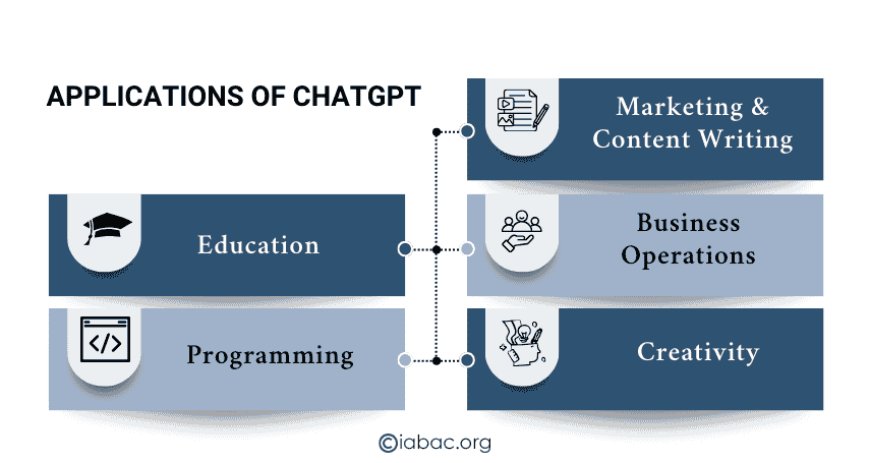
Applications of ChatGPT (Real Uses)
ChatGPT acts as an on-demand learning assistant for students of all ages.
1. Education: Instant, Personalized Learning
Common uses:
-
Doubt solving for any subject
-
Explaining complex concepts in simple language
-
Homework guidance and assignment support
-
Personalized study help based on the student’s learning pace
It makes learning more interactive, accessible, and convenient.
2. Programming: A Smart Assistant for Developers
Developers worldwide use ChatGPT as a coding companion.
Key uses:
-
Debugging and identifying errors
-
Generating code in multiple programming languages
-
Writing scripts and automation snippets
-
Explaining error messages and technical concepts
This saves hours of work and helps beginners learn coding faster.
3. Marketing & Content Writing: Fast, Creative Output
ChatGPT supports businesses and creators by speeding up content production.
Used for:
-
Blog writing and content drafts
-
Email and copywriting
-
SEO-friendly content creation
-
Ad copy for campaigns
It improves consistency and reduces content creation time.
4. Business Operations: Automating Daily Tasks
Companies rely on ChatGPT to simplify internal processes and improve productivity.
Helps with:
-
Customer support responses
-
Report preparation and documentation
-
Routine task automation
-
Data interpretation and summarization
This leads to better efficiency and reduced operational workload.
5. Creativity: A Partner for Ideas and Innovation
ChatGPT also supports creative fields with original ideas and content.
Popular uses:
-
Story writing and plot development
-
Song lyrics and poetry
-
Branding ideas and taglines
-
Video and film script writing
Its creative flexibility makes it valuable to writers, marketers, and content creators.
Benefits of ChatGPT
1. Fast and Efficient
ChatGPT provides answers almost instantly, allowing users to get information, solve problems, and generate ideas without delay. This speed is especially useful for students, researchers, and professionals working on deadlines.
2. Human-Like Conversations
One of ChatGPT’s biggest strengths is its ability to communicate naturally. Its responses feel intuitive, friendly, and easy to understand, making interactions more comfortable and engaging compared to traditional chatbots.
3. Multi-Purpose Tool
ChatGPT can handle a wide range of tasks—writing, coding, summarizing, brainstorming, reasoning, explaining, creating, and more. Instead of switching between multiple tools, users can rely on one AI for many different requirements.
4. Available 24/7
There are no time limits, no office hours, and no waiting. ChatGPT is always accessible, making it a reliable companion for late-night study sessions, urgent work needs, or quick information checks anytime.
5. Cost-Effective for Businesses
Companies use ChatGPT to reduce workload, automate routine processes, support employees, and streamline communication. This cuts operational costs, boosts productivity, and allows human teams to focus on high-value tasks.
6. Personalized Responses
ChatGPT adapts to user input, adjusting tone, style, and explanations based on individual preferences. Over time, it becomes better at understanding how a user likes to communicate, creating a more personalized interaction.
Why ChatGPT Became Popular Worldwide
1. Easy to Use
ChatGPT requires no technical skills. Anyone—whether a student, professional, or beginner—can simply type a question and receive an instant, clear response. This simplicity made AI accessible to the general public for the first time.
2. Highly Intelligent
Compared to earlier chatbots, ChatGPT felt much more capable. It could understand context, write detailed content, solve problems, explain concepts, and even engage in creative tasks. Its human-like intelligence surprised and impressed users worldwide.
3. Free Accessibility
The availability of a fully functional free version played a major role in its widespread adoption. Millions could try ChatGPT without paying, which rapidly expanded its user base and increased global awareness.
4. Viral Social Media Moment
When ChatGPT launched, people began sharing screenshots of its creative and humorous responses online. These viral posts sparked curiosity and encouraged more people to try the tool, accelerating its popularity.
5. Multi-Language Support
ChatGPT can understand and generate text in many languages, making it useful for people across different countries. This global compatibility drastically increased its reach and relevance.
6. Universal Usefulness
One of ChatGPT’s biggest strengths is its ability to help almost anyone—students, developers, teachers, writers, CEOs, small businesses, marketers, and creators. Its wide range of use cases made it valuable across industries.
10. ChatGPT vs Other AI Tools (Gemini, Claude, LLaMA)
ChatGPT
-
Best overall conversational AI
-
Strong reasoning
-
Great for long content and coding
Google Gemini
-
Excellent multimodal abilities
-
Strong visual understanding
Claude (Anthropic)
-
Best for long documents
-
High safety standards
LLaMA (Meta)
-
Open-source
-
Great for developers
-
Highly customizable
ChatGPT remains the most general-purpose assistant, while others excel in niche areas.
Limitations of ChatGPT
Even with powerful intelligence, ChatGPT has limitations:
-
May produce incorrect answers (hallucinations)
-
Cannot browse the real-time internet (depending on model)
-
No personal memory unless allowed
-
No real emotions or consciousness
-
Depends on quality of training data
Being aware of these limitations supports responsible use.
Ethical Concerns & AI Safety
AI safety is a major priority.
Key ethical issues:
-
Bias: The model may reflect biases from training data
-
Misinformation can generate inaccurate content
-
Privacy: must not expose sensitive information
-
Dependence: people may rely too much on AI
OpenAI and other organizations work continuously on:
-
Safer models
-
Transparent policies
-
Stronger alignment techniques
Real-World Case Studies
Case Study 1: Customer Support Automation
A telecom company added ChatGPT-powered bots →
response time dropped from 20 minutes to under 1 minute.
Case Study 2: Education & Tutoring
Students used ChatGPT for personalized learning →
improved understanding of math and science topics.
Case Study 3: Marketing Agency Productivity
Blog production increased 3×
with AI-assisted research, outlines, and first drafts.
How Businesses Can Use ChatGPT
Businesses worldwide use ChatGPT for:
Operations
-
Automating repetitive tasks
-
Creating reports
-
Streamlining workflows
Sales & Marketing
-
Email campaigns
-
Social media posts
-
Lead generation
Customer Experience
-
Chatbots
-
FAQ assistance
-
Complaint resolution
Productivity
-
Brainstorming
-
Document drafting
-
Training material
ChatGPT boosts efficiency and lowers costs.
Skills Needed to Work With ChatGPT / AI
If someone wants to use or work with AI tools, these skills help:
1. Prompt Engineering
Knowing how to write effective prompts.
2. Basic AI & NLP Understanding
Understanding how models work.
3. Data Literacy
Ability to interpret AI-generated output.
4. Ethical Awareness
Using AI responsibly and safely.
5. Creativity & Critical Thinking
Evaluating and improving AI responses.
Future of ChatGPT & AI (2025–2030)
-
Smarter conversational agents — AI will talk more naturally and understand people almost like humans.
-
Near-human reasoning ability — AI will perform deeper thinking, problem-solving, and logical tasks.
-
AI agents that take actions — Tools will handle tasks like booking appointments, replying to emails, and automating routines.
-
Personalized AI assistants — AI will learn user preferences and behave like a tailored digital companion.
-
Deeper industry integration — AI will be widely used in healthcare, finance, education, retail, HR, and manufacturing.
-
Hybrid human–AI workforces — Humans and AI will work together, with AI supporting—not replacing—jobs.
-
Stronger safety systems — AI models will include better protections to reduce misuse and improve trust.
-
AI as a partner — The coming decade will shift AI from being a tool to becoming a true collaborator in daily life.
Upskilling for the AI Era
Still not sure where to start with AI or how to use tools like ChatGPT confidently?
If learning alone feels confusing, IABAC certifications can give you a clearer path. They explain AI in simple terms and guide you step by step.
IABAC also offers different options based on what you need:
-
Generative AI Foundation – a beginner-friendly start
-
Generative AI Specialist – deeper skills in using and applying GenAI
-
AI Specialist in Manufacturing – AI skills for industry and factory workflows
-
AI Business Leader Program – for managers who want to use AI in decision-making
You don’t need a certification to begin, but having a trusted IABAC credential can make learning easier and help you feel more confident when using AI in real work.
ChatGPT’s artificial intelligence is special not just because it talks like a human—but because of the technology behind it. Transformers, neural networks, attention mechanisms, and massive training datasets combine to create extraordinary capabilities. Its applications span industries, empowering individuals and businesses alike.
From simple conversations to complex reasoning, from content generation to automation, ChatGPT has redefined what AI can do.
As we move toward 2030, ChatGPT and similar AI systems will continue shaping the future of work, learning, creativity, and human-computer interaction. The AI revolution has only begun—and ChatGPT is leading the way.