



























































How Facial Recognition Works with Machine Learning
See how AI and machine learning recognize your face instantly and discover real-world uses of facial recognition technology.


Imagine walking through an airport, and the security camera recognizes you without even checking your boarding pass. Or picking up your phone and unlocking it just by looking at it. These are everyday examples of facial recognition, a technology that’s becoming more common thanks to machine learning (ML).
Machine learning helps computers learn patterns from data, which allows them to recognize faces, even when lighting, angles, or expressions change.
Understanding Machine Learning in Simple Terms
At its simplest, machine learning means teaching computers to learn from examples instead of telling them every step. Instead of writing rules for “what a face looks like,” we feed the computer many pictures and let it figure out patterns.
There are several types of ML relevant to facial recognition:
-
Supervised Learning: Systems are trained on labeled datasets where each image is associated with a known identity. The model learns to predict the identity of new images based on the training data.
-
Unsupervised Learning: In cases where labeled data is scarce, unsupervised learning clusters faces based on similarity, without requiring explicit labels. This can help in grouping unknown faces or discovering patterns in large datasets.
-
Deep Learning: This involves neural networks with multiple layers, capable of extracting hierarchical features from images. Deep learning has become the standard for facial recognition because it handles complex visual patterns better than traditional ML methods.
Different types of learning contribute differently: supervised learning is essential for identity verification, unsupervised learning helps in exploratory analysis, and deep learning ensures accuracy and scalability for large-scale systems.
Evolution of Facial Recognition Technology
Facial recognition has evolved significantly over the last few decades:
-
Early Days: Computers measured distances between facial features like eyes and nose. This was limited and often inaccurate.
-
Classical Machine Learning: Systems started learning from data, improving performance, but still needed careful feature design.
-
Deep Learning: Convolutional neural networks (CNNs) and newer models can automatically find the important features, making recognition much more reliable.
-
Key Milestones:
-
Eigenfaces & Fisherfaces: Introduced the concept of representing faces as combinations of principal components.
-
DeepFace (Facebook, 2014): Achieved near-human accuracy using deep learning.
-
FaceNet & ArcFace: Modern embeddings-based approaches for highly accurate recognition in real-world scenarios.
-
Transition to Real-World Applications: Advances in computing power, cloud storage, and mobile processing have moved facial recognition from lab experiments to real-time applications in security systems, retail analytics, and personal devices.
The Facial Recognition Workflow
Facial recognition is a multi-step process that combines computer vision and machine learning:
-
Image Acquisition: Cameras capture images or video streams. Factors such as lighting, angle, and resolution influence performance.
-
Face Detection: ML models detect the presence of a face and separate it from the background. Libraries like OpenCV facilitate this process.
-
Facial Landmarking: Key points, such as eyes, nose, and mouth, are identified to understand facial geometry.
-
Normalization/Alignment: Faces are rotated, scaled, and aligned to standardize orientation and size, improving feature extraction consistency.
-
Feature Extraction: The aligned face is converted into a numerical vector, known as a face embedding, which encodes its unique features. CNNs are commonly used at this stage to capture hierarchical patterns.
-
Face Matching & Classification: The embedding is compared against a database using similarity metrics, such as Euclidean distance or cosine similarity, to identify or verify the individual.
-
Decision Stage: Based on similarity scores, the system either confirms a match or flags it as unknown. Thresholds are set to balance accuracy and security.
Face Embeddings in Simple Words: Think of each face as a point in a huge space. The closer two points are, the more similar the faces.
How Face Recognition Works – Simple Explanation
This image shows how computers identify a face (like Angelina Jolie’s) using different methods — from basic to advanced.
1. Deep Learning (Modern AI)
-
Uses many layers to automatically learn features from the face.
-
No manual work needed, highest accuracy.
-
Final step: AI correctly says “Angelina”.
2. Shallow Learning
-
First extracts simple features like edges.
-
Then groups them using methods like K-means.
-
Classifier identifies the face.
3. Local Handcrafted Features
-
Humans design features (edges, shapes).
-
Computer uses them + a classifier to recognize the person.
4. Holistic Learning (Old Method)
-
Looks at the whole face at once.
-
Uses simple math models like PCA/Eigenfaces.
- Least accurate.

Key Algorithms Behind Facial Recognition
Modern facial recognition relies on a combination of algorithms and architectures:
-
Convolutional Neural Networks (CNNs): Extract hierarchical visual features to differentiate faces.
-
Siamese Networks & Triplet Loss: Train models to measure similarity between embeddings rather than classifying identities.
-
Transfer Learning: Pre-trained models like VGGFace, FaceNet, or ArcFace are adapted to new datasets for faster deployment.
-
Transformers & Vision Models (ViT, CLIP): Emerging architectures process large-scale image data efficiently and support multi-task learning.
-
Vector Databases: Embeddings are often stored in specialized databases to enable fast large-scale comparisons.
Datasets and Training Process
Data quality directly affects the accuracy and fairness of facial recognition systems:
-
Diverse and Representative Datasets: Public datasets like LFW, MS-Celeb-1M, and VGGFace2 provide labeled images that represent varied demographics.
-
Data Augmentation: Techniques such as rotation, brightness adjustments, and occlusion simulation improve model robustness.
-
Data Labeling & Annotation: Supervised learning requires accurately labeled images to teach the system which faces correspond to which identities.
-
Ethical Considerations: Consent, privacy, and minimizing bias are critical during dataset collection. Skewed datasets can lead to unequal performance across ethnicities or age groups.
Evaluation Metrics and Model Performance
Accurate evaluation ensures reliable facial recognition deployment:
-
Metrics: Accuracy, precision, recall, and ROC curves provide insight into model performance.
-
Security Trade-offs: False Acceptance Rate (FAR) and False Rejection Rate (FRR) are essential for balancing convenience and security.
-
Benchmarking: Frameworks like NIST FRVT enable standardized comparisons across systems.
Including these metrics makes the system transparent and credible for stakeholders.
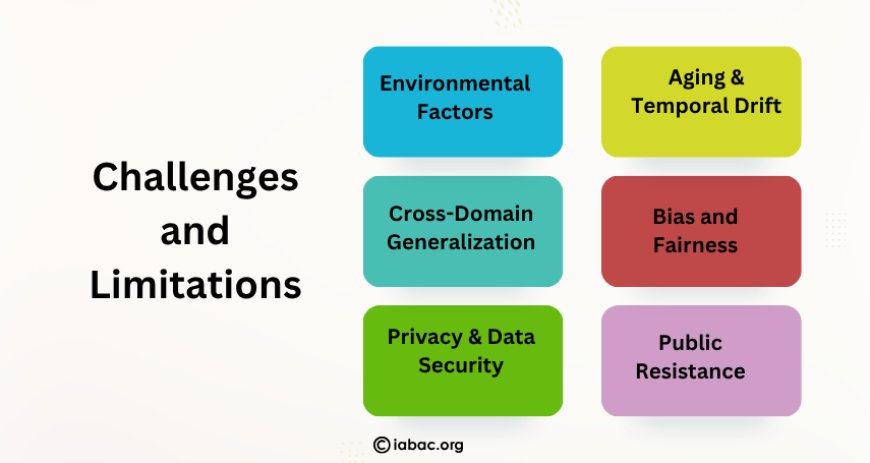
Challenges and Limitations
Despite advances, facial recognition systems face several challenges:
-
Environmental Factors: Variations in lighting, angles, and occlusion can reduce accuracy.
-
Aging & Temporal Drift: Faces change over time, requiring periodic model retraining.
-
Cross-Domain Generalization: Performance may vary across different cameras or settings.
-
Bias and Fairness: Models trained on unbalanced datasets may underperform for certain demographics.
-
Privacy & Data Security: Biometric data is sensitive; mishandling can lead to breaches and loss of consumer trust.
-
Public Resistance: Societal concerns about surveillance and misuse of personal data.
Real-World Applications Beyond Security
Facial recognition has applications beyond traditional security:
-
Retail Analytics: Understanding demographics and customer behavior in stores.
-
Fintech & eKYC: Fast onboarding and identity verification in Neobanking and financial services.
-
Smart Cities & Surveillance: Traffic monitoring, law enforcement, and public safety.
-
Healthcare: Patient identification and monitoring in hospitals.
-
Digital Marketing: Personalized campaigns, sentiment analytics, and customer engagement.
-
AR/VR Personalization: Face-based avatars or interactive experiences in gaming and virtual environments.
Marketing personalization is particularly relevant for brands leveraging AI-driven smart tech. By ethically analyzing customer faces, companies can improve engagement and tailor experiences.
Regulatory and Ethical Landscape
Facial recognition raises significant legal and ethical considerations:
-
Regulations: GDPR (Europe) and CCPA (California) impose strict rules on collection, storage, and use of biometric data.
-
Consent & Transparency: Individuals should know when and how their data is used, with clear opt-in mechanisms.
-
Explainable AI: Understanding how recognition decisions are made helps ensure accountability.
-
AI Governance: Companies must adopt frameworks to monitor bias, accuracy, and compliance with ethical standards.
Future Trends and Innovations
Emerging trends are reshaping facial recognition technology:
-
Edge AI: Running recognition on devices improves speed and privacy.
-
Federated Learning: Enables model training without centralizing sensitive data.
-
Multi-Modal Biometrics: Combining face, voice, and behavior for higher accuracy.
-
Generative AI & Synthetic Data: Artificially generated datasets reduce bias and improve model robustness.
-
Responsible AI & Auditing: Continuous monitoring ensures systems remain accurate, fair, and secure.
These trends indicate that facial recognition will become more secure, adaptive, and privacy-conscious.
Facial recognition has come a long way. It started with basic measurements of faces and now uses machine learning and deep learning to identify people accurately. Today, it’s used in security, banking, retail, healthcare, marketing, and even gaming.
The technology is useful, but it also has challenges like bias, privacy issues, and ethical concerns. Businesses need to use fair and diverse data, check how well the system works, be clear about how they use it, and follow the rules.
In the future, new trends like edge AI, federated learning, and synthetic data will make facial recognition faster, safer, and smarter. By understanding how it works and using it responsibly, companies can improve services, personalize experiences, and earn the trust of their customers.