























































What is General AI?
Learn what General AI is, how it differs from narrow AI, and its potential to perform a wide range of tasks like human intelligence.


Artificial Intelligence (AI) is becoming an integral part of modern life. From the moment we use smartphones to check directions or stream music, AI quietly powers our daily activities. AI systems are behind virtual assistants like Siri and Alexa, recommendation engines on platforms like Netflix and Amazon, autonomous vehicles, and even advanced medical diagnostics. While these systems are impressive, they are usually designed for very specific tasks.
However, there is a bigger idea in Artificial Intelligence called General AI, or Artificial General Intelligence (AGI). Unlike the AI we use today, General AI would be able to do any task a human can do, learn new things on its own, handle unexpected problems, and think and reason like a human.
Narrow AI vs. General AI
To understand General AI, we first need to know about Narrow AI or Artificial Narrow Intelligence (ANI).
Narrow AI is designed to do one specific job or a few closely related jobs. Examples include:
-
Chatbots that answer customer questions.
-
Recommendation engines on platforms like Netflix or YouTube.
-
Fraud detection systems in banking.
-
Autonomous driving software.
These systems are very good at their task but cannot learn unrelated tasks. For example, an AI trained to play chess cannot suddenly write an essay or diagnose a medical condition without being retrained.
General AI would not have this limitation. It would be able to learn different skills, adapt to new challenges, and solve problems it has never seen before. Essentially, General AI could do any task a human can do.
Here’s an analogy:
-
A chess-playing program represents narrow AI. It only knows chess.
-
A human represents General AI. Humans can learn chess, drive a car, cook, write, and solve different problems.
Core Features of General AI
General AI is defined not just by what it can do, but by how it learns and makes decisions. Some key features include:
-
Learning Across Areas
General AI would be able to learn from one domain and apply that knowledge to another. For example, learning physics could help it solve engineering problems.
-
Reasoning and Logic
General AI would use reasoning similar to human thinking. It would make decisions, understand problems, and find solutions even for things it hasn’t seen before.
-
Adaptability
A General AI system could face a new problem, figure out how to approach it, and solve it efficiently, even without prior experience.
-
Independence
True General AI would improve and learn without constant help from humans. It would learn on its own.
-
Human-like Decisions
General AI would ideally consider context, ethics, and long-term results when making decisions, much like humans do.
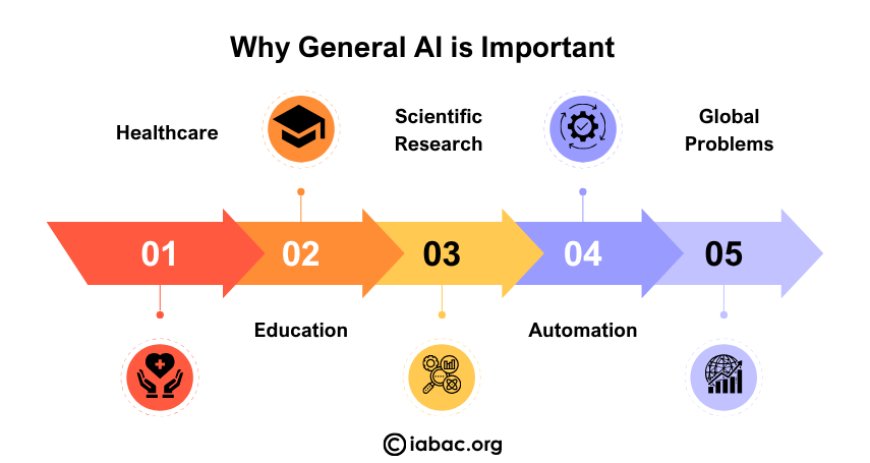
Why General AI is Important
General AI has the potential to change many areas of life:
-
Healthcare: It could help diagnose diseases, create personalized treatment plans, and analyze complex medical data.
-
Education: General AI could create learning programs tailored for each student.
-
Scientific Research: It could solve complex problems in areas like climate science, physics, and biology.
-
Automation: Beyond simple tasks, it could make decisions in fields like finance, logistics, and law.
-
Global Problems: By using knowledge from many areas, General AI could help tackle issues like climate change, natural disasters, and resource management.
Challenges and Risks
While General AI could bring many benefits, it also comes with challenges:
-
Ethics
General AI could inherit biases from data or be used in ways that are unfair or harmful. Ensuring fairness and accountability would be very important.
-
Control and Safety
Making sure General AI acts in ways humans want is a major concern. Uncontrolled decisions could lead to unintended outcomes.
-
Impact on Jobs and Economy
General AI could replace some jobs while creating new opportunities. Managing this change would be necessary to avoid major disruptions.
-
Security Risks
Advanced AI could be misused in cyberattacks, surveillance, or military applications if not controlled properly.
-
Uncertainty
Experts do not agree on whether General AI is possible and, if so, when it will happen. It could take decades, or it might never be fully realized.
The Current State of General AI
At present, true General AI does not exist. The most advanced AI systems, like GPT, AlphaGo, or self-driving cars, are all narrow AI. They can perform certain tasks very well but cannot transfer knowledge across unrelated areas.
Research on General AI includes:
-
Reinforcement Learning: Training AI to make decisions based on rewards and penalties.
-
Neuromorphic Computing: Creating computer systems inspired by the human brain.
-
Large Language Models: Allowing machines to process and generate human-like language across different contexts.
Despite progress, the timeline for General AI is uncertain. Technical challenges and questions about whether machines can truly replicate human thinking make it difficult to predict.
The Future of General AI
General AI could develop in several ways:
-
Optimistic
Advances in technology, computing, and neuroscience could bring General AI in a few decades, allowing rapid improvements in many fields. -
Skeptical
Some experts believe there may be limits to machine reasoning, keeping AI within advanced but narrow tasks. -
Cautious
Progress may be gradual, with AI gradually gaining General AI capabilities over time, alongside careful regulation and ethical safeguards.
In all cases, ethical development and proper rules will be critical. Governments, companies, and researchers will need to work together to ensure AI is safe and responsible.
General AI is the next step beyond the AI we use today. Its main traits—adaptability, cross-domain learning, independence, and human-like reasoning—make it a major topic of interest. While its potential benefits are large, there are serious challenges and ethical considerations.
Currently, General AI is theoretical. Research is ongoing, but the timeline for its arrival is uncertain. The focus should not only be on when it will appear but also on how society prepares for it responsibly. General AI is not just about technology—it is about shaping a future where machines may share some human-level thinking abilities while being safe and ethical.