





























































Deep Learning Fundamentals
Learn deep learning basics: key concepts, neural networks, algorithms, and applications. Mastering these fundamentals opens doors to powerful AI solutions.

As someone who loves technology and data science, I've always been intrigued by how computers can learn from data. Recently, I stumbled upon the term “deep learning” a lot in conversations about artificial intelligence (AI). I remember when I first heard about deep learning; it felt like entering a whole new world where algorithms could think and learn like humans. This was fascinating but also a bit overwhelming. Understanding the basics of deep learning is important for anyone who wants to use this powerful tool, especially as it becomes a part of many industries.
Deep learning is changing everything, from how we use our smartphones to how doctors diagnose diseases. However, the amount of information available can be confusing. In this blog, I want to break down the essential parts of deep learning into simple concepts that everyone can understand.
Challenges in Understanding Deep Learning
Even though deep learning is becoming more popular, many people find it hard to grasp its fundamental ideas. The technical language used can be intimidating, and some might feel lost when they encounter terms like “neural networks” or “activation functions.” It’s easy to get discouraged and decide that deep learning is too complicated to explore.
Moreover, the pace at which deep learning is developing can add to the confusion. New methods and technologies are constantly emerging, making it difficult to keep up. For example, people often hear about “convolutional neural networks” (CNNs) or “recurrent neural networks” (RNNs) without fully understanding what they mean. This jargon can make the field feel exclusive and hard to break into.
Another challenge is overfitting, which happens when a model learns the training data too well but fails to perform on new data. Without hands-on experience and a good understanding of these concepts, it can be hard to apply deep learning effectively in real-world situations.
How can we simplify these complex ideas and develop a good understanding of deep learning fundamentals?
Deep Learning vs Machine Learning
Before going deeper into the topic, it helps to understand how deep learning relates to machine learning.
Machine learning is a broader field where computers learn patterns from data to make predictions or decisions. Deep learning is a special part of machine learning that uses multi-layer neural networks to learn complex patterns automatically.
In traditional machine learning, data scientists often need to select features from the data manually. In deep learning, the system can learn these features on its own when trained on large datasets.
This is one of the reasons deep learning has become popular in areas such as image recognition, speech recognition, and language processing.
A Brief History of Deep Learning
Deep learning may sound like a recent breakthrough, but its roots go back several decades.
In the 1940s, researchers first proposed artificial neurons inspired by the human brain. In the 1980s, the backpropagation algorithm helped neural networks learn more effectively.
For many years, progress was slow because computers were not powerful enough. Around the early 2010s, improvements in computing power and the availability of large datasets changed everything. In 2012, deep learning models achieved remarkable results in image recognition tasks, attracting global attention.
Today, deep learning powers many technologies we use daily, from recommendation systems to advanced language tools.
1. Understanding Neural Networks
At the core of deep learning is the neural network. Think of it as a computer model inspired by how our brains work. Just like our brains have interconnected neurons that help us think and learn, neural networks have interconnected nodes (or “neurons”) that work together to learn from data.
Structure of Neural Networks
A neural network is made up of three main types of layers:
- Input Layer: This layer takes in the data, like images, text, or numbers. Each neuron in this layer represents a specific feature of the input.
- Hidden Layers: These are the layers in between the input and output. They are where the magic happens! A network can have multiple hidden layers, and each layer processes the input in different ways to learn complex patterns.
- Output Layer: This is the final layer that gives us the model’s prediction. For example, if we’re classifying an image of a cat or a dog, this layer will indicate whether the image is a cat or a dog.
The Learning Process
Neural networks learn through two main steps called forward propagation and backpropagation. In forward propagation, data flows through the network, and each neuron processes it using something called an activation function. At the end of this step, the network's prediction is compared to the actual answer, and a loss function measures how wrong the prediction was.
In backpropagation, the network makes adjustments to its weights based on the loss, which helps it improve over time. This process repeats until the model learns to make accurate predictions.
2. Activation Functions
Activation functions are crucial because they help the network understand complex patterns. They determine whether a neuron should be activated (i.e., contribute to the output) based on its input. Without them, neural networks would be like simple linear equations, unable to learn anything meaningful.
Common Activation Functions
- ReLU (Rectified Linear Unit): This is a popular activation function. If the input is positive, it returns that input; if it’s negative, it returns zero. This helps the network learn faster.
- Sigmoid: This function converts input values to a range between 0 and 1, making it useful for tasks where we need a probability, like binary classification (yes/no).
- Softmax: Used in the output layer for multi-class problems, softmax converts raw scores into probabilities. It ensures that the sum of probabilities for all classes equals one.
3. Loss Function
The loss function is essential because it tells us how well the neural network is doing. It measures the difference between the model's predictions and the actual outcomes. A good loss function helps the model learn effectively.
Common Loss Functions
- Mean Squared Error (MSE): Used in regression tasks, MSE calculates the average squared difference between predicted and actual values.
- Cross-Entropy Loss: Commonly used for classification tasks, this loss function measures how well the model’s predicted probabilities match the actual labels.
4. Optimization Algorithms
Optimization algorithms help improve the model’s accuracy by adjusting the weights. The most common method is called gradient descent. This method works by repeatedly changing the model’s weights to minimize the loss function.
Variants of Gradient Descent
- Stochastic Gradient Descent (SGD): This updates the weights after looking at each training example. It can be faster but may add some noise to the learning process.
- Mini-Batch Gradient Descent: This method strikes a balance by updating the weights after processing small batches of training examples, helping the model learn efficiently.
- Adam (Adaptive Moment Estimation): This is a popular optimization algorithm that combines benefits from both SGD and momentum, adjusting the learning rate for each weight based on its past gradients.
Important Hyperparameters in Deep Learning
While training a model, certain settings must be chosen before the learning process begins. These are called hyperparameters.
Some common hyperparameters include:
Learning Rate: Controls how quickly the model updates its weights.
Batch Size: The number of training samples processed at once.
Epochs: The number of times the model goes through the entire dataset.
Number of Layers and Neurons: Determines the complexity of the neural network.
Selecting the right hyperparameters can significantly improve a model’s performance.
5. Training and Testing
Training and testing are key parts of the deep learning process. During training, the model learns from labeled data and adjusts its weights. Testing is when we evaluate how well the model performs on new, unseen data.
The Importance of Validation
To avoid overfitting (when a model learns too much from the training data), we need to validate the model. This means dividing the dataset into training, validation, and testing sets. The validation set helps us fine-tune the model and check its performance before testing it on completely new data.
6. Data Preparation in Deep Learning
Before training a deep learning model, data must be carefully prepared. Good data quality plays a major role in how well the model performs.
Common data preparation steps include:
-
Cleaning incorrect or missing data
-
Normalizing numerical values
-
Transforming images or text into usable formats
-
Splitting the dataset into training and testing groups
In image tasks, techniques like data augmentation can create additional training samples by rotating or flipping images.
7. Overfitting and Regularization
One of the main challenges in deep learning is overfitting. This happens when a model learns the training data too well, including any noise or errors, leading to poor performance on new data. Regularization techniques help prevent overfitting.
Common Regularization Techniques
- Dropout: This technique randomly “drops” some neurons during training. By not allowing certain neurons to work together all the time, it helps the model learn better and generalize well.
- L1 and L2 Regularization: These methods add penalties to the loss function based on the size of the weights. L1 encourages sparse weights (many weights become zero), while L2 encourages smaller weights.
8. Types of Deep Learning Models
Deep learning includes various models tailored for specific tasks. Understanding these models helps you choose the right one for your project.
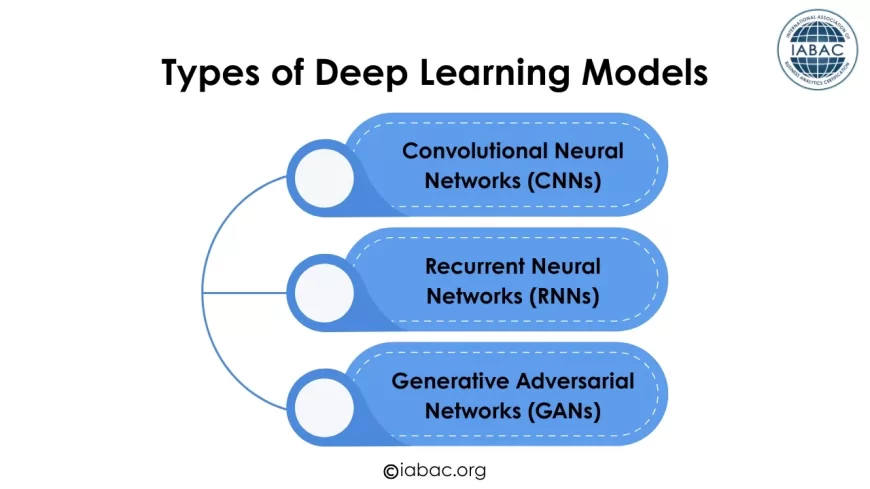
Convolutional Neural Networks (CNNs)
CNNs are designed for image processing. They automatically learn patterns in images, making them great for tasks like recognizing faces or detecting objects.
Recurrent Neural Networks (RNNs)
RNNs are used for sequential data, like time series or language. They remember past inputs, which makes them suitable for tasks such as language translation or text generation.
Generative Adversarial Networks (GANs)
GANs consist of two networks: a generator that creates data and a discriminator that evaluates it. This setup allows GANs to generate realistic data samples, used in tasks like creating art or enhancing images.
Transformer Models and Modern Deep Learning Trends
In recent years, transformer models have become one of the most important developments in deep learning.
Transformers use a mechanism called attention to understand relationships within large amounts of text or data. This allows them to process information more efficiently than older sequential models.
These models are widely used in language translation, chat systems, and advanced text analysis tools. Their ability to understand context across long pieces of text has made them a key part of modern AI systems.
9. Frameworks and Libraries
Many frameworks and libraries make it easier to implement deep learning models. These tools provide pre-built functions and structures that simplify the development process.
Popular Deep Learning Frameworks
- TensorFlow: Developed by Google, TensorFlow is a flexible framework that supports deep learning and traditional machine learning. It helps with building and training models.
- Keras: A high-level API that runs on top of TensorFlow, Keras is user-friendly and makes it easy to build deep learning models quickly.
- PyTorch: Developed by Facebook, PyTorch is known for its dynamic computation, making it easy to experiment with different models. It is popular among researchers.
Hardware Requirements for Deep Learning
Deep learning models often require significant computing power.
Graphics Processing Units (GPUs) are commonly used because they can perform many calculations simultaneously. This makes training deep learning models much faster than using standard processors.
Cloud platforms also allow organizations to access powerful computing resources without investing in expensive hardware.
10. Applications of Deep Learning
Deep learning has many real-world applications, transforming various fields. Here are some areas where deep learning has made a significant impact:
Image and Speech Recognition
Deep learning has improved how computers recognize images and speech. This technology powers facial recognition on our phones and voice assistants like Siri or Alexa.
Natural Language Processing
Natural language processing (NLP) has greatly benefited from deep learning. It helps in creating chatbots, translating languages, and analyzing sentiments in texts.
Autonomous Systems
Self-driving cars and robots use deep learning to process data from their surroundings, make decisions, and navigate safely.
Healthcare
In healthcare, deep learning assists in diagnosing diseases, analyzing medical images, and predicting patient outcomes. This technology helps doctors make more accurate and timely decisions.
Deep learning is a powerful technology that is shaping our world and creating exciting opportunities. By understanding its fundamental concepts—neural networks, activation functions, loss functions, optimization algorithms, and more—you can start your journey into the world of deep learning with confidence.
Limitations of Deep Learning
Despite its impressive capabilities, deep learning also has limitations.
It often requires large amounts of labeled data, which can be expensive and time-consuming to collect. Training deep learning models can also demand significant computing resources.
Another challenge is interpretability. Deep learning models can sometimes behave like “black boxes,” making it difficult to understand how certain decisions are made.
Basic Deep Learning Workflow
A typical deep learning project follows several steps:
-
Collecting and preparing data
-
Choosing the right model architecture
-
Training the model
-
Evaluating performance
-
Improving the model through tuning
-
Deploying the model for real-world use
Following this structured process helps ensure reliable results.
Deep learning is a powerful technology that is shaping our world and creating exciting opportunities. By understanding its fundamental concepts, neural networks, activation functions, loss functions, optimization algorithms, and more, you can start your journey into deep learning with confidence.
As deep learning continues to evolve, new models and tools will continue to expand its possibilities. Staying curious and practicing with real projects will help you build a strong understanding of how these systems work and how they can be used to solve real-world problems.
For professionals seeking to deepen their knowledge and gain industry-recognized credentials, pursuing the Deep Learning Certification can be a valuable step toward building a successful career in this rapidly growing field.