















































Deep Learning Certification: Advance Your Career in AI
Looking to specialize in AI? A deep learning certification can boost your expertise, credibility, and job prospects in top tech roles.

Deep learning is a major part of artificial intelligence (AI) that is changing industries like healthcare and finance. As the need for AI experts continues to grow, getting a certification in deep learning can greatly improve your career chances. These certifications show that you have the skills to work with advanced technologies like neural networks and machine learning. Whether you’re experienced in AI or just starting, earning a certification proves your dedication to learning and applying complex AI ideas.
A deep learning certification can also lead to many job opportunities, such as becoming an AI engineer, data scientist, or machine learning expert. With knowledge of important topics like neural networks, reinforcement learning, and natural language processing (NLP), you’ll be prepared to take on real-world challenges using AI
What is Deep Learning?
Deep learning is a type of machine learning that works like the human brain by using "neural networks" to process large amounts of data. It’s called "deep" because it uses many layers of these networks, with each layer learning different patterns from the data. Unlike regular machine learning, deep learning can find useful information in raw data on its own, making it great for solving more complex problems.
deep learning helps computers learn from experience, just like people, by recognizing patterns and using that knowledge to make predictions.
Applications of Deep Learning:
- Computer Vision: Deep learning is used in systems that recognize images and videos, like facial recognition or medical scans (such as detecting tumors). For example, social media platforms use deep learning to automatically tag people in photos.
- Natural Language Processing (NLP): This involves teaching machines to understand and create human language. Deep learning is behind virtual assistants like Siri and Alexa, translation tools, and systems that analyze the mood behind texts or social media posts.
- Autonomous Driving: Self-driving cars use deep learning to understand their environment, like recognizing road signs, detecting people, and learning traffic patterns. The neural networks help the car make quick decisions, improving safety on the road.

Why Get Certified in Deep Learning?
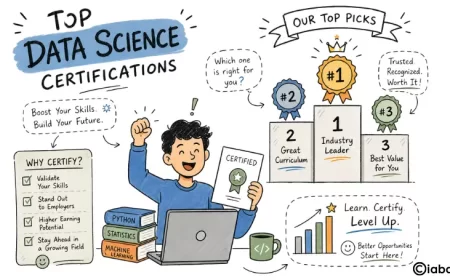
Getting certified in deep learning has many benefits for both beginners and experienced professionals looking to advance their careers. some important reasons to consider:
- Career Growth: A certification can lead to new job opportunities and promotions. For beginners, it helps build a strong foundation of knowledge and skills, making them more appealing to employers. For experienced workers, a certification can help them move into specialized roles like AI engineer or machine learning researcher, further advancing their careers.
- Salary Boost: Professionals with deep learning certifications often earn higher salaries. As companies increasingly depend on AI, the demand for skilled individuals continues to rise, leading to better pay. Surveys show that certified deep learning experts can earn significantly more than those without certification.
- Recognition and Credibility: Having a certification from a respected organization, like IABAC, adds credibility to your resume. It shows that you are dedicated to mastering deep learning concepts and can apply them effectively. This recognition can help you stand out in a competitive job market and give potential employers confidence in your skills.
- Networking Opportunities: Certification programs often connect you to professional communities and networking opportunities. Meeting peers and industry leaders can lead to valuable connections, mentorships, and job referrals, further boosting your career prospects.
- Staying Current: The field of deep learning is always changing, with new techniques and tools emerging regularly. Certification programs usually require you to stay updated on the latest trends and technologies, ensuring you remain competitive and knowledgeable in your field.
IABAC Certified Deep Learning Professional
Overview: This certification is aimed at validating your understanding of deep learning concepts, such as neural networks, natural language processing, and computer vision.
Benefits:
- Comprehensive Curriculum: The program covers both fundamental and advanced topics in deep learning, providing a solid knowledge base.
- Practical Skills: It emphasizes real-world applications and includes hands-on projects to help you gain practical experience.
- Industry Recognition: This certification is recognized by employers who are looking for qualified deep-learning professionals, making it a valuable addition to your credentials.
- Career Advancement: Earning this certification can enhance your resume and open doors to better job opportunities and higher salary prospects.
Skills You Will Learn in Deep Learning Certification
- Neural Networks:
- Understand the architecture and components of neural networks, including input, hidden, and output layers.
- Learn about activation functions, loss functions, and the backpropagation process used to train models.
- Deep Learning Frameworks:
- Gain proficiency in popular frameworks such as TensorFlow and PyTorch.
- Learn how to build, train, and evaluate deep learning models using these tools, enabling you to work on complex projects.
- Programming with Python:
- Master Python, the primary programming language for deep learning.
- Make yourself with essential libraries like NumPy for numerical computing, Pandas for data manipulation, and Matplotlib for data visualization.
- Convolutional Neural Networks (CNNs):
- Explore how CNNs work and their applications in image processing tasks like classification and object detection.
- Recurrent Neural Networks (RNNs):
- Understand the structure and function of RNNs, which are particularly useful for sequential data tasks, such as time series prediction and natural language processing.
- Model Evaluation and Tuning:
- Learn techniques for evaluating model performance, including metrics like accuracy, precision, recall, and F1 score.
- Understand hyperparameter tuning methods to optimize model performance.
- Real-World Applications:
- Gain insights into how deep learning is applied across various industries, including healthcare, finance, and autonomous systems.
Career Paths with Deep Learning Certification
AI Engineer
Role: AI engineers design and create AI models and systems. They integrate machine learning algorithms into different applications.
Job Titles: AI Engineer, AI Developer, Machine Learning Engineer.
Industries: You can work in technology, automotive (like self-driving cars), healthcare (such as medical imaging), and finance (like fraud detection).
Data Scientist
Role: Data scientists analyze complex data using statistical methods and machine learning techniques to provide useful insights.
Job Titles: Data Scientist, Data Analyst, Quantitative Analyst.
Industries: They are in demand in e-commerce (to analyze customer behavior), marketing (to optimize campaigns), and finance (for risk analysis).
Machine Learning Expert
Role: These specialists develop algorithms that allow machines to learn from data and improve their performance over time.
Job Titles: Machine Learning Engineer, Research Scientist, Deep Learning Specialist.
Industries: They often work in technology (for recommendation systems), gaming (creating AI for non-player characters), and telecommunications (optimizing networks).
Computer Vision Engineer
Role: Computer vision engineers create applications that help computers understand and process visual information, like images and videos.
Job Titles: Computer Vision Engineer, Image Processing Engineer, Vision Researcher.
Industries: They work in security (like facial recognition), retail (for checkout systems), and automotive (for driver assistance systems).
Natural Language Processing (NLP) Engineer
Role: NLP engineers focus on helping machines understand and respond to human language.
Job Titles: NLP Engineer, Text Mining Specialist, Linguistic Data Scientist.
Industries: They are found in customer service (like chatbots), finance (for sentiment analysis), and education (developing language learning apps).
Deep learning is truly changing how we tackle complex problems in industries like healthcare and finance. As the need for skilled professionals in this field grows, getting certified can significantly boost your career opportunities. The IABAC Certified Deep Learning Professional program offers a well-rounded curriculum that not only covers essential concepts but also includes practical applications. This means you’ll be well-prepared for the challenges in the tech world. Plus, having this certification on your resume adds a level of credibility that can make you stand out to potential employers.
By earning an IABAC certification, you’re opening the door to a variety of exciting career paths, such as AI engineer, data scientist, and NLP engineer. The knowledge and skills you gain will help you shine in a competitive job market and make a real impact on innovative projects. Embracing deep learning isn’t just about advancing your own career; it’s about being part of a transformative movement that’s shaping the future of technology and improving lives all around us.