





















































How to Build a Career in Generative AI – Skills, Courses & Certifications
Not sure how to start a career in generative AI? Here’s a simple, clear guide to the skills, courses, and certifications that can help you get hired faster.


A lot of beginners trying to break into generative AI make the same mistake: they consume content endlessly and build nothing. They complete courses, follow the discourse, and still feel unqualified.
The field rewards a different approach: one grounded in layered, compounding skills rather than surface-level familiarity.
Here's a clear-eyed look at what the generative AI career landscape actually looks like in 2026, which skills open doors, which certifications carry weight, and what separates people who break in from those who stay on the sidelines.
Understanding the Generative AI Career Landscape
Before mapping a learning path, it helps to understand where the roles actually sit. The generative AI job ecosystem in 2026 has matured into several distinct tracks, and knowing which one fits your background will save you months of misdirected effort.
Core Generative AI Job Roles
Prompt Engineer designs and refines the instructions that guide model behaviour, balancing logic, language, and output control. Best suited to people with strong communication instincts and analytical thinking.
LLM Engineer / AI Developer builds real-world applications using APIs, fine-tuning, and retrieval-based systems. This is the most in-demand role right now and the natural target for developers looking to transition into AI.
ML Research Scientist works on model architecture, training techniques, and performance benchmarks. Requires strong mathematical grounding and typically a postgraduate background, not the entry point for most career switchers.
AI Product Manager translates business problems into AI-backed solutions, deciding what gets built and why. Most effective for professionals with prior product or domain experience who understand both the user and the technology.
Generative AI Consultant advises organisations on adoption strategy, use case prioritisation, and implementation roadmaps. A role where deep domain credibility matters more than coding ability.
MLOps / AI Infrastructure Engineer handles the deployment, monitoring, and scaling of AI systems in production, a role that determines whether a model actually works in the real world, not just in a notebook.
The key insight: Pick the role that maps to your existing strengths and build outward from there. A developer targets LLM engineering. A domain expert targets consulting or a product. Trying to pursue all six at once is how people spend a year learning and still feel unready.
Generative AI Skills Required to Actually Get Hired
Everyone in this space lists Python and machine learning basics, and those are indeed foundational. But hiring managers in 2026 are screening for something more specific. Here is what the skills picture actually looks like at each layer.
Foundation Layer
To build a strong Gen AI foundation, you need:
-
Python proficiency (not just syntax, but writing clean, production-grade code).
-
Linear algebra, statistics, and calculus at a level that lets you reason about model behaviour.
-
Basic understanding of neural networks and gradient-based optimisation.
Intermediate Layer
-
Working knowledge of transformer architecture and attention mechanisms.
-
Hands-on experience with at least one major framework: PyTorch or TensorFlow.
-
Familiarity with the Hugging Face ecosystem, including model loading, tokenisers, and fine-tuning pipelines.
-
API integration with platforms like OpenAI, Anthropic, or Google Gemini.
Advanced and Differentiating Skills
-
Retrieval-Augmented Generation (RAG) architecture and vector database implementation.
-
Fine-tuning and RLHF techniques for domain-specific model adaptation.
-
LLM evaluation frameworks and responsible AI practices.
-
MLOps and model deployment using cloud platforms (AWS, GCP, Azure).
-
Prompt engineering with structured output control and chain-of-thought reasoning.
A real-world example worth noting: a mid-level developer with an existing Python and API background who added LLM fine-tuning expertise reported moving from INR 14 LPA to INR 18-20 LPA within eight months. The skill gap in this area remains wide, which is why targeted upskilling continues to have an outsized impact on compensation.
Discussions from developer communities on Reddit indicate that engineers with both AI modelling and deployment skills often command 30–50% higher salaries than those limited to model development.
How to Learn Generative AI: A Structured Roadmap
The generative AI learning journey works best when it follows a deliberate sequence rather than a scattered collection of tutorials. Here is a realistic roadmap that accounts for where most people begin.
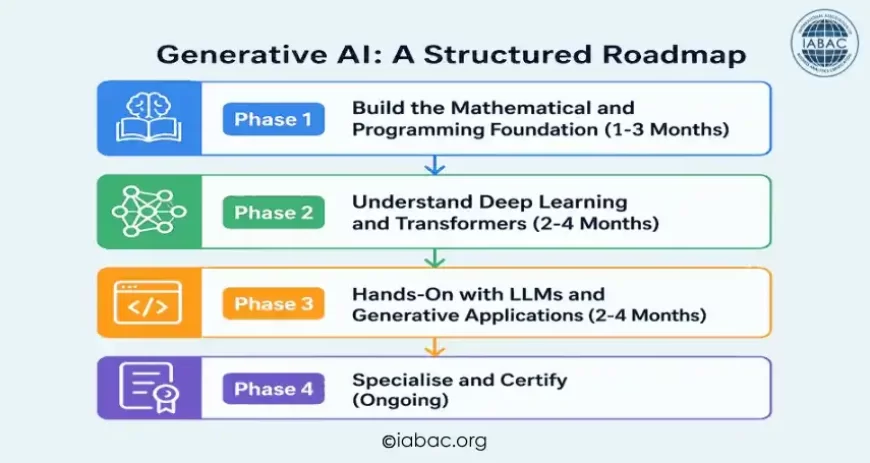
Phase 1: Build the Mathematical and Programming Foundation (1-3 Months)
Focus on Python, statistics, and basic ML concepts. Complete small end-to-end projects, even if they are simple sentiment classifiers or regression models. The goal is not to master everything but to stop feeling unfamiliar with how data flows through a learning system.
Phase 2: Understand Deep Learning and Transformers (2-4 Months)
Work through the core ideas behind neural networks, backpropagation, and eventually transformer architecture. Andrej Karpathy's open-source materials and fast.ai's practical deep learning course are widely respected starting points. Build at least one project using a pre-trained model.
Phase 3: Hands-On with LLMs and Generative Applications (2-4 Months)
This is where generative AI learning becomes tangible. Build a RAG pipeline, experiment with fine-tuning a smaller open-source model, and integrate LLM APIs into a functional application. The portfolio work you create in this phase is what hiring managers actually evaluate.
Phase 4: Specialise and Certify (Ongoing)
Choose a domain that aligns with your career target, whether that is healthcare AI, legal document analysis, or enterprise automation. Pursue a structured certification to validate your skills and signal credibility to employers.
Generative AI Courses and Certifications Worth Pursuing
The certification market for AI has expanded rapidly, which means quality varies considerably. These are the programmes and credentials that consistently appear in conversations with hiring managers and practitioners.
1. IABAC Certified Generative AI Specialist – Structured for working professionals who want industry-aligned validation. The curriculum covers LLMs, responsible AI, and applied use cases, with assessment-based credentialing recognised across enterprise hiring contexts.
2. DeepLearning.AI Specialisations – Andrew Ng's structured programmes remain among the most rigorous foundations available. The 'Generative AI with LLMs' specialisation is particularly well-regarded.
3. fast.ai Practical Deep Learning – Free, project-first, and respected by practitioners. Particularly strong if you prefer learning through building.
4. Google's Generative AI Learning Path – A structured series on Google Cloud that covers everything from prompt design to deploying Vertex AI applications.
The Career Transition Angle Nobody Talks About: Domain Expertise as Your Edge
Your prior domain knowledge is probably your strongest differentiator, not your AI skills.
A radiologist who learns to work with medical imaging models brings clinical judgment that a computer science graduate simply does not have.
A finance professional who understands risk modelling and learns to build RAG systems for regulatory documents is more valuable to a bank than a generalist AI engineer with no sector context.
A legal researcher who learns prompt engineering and document summarisation techniques can command rates that junior AI developers cannot match.
The most overlooked generative AI career path is the hybrid professional: someone with 3-7 years in a domain who adds structured AI skills on top.
These individuals are genuinely scarce in 2026, and they tend to earn at the upper end of the salary range for their experience level precisely because they can translate between the technical and the operational worlds.
If you come from a non-technical background, the path is not to compete with computer science graduates on their own ground. It is to take your domain fluency and build a targeted AI skill set around it. That combination is what most employers are searching for and failing to find.
What Experienced AI Practitioners Would Tell Their Earlier Selves
Skip the Tutorial Trap
There is a very common pattern where someone completes fifteen online courses, accumulates a range of certificates, and still cannot build a working application. Tutorials create an illusion of progress. The shift from learner to practitioner happens the moment you start building something with no step-by-step guide available. Aim to spend at least 40% of your learning time on original projects.
Portfolio Over Certificates, Always
A well-documented GitHub repository with a functional RAG application, a fine-tuned domain-specific model, or an LLM-powered tool does more for your hiring prospects than any single certificate. Recruiters want evidence of judgment, not just knowledge.
Pick One Framework First
The debate between PyTorch and TensorFlow, or between LangChain and LlamaIndex, consumes enormous amounts of mental energy in AI communities. In practice, pick one, go deep, and cross-train later. Shallow familiarity with five tools is worth less than genuine depth with two.
Ignore Salary Comparisons Until You Have a Speciality
The generative AI salary range in India in 2026 runs from INR 6 LPA to INR 1 crore or more, depending on role, depth, and company type. Comparing yourself to the top end of that range early in your journey will distort your learning decisions. Focus on building depth in a specific track, and compensation will follow the expertise.
Build in Public
Writing about what you are learning, sharing projects on LinkedIn, and contributing to open-source AI repositories: these activities compound over time in ways that are difficult to quantify but consistently appear in the career trajectories of practitioners who advance quickly.
Ready to Start Your Generative AI Career?
The generative AI career window is open right now, but the professionals who build durable positions in this field are those who invest in structured, validated learning rather than scattered self-teaching. IABAC's Generative AI professional programmes are designed specifically for this purpose: practical, assessment-driven, and aligned with what employers in 2026 are actually asking for.
Explore IABAC Generative AI Certifications – Validate your skills with globally recognised credentials and take the next step in your AI career.
Whether you are a developer expanding into AI, a domain expert making a transition, or a student planning your first role, the path is clearer than it might seem. The skills are learnable. The roles are available. And a recognised generative AI certification from a credible global body like IABAC gives you the credential that opens the conversation.
Frequently Asked Questions
1. What is the average generative AI salary in India in 2026?
Entry-level roles start around INR 6–12 LPA. Mid-level professionals earn INR 15–30 LPA with LLM/RAG skills. Senior roles in top companies or startups range from INR 40 LPA to ₹1 crore+ based on expertise.
2. Can I build a generative AI career without a computer science degree?
Yes. Domain expertise plus targeted AI skills is highly valued in 2026. Certifications and hands-on projects help bridge the gap and build credibility.
3. How long does it take to become job-ready in generative AI?
With a technical base, 6–12 months is enough for entry roles. Beginners may take 18–24 months. Focusing on one role can significantly shorten the timeline.
4. Which generative AI certification is most recognised by employers?
Employers prefer certifications with practical assessments like IABAC’s Generative AI credential. Google and Microsoft certifications are also valued. A strong project portfolio matters more than any single certification.
5. What is the difference between a prompt engineer and an LLM engineer?
A prompt engineer focuses on crafting inputs to guide AI outputs. An LLM engineer builds and integrates AI systems, including fine-tuning and deployment. LLM engineers usually earn more due to a broader technical scope.
Key Takeaways
-
A generative AI career in 2026 is accessible to professionals from diverse backgrounds, not only computer science graduates.
-
The most in-demand generative AI skills include LLM engineering, RAG architecture, fine-tuning, and MLOps – not just Python basics.
-
Domain expertise combined with AI skills is a significant differentiator that most career guides undervalue.
-
A structured learning path through phases – foundation, deep learning, LLM application, specialisation – is more effective than scattered tutorial consumption.
-
Recognised generative AI certifications from bodies like IABAC, paired with a practical project portfolio, are what actually move hiring conversations forward.
-
The generative AI salary in India ranges widely, with Bengaluru leading and global remote roles offering the highest earning potential.
-
The field is moving fast, but the core principle does not change: build depth, build evidence, and build in public. The career follows the craft.