

















































Generative AI Certification – Is It Worth It for Your Career?
Thinking about a generative AI certification? Learn if it’s worth your time, who it suits, and how it can shape your career path and growth in 2026.

You've probably heard colleagues talking about it. You've seen job descriptions mention it. And somewhere between curiosity and concern, a question has been sitting in the back of your mind: Should I get a generative AI certification?
Here's the honest answer. It depends on how you approach it. A generative AI certification by itself won't transform your career overnight. But when chosen wisely and paired with applied learning, it can become the single smartest move you make in 2026.
This guide breaks down who benefits, what to look for, and exactly how to avoid the traps that make most certifications feel like wasted time and money.
Why Generative AI Skills Have Become Non-Negotiable?
The demand for AI-skilled professionals has moved far beyond the tech sector. AI-related job postings peaked at 16,000 per month in late 2024, and positions requiring generative AI skills quadrupled over the past two years.
That growth shows no signs of cooling. Global AI talent demand now outpaces supply by 3.2 to 1 in 2026, with over 1.6 million open roles and only 518,000 qualified candidates available to fill them.
Put simply, employers are desperate for people who understand generative AI. And right now, the professionals who hold a credible generative AI certification have a meaningful head start over those who don't.
Take the case of a mid-career marketing strategist who enrolled in a structured AI certification program in early 2025. Within six months of completing it, she moved into an AI content strategist role at a SaaS company, a position that hadn't existed two years prior. The certification alone didn't land her the job. But it gave her the vocabulary, the framework, and the confidence to show exactly what she could do with generative AI tools.
That's what a well-chosen generative AI certification does. It gives you a structured path in a field where self-learning alone often leads to scattered, incomplete knowledge.
What a Generative AI Certification Actually Covers?
A quality generative AI certification goes well beyond learning how to write prompts.
The best programs teach you to understand and work with the underlying architecture of large language models, build applications using APIs and frameworks like LangChain, design retrieval-augmented generation (RAG) systems, evaluate and iterate on model outputs for reliability, and apply responsible AI principles, including bias detection and governance.
For technical professionals, this means building systems like chatbots, AI agents, and production-ready deployments.
For non-technical professionals, it means understanding enough to lead AI initiatives, evaluate vendor solutions, and manage AI projects with confidence.
The distinction matters because not every certification covers the same ground. Some are designed for builders; others are designed for decision-makers.
Picking the right one for your role is the most important decision you'll make.
Generative AI Certification Value: What the Numbers Say
If you've been wondering whether a generative AI certification translates to real financial upside, the data gives a clear answer.
Jobs requiring AI skills advertise a 28% salary premium, equivalent to nearly $18,000 more per year. Professionals with multiple AI competencies see salary premiums of up to 56%.
Professionals with generative AI expertise can expect an average salary of around $174,727 per year.
These numbers reflect a market where skills are scarce, and demand is accelerating. AI salaries have climbed 38% year-over-year across all experience levels, and AI roles now pay 67% more than traditional software jobs.
For professionals weighing the ROI of a generative AI certification, the result speaks clearly. A few months of focused study can unlock a career trajectory that otherwise takes years to build.
Who Should Pursue a Generative AI Certification?
A generative AI certification adds the most value for four groups of professionals.
Career switchers who want to move into AI-adjacent roles but lack a formal technical background. Certifications provide the structured credibility that a self-taught portfolio alone often can't deliver to hiring managers.
Developers and engineers who are already building software and want to integrate AI capabilities into their work. For this group, a generative AI certification signals that they understand LLM architecture, not just how to use ChatGPT via an interface.
Business and functional professionals, including product managers, marketers, consultants, and HR leaders, who want to lead AI projects or advise on AI strategy. They don't need to write code; they need to understand what's possible, what's responsible, and what questions to ask.
Mid-level professionals facing skill gaps in AI-exposed industries. Seven out of the ten fastest-growing ICT roles are AI-related, and critical skill gaps were identified specifically in generative AI, large language models, and prompt engineering. Bridging those gaps with a recognized certification sends a clear signal to employers.
Best Generative AI Certification 2026 – What to Look For
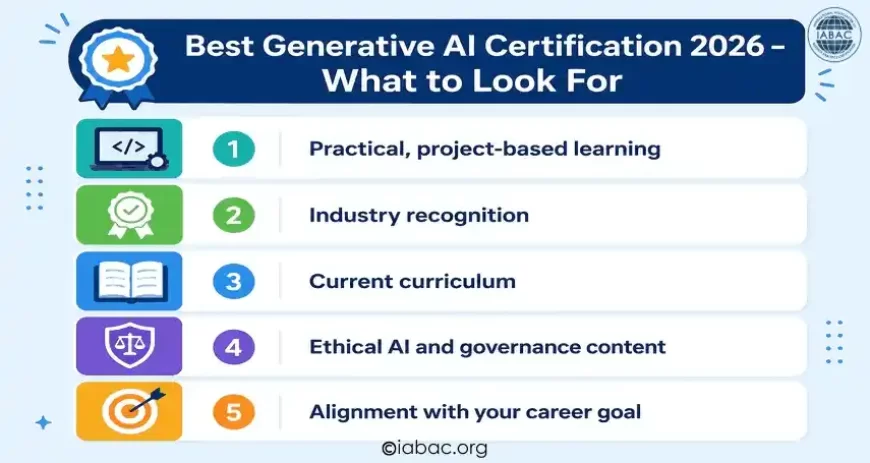
With hundreds of programs available, separating genuine value from badge-collecting is important. Here's what separates the best generative AI certifications from the noise.
-
Practical, project-based learning
A program that ends with a portfolio of deployed projects is worth far more than one that ends with a multiple-choice exam. When an interviewer asks about your experience, you want a real project to walk through, not just a score.
-
Industry recognition
Certifications from globally recognized providers carry weight with hiring managers. Programs offered through established platforms with credible institutional backing matter more than obscure badges from unknown organizations.
-
Current curriculum
AI evolves fast. A certification covering 2023 techniques may already be outdated. Prioritize programs that have been updated in the last 12 months and explicitly cover LLM deployment, RAG systems, and agentic AI.
-
Ethical AI and governance content
Demand for skills in AI governance is up 150%, and AI ethics skill demand is up 125%. Programs that include responsible AI principles aren't just morally sound — they're teaching skills employers are actively paying for.
-
Alignment with your career goal
If you're targeting enterprise cloud roles, a platform-specific certification from AWS, Azure, or Google Cloud makes strategic sense. If you're focused on building AI applications, a skills-based program covering LangChain, vector databases, and deployment pipelines serves you better.
Things Most People Get Wrong About AI Certification - Learn These Before You Enroll
This section covers the mistakes that turn a smart investment into a regrettable one.
-
Chasing the most popular name instead of the best fit
Brand recognition matters, but a certification that doesn't match your career direction wastes months of effort. Map your goal first, then choose the program.
-
Treating certification as the destination
The professionals who extract the most career value from a generative AI certification treat it as a starting point, not a finish line. They immediately apply what they learned in their current role, document results, and build on the foundation with continuous learning.
-
Ignoring practical application
Knowing theory without building anything is a common trap. The hiring managers filling the most competitive roles want to see what you've deployed, not just what you've studied.
-
Picking an outdated program
A certification from 2022 or 2023 that hasn't been updated may teach techniques that have already been superseded. Always check when the curriculum was last revised.
-
Expecting the certificate to do all the talking
A generative AI certification opens the door. What you do with the skills behind it determines whether you walk through.
Generative AI Career Opportunities Across Industries
The assumption that generative AI jobs exist only in tech companies has quietly become outdated. AI talent demand has expanded well beyond tech; healthcare, consulting, and financial services are rapidly catching up, and AI fluency is becoming essential across every function.
In healthcare, professionals with generative AI expertise are building tools for clinical documentation, patient communication, and diagnostic support.
In legal services, AI-literate professionals are working on contract analysis, research automation, and compliance workflows.
In finance, generative AI skills are driving roles in risk modeling, fraud detection, and client-facing advisory tools.
The generative AI certification you earn today follows you across industries. That cross-sector portability is part of what makes it a uniquely durable investment at this stage of the market.
Explore how generative AI is applied across industries in depth in our detailed guide: Top Generative AI Examples Across Industries
The Right Certification Path for High-Impact AI Careers
If you're serious about building AI credentials that hiring managers recognize and that translate into career growth, IABAC offers a structured and globally respected path.
IABAC is the world’s first and one of the largest registered bodies for global data science and business analytics certifications, built on the European Commission Framework Edison®. Its focus is clear: align professional skills with current industry requirements.
IABAC’s generative AI certification programs are designed around what the industry demands today, covering LLM foundations, prompt engineering, responsible AI practices, and practical application. Whether you're entering the field or advancing within it, IABAC provides the frameworks, curriculum, and credentialing support to help you move forward with confidence.
Before you get started, you can check your eligibility for the IABAC Certification.
FAQs: Generative AI Certification
How long does it take to earn a generative AI certification?
Timelines vary significantly by program. Foundational certifications can be completed in two to four weeks. More comprehensive, project-based programs typically take three to eight months, depending on your pace and prior experience.
Do I need a technical background to pursue a generative AI certification?
Some programs are designed specifically for non-technical professionals and require no coding background. Others are built for developers and engineers. The right choice depends on your current skill level and the role you're targeting. Always review the prerequisites before enrolling.
Will a generative AI certification increase my salary?
Statistically, yes, skills in generative AI carry a strong salary premium across most industries. However, the increase you see depends on your experience level, the role you pursue, and how well you apply the skills in practice. Certification, combined with real projects, consistently produces the strongest outcome.
Are free generative AI certifications worth pursuing?
Free programs from credible providers can offer genuine skill development. The limitation is that they often carry less external recognition than paid, structured certifications. Using free programs to build foundational knowledge before investing in a recognized credential is a smart sequence.
How do I choose between so many generative AI certification options?
Start with your career goal, then match the program to it. Ask three questions: Is the curriculum recent and project-based? Is the provider recognized by employers in my target industry? Does the content align with the specific skills, technical, strategic, or ethical that my target role requires?
The Bottom Line
A generative AI certification earns its value when you choose the right program, apply the knowledge actively, and treat it as a launchpad rather than a trophy. The market for AI-skilled professionals is growing faster than the talent supply can keep pace with, and that gap creates a genuine window for professionals who move decisively.
The question isn't really whether generative AI certification is worth it. The question is whether you can afford to keep waiting while others close the skills gap you're already aware of.
A generative AI certification matters when it turns into work you can show and results you can explain.