



























































What Is the Role of a Data Analytics Manager?
What does a Data Analytics Manager really do? Learn how they turn raw data into clear decisions, lead teams, and help businesses grow faster every day.

Two companies. Same data. Completely different outcomes.
One launches a product that dominates the market. The other is still stuck in a review meeting three months later.
The difference was never the data — it was the person leading the team behind it.
That person is the data analytics manager.
Right now, every industry is drowning in data but struggling to act on it. The analytics manager bridges that gap. They turn raw numbers into real decisions, and talented analysts into high-performing teams.
It's one of the most valuable roles in business today. And massively misunderstood.
Let's fix that.
More Than Just Managing People
The first thing to understand is that a data analytics manager isn't simply a senior data analyst who got promoted and now sits in meetings. The role is genuinely different in scope and responsibility.
They blend an analyst's mindset with project management abilities, scoping analytics projects, setting timelines, and building the right team structure to hit specific business goals. They sit at the intersection of technical knowledge and business strategy, and must be fluent in both.
They also manage a variety of roles, including data engineers, data scientists, and data analysts, and often act as spokespersons for the entire department. That means polished communication isn't optional. It's core to the job.
Think of it this way: your data team might be brilliant at pulling insights from complex datasets, but without a manager who can direct that effort toward the right problems and present results clearly to leadership, a lot of that brilliance goes to waste.
What Does a Data Analytics Manager Actually Do Every Day?
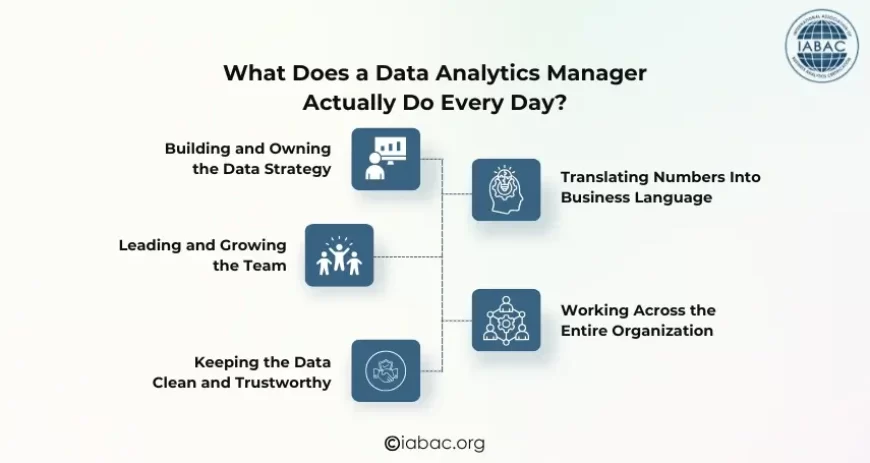
Building and Owning the Data Strategy
One of the most overlooked parts of this role is strategy. A data analytics manager isn't just reacting to requests. They're thinking ahead, asking which data the organization should be collecting, how it should be stored, and what kind of analysis will actually matter six months from now.
They develop the roadmap. They own it. And they make sure every project the team works on connects back to a real business outcome.
Leading and Growing the Team
This is where management truly lives. A good analytics manager hires thoughtfully, identifies skill gaps, reviews work for quality, and makes sure every analyst understands how their individual contribution fits the bigger picture.
Mentorship is a huge part of this role, one that rarely shows up in job descriptions but separates a good manager from a great one. If your analysts aren't growing, the team isn't growing. It's that simple.
Keeping the Data Clean and Trustworthy
Bad data leads to bad decisions. Full stop.
The analytics manager is responsible for putting processes in place that ensure the data being collected, stored, and analyzed is accurate and reliable. That includes data validation, setting quality standards, and making sure the organization stays compliant with relevant data privacy regulations — whether that's GDPR, HIPAA, or anything else applicable to the industry.
Translating Numbers Into Business Language
Here's where many technically strong analysts hit a ceiling — they can find the insight, but struggle to explain why it matters to a VP or a CFO.
A skilled analytics manager bridges that gap. They take a finding and frame it as a business opportunity or a risk. They don't just hand over a chart — they walk into a room and say, "Here's what this means for us, and here's what we should do about it."
That ability to speak two languages, data and business, is genuinely rare, and it's one of the biggest reasons analytics managers are paid what they are.
Working Across the Entire Organization
Data doesn't belong to one team. The analytics manager works with marketing, product, sales, finance, operations — whoever needs insights. That takes relationship-building skills just as much as technical ones.
The goal isn't just to produce reports. It's to make sure those reports actually influence decisions, rather than sitting in someone's inbox unopened.
The Numbers Behind the Role
If there's any doubt about how valued this role has become, the salary data makes it clear.
The average salary for a data analytics manager in the United States sits between $125,000 and $209,000 per year, with top earners reaching above $260,000. In tech-heavy companies like Meta and Google, the total compensation goes significantly higher.
Job growth in this field is projected at around 23% by 2033, according to the US Bureau of Labor Statistics, a growth rate that very few professions can match right now.
And for those thinking about upskilling, holding a relevant certification can boost your pay by 10–20% in analytics and business intelligence roles. In a competitive hiring market, that kind of edge matters.
The Skills That Actually Set Great Analytics Managers Apart
Yes, the technical foundation matters, SQL, statistical modeling, data visualization tools like Tableau or Power BI, and familiarity with big data platforms are standard expectations. But the skills that actually define great analytics managers go deeper than that.
Strategic thinking. The ability to look at a messy business problem and immediately understand what data is needed, what questions to ask, and what a useful answer would look like.
Stakeholder management. Knowing how to balance competing requests from five different departments without burning out your team or losing focus on what matters most.
Building a data culture. The best analytics managers don't just use data themselves — they teach the people around them to think more data-consciously. They make data literacy part of how the organization operates, not just something the analytics team does in the background.
Ethical judgment. This one almost never makes the list, but it's increasingly critical. As companies collect more data about customers and employees, someone has to ask the harder questions — about privacy, about fairness, about how findings might be misused. The analytics manager is often that person.
How Do You Get Into This Role?
Most people who become data analytics managers don't start there. It's a senior position, and it's earned through experience.
The typical path looks like this:
You begin as a data analyst or junior analyst, developing your technical skills and learning a specific industry. Over time, you take on project leadership — coordinating work across a small team, presenting findings to stakeholders, and managing timelines. That experience eventually opens the door to a formal management role.
Most companies expect a minimum of five years of experience in data management or analysis, with at least two to three years in some form of leadership capacity before hiring someone into this position.
From there, the path can continue upward, toward Head of Analytics, VP of Data, or even Chief Data Officer for those who want to operate at the executive level.
What Nobody Really Tells You About the Job
This is the part most job descriptions don’t prepare you for.
You're managing people who are often more technically skilled than you in specific areas. So you can't lead through technical authority alone — you lead through trust, direction, and good judgment.
You're constantly making prioritization calls. A request comes in from marketing, another from product, and your team has capacity for one. You have to decide which one gets resources now, and how to say no to the other without damaging the relationship.
You're working with data that is rarely clean and never perfect. And you're still expected to deliver reliable insights on a deadline.
Meanwhile, you're keeping one eye on the future, evaluating new tools, watching how the industry is evolving, and figuring out how your team needs to change before the business asks you why it hasn't.
It's genuinely demanding. But it's also the kind of role where you can see your work shape real decisions, and that's what keeps most people in it.
The data analytics manager role is far more layered than most people assume. It's not just about knowing your tools or running dashboards. It's about building a team that delivers insights worth trusting, creating a culture where data actually influences how the business thinks, and making sure that the work your analysts do every day connects back to something that matters.
Any organization that's serious about making good decisions needs someone in this role. Not just to manage the data — but to make it count.
If you're looking to move into this position or validate your expertise professionally, the Data Analytics Manager Certification is a globally recognized credential that can help you get there faster and stand out in a competitive job market.