








































AI Certification for Beginners: What It Is and Why You Need It in 2026
AI certification for beginners in 2026: learn benefits, career impact, skills covered, and how to choose the right certification to stay competitive.

Artificial intelligence is no longer a technology of the future — it is the operating system of the present. From healthcare diagnostics to supply chain automation, AI is reshaping every industry at a pace that has left many professionals scrambling to keep up. But here is the real question: how do you prove to an employer that you actually understand AI — not just the buzzwords, but the real skills?
That is exactly where AI certification comes in. Whether you are a student just entering the workforce, a manager trying to understand how AI affects your department, or a developer looking to specialize, an AI certification gives you a structured, credible, and globally recognized pathway to validate your knowledge. In this guide, we break down what AI certification is, who it is for, what you will learn, and why 2026 is the right time to get started.
What Is AI Certification?
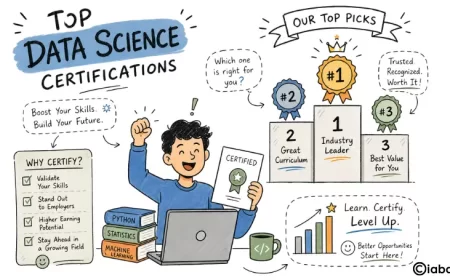
AI certification is a formal credential awarded to individuals who demonstrate competency in artificial intelligence concepts, tools, and applications — typically through a structured course followed by an examination or project-based assessment.
Unlike a general online course that gives you a completion badge, a professional AI certification is tied to a credentialing framework assessed against industry standards. For example, IABAC's certifications are built on the EDISON Data Science Framework — a body of knowledge developed under the European Commission — which means the competencies tested reflect what global employers actually expect from AI professionals.
AI Foundation vs AI Expert: What's the Difference?
IABAC offers certifications across experience levels:
-
AI Foundation Certification → is designed for beginners. It covers core AI concepts, basic machine learning principles, and how AI is applied across industries — no coding required.
-
Certified AI Expert → is an advanced credential for professionals who design, implement, and manage AI systems. It requires deeper technical and strategic knowledge.
The right level depends on where you are today and where you want to go.
Why AI Certification Matters More Than Ever in 2026
The AI skills gap is real: "AI skills shortage" →. According to the World Economic Forum, AI and machine learning roles are among the fastest-growing job categories globally, yet the supply of qualified professionals continues to lag behind demand.
Here is what that means practically: employers are actively looking for candidates who can demonstrate AI competence — not just familiarity. A certification does three things that a resume bullet point cannot:
1. It signals verified competence. Anyone can write "familiar with AI" on a CV. A certification from a globally recognized body like IABAC — with exams graded against the EDISON framework — tells a hiring manager that your knowledge has been tested and validated.
2. It gives you a structured learning path. In our experience working with thousands of certification candidates, one of the most common struggles is not knowing where to start with AI. There is an overwhelming amount of free content online, but no clear progression. A certification course gives you a curriculum designed by domain experts, so you build knowledge in the right order.
3. It accelerates career growth. Certified professionals earn significantly more on average than their non-certified peers. The credential also opens doors to roles with titles like AI Analyst, Machine Learning Engineer, AI Consultant, and Head of AI Strategy — positions that did not exist at scale five years ago.
Who Should Get an AI Certification?
One of the most persistent myths about AI is that it is only for software engineers or data scientists. This is simply not true — and it is a myth we have seen hold back excellent professionals across industries.
Here is who genuinely benefits from: AI certification courses → Students and fresh graduates entering a competitive job market need every differentiator they can get. An AI certification demonstrates initiative and future-readiness that stands out on a CV.
Working professionals in non-technical roles — HR managers, marketing leads, finance analysts, operations managers — are increasingly expected to understand how AI affects their function. The AI Foundation Certification was specifically designed to be accessible without a coding background.
Is AI Certification Worth It for Non-Technical Professionals?
Absolutely. In our experience supporting learners across industries, some of the most successful AI certification candidates come from management, consulting, and business strategy backgrounds. The goal is not to make everyone a machine learning engineer — it is to ensure every professional can work intelligently alongside AI systems, interpret AI-generated insights, and make better decisions using AI tools.
Developers and data scientists who already work in technical roles benefit from specialized certifications like the Generative AI Foundation → or NLP Expert certification, which signal depth in emerging sub-fields of AI.
Managers and executives who oversee AI adoption projects need to understand risk, ethics, and strategy — all covered at the expert certification level.
What Will You Learn in an AI Certification Course?
The exact curriculum varies by level, but a well-structured AI certification course will cover:
Foundations of AI and Machine Learning You will learn what AI actually is — not the Hollywood version, but the technical reality. This includes supervised and unsupervised learning, neural networks, decision trees, and how models are trained on data.
Real-World AI Applications AI concepts become meaningful when you see them applied. Certification programs walk through use cases in healthcare (diagnostic imaging), finance (fraud detection), retail (recommendation engines), and manufacturing (predictive maintenance).
Tools and Frameworks Depending on the level, you will be introduced to tools like Python, TensorFlow, and scikit-learn, as well as no-code AI platforms becoming common in business environments.
AI Ethics and Governance A topic that is becoming non-negotiable in 2026. You will learn about bias in AI models, data privacy regulations (GDPR, India's DPDP Act), and responsible AI deployment — knowledge that is increasingly required in enterprise environments.
How IABAC's EDISON Framework Ensures Global Recognition
IABAC's credentialing framework is built on the EDISON Data Science Body of Knowledge — a standard developed through a European Commission-funded initiative. This means IABAC certifications are not proprietary or regional. They map to internationally recognized competency standards, which is why IABAC credentials are cited in job descriptions by multinational corporations in the US, UK, Singapore, UAE, and India.
How to Choose the Right AI Certification
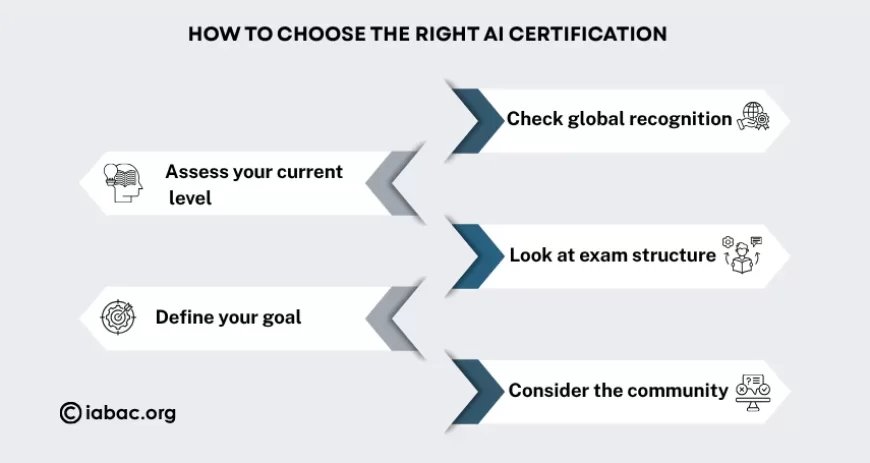
With dozens of AI certifications available in 2026, here is a straightforward framework for choosing:
Step 1 — Assess your current level. Are you starting from zero, or do you have a data or tech background? Be honest. Starting at the wrong level wastes time and money.
Step 2 — Define your goal. Do you want to switch careers into AI, upskill within your current role, or specialize in a sub-field like computer vision or NLP? Your goal determines whether you need a foundation cert or a specialist one.
Step 3 — Check global recognition. Look for certifications tied to established frameworks (EDISON, PMI, ISO) or awarded by bodies recognized by employers in your target market.
Step 4 — Look at exam structure. A credible certification has a proctored exam or project-based assessment — not just a multiple-choice quiz at the end of a video series.
Step 5 — Consider the community. IABAC members get access to global AI summits, webinars, and a professional network spanning 50+ countries — a benefit that extends far beyond the certificate itself.
What Career Opportunities Open Up After AI Certification?
Earning an AI certification is a milestone, not a finish line. Here is a realistic picture of where it can take you:
|
Role |
Typical Entry Point |
|
AI Analyst |
AI Foundation Certification |
|
Machine Learning Engineer |
Certified AI Expert |
|
AI Consultant |
Foundation + domain experience |
|
NLP Specialist |
Certified NLP Expert |
|
Computer Vision Engineer |
Certified Computer Vision Expert |
|
AI Strategy Lead |
Expert + management experience |
|
Generative AI Developer |
Generative AI Foundation + Expert |
Salaries for certified AI professionals in India range from ₹8–35 LPA depending on role and experience, with senior AI architects and strategists commanding significantly more. In the US and UK, entry-level certified AI roles start at $70,000–$90,000 annually.
The Best Time to Get AI Certified Is Now
The window to get ahead of the AI curve is still open — but it is narrowing. Every month, more professionals earn AI credentials. Every quarter, more employers add AI literacy as a baseline expectation. Getting certified today puts you on the right side of that shift.
Whether you are starting completely from scratch or looking to formalize expertise you have already built on the job, there is a certification level designed for exactly where you are.
Ready to take the first step?: Explore IABAC's AI Certification Programs → and find the right credential for your career stage.