



























































How Long Does It Take to Become a Senior Business Analyst?
Find out how long it takes to become a senior business analyst, including career stages, skills, and salary insights to plan your growth and reach senior roles.


If you're a business analyst thinking about when you'll finally earn that "senior" title or a career-changer mapping out how long this journey will take, you're asking exactly the right question.
The honest answer: Most professionals reach the senior business analyst level within 5 to 8 years of entering the field. But that range depends on several variables: your educational background, the industry you work in, how aggressively you build your skill set, and whether you're proactively managing your career path.
This guide breaks down every stage of the journey, from entry-level analyst to senior contributor, timelines, and practical steps you can act.
What Does a Senior Business Analyst Actually Do?
Before mapping the timeline, it's worth being precise about what "senior" actually means. A senior business analyst isn't just someone who's been around longer. They operate at a fundamentally different level of ownership, influence, and complexity.
Core Responsibilities at the Senior Level
-
Leading end-to-end requirements gathering for enterprise-level projects
-
Serving as the bridge between C-suite stakeholders and technical delivery teams
-
Mentoring junior analysts and reviewing their work
-
Owning the quality of business cases, process models, and solution designs
-
Driving decisions on scope, prioritisation, and business impact
At companies like Deloitte and Accenture, senior BAs are often embedded in client-facing delivery teams as subject matter authorities, not just documentation specialists. They're expected to challenge assumptions, surface risks, and advocate for user needs, all while keeping projects commercially viable.
The Typical Business Analyst Career Path
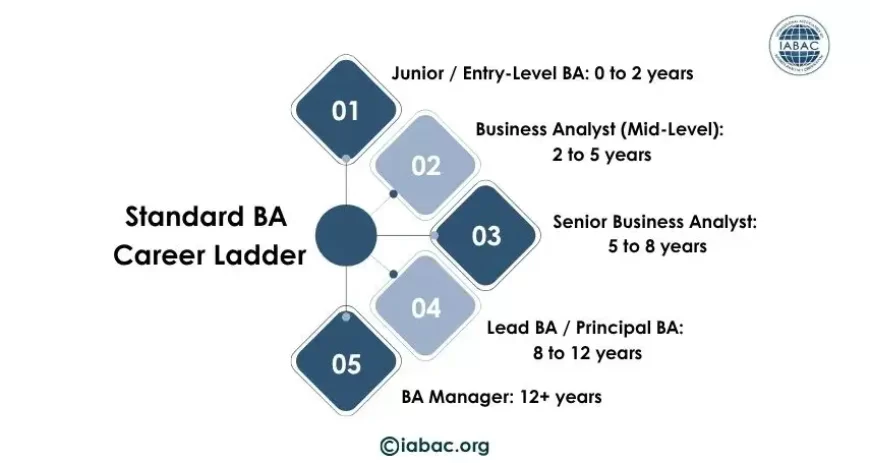
Understanding the business analyst career path within the broader field of business analytics is essential before you can estimate timelines. Most organisations use a progression that looks like this:
Standard BA Career Ladder
-
Junior / Entry-Level BA: 0 to 2 years
-
Business Analyst (Mid-Level): 2 to 5 years
-
Senior Business Analyst: 5 to 8 years
-
Lead BA / Principal BA: 8 to 12 years
-
BA Manager / Head of Business Analysis: 12+ years
Some professionals skip levels, particularly those who enter with prior domain expertise (say, a finance professional transitioning into a BA role at a bank). Others plateau mid-level if they don't actively develop leadership and strategic skills.
How Long Does Each Stage Take?
Let's be specific. The career progression isn't uniform, and each stage has its own demands.
Stage 1: Entry-Level Business Analyst (0–2 Years)
This is where you build fundamentals: process mapping, requirements documentation, stakeholder interviews, and tools like JIRA, Confluence, or Visio.
Most professionals in this stage are still learning the difference between a business requirement and a functional requirement, and that's okay.
Real-world example: A graduate joining Capgemini as a junior BA on an ERP implementation project would typically spend 18 to 24 months learning the delivery lifecycle, shadowing senior analysts, and taking ownership of smaller workstreams.
Key milestone: You're ready to move on when you can independently run a requirements workshop and produce documentation that needs minimal revision.
Stage 2: Mid-Level Business Analyst (2–5 Years)
This is where most BAs spend the bulk of their formative years. You're taking on larger, more ambiguous projects. You're being trusted with stakeholder relationships. You're starting to specialize in Agile delivery, data analytics, digital transformation, or a specific sector like healthcare or financial services.
Challenge: Many BAs stall here because they focus almost entirely on technical execution and never develop the strategic, communication, or commercial skills that differentiate a senior contributor.
Stage 3: Becoming a Senior Business Analyst (5–8 Years)
This is the inflection point. To earn a senior title, you typically need to demonstrate not just competence but leadership in complex analysis work.
Organisations like McKinsey expect senior BAs to own problem framing not just solution documentation. That distinction matters enormously in how you position yourself for promotion.
Senior Business Analyst Skills You Must Develop
Skills, not just years, are what actually earn you the promotion. Here are the capabilities that separate senior BAs from mid-level ones.
Technical and Analytical Skills
-
Advanced data analysis (SQL, Power BI, Tableau)
-
Business process modelling (BPMN), UML (Unified Modeling Language)
-
Requirements management in Agile and waterfall environments
-
Familiarity with enterprise tools (SAP, Salesforce, ServiceNow)
Strategic and Soft Skills
-
Executive stakeholder management: the ability to simplify complexity for a CFO or CTO
-
Business case development and ROI analysis
-
Workshop facilitation at a senior leadership level
-
Conflict resolution and negotiation
Certifications That Accelerate Your Path
BAs who hold a Certified Business Analytics Expert (CBAE) certification earn more than non-certified peers and reach senior roles approximately 12 months faster.
Other valuable credentials include:
-
CBAM (Certified Business Analytics for managers)
-
Agile certifications (SAFe, CSM, or PSPO)
Does Your Industry Affect How Fast You Progress?
Absolutely, and this is often underestimated.
Fast-Track Industries
Financial services, consulting, and technology tend to promote BAs faster due to high project volumes, clear internal career frameworks, and strong investment in professional development.
A BA at a major bank like HSBC or JPMorgan Chase working on digital banking transformation may reach a senior level in 4 to 5 years if they're consistently placed on high-visibility projects.
Slower Progression Environments
Public sector organisations and large legacy enterprises often have rigid banding structures where promotion cycles are tied to annual reviews rather than performance. In these environments, 7 to 9 years to the senior level is common.
Practical tip: If you're in a slow-progression environment and you're clearly performing at a senior level, don't wait for an internal title; build your external profile (through LinkedIn, speaking, or certifications) to secure a senior role at another organization.
Senior Business Analyst Salary: What to Expect
Let's talk numbers because understanding senior business analyst salary benchmarks helps you know when you're being compensated fairly and what you're working toward.
United States
According to Glassdoor's 2026 data, the average salary for a senior business analyst in the United States is $149,640 per year, with a typical pay range of $123,756 at the 25th percentile to $183,549 at the 75th percentile. Top earners reach up to $219,502 annually.
The U.S. Bureau of Labor Statistics reports the median annual wage for management analysts was $101,190 in May 2024, with the lowest 10% earning under $59,720 and the highest 10% earning over $174,140.
United Kingdom
According to IT Jobs Watch, the median senior business analyst salary in the UK is £65,000 per year, based on job vacancies posted in the six months leading to April 2026.
Robert Half's 2026 UK Salary Guide places senior business analyst salaries in London between £79,500 and £98,000.
India
Glassdoor India's March 2026 data, based on 10,274 anonymously submitted salaries, shows the average senior business analyst salary in India at ₹13,00,000 per year, with the typical range sitting between ₹9,69,500 at the 25th percentile and ₹18,71,750 at the 75th percentile. Top earners reach up to ₹27,54,000.
Australia
According to Jacinth Solutions' 2026 Australia Business Analyst Salary Guide, which cross-references data from Hays, SEEK, and market placement data, senior business analysts earn between AUD $120,000 and AUD $160,000 (base + super), with the top of the range common in Sydney and Melbourne for BAs in major banks, insurers, or tier-one consulting firms.
How to Become a Senior Business Analyst Faster
If your goal is accelerated progression, here's what the evidence and experience suggest actually works.
1. Seek Complexity, Not Comfort
The BAs who progress fastest are those who consistently volunteer for the most complex, high-stakes projects even when it's uncomfortable.
Complexity builds capability at a rate that comfortable, repetitive work simply cannot replicate.
2. Build Stakeholder Equity Early
Senior BAs are trusted advisors, not just analysts. Start building those relationships now. Ask for opportunities to present to leadership, co-facilitate steering committees, or represent your team in cross-functional governance forums.
Every senior-level exposure you accumulate before you hold the title makes the case for promoting you more compelling.
3. Certify Strategically
Don't collect certifications randomly. Choose credentials aligned to your target industry or specialization. The CBAE signals BA mastery within project environments. A Salesforce certification signals CRM domain depth.
A Power BI or Tableau certification signals data proficiency. Each credential should tell a coherent story about where you are heading, not just what you have done.
4. Build an External Professional Profile
Senior-level hiring managers regularly review Look on LinkedIn for evidence of credibility through articles, endorsements, recommendations, or consistent engagement on industry topics.
As noted in Bristow Holland's 2026 UK Business Analysis Salary report: Analysts who can demonstrate experience with complex transformation programs and strong stakeholder management command significantly higher salaries and attract more senior opportunities. Your external profile is the proof point.
Common Reasons BAs Get Stuck Before Reaching Senior Level
Knowing what slows people down is just as useful as knowing what speeds things up.
The Technical Trap
Many talented BAs become so technically proficient, brilliant at process diagrams, and impeccable at documentation that they're siloed into delivery roles and never given strategic exposure. Technical excellence is necessary but not sufficient.
Avoiding Conflict
Senior BAs challenge stakeholders, push back on unrealistic scope, and surface uncomfortable truths. If you habitually say yes to avoid friction, you're signaling junior-level judgment regardless of your years of experience.
Not Quantifying Your Impact
At performance review time, "I documented requirements for Project X" is weak. "I identified a scope gap in Project X that prevented an estimated $200K in rework costs" is senior-level framing. Get into the habit of measuring and articulating business impact.
How to Know You're Ready for a Senior Business Analyst Role
Here are concrete signals that you're operating at or near a senior level:
-
Junior BAs come to you for guidance without being asked
-
You regularly influence project direction, not just document it
-
You can run a stakeholder workshop with a VP in the room without preparation anxiety
-
Your business cases are approved with minimal revisions
-
You understand the commercial and strategic context behind every project you work on
If most of these are true, you may already be performing at a senior level even if your title hasn't caught up yet.
FAQ's
Q1: What qualifications do I need to become a senior business analyst?
A bachelor's degree in business, IT, or a related field is typical. The CBAE certification is widely recognized as the gold standard for senior-level BAs. Advanced degrees (MBA, MSc) can help but are not mandatory.
Q2: Is the senior business analyst role technical or strategic?
It's both. Senior BAs need strong analytical and technical skills, data tools, process modeling, and Agile frameworks combined with strategic thinking, executive communication, and business acumen.
Q3: Can I become a senior BA without a degree?
Yes, increasingly so. While a degree helps early in your career, employers at the senior level prioritize demonstrated experience, certifications, and proven business impact over academic credentials. Several senior BAs have transitioned from non-degree backgrounds via professional certifications and strong project portfolios.
Q4: What's the difference between a senior business analyst and a business analyst manager?
A senior BA is an individual contributor who leads complex analysis work and mentors others. A BA manager takes on formal people management responsibilities, including hiring, performance reviews, and team development, in addition to or instead of hands-on analysis work.
Q5: How do I make the jump from mid-level to senior business analyst?
Focus on three things: taking ownership of complex, high-stakes projects; developing executive stakeholder relationships; and quantifying your business impact in every performance conversation. Certifications and external visibility accelerate the process.
Becoming a senior business analyst is a 5-to-8-year journey for most professionals, but it's not a passive one. The analysts who reach that level fastest are those who deliberately seek complexity, build strategic skills alongside technical ones, and make their impact visible and measurable.
The title is a lagging indicator. Focus on performing at the senior level before the promotion arrives, and the recognition and the salary that come with it will follow.