





























































Cloud AI in 2026: The Complete Guide to AWS, Azure, and Google Cloud's Latest AI Features
WS, Azure, or Google Cloud — which AI platform wins in 2026? A complete breakdown of features, pricing, use cases & what it means for your business.

Imagine walking into a store where an AI assistant already knows what you want, helps you try it on virtually, and processes your order — all without a single human employee involved. That is not science fiction. That is what Macy's deployed in 2026 with their AI shopping concierge, "Ask Macy's." And it runs entirely on Cloud AI.
Cloud AI has crossed a threshold. It is no longer an experimental technology reserved for tech giants with massive budgets. In 2026, it is the backbone of how businesses operate, compete, and grow — from Fortune 500 companies to mid-sized startups.
But here is the challenge most people face: there are three massive Cloud AI platforms competing for your attention — AWS, Microsoft Azure, and Google Cloud — and each one claims to be the best. Which one is right for your needs? What are they actually offering in 2026? And how do you make sense of it all without a computer science degree?
This guide answers all of that. In plain English. No jargon. No hype. Just what you need to know.
What Is Cloud AI, and Why Does It Matter in 2026?
Let us start from the beginning.
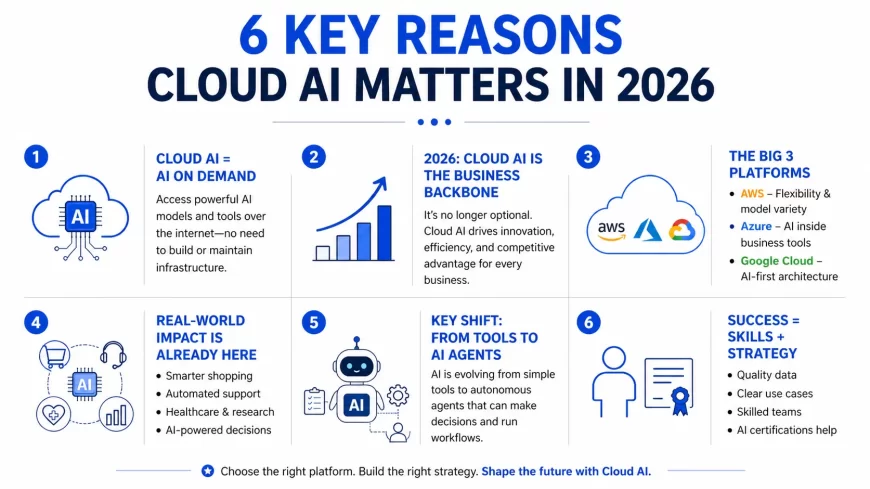
Cloud AI is the delivery of artificial intelligence capabilities — like natural language understanding, image recognition, prediction, and automation — through remote servers accessed over the internet. Instead of building and maintaining expensive AI hardware yourself, you simply connect to a cloud platform and use AI as a service.
Think of it like electricity. You do not generate your own power at home. You plug into the grid and use what you need. Cloud AI works the same way — you plug into AWS, Azure, or Google Cloud and use AI models, tools, and infrastructure on demand.
Why does this matter so much in 2026? Because the market has reached an inflection point. The global cloud infrastructure market hit $119 billion in a single quarter at the end of 2025. The technology has matured. The tools have become accessible. And the competitive gap between businesses that use Cloud AI and those that do not is widening every single month.
The Big Three: An Overview
Before diving into features, here is a quick snapshot of where each platform stands today.
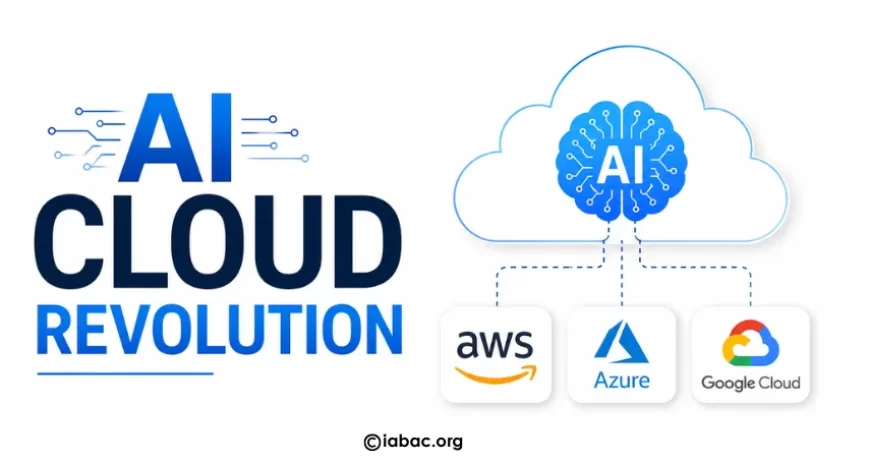
Amazon Web Services (AWS) is the market leader with 31% of the global cloud market. It has been in the game the longest, offers over 200 services, and has the largest ecosystem of third-party tools and certified professionals. Think of AWS as the most experienced player on the field.
Microsoft Azure holds 24% market share and is the enterprise favorite, largely because it plugs directly into tools that most businesses already use — Microsoft 365, Teams, Outlook, and Dynamics. If your company runs on Microsoft, Azure feels like a natural extension.
Google Cloud holds 12% market share but is growing faster than either of the others, posting 28% year-over-year revenue growth in 2025. Google's edge is its AI-first architecture — it builds everything from custom chips to end-user applications around artificial intelligence. For data-heavy and AI-native workloads, Google Cloud consistently outperforms.
Now let us go deeper into what each platform is actually offering in 2026.
AWS: The Model Marketplace Approach
Amazon's AI strategy centers on choice and flexibility. Rather than betting on a single AI model, AWS built Amazon Bedrock — a platform that gives developers API access to a wide range of foundation models from different providers. Want to use Anthropic's Claude? It is on Bedrock. Prefer Meta's Llama or Mistral? Also on Bedrock. This model-agnostic approach means you are never locked into a single AI provider.
Beyond Bedrock, AWS has made major hardware investments in 2026. Its newly launched Trainium3 AI training chips are three times faster than the previous generation, making it significantly more affordable and efficient to train large custom AI models on AWS infrastructure.
For businesses that want AI without complexity, Amazon SageMaker Canvas offers a no-code AutoML environment — you bring your business data, and the platform automatically finds the best machine learning model for your problem. No data science team required.
And for enterprises building the next generation of autonomous AI systems, AWS Agentcore is a new runtime environment specifically designed to deploy, manage, and govern AI agents at enterprise scale.
AWS is best for: Organizations that want maximum flexibility, access to multiple AI models, and a vast ecosystem of tools and integrations.
Microsoft Azure: AI Embedded in Everything You Already Use
Microsoft's strategy is elegantly simple: bring AI to where employees already are. Rather than asking people to log into a new AI platform, Azure embeds intelligence directly into the software your teams use every day.
Azure OpenAI Service gives enterprise customers access to GPT-5 — Microsoft's flagship language model in partnership with OpenAI — through a secure, enterprise-grade API. This is the same technology powering Microsoft Copilot, which is now integrated natively into Word, Excel, Teams, PowerPoint, and Outlook.
What does that mean practically? A sales manager can ask Excel to analyze last quarter's pipeline data and summarize the top risks — in plain English, without writing a single formula. A project manager can ask Teams to summarize a two-hour meeting, pull out action items, and draft follow-up emails automatically.
For businesses that want to build their own custom AI agents, Microsoft Copilot Studio provides a low-code environment to create, test, and deploy AI assistants that connect to your specific business systems.
On the hardware side, Azure has deployed NVIDIA GB300 NVL72 clusters delivering twice the prior AI performance — essential infrastructure for companies running large-scale AI training workloads.
Azure is best for: Organizations already running on Microsoft 365, Teams, or Dynamics who want AI embedded into their existing workflows with minimal disruption.
Google Cloud: The Vertically Integrated AI Machine
Google Cloud's approach is the most ambitious of the three. While AWS lets you choose your models and Azure plugs AI into Microsoft software, Google is building an end-to-end AI stack — from custom silicon at the bottom to consumer-facing applications at the top.
At the chip level, Google's TPU Ironwood — the 7th generation of its custom Tensor Processing Units — offers five times more peak compute capacity than its predecessor. Slated for wider availability in late 2026, Ironwood is specifically optimized for serving massive AI models to millions of users simultaneously.
At the platform level, Vertex AI serves as Google's unified environment for building, training, deploying, and monitoring AI models. Paired with the Gemini family of models — Google's flagship AI — Vertex AI powers everything from custom chatbots to enterprise AI agents.
One of Google's most significant 2026 launches is the Agent Development Kit (ADK), which lets developers build sophisticated AI agents backed by enterprise-grade infrastructure. What makes this notable is its support for Model Context Protocol (MCP) servers — a standard that allows AI agents from different platforms to communicate and share context, described by engineers as "USB-C for AI."
For data teams, Google's Cross-Cloud Lakehouse is a breakthrough: it can run AI queries directly against data stored in AWS or Azure — without copying or moving the data. This solves one of enterprise IT's longest-standing headaches, the inability to use one cloud's AI tools on another cloud's data.
And for business intelligence teams, Looker Dashboard Agents transform static charts and reports into interactive AI conversations. Instead of staring at a dashboard and wondering why sales dipped in March, you simply ask the dashboard — and it tells you, with context.
Google Cloud is best for: Data-intensive organizations, AI-native companies, and teams that need deep analytics capabilities or want to build sophisticated AI agents.
Head-to-Head Comparison: The Quick Reference
Here is how the three platforms stack up across the dimensions that matter most to most businesses:
Market Share and Stability: AWS leads at 31%, followed by Azure at 24% and Google Cloud at 12%. All three are financially strong and here to stay.
AI Model Access: AWS wins on variety through Bedrock's multi-model marketplace. Azure wins on depth with its exclusive GPT-5 integration. Google wins on native intelligence with Gemini built into every service.
Ease of Use: Azure wins for non-technical users, especially those already inside the Microsoft ecosystem. Google Cloud scores highest in customer satisfaction ratings at 8.5 out of 10, compared to Azure's 6.5 and AWS's 6.0.
Pricing: For AI-specific workloads, Google Cloud is consistently 5 to 10 percent cheaper than AWS or Azure. GCP also cut compute pricing by 8% across all regions in early 2026, reinforcing its value position.
Custom AI Hardware: All three now have proprietary AI chips — AWS Trainium3, Azure Maia, and Google TPU Ironwood — reducing dependency on NVIDIA and lowering long-term costs for heavy AI workloads.
Multi-Cloud Compatibility: Google leads here with its Cross-Cloud Lakehouse and a new multicloud networking partnership with AWS, with Azure expected to join later in 2026.
Real-World Examples: Cloud AI in Action Today
Understanding Cloud AI features on paper is one thing. Seeing them in action is another. Here are four real deployments from 2026 that show what is actually possible right now.
Retail — Macy's "Ask Macy's": A multimodal AI shopping assistant that handles text and image queries, recommends products, and includes a virtual try-on feature. Customers describe what they are looking for or upload a photo, and the AI curates a personalized selection. Built on Google Cloud's Gemini.
Home Improvement — Home Depot's Magic Apron: An AI phone agent that identifies customer needs in under 10 seconds and routes them to the right solution — skipping complicated phone menus entirely. Customers call with a problem; the AI diagnoses and responds before a human even picks up.
Healthcare — Highmark Health's Sidekick: An AI assistant that automates research protocols and provides AI-powered search for internal clinical and operational teams. The system delivered $27.9 million in documented value in 2025 alone.
Consumer Goods — Mars: The chocolate and food giant selected Google's Gemini Enterprise as the primary AI operating system for its entire global workforce — meaning Gemini assists employees across every function, from marketing to supply chain.
What Should Your Business Do Right Now?
If you are trying to decide where to start with Cloud AI in 2026, here is a practical framework.
Start with what you already have. If your company runs Microsoft 365 and Teams, exploring Azure Copilot features costs almost nothing and delivers immediate productivity gains. Do not rebuild your tech stack to chase a platform — meet your team where they are.
Pick one use case, not a strategy. The businesses that fail with AI try to transform everything at once. The ones that succeed pick a single high-value, low-risk use case — customer support automation, data summarization, sales forecasting — prove it works, and then expand.
Do not skip data quality. Every Cloud AI expert will tell you the same thing: AI is only as good as the data you feed it. Before deploying any AI tool, audit the quality, completeness, and organization of your data. Garbage in, garbage out — no matter how powerful the model.
Plan for governance from day one. As AI agents become more autonomous, the question of who is responsible when something goes wrong becomes critical. Define clear ownership, audit trails, and human review processes before you scale.
Use free tiers to experiment. AWS, Azure, and Google Cloud all offer free tiers with meaningful AI capabilities. Spend a few weeks experimenting before committing to a platform or a budget.
Looking Ahead: What Is Coming Next
The features available in 2026 are impressive. What is coming in the next two to three years is extraordinary.
AI agents will move from handling single tasks to running entire business processes end to end — customer onboarding, financial reporting, supply chain management — with humans reviewing exceptions rather than doing the work. Multi-cloud interoperability will improve dramatically as AWS, Azure, and Google Cloud collaborate on shared networking standards, making it easier to use the best tool from each platform without the headaches of data transfer and lock-in. And custom AI silicon from all three providers will continue driving costs down, making advanced AI accessible to smaller organizations that could not afford it just two years ago.
The cloud AI landscape is moving fast. But the fundamentals — good data, clear use cases, and thoughtful governance — remain constant.
Cloud AI in 2026 is not about picking the most advanced platform—it’s about choosing what fits your business needs and team capabilities.
Amazon Web Services offers flexibility and a strong ecosystem. Microsoft Azure integrates AI into everyday business tools. Google Cloud provides powerful AI-native infrastructure.
All three are strong and evolving fast.
But success depends on how well your team can use them. Building the right skills—through practical experience and recognized AI certifications like those from International Association of Business Analytics Certifications—can make a real difference.
The question isn’t whether to adopt Cloud AI. It’s where you start.
Here are the key sources for the blog:
Cloud Market Share Statista — Synergy Research Group https://www.statista.com/chart/18819/worldwide-market-share-of-leading-cloud-infrastructure-service-providers/
Google Cloud Q4 2025 Earnings ($17.7B, +48%) Alphabet Official SEC Filing https://s206.q4cdn.com/479360582/files/doc_financials/2025/q4/2025q4-alphabet-earnings-release.pdf
Microsoft + OpenAI Partnership Microsoft Official Blog https://blogs.microsoft.com/blog/2025/10/28/the-next-chapter-of-the-microsoft-openai-partnership/
Google Ironwood TPU (7th Gen) Google Official Blog https://blog.google/innovation-and-ai/infrastructure-and-cloud/google-cloud/ironwood-tpu-age-of-inference/
Ransomware 22-Second Handoff Google M-Trends 2026 Report https://cloud.google.com/blog/topics/threat-intelligence/m-trends-2026