
















































AI Certification in 2026: Does It Really Help You Get a Job?
Wondering if an AI certification is worth it in 2026? Get an honest, data-backed answer with real examples, audience-specific advice, and what gets you hired.

Yes, AI certification can help you get a job — but in 2026, it functions more like an entry pass than a golden ticket. Alone, it opens a door. Combined with real projects, documented skills, and the ability to explain your thinking clearly, it becomes a genuine career accelerator. The devil, as always, is in the details.
Why AI Certification Has Become So Complicated
The Explosion That Created the Confusion
Five years ago, the AI certification landscape was relatively simple. A handful of vendor certifications from major cloud providers. A small number of academic credentials from established universities. A nascent but recognizable set of professional designations from established credentialing bodies.
Then the generative AI wave hit, and the market transformed almost overnight.
Between 2023 and 2026, the number of organizations offering AI-related credentials grew by an estimated 400%. Every major learning platform launched AI certification tracks. Every major technology company expanded its certification portfolio. Hundreds of new providers — bootcamps, private training institutes, professional associations, content creators — entered the market with credentials ranging from genuinely rigorous to essentially fraudulent.
The professionals navigating this market in 2026 face a landscape that is categorically more complex than the one that existed even two years ago. The frameworks that experienced practitioners use to evaluate certifications have not kept pace with the market's expansion. And the guidance available to professionals making these decisions is frequently written by people with financial relationships with the providers they are recommending.
Why Employers Are Increasingly Skeptical
The certification explosion has had a predictable effect on employer perception: as the supply of credentialed candidates has increased dramatically, the signal value of credentials has decreased significantly.
Hiring managers who reviewed resumes in 2021 rarely saw AI certifications. Those reviewing resumes in 2026 see them on almost every application. The credential that distinguished a candidate two years ago is table stakes today — and in many cases, a credential of uncertain rigor is actively neutral, signaling nothing about the candidate's actual capability.
This does not mean certifications are worthless. It means the certification market has stratified — and navigating that stratification correctly, by choosing credentials that retain genuine signal value, is more important than it has ever been. The difference between a credential that helps and a credential that is ignored is not always large in terms of time or money invested. But in terms of career impact, it can be enormous.
The Regulatory Dimension
A development that has significantly affected the AI certification landscape since 2025 is the regulatory enforcement of the EU AI Act and the emergence of equivalent frameworks in other jurisdictions. These regulations have created genuine compliance requirements around AI competency — requirements that are beginning to translate into demand for specific, verifiable credentials that demonstrate regulatory knowledge alongside technical competency.
For professionals working in regulated industries or targeting roles with AI governance responsibilities, this regulatory dimension is not peripheral. It is increasingly central to which credentials carry weight and which do not.
01. Why This Question Matters More Than Ever
Artificial Intelligence has moved from buzzword to baseline. In 2026, nearly every sector — from finance to healthcare to logistics — is integrating AI into its core operations. Naturally, the demand for AI-capable workers has surged. And with that surge has come an explosion of certifications, bootcamps, credentials, and courses, all promising to make you "AI-ready."
The result? A flooded market. Hiring managers now see hundreds of resumes from candidates who all claim to have "completed AI training." The credential that once set you apart is increasingly becoming table stakes — a minimum, not a differentiator.
So the real question isn't "Should I get certified?" — it's "Which certification, and then what?"
"In 2026, the AI job market doesn't have a skills shortage — it has a proof-of-skills shortage. Employers aren't struggling to find candidates with certificates. They're struggling to find candidates who can actually demonstrate competency."
What the data shows:
-
73% of hiring managers say they value demonstrated AI projects over certificates when shortlisting candidates (LinkedIn Workforce Report, 2025)
-
Candidates who pair a certification with a public portfolio receive 4× more interview callbacks than those with a certificate alone
-
68% of AI roles posted in Q1 2026 listed "portfolio or GitHub" as a preferred or required element in applications
02. The Landscape: Not All Certifications Are Created Equal
One of the most common mistakes job seekers make is treating all AI certifications as interchangeable. They are not. The source, rigor, and relevance of a certification dramatically affects how employers perceive it.
Type 1 — Big Tech Certifications (Google, AWS, Microsoft, IBM) Issued by large technology companies, these credentials are tightly aligned with specific platforms and real industry workflows. They carry significant brand weight and are particularly valued in technical and cloud-heavy roles. If your target role involves a specific cloud platform, the corresponding vendor certification is often the most direct signal you can send.
Type 2 — Board & Association Certifications (IABAC, AAAI, IAPP) Independent bodies that focus on structured assessment standards and global credibility. Unlike course-completion badges, these typically require passing proctored exams and demonstrate validated competency — a meaningful differentiator in credibility. Worth considering if you want a credential that signals professional-grade validation rather than course completion.
Type 3 — Educational Platform Certifications (Coursera, edX, Udemy, DeepLearning.AI) Hosted on learning platforms, often offered by universities or companies. Highly accessible and affordable, making them an excellent starting point. Quality control varies significantly between providers, so research the specific course carefully — a credential from Andrew Ng's DeepLearning.AI carries more weight than a generic platform badge.
Type 4 — Bootcamps & Private Institutes Intensive, fast-track programs ideal for career changers who need structured learning environments. Outcomes vary dramatically. The best programs offer job placement support and industry mentors; the worst are essentially paid courses with a badge at the end. Always research graduate employment outcomes before committing.
Key Insight: The most credible certifications in employers' eyes share a common feature — they require you to prove knowledge under controlled assessment conditions, not merely complete a series of video lessons. When evaluating any certification, ask: "Is there a rigorous, proctored exam? Can this credential be independently verified?"
03. What Employers Actually Look For in 2026
The hiring process for AI roles has matured considerably. Early-stage AI hiring was often chaotic — employers weren't sure what to look for, so credentials acted as proxies. Today, most technical teams have refined their evaluation criteria significantly.
Then (2022–2023) vs. Now (2026):
|
What Was Prioritized |
What's Prioritized Now |
|
Certificate from a known platform |
Demonstrated project portfolio |
|
Number of courses completed |
Depth of understanding in 1–2 areas |
|
Familiarity with AI concepts |
Ability to solve real business problems |
|
Theoretical knowledge |
Tool proficiency + communication of results |
|
LinkedIn badge |
Verifiable assessment + GitHub/portfolio link |
This doesn't mean certifications are irrelevant — far from it. What it means is that employers now use certifications as a filter, not a final verdict. They'll glance at your credential to confirm baseline knowledge, then immediately pivot to: "Tell me about something you've actually built."
04. The Assessment Integrity Problem — and Why It Matters
Here's something the broader conversation about AI certification almost never addresses seriously: the credibility gap created by low-stakes, no-assessment certifications.
In an era where AI tools can help anyone pass an online quiz or generate convincing project write-ups, employers have grown increasingly skeptical of credentials that don't include rigorous, proctored assessment. The market is quietly bifurcating:
High-Trust Certifications include proctored exams, anti-cheating platforms, live assessments, or practical problem-solving under supervised conditions. These are increasingly valued because they provide genuine signal about candidate ability. Employers know that if you hold one of these, you actually earned it.
Low-Trust Certifications are course-completion badges, unproctored online quizzes, or credentials obtained by simply watching videos and clicking "next." These are increasingly discounted by sophisticated hiring teams — not because the learning is bad, but because the credential is unverifiable.
The implication for job seekers is practical: when choosing a certification, prioritize programs where you have to truly earn the credential. The momentary discomfort of a rigorous exam translates directly into a more credible signal for employers.
"A certification that's easy to get is also easy to dismiss. If everyone can get it, it tells employers nothing about who is actually competent."
05. The Three-Part Framework That Actually Gets You Hired
Based on patterns in current hiring data and what top AI employers consistently report, candidates who land jobs in 2026 are following a three-part playbook — not just collecting credentials.
Part 1 — Choose One Strong, Verifiable Certification
Pick a certification with genuine assessment rigor — ideally from a big tech company aligned to your target role, or a board-backed credential with strict examination standards. Depth over breadth. One excellent certification beats five mediocre ones every time. Resist the temptation to "just do one more course" before applying.
Part 2 — Build 2–3 Real, Documented Projects
Use public datasets (Kaggle, UCI, government open data). Solve genuine problems: churn prediction, NLP classification, recommendation systems, computer vision applications. Host everything on GitHub with clear, well-written READMEs. Include your methodology, results, and what you would improve with more time. Employers actually read READMEs — they're looking at how you think, not just what you built.
Part 3 — Master the Art of Explaining Your Work
This is the step most candidates skip, and it is the most important one. Practice articulating: what problem you solved, why you chose your approach, what the results were, and what the limitations are. If you can do this clearly and confidently in an interview, you will stand out from the majority of candidates who can show their work but can't explain it.
Do This:
-
Choose a certification with proctored, rigorous assessment
-
Build at minimum one end-to-end project (not just a tutorial notebook)
-
Host your work publicly — GitHub, a portfolio site, or both
-
Learn the core stack your target employers actually use
-
Practice one-minute project explanations out loud — record yourself, refine, repeat
Stop Doing This:
-
Collecting multiple low-quality certifications hoping quantity compensates
-
Submitting resumes without at least one concrete project link
-
Relying on theory knowledge alone — employers test application, not memorization
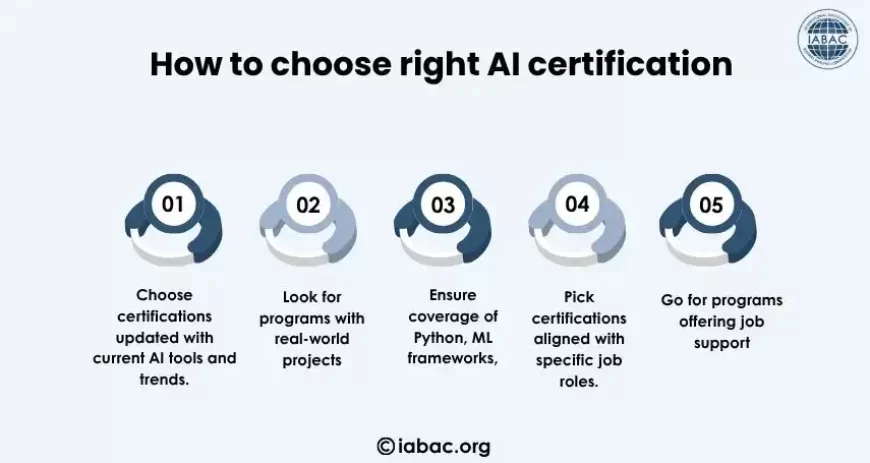
06. Tailored Advice Based on Where You Are Right Now
Context matters enormously. The right strategy for a final-year student is completely different from the right strategy for a marketing manager looking to pivot into AI.
If You're a Student: Complete one rigorous certification during your penultimate year. Focus your projects on your domain of interest — finance AI, health AI, retail AI — because domain specificity sets you apart. Contribute to open source, even in small ways. Apply early; internships convert to full-time offers far more often than most students realize. Build in public: write about what you're learning on LinkedIn or a personal blog.
If You're a Working Professional: Choose a certification that's directly relevant to your industry vertical — this is a significant advantage over generalist candidates. Apply AI to your current role, even in small, experimental ways, and document those use cases. Your existing domain expertise is not a liability — it's a genuine differentiator that pure AI candidates don't have. Use it.
If You're Actively Job Hunting: Stop adding certifications and start completing one strong portfolio project. Tailor your portfolio specifically to the role you're applying for. Move your "projects" section above your certifications section on your resume — that's what employers actually want to see first. Practice explaining each piece of work in under 90 seconds. Apply broadly, but follow up specifically and personally.
07. The Tools That Actually Matter: Build the Right Stack
No certification alone teaches you the tools employers use day-to-day. Alongside your credential, develop genuine proficiency in the core AI practitioner stack:
Python — Non-Negotiable The lingua franca of AI and machine learning. You need to be fluent, not just familiar. Focus on pandas, numpy, scikit-learn, and at least one deep learning framework. PyTorch is preferred in research contexts; TensorFlow remains strong in production environments.
SQL — Underrated and Essential Almost every real AI project starts with querying a database. SQL fluency separates candidates who can work in real business environments from those who can only work with pre-cleaned Kaggle datasets. This skill is consistently underestimated by new entrants and consistently valued by hiring teams.
Cloud Platforms — At Least One, Deeply AWS (SageMaker), Google Cloud (Vertex AI), or Azure (Machine Learning Studio). Pick one and get genuinely comfortable with it. Vendor certifications from these providers directly validate this skill, making cloud certs particularly high-value for technical roles.
MLOps Fundamentals Knowing how to train a model is table stakes. Knowing how to deploy, monitor, and maintain it in production is what separates junior candidates from mid-level ones. Explore MLflow, DVC, and basic Docker/container knowledge. Even a surface-level understanding here puts you ahead of most certificate-only candidates.
Final Takeaway: The Honest Summary
AI certifications in 2026 are neither useless nor sufficient. They serve a specific function in the hiring process — they signal baseline knowledge and professional intent. But the employers making the best hires are not selecting on certificates. They're selecting on demonstrated ability, clear communication, and the judgment to choose the right tool for the right problem.
The candidates landing roles are those who treat certification as the beginning of their professional development journey, not the end. They use their certified knowledge to fuel real projects, document their thinking clearly, and walk into interviews ready to show — not just tell.
The 2026 Formula: Rigorous Certification + Real Projects + Clear Communication = Consistent Job Opportunities
The good news: this is entirely within your control. Pick the right certification. Build something real. Learn to explain it with confidence. That combination, in 2026, remains genuinely powerful — and genuinely rare.
This guide has intentionally avoided recommending specific certification providers. The right choice depends on your industry, role, budget, and career stage. What matters far more than the brand on your certificate is the rigor of its assessment and how you use the knowledge you gain. Do your own research, verify the assessment standards, and choose accordingly.
Recommended Next Blog
"How to Switch to an AI Career in 2026 — Even If Your Background Has Nothing to Do With Tech"