




























































Certifications that Increase Data Analyst Jobs Salary?
Learn which certifications can increase a data analyst’s salary, including Google, Microsoft, AWS, and IBM credentials that improve skills and job opportunities.


Today, numbers run the world. From tracking sales to understanding customer behavior, businesses rely on data. But just having data isn’t enough. You need people who can understand it, make sense of it, and explain it in a way that helps companies make decisions. That’s where Data Analytics Certifications come in. They can boost your data analyst jobs salary significantly.
Why Certifications Are Important
Think of certifications like proof that you really know your work. Employers like to see evidence that someone can handle data well. Certifications from trusted sources like IABAC show that you have the skills. They not only make you more credible but also often lead to a higher data analyst jobs salary.
A 2024 survey shows that certified analysts earn around 20–35% more than analysts without certification. Just having a certificate can make a big difference.
Popular Data Analytics Certificate Programs
IABAC offers structured data analytics certificate programs for professionals who want to grow. Here are some certifications that can help you earn more:
- Certified Data Analyst
- Focus: Basic data analytics skills, data visualization, and statistics.
- Effect: Certified analysts can work faster and provide better insights, leading to higher pay.
- Advanced Data Analytics Professional
- Focus: Advanced Excel, SQL, Python, R, and applying machine learning.
- Effect: Prepares you for senior analyst roles with bigger salaries.
- Business Analytics Specialist
- Focus: Using data to make business decisions, KPI analysis, reporting.
- Effect: Bridges the gap between data and business, which often means higher pay.
- Data Analytics Executive Certification
- Focus: Using data strategically across an organization.
- Effect: Prepares you for leadership roles, which usually come with higher salaries.
These certifications from IABAC are recognized globally, so your credentials matter whether you are in New York, London, or Mumbai.
How Certifications Affect Salary
The more skills you can prove, the more employers are willing to pay. Here’s a simple example:
- Entry-level analyst (no certification): $50,000/year
- Certified Data Analyst: $60,000/year (+20%)
- Advanced Data Analytics Professional: $70,000/year (+40%)
- Business Analytics Specialist: $75,000/year (+50%)
- Data Analytics Executive Certification: $85,000/year (+70%)
This shows that certifications can have a strong impact on your data analyst jobs salary.
Other Benefits of Certification
Certifications are not only about money. They also provide:
- Confidence: You can explain complex datasets easily.
- Recognition: Become the go-to person in your team.
- Global Opportunities: A certificate from IABAC is valued worldwide.
- Skill Validation: Shows you know important tools like SQL, Python, Excel, Tableau, and Power BI.
Skills That Increase Salary
Certified analysts often have these valuable skills:
- Data Cleaning and Preparation: Make messy data ready for analysis.
- Statistical Analysis: Understand correlation, regression, and probabilities.
- Data Visualization: Create charts, dashboards, and graphs that explain insights.
- SQL and Databases: Manage and query data efficiently.
- Programming (Python/R): Analyze large datasets and automate tasks.
- Business Knowledge: Know which metrics are most important for decision-making.
Think of it like baking a cake: the right recipe and presentation make all the difference. Certifications help you get both.
A Truth About Non-Certified Analysts
Many analysts say, “I can do everything in Excel,” but struggle with SQL or visualization tools. This can affect their pay. Certifications prevent this by proving your skills.
Average Salaries Worldwide
Here’s a look at data analyst jobs salary around the world in 2025:
|
Country |
Certified Salary |
Non-Certified Salary |
|
USA |
$75,000 |
$55,000 |
|
UK |
£55,000 |
£42,000 |
|
Canada |
CAD 70,000 |
CAD 50,000 |
|
India |
₹900,000 |
₹600,000 |
|
Australia |
AUD 85,000 |
AUD 60,000 |
Certified analysts consistently earn 25–35% more worldwide.
Choosing the Right Certification
Here’s how to pick the right data analytics certificate program:
- Global Recognition: Make sure it is accepted worldwide, like IABAC.
- Career Goals: Choose the certification that fits the role you want.
- Practical Skills: Learn tools like SQL, Python, Tableau, and Power BI.
- Industry Relevance: Check if it includes business analytics, statistics, and decision-making.
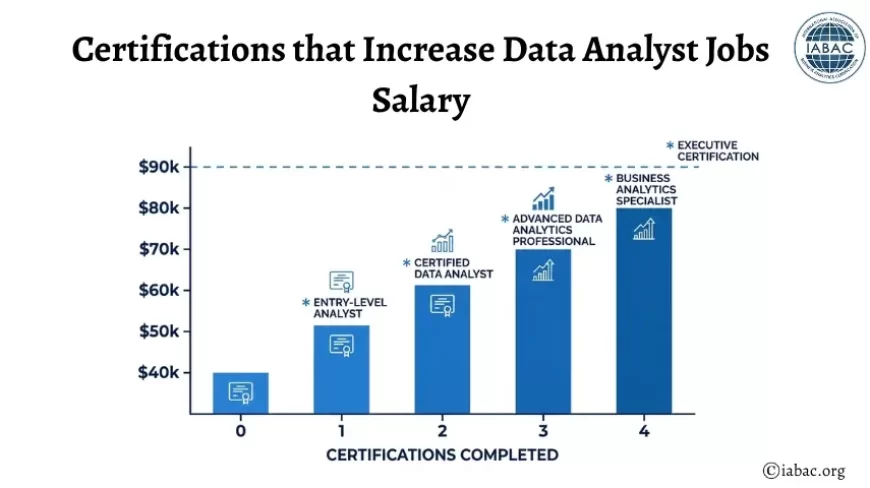
This shows a clear trend: more certifications, higher pay.
Combining Certification With Experience
Experience plus certification is powerful:
- 2 years experience + Certified Data Analyst → $65,000
- 5 years + Advanced Data Analytics Professional → $85,000
- 7 years + Executive Certification → $100,000+
Learning Tips
- Hands-On Practice: Work on real datasets.
- Mini Projects: Make dashboards, reports, or predictive models.
- Visualization Tools: Learn Tableau or Power BI.
- Simple Math: Focus on mean, median, regression, correlation for practical use.
Future Outlook
Automation and AI are growing, but human insight is key. Certified analysts who can interpret and advise will continue to earn higher salaries.
How to Prepare for Data Analytics Certifications and Boost Your Salary
Getting certified is just the first step. To really benefit from data analytics certificate programs and increase your data analyst jobs salary, you need a proper preparation strategy. Preparation helps you not just pass exams but also apply your skills in real work situations.
Step 1: Understand the Certification Requirements
Every certification from IABAC has its own focus areas. Before starting, know what topics will be tested:
- Core analytics skills: Statistics, probability, and data visualization.
- Technical tools: SQL, Python, R, Excel, Tableau, Power BI.
- Business insights: Understanding KPIs, trends, and decision-making.
Reading the syllabus carefully saves time and ensures you focus on what matters most.
Step 2: Create a Study Plan
Divide your preparation into small, manageable tasks:
- Daily Practice: Spend 1–2 hours on coding and data analysis exercises.
- Weekly Goals: Complete a mini project or a case study.
- Revision Time: Dedicate the last week to reviewing concepts and practicing sample tests.
A study plan keeps you organized and reduces stress.
Step 3: Hands-On Experience
Theory is not enough. Apply what you learn on real datasets:
- Use Kaggle competitions or open datasets.
- Create dashboards with Tableau or Power BI.
- Analyze business datasets to practice reporting and insights generation.
This experience also improves your interview readiness and makes your resume stronger.
Step 4: Join Study Groups and Online Communities
Learning in isolation can be slow. Join forums or LinkedIn groups focused on Data Analytics Certifications. You can:
- Ask questions and clarify doubts.
- Share projects and get feedback.
- Stay updated on new trends and tools.
Step 5: Practice Exam Questions
Try mock tests and previous exam questions. This helps you:
- Understand the exam pattern.
- Manage time during exams.
- Identify weak areas to focus on.
Step 6: Focus on Soft Skills
Certification is important, but soft skills make you stand out:
- Communication: Explaining insights clearly to non-technical people.
- Problem Solving: Using data to make practical recommendations.
- Presentation: Creating reports and dashboards that are easy to understand.
These skills often directly impact your data analyst jobs salary.
Step 7: Plan Post-Certification Application
After certification:
- Update your LinkedIn and resume with the certification.
- Apply to higher-paying positions or negotiate a raise.
- Take on challenging projects that show off your skills.
Certifications combined with practical experience can significantly boost your earnings.
Getting certified through IABAC is not just learning; it’s about growing your career and increasing your data analyst jobs salary. Certified analysts get noticed, trusted, and rewarded. Pick the right program, gain the skills, and watch your career—and your paycheck—grow.