























































Why companies cannot survive without business data analyst?
Business data analysts help companies turn data into insights improve decisions track performance and support strategic growth in competitive markets.

Imagine running a company without knowing what your customers want, which product is selling, or why your website visitors leave in 5 seconds. Sounds risky, right? That’s exactly what happens when businesses ignore data.
Today, companies don’t fail because they lack ideas—they fail because they lack understanding. And that understanding comes from one key role: the business data analyst. From small startups to global brands, every organization depends on data to make decisions. Without it, they are simply guessing. And in today’s competitive world, guessing is expensive.
What is a Business Data Analyst?
A business data analyst is someone who studies data and turns it into useful insights. They help companies answer questions like:
- Why are sales dropping?
- Which marketing campaign is working?
- What do customers really want?
- Where is the company losing money?
They don’t just look at numbers—they tell a story using data.
Why Data is the Backbone of Every Company
Every action in a business creates data:
- Customer clicks on a website
- Purchases made online
- Social media engagement
- Customer feedback
- Sales performance
This data is valuable. But without someone to analyze it, it’s just noise.
This is where Business Analytics plays a major role. It helps companies turn raw data into smart decisions.
What Happens When Companies Ignore Data?
Let’s look at a simple example.
A company launches a product and spends $50,000 on marketing. But they don’t track:
- Who clicked the ads
- Who bought the product
- Why others didn’t
Result? They keep spending money without knowing what works.
Now imagine the same situation with a business data analyst:
- They track user behavior
- Identify best-performing channels
- Improve targeting
Result? Higher sales, lower cost, better growth.
Real-Life Impact of Data Analytics
Let’s take a simple scenario:
An e-commerce company notices a drop in sales.
Without Data Analyst:
- They guess it’s due to pricing
- They reduce prices
- Profit drops further
With Data Analyst:
- They analyze website data
- Find that users leave at checkout
- Discover a payment issue
Fixing that issue increases sales by 30%.
That’s the power of Data Analytics.
Data is Everywhere: A Simple Breakdown
Here’s how data flows in a business:
|
Area |
Data Collected |
|
Marketing |
Clicks, impressions, conversions |
|
Sales |
Revenue, product performance |
|
Customer Support |
Complaints, feedback |
|
Website |
Traffic, bounce rate, session time |
A business data analyst connects all these dots.
Simple Math That Shows Why Data Matters
Let’s say:
- Website visitors = 10,000
- Conversion rate = 2%
- Sales = 200
Now, a data analyst improves the conversion rate to 3%.
- New sales = 300
That’s a 50% increase without increasing traffic.
This is why companies invest in Business Analytics.
How Companies Use Data to Survive and Grow
1. Better Decision Making: Companies no longer rely on guesswork. Data gives clear direction.
2. Understanding Customers: Data shows what customers like, dislike, and expect.
3. Cost Reduction: Data helps find wasteful spending.
4. Risk Management: Companies can predict risks before they happen.
5. Competitive Advantage: Businesses using data grow faster than those who don’t.
Graph Explanation: Data vs Growth
Imagine a simple graph:
- X-axis = Time
- Y-axis = Revenue
Two lines:
- Company A (no data use) → slow growth
- Company B (uses data analytics) → steady upward growth
Over time, the gap becomes huge.
That’s the difference data makes.
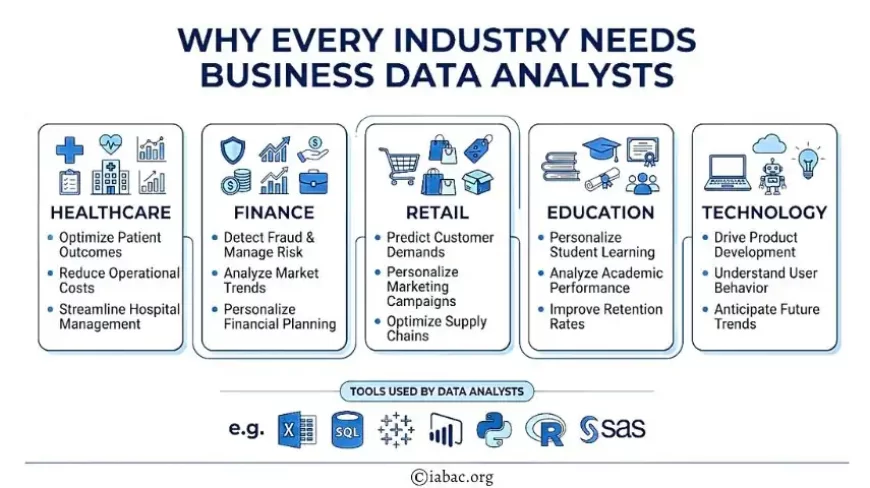
Why Every Industry Needs Business Data Analysts
Healthcare
In healthcare, data analysts help improve patient care. By studying patient records and treatment results, hospitals can understand what treatments work best. Data Analytics can also help predict disease trends and possible outbreaks, allowing healthcare providers to prepare in advance and provide better care to patients.
Finance
In the finance industry, data analysts help detect fraud and manage financial risks. By analyzing transaction data, banks can identify unusual activities and stop fraud quickly. Analytics also helps financial institutions make better investment decisions and manage customer credit risk.
Retail
Retail companies use data analytics to understand customer buying patterns. By analyzing what customers buy and when they buy it, businesses can improve marketing strategies and offer the right products. Data analytics also helps retailers manage inventory so that popular products are always available.
Education
In education, data analytics helps improve learning outcomes. Schools and universities analyze student performance data to understand learning patterns. This helps teachers identify students who need extra support and improve teaching methods to help students succeed.
Technology
Technology companies rely on data analytics to improve their products and services. By studying user behavior and feedback, companies can optimize their products and create better user experiences. This helps them build more efficient and user-friendly technologies.
The Emotional Side of Data
Behind every number, there is a human story.
- A customer leaving your site means a lost opportunity
- A failed product means wasted effort
- A bad experience means a disappointed user
A business data analyst helps companies understand these moments and improve them.
Why Companies Cannot Survive Without Data Analysts
Let’s be honest—running a business without data today is like driving with your eyes closed.
Here’s what companies lose without analysts:
- Clear direction
- Customer understanding
- Profit opportunities
- Competitive edge
And eventually, they lose their place in the market.
The Growing Demand for Data Analysts
The demand for data professionals is increasing worldwide.
Key trends:
- Companies are hiring more analysts
- Salaries are increasing
- Remote opportunities are growing
This makes it a great career choice.
Skills Required to Become a Business Data Analyst
To succeed in this field, you need:
- Excel
- SQL
- Python (basic level)
- Data visualization tools (Power BI, Tableau)
- Critical thinking
- Communication skills
Why Certifications Matter
Learning skills is important, but proving them is equally important.
This is where Data Analytics Certifications help.
They:
- Validate your skills
- Improve job chances
- Increase credibility
- Help you stand out
Platforms like IABAC (International Association of Business Analytics Certifications) provide globally recognized certifications that prepare you for real-world challenges.
Mentioning the domain naturally: Many professionals explore programs through iabac.org to build strong careers in Business Analytics.
Step-by-Step Career Path
Step 1: Learn Basics: Start with data concepts and tools.
Step 2: Practice: Work on real datasets.
Step 3: Build Projects: Create a portfolio.
Step 4: Get Certified: Choose relevant Data Analytics Certifications.
Step 5: Apply for Jobs: Start with entry-level roles.
Common Mistakes Companies Make Without Data Analysts
- Making decisions based on assumptions
- Ignoring customer feedback
- Not tracking performance
- Wasting marketing budget
These mistakes can cost millions.
Marketing Without Data
Company spends $10,000 on ads.
Without Data:
- No tracking
- No optimization
- Low returns
With Data:
- Track best ads
- Improve targeting
- Increase ROI
Even a small improvement can double profits.
How Data Builds Strong Companies
Companies that use data:
- Grow faster
- Make better decisions
- Keep customers happy
- Reduce losses
Companies that don’t?
They struggle to survive.
Future of Business Data Analysts
The future looks strong for this role.
- AI and automation will increase data usage
- More companies will depend on analytics
- Demand for skilled analysts will continue to rise
This is not just a trend—it’s a necessity.
Data is not optional—it’s essential.
A business data analyst is not just a role; it’s the backbone of modern business decisions.
Without data:
- Companies guess
- Mistakes increase
- Growth slows
With data:
- Decisions improve
- Profits grow
- Businesses succeed
For anyone planning a career, learning Data Analytics and Business Analytics is one of the smartest choices today. With the right skills and Data Analytics Certifications, you can become the person every company needs. Because at the end of the day, companies don’t just run on products or services—they run on decisions. And good decisions always come from data.