

















































Artificial Intelligence Syllabus from Basics to Advanced
Learn AI step by step from Python basics to deep learning, NLP & cloud tools. Follow this complete AI syllabus and get job-ready with IABAC certification.

Most people who want to learn AI don't fail because they lack intelligence. They fail because no one handed them a map.
They watch one YouTube tutorial, enroll in a random course, then spend months learning things in the wrong order and still can't answer a basic interview question.
By the end of this post, you will have a clear, stage-by-stage AI syllabus of what to learn, in what order, how deep to go, and which tools to use. This works whether you come from an IT background or none at all.
Why Most AI Learners Get Stuck Before They Start
I have reviewed hundreds of AI learning journeys Students, IT professionals, and career switchers alike.
The most common pattern? They skip the fundamentals and jump straight to deep learning. Then they hit a wall they don't understand, lose confidence, and quit.
According to the World Economic Forum's Future of Jobs Report 2023, AI and machine learning specialists rank among the top five fastest-growing roles globally. That means the demand is real but so is the competition. The learners who get hired are not the ones who watched the most videos. They are the ones who built their knowledge in the right sequence and proved it with projects.
Stage 1: Build the Foundation
Step 1: Start with Python for AI
Before touching any AI concept, get comfortable with Python. It is the language of AI not because it is perfect, but because the entire ecosystem is built around it.
Focus on: variables, loops, functions, lists, dictionaries, NumPy, and Pandas.
You do not need to master software engineering. You need to be able to read data, manipulate it, and pass it into a model. That is it at this stage.
What you should see after this step: You can load a CSV file, clean it, and run basic descriptive statistics without looking at documentation every five minutes.
Step 2: Mathematics Essentials
You do not need a PhD in math. But you do need:
-
Linear algebra (vectors, matrices, dot products)
-
Statistics (mean, variance, distributions, probability)
-
Calculus basics (what a derivative means not how to solve complex integrals)
Step 3: Introduction to Artificial Intelligence
Cover: what AI is, what it is not, the difference between AI, machine learning, and deep learning, the history of AI, and real-world AI applications across industries.
This stage matters more than most courses admit. A clear mental model of how AI systems learn will anchor everything you study afterwards.
Stage 2: Machine Learning Core
Step 4: Supervised Learning
Topics: linear regression, logistic regression, decision trees, random forests, support vector machines.
For each algorithm, I recommend learning three things: what problem it solves, what data it needs, and where it breaks down. Most courses teach the first. The best practitioners know all three.
Step 5: Unsupervised Learning
Topics: k-means clustering, hierarchical clustering, PCA (dimensionality reduction), anomaly detection.
What you should see after this step: You can take an unlabelled dataset and segment it into meaningful groups. A simple customer segmentation project is a perfect exercise here.
Step 6: Data Preprocessing and Feature Engineering
In my experience, 60–70% of time on any AI project goes into data cleaning and feature preparation. Raw data is almost never ready for a model. Learning to handle missing values, encode categorical variables, normalise features, and engineer new ones from existing columns is not optional, it is the job.
Step 7: Model Evaluation Techniques
Topics: train-test split, cross-validation, confusion matrix, precision, recall, F1 score, ROC-AUC.
A model is only as trustworthy as how you measure it. I have seen teams deploy models with 95% accuracy that were practically useless because the metric did not match the business problem. Learn this step with that in mind.
Stage 3: Deep Learning and Specialisations
Step 8: Neural Networks Basics
Start with the perceptron. Understand forward propagation and backpropagation intuitively before implementing them.
Then build a simple neural network from scratch in Python with no libraries. Once, and once only. After that, use frameworks. But doing it once manually will cement your understanding in a way that no amount of watching will.
Step 9: Deep Learning Concepts
Topics: activation functions, dropout, batch normalisation, optimisers (SGD, Adam), overfitting and regularisation.
Framework: Start with TensorFlow or PyTorch. Both are industry-standard. I personally use PyTorch for research-style work and TensorFlow for production pipelines but for learning, pick one and go deep before switching.
Step 10: Natural Language Processing (NLP)
Topics: tokenisation, word embeddings (Word2Vec, GloVe), sequence models, transformers, BERT basics, text classification, sentiment analysis.
NLP is one of the highest-demand specialisations right now. According to Statista, the NLP market is projected to reach over $43 billion by 2025 which means organisations across every sector are actively hiring for these skills. If you are choosing a specialisation, NLP has one of the clearest career paths.
Step 11: Computer Vision Fundamentals
Topics: image classification, convolutional neural networks (CNNs), object detection (YOLO, Faster R-CNN basics), image segmentation.
Start with the classic MNIST handwriting dataset, then work up to real image classification tasks.
Step 12: Reinforcement Learning Basics
Topics: agents, environments, rewards, Q-learning, policy gradients.
This is genuinely complex. I recommend treating this as an introduction rather than a mastery goal at this stage unless you are specifically targeting robotics or gaming AI roles.
Stage 4: Advanced Topics and Tools
Step 13: Generative AI Basics
Topics: GANs (Generative Adversarial Networks), VAEs, large language models, prompt engineering, fine-tuning pre-trained models.
Generative AI is no longer a niche topic. Understanding how these models work, not just how to use them, will separate you from the majority of applicants who only know the surface layer.
Step 14: AI Ethics and Bias
Learn: what algorithmic bias is, how it enters models through data, fairness metrics, and how to audit a model for discriminatory outcomes.
I have seen real projects get halted and in some cases, reversed because no one thought about this early enough. Most certification programmes treat ethics as an afterthought. We at IABAC treat it as a core competency.
Step 15: Big Data Tools and Cloud AI Platforms
Topics: introduction to Spark, cloud AI services (AWS SageMaker, Google Vertex AI, Azure ML), deploying a model as an API.
You do not need to be a cloud architect. But you need to understand how models move from a notebook to a production environment. Even a basic Flask or FastAPI deployment teaches you more than any slide on the topic.
Step 16: Robotics and Automation (Overview)
This is a broad topic worth understanding at the conceptual level especially for professionals in manufacturing, logistics, or industrial sectors. Topics include: ROS basics, computer vision in robotics, and AI-driven process automation.
Stage 5: Projects and Career Readiness
Step 17: Build 3 Real AI Projects
This is non-negotiable. Every AI role junior or senior asks for a portfolio.
-
A supervised learning project (e.g., churn prediction or house price estimation)
-
An NLP project (e.g., sentiment classifier or chatbot)
-
A computer vision project (e.g., object detection or image classification)
Step 18: Understand Your AI Career Path
Know the difference between these roles before you apply: Data Analyst, Machine Learning Engineer, Data Scientist, AI Researcher, NLP Engineer, Computer Vision Engineer, MLOps Engineer.
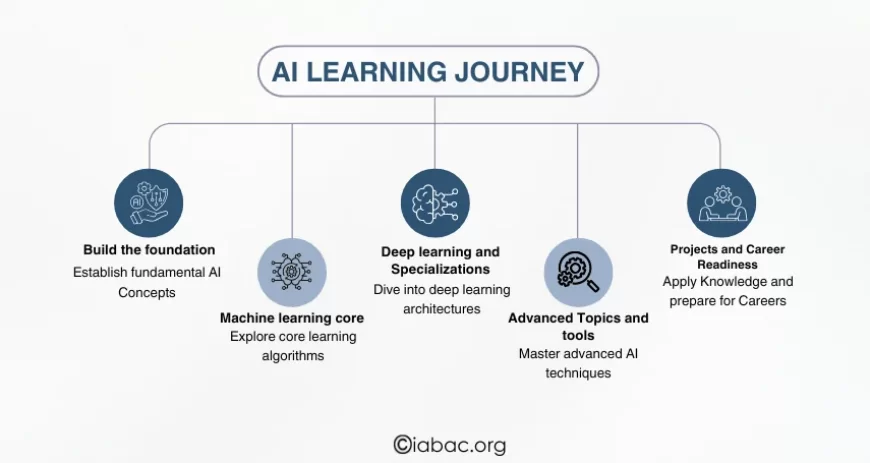
Full AI Syllabus at a Glance
|
Focus Area |
Duration |
Skills |
|
Foundations |
Weeks 1–4 |
Python, Math, AI Concepts |
|
Machine Learning Core |
Weeks 5–10 |
Supervised, Unsupervised, Feature Engineering, Evaluation |
|
Deep Learning & Specialisations |
Weeks 11–18 |
NLP, Computer Vision, Neural Networks, RL Basics |
|
Advanced & Tools |
Weeks 19–24 |
Generative AI, Ethics, Cloud, Big Data |
|
Projects & Career Readiness |
Weeks 25–28 |
Portfolio, Role Clarity, Certification |
If you want a programme that follows exactly this structure with mentorship, projects, and a globally recognised certification, explore the IABAC Artificial Intelligence Certification programme. It is built for both beginners and working professionals, and the curriculum maps directly to what hiring teams are actually looking for.
You have a complete, structured AI course syllabus that takes you from Python basics through to deployable models and career-ready skills in a sequence that actually makes sense.
You came here without a map. Now you have one. The only thing left is to start.