


















































Data Science Career Roadmap: Skills, Salary, Jobs & Learning Path
Roadmap to data science careers covering skills, tools, salaries, roles, projects, and a step-by-step learning path for beginners preparing for job readiness.


Why Data Science Became the Career Everyone Wants
Imagine a world where every decision, from what you watch on Netflix to how doctors diagnose diseases, is powered by invisible algorithms working quietly behind the scenes.
A world where companies don’t just guess what customers want; they predict it.
A world where data has become the new currency, and the people who understand it are shaping the future.
That world is no longer “coming.”
It’s already here.
And the people driving it forward are Data Scientists.
But here’s the truth nobody tells you:
Data Science isn’t a single skill. It’s a journey. A roadmap. A layered, evolving path that transforms raw curiosity into analytical mastery.
If you’re reading this, you’re not just exploring a career, you’re exploring a future where your skills can literally change how businesses, technologies, and societies work.
What Does a Data Scientist Actually Do?
A Data Scientist is a problem-solver who uses data to answer important questions.
If an e-commerce company asks:
-
“Why are customers leaving the app?”
-
“What products should we recommend next?”
-
“How can we reduce delivery time?”
The Data Scientist finds the answer using:
✔ Data
✔ Statistics
✔ Machine Learning
✔ Tools like Python, SQL, and Power BI
Think of Data Science as a cycle:
-
Collect data: Gather information from relevant sources to understand the environment.
-
Clean data: Remove errors and inconsistencies so the information is usable.
-
Analyze data: Examine patterns and relationships to understand what the data shows.
-
Build models: Use statistical or machine-learning methods to estimate outcomes.
-
Give insights: Translate findings into clear takeaways that explain what matters.
-
Help leaders make better decisions: Provide guidance grounded in evidence to support strategic choices.
That’s why Data Scientists are in demand across:
-
Banking: Use data to track transactions, assess risks, and guide financial decisions.
-
Healthcare: Apply data to monitor patient patterns and support treatment planning.
-
E-commerce: Analyze user behavior to improve product recommendations and sales strategies.
-
Manufacturing: Use data from machines and processes to improve output and reduce issues.
-
IT companies: Apply data to optimize systems, strengthen performance, and guide development.
-
Transportation: Use route and demand data to improve scheduling and fleet operations.
-
Startups: Rely on data to validate ideas, understand users, and shape early growth steps.
-
Consulting firms: Use data-driven findings to advise clients on operations and strategy.
Every industry needs people who can understand data.
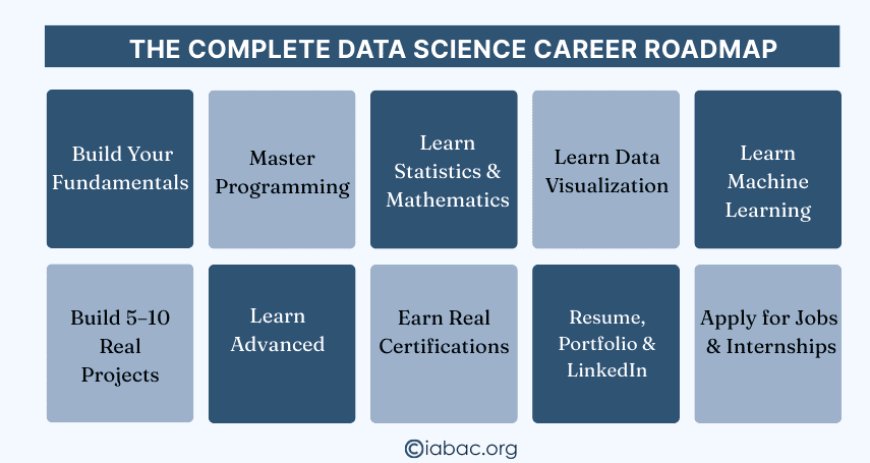
The Complete Data Science Career Roadmap
This is the roadmap followed by successful Data Scientists across the world.
Step 1: Build Your Fundamentals
Before touching Python or ML algorithms, you need clarity in the basics:
Key Fundamentals
-
Difference between Data Science, ML, AI, Data Analytics
-
Business understanding (crucial for job interviews)
Why fundamentals matter
Without fundamentals, you’ll feel lost later in ML, statistics, or projects.
Step 2: Master Programming (Python Is #1)
Python is the heartbeat of data science.
You must learn:
-
Python basics: Use variables, loops, and functions to structure logic in code.
-
NumPy: Work with arrays to handle numerical operations efficiently.
-
Pandas: Manage tables, clean data, and prepare datasets for analysis.
-
Matplotlib & Seaborn: Build visual summaries that help interpret trends.
-
Scikit-Learn: Create and evaluate models for classification, regression, and other tasks.
SQL is the second required language.
SQL Skills Needed:
-
SELECT, JOIN, GROUP BY: Retrieve data, combine related tables, and summarize information.
-
Subqueries: Use nested queries to answer layered or conditional questions.
-
Window functions: Perform calculations across rows while keeping the original structure.
Most data science interviews start with Python + SQL questions.
Step 3: Learn Statistics & Mathematics
Statistics gives meaning to data.
Math helps you understand how algorithms work.
Must-learn topics
-
Probability: Estimate the likelihood of events to understand uncertainty in data.
-
Hypothesis testing: Compare assumptions with evidence to judge whether patterns are meaningful.
-
Regression: Model relationships between variables to understand or estimate outcomes.
-
Distributions: Describe how data spreads or clusters to guide analysis choices.
-
Linear algebra (basics): Use vectors and matrices to support many machine-learning methods.
This is one of the most important parts of your roadmap.
Step 4: Learn Data Visualization
Because no matter how good your model is…
If you can’t present insights, it’s useless.
Tools to learn
-
Power BI: Build interactive dashboards that help teams review metrics.
-
Tableau: Create visual stories that make patterns easier to interpret.
-
Matplotlib: Generate customizable plots for detailed analysis work.
-
Seaborn: Produce statistical visuals that highlight trends and relationships.
-
Plotly: Build interactive charts that support exploration of data.
Data Scientists must communicate results clearly.
Step 5: Learn Machine Learning
Machine Learning is what makes Data Scientists highly valuable.
Algorithms To Master
-
Linear Regression: Estimate how one variable changes in relation to another.
-
Logistic Regression: Model the probability of outcomes that fall into categories.
-
Decision Trees: Split data into branches to guide decisions based on conditions.
-
Random Forest: Combine many decision trees to improve stability and reduce noise.
-
XGBoost: Use boosted trees to handle complex patterns in structured data.
-
K-Means: Group data points into clusters based on similarity.
-
PCA: Reduce dimensions by finding components that capture most of the variation.
-
Time-Series Forecasting: Use historical patterns to estimate future values over time.
Skills Needed
-
Model training
-
Model evaluation
-
Feature engineering
-
Hyperparameter tuning
This is where you turn from “analyst” into “data scientist.”
Step 6: Build 5–10 Real Projects
Projects are more important than degrees.
More important than courses.
Even more important than certificates.
Why?
Because companies hire portfolios, not students.
Here are high-value projects:
-
Customer churn prediction: Estimate which users are likely to stop using a service.
-
Fraud detection system: Identify unusual actions that may signal misuse or risk.
-
Sales forecasting: Use past trends to estimate future demand.
-
Image classification: Categorize images based on learned patterns.
-
Movie recommendation engine: Suggest content by comparing user behavior and preferences.
-
Sentiment analysis: Detect opinions or emotions from text.
-
Credit risk analysis: Assess the likelihood that a borrower may miss payments.
How many projects do you need?
✔ 5 beginner projects
✔ 3 intermediate
✔ 2 advanced (ML + real datasets)
This instantly boosts your portfolio.
Step 7: Learn Advanced Skills (Optional but Powerful)
If you want to grow faster:
-
Deep Learning: Train neural networks to handle complex patterns in text, images, or signals.
-
NLP: Work with language data to extract meaning, classify text, or build conversational systems.
-
Computer Vision: Analyze images and video to detect objects, classify scenes, or track movement.
-
Big Data tools (Spark, Hadoop): Process large datasets that don’t fit into standard workflows.
-
MLOps (Docker, Airflow, MLflow): Manage models, automate pipelines, and coordinate deployment.
These skills help you move to senior roles quickly.
Step 8: Earn Real Certifications (Adds Credibility)
Many beginners ask:
“Are certifications necessary?”
They are not mandatory, but they help because:
They validate your skills by showing that you can apply what you’ve learned in real situations rather than relying only on theory. They look strong on a resume because they give hiring teams a clear view of the work you’ve completed and the problems you can handle. They help you stand out in shortlisting by offering concrete evidence of your abilities, which makes it easier for recruiters to judge your fit for a role.
Recommended Certifications:
IABAC certifications (globally recognized):
-
Certified Data Scientist
-
Data Analytics Certification
-
Machine Learning Associate
IABAC is popular because:
✔ Industry-recognized
✔ Practical exam
✔ Globally accepted
✔ Helps in job shortlisting
A certification + projects is a powerful combination.
Step 9: Prepare Your Resume, Portfolio & LinkedIn
Your resume must include:
-
Skills
-
Tools
-
8–10 projects
-
GitHub links
-
Certifications (IABAC, Coursera, etc.)
-
Internship details
Portfolio includes:
-
GitHub
-
Power BI dashboards
-
Kaggle notebooks
-
Project documentation
LinkedIn is crucial
Because 70% of recruiters search for “Data Scientist” talent on LinkedIn first.
Step 10: Apply for Jobs & Internships
Your first job may be:
-
Data Analyst: Work with datasets, create reports, and help teams understand patterns.
-
Business Analyst: Translate business needs into data requirements and support decision-making.
-
Junior Data Scientist: Assist with modeling, analysis, and building small components of larger projects.
-
ML Engineer Intern: Support model development, testing, and basic pipeline tasks.
-
Research Assistant: Help gather data, run experiments, and support analytical studies.
-
Career growth: Each role adds experience that gradually shapes your path.
Every small step builds your career.
Skills Required to Become a Data Scientist (2025-Ready)
Core Skills
-
Python: Write scripts and handle workflows used in analysis and modeling.
-
SQL: Query databases to extract and organize information.
-
Statistics: Interpret data patterns and support evidence-based decisions.
-
Machine Learning: Build models that estimate outcomes or classify data.
-
Data Cleaning: Fix errors and prepare datasets for reliable analysis.
-
Feature Engineering: Create useful variables that improve model performance.
-
Model Deployment (optional): Move models into real use through simple pipelines.
Soft Skills
-
Problem-solving: Break down issues and find workable solutions.
-
Communication: Explain findings in a way teams can use.
-
Critical thinking: Evaluate information and question assumptions.
-
Storytelling with data: Present results in a clear narrative that highlights what matters.
Business Skills
-
Understanding KPIs: Track metrics that reflect business performance.
-
Building dashboards: Create visual summaries that help teams monitor progress.
-
Presenting insights: Share conclusions that guide actions.
-
Domain knowledge: Use industry context to interpret results in areas like finance, retail, healthcare, or e-commerce.
Data Science Tools You Must Learn
1. Programming Languages
Python
The most important language in data science. It’s easy to learn, has powerful libraries (NumPy, Pandas, Scikit-Learn), and is used in almost every real-world project.
R (Optional)
A statistical programming language. Great for research, academics, and heavy statistical analysis, but less used in industry compared to Python.
2. Databases
SQL
The foundation of data retrieval. Almost every company stores data in databases, and SQL is the skill used to extract, filter, join, and analyze that data.
MongoDB
A NoSQL database that stores data in flexible JSON-like formats. Useful when working with unstructured data or large-scale applications.
3. Data Visualization Tools
Power BI
A business intelligence tool used to build dashboards and reports. Helps Data Scientists communicate insights to managers and stakeholders.
Tableau
A powerful visualization tool that transforms data into interactive charts, maps, and dashboards. Highly valued in analytics and data roles.
4. Machine Learning Libraries
Scikit-Learn
The essential ML library for beginners and professionals. It supports almost all classical machine learning algorithms and makes model building simple.
TensorFlow
A deep learning framework by Google. Used for neural networks, image recognition, NLP models, and large-scale deep learning projects.
PyTorch
A deep learning library popular in research and advanced AI development. It offers flexibility and is widely used for cutting-edge ML models.
5. Big Data Tools
Spark
A powerful engine for processing massive datasets quickly. Used when data is too large for traditional tools like Pandas.
Hadoop
A framework for storing and managing huge datasets across multiple machines. Common in big enterprises working with petabytes of data.
6. Deployment Tools
Flask
A lightweight Python framework used to convert ML models into simple web APIs so they can be used in real applications.
FastAPI
A modern, fast framework for deploying machine learning models as APIs. Faster and more flexible than Flask.
Docker
A tool that packages your code and models into “containers” so they run consistently on any computer or server. Essential for production deployment.
Data Scientist Salary (2025 Global Overview)
Data Scientist Salary (2025 Global Overview)
|
Region / Country |
Level |
Salary Range |
|
India |
Fresher |
₹6 LPA – ₹10 LPA |
|
Mid-level |
₹12 LPA – ₹20 LPA |
|
|
Senior |
₹22 LPA – ₹40+ LPA |
|
|
High-paying cities (India) |
— |
Bangalore, Hyderabad, Pune |
|
United States |
Fresher |
$90,000 – $120,000 |
|
Mid-level |
$130,000 – $160,000 |
|
|
Senior |
$180,000 – $250,000 |
|
|
Europe |
Average |
€55,000 – €110,000 |
|
UAE |
Average |
AED 120,000 – 250,000 |
|
Singapore |
Average |
SGD 60,000 – 120,000 |
Job Roles You Can Get in Data Science
The Data Science field offers career opportunities at every level, from beginners to highly experienced professionals.
Here’s what each role means and what you actually do in that job.
Entry-Level Roles (Beginner-Friendly)
1. Data Analyst
You analyze data, create dashboards, and help teams make decisions using charts, trends, and reports.
A great starting role for anyone entering the data world.
2. Business Analyst
You understand business problems and translate them into data-driven insights.
More business-focused, less coding-heavy.
3. Junior Data Scientist
You assist senior Data Scientists with cleaning data, basic modeling, and small ML tasks while learning real-world workflows.
4. Research Analyst
You work with research teams to analyze datasets, explore trends, and support academic or business studies.
Mid-Level Roles (Core Data Science Careers)
1. Data Scientist
You build machine learning models, analyze large datasets, apply statistics, and solve business problems using data.
This is the most common and high-demand role.
2. Machine Learning Engineer
You take ML models and make them production-ready.
This role focuses on model deployment, pipelines, and scalability.
3. NLP Engineer
You work with text-based datachatbots, sentiment analysis, document processing, and language-based AI systems.
4. Computer Vision Engineer
You work with image and video dataobject detection, face recognition, medical imaging, and autonomous systems.
Senior-Level Roles (Leadership & Strategy)
1. Senior Data Scientist
You lead complex ML projects, guide junior members, and take ownership of end-to-end solutions.
2. Lead Data Scientist
You manage teams, oversee multiple projects, define strategy, and improve model accuracy and performance.
3. AI Architect
You design large-scale AI systems, choose the right tools, build ML pipelines, and integrate AI into company products.
4. Data Science Manager
You handle team planning, stakeholder communication, project priorities, and ensure the delivery of AI/ML projects.
5. Chief Data Officer (CDO)
A senior executive role responsible for the company’s entire data strategy.
You define how data is collected, managed, used, and protected across the organization.
Why This Field Has One of the Strongest Growth Paths in Tech
Because as you gain experience:
-
You move from analysis → modeling → leadership
-
Every level opens new opportunities
-
Skills compound over time
-
AI adoption is growing in every industry
-
Senior roles offer very high salaries and stability
Data Science isn’t just a job
It’s a long-term career path with exponential opportunities.
A Beginner-Friendly Learning Path (Roadmap from 0 → Job-Ready)
Month 1–2: Fundamentals + Python
-
Learn Python
-
Learn SQL
-
Understand basics of data science
Month 3–4: Statistics + Visualization
-
Learn statistics
-
Learn Power BI or Tableau
-
Start small projects
Month 5–6: Machine Learning
-
Learn ML algorithms
-
Build ML projects
Month 7–9: Portfolio + GitHub
-
Build dashboards
-
Create 8–10 projects
-
Document everything
Month 9–12: Job Preparation
-
Resume
-
LinkedIn
-
Certifications
-
Start applying
This roadmap is realistic and effective.
Projects You Must Build (To Get Shortlisted)
|
Level |
Projects |
|
Beginner |
Exploratory Data Analysis, Power BI sales dashboard, Movie dataset analysis |
|
Intermediate |
Customer churn prediction, House price prediction, Credit score prediction |
|
Advanced |
Fraud detection, Recommendation engine, NLP sentiment analysis, Image classification |
Projects help you stand out in interview shortlisting.
Top Certifications to Boost Your Career (Including IABAC)
Why certifications matter
-
Show commitment
-
Validate skill
-
Improve shortlisting
-
Build confidence
Best certifications
-
IABAC Certified Data Scientist
-
Coursera Data Science Specialization
IABAC stands out for its global recognition and practical exam pattern.
Data Science isn’t a career you choose’s a journey you grow into.
You’ll start with curiosity.
Then you’ll learn skills.
Then you’ll build projects.
And one day, you’ll realize:
You can solve business problems.
You can build ML models.
You can make data-driven decisions.
You can impact the world.
That’s what makes Data Science special.
It doesn’t just teach you how to work with data
It teaches you how to think.
If you follow this roadmap
you will become job-ready, confident, and industry-ready.
Your future in Data Science starts today.