

















































MODULE 10 GENERATIVE AI
Generative AI overview covering GANs, transformers, GPT models, uses, risks, and how machine learning evolves into creative systems.

When Intelligence Takes a Creative Leap
There’s a moment in every AI learner’s journey when the excitement changes shape.
When you first discover machine learning, the excitement is analytical numbers, patterns, predictions, accuracy.
When you discover deep learning, the excitement becomes structural layers, neurons, features, activation functions.
When you explore NLP, it becomes linguistic meaning, context, tokens, semantics.
But when you meet Generative AI, the excitement becomes emotional.
Because for the first time, you’re not just teaching machines to understand the world you’re teaching them to create something new within it.
If every previous module taught your AI how to perceive, analyze, interpret, and learn, Generative AI teaches it how to imagine.
It’s the turning point where artificial intelligence stops behaving like a computer…
…and starts behaving like a creator.
Not because it feels creativity but because it can learn the patterns behind creativity so deeply that it can recreate them, remix them, and sometimes even move beyond them.
From GANs that create human faces that don’t exist,
to GPT models that generate essays, strategies, jokes, stories, and code in seconds,
Generative AI is rewriting what is possible and what it means to be an Artificial Intelligence Expert in today’s world.
This module is your entry into that frontier.
The Moment AI Learned to Create
To understand why Generative AI is so powerful, you need to revisit a simple idea:
Traditional AI is reactive.
It responds. It predicts. It classifies.
It tells you what something is not what something could be.
Generative AI flips that idea.
It says:
“Here is what I’ve learned.
Now I will create something new.”
It’s the difference between:
-
recognizing a cat
and -
drawing one from scratch.
-
predicting a sentence
and -
writing a paragraph no one has ever written.
-
identifying a style
and -
generating an original painting in that style.
This shift is not small it’s monumental.
It moves AI from automation to innovation.
To appreciate the power of Generative AI, you need to understand the two pillars that made it possible:
-
GANs (Generative Adversarial Networks)
-
Transformers / GPT models
Let’s start with the first spark that started it all.
The Story of GANs A Battle That Creates Beauty
In 2014, a researcher named Ian Goodfellow introduced a strange but brilliant idea.
What if machines could learn to create by competing against themselves?
This idea became the foundation of GANs, Generative Adversarial Networks, one of the most influential innovations in AI.
Think of a GAN as a rivalry between two artists:
-
One artist, the Generator, tries to produce something that looks real.
-
The other artist, the Discriminator, tries to judge whether it’s real or fake.
The Generator keeps improving because it keeps getting caught.
The Discriminator keeps improving because the Generator keeps getting better.
It’s a rivalry that forces creativity.
This process continues until the Generator becomes so good that the Discriminator can no longer tell the difference.
That’s when machine creativity begins.
Faces.
Landscapes.
Products.
Fashion.
Textures.
Music.
Synthetic data.
GANs opened the door to a new world one where machines could generate reality-like content that even humans struggle to identify as fake.
The astonishing thing is that all of this creativity comes from simple beginnings a latent vector, a string of random numbers.
Noise transformed into meaning.
It’s the digital equivalent of imagination.
Behind Every GAN Is a Battle
The Generator learns:
“What can I create that looks real?”
The Discriminator learns:
“How can I catch the fake?”
Together, they create an adversarial dance, one that pushes both networks toward excellence.
You can think of GANs as:
-
A student trying to fool a teacher
-
A teacher trying to stay ahead
-
A cycle that never stops learning
-
An engine that pushes the boundaries of generative intelligence
GANs don’t just generate images they generate possibilities.
Where GANs Changed the World
As an Artificial Intelligence Expert, you need to know where GANs are used not just how they work.
You’ve seen GANs in action, even if you didn’t realize it:
-
AI-generated art pieces that sell for millions
-
Deepfake videos that mimic celebrities
-
Photo restoration tools that bring old images back to life
-
AI that turns sketches into real landscapes
-
Fashion AI that designs clothes for global brands
-
Medical AI that creates synthetic MRI scans for training
-
Gaming AI creating 3D textures and worlds
GANs unlocked new industries and new fears because creativity is power.
That power comes with responsibility, which we’ll get to later.
But first, the next revolution: Transformers.
Transformers The Architecture That Changed the World
When the research paper “Attention is All You Need” was published in 2017, no one expected it to transform the entire industry.
Before transformers, models struggled with long context:
-
RNNs forgot
-
LSTMs improved it, but couldn’t scale
-
Encoder–decoder architectures worked, but were slow
Transformers arrived with one message:
We don’t need recurrence.
We need attention.
Self-attention, to be specific.
This mechanism lets AI read an entire sentence at once and understand how each word relates to the others.
This single insight changed everything:
-
Better language understanding
-
Faster training
-
Larger models
-
Deeper context
-
More accurate predictions
Transformers became the backbone of GPT, BERT, T5, PaLM, LLaMA, Claude, Gemini every major model you see today.
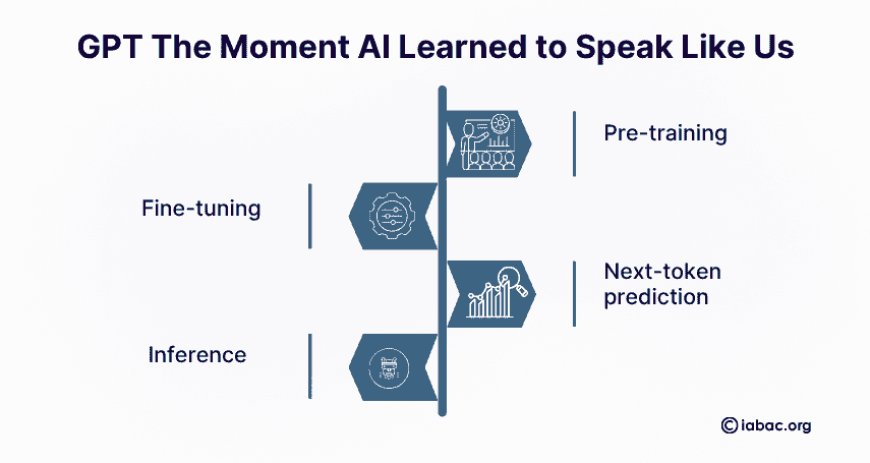
GPT The Moment AI Learned to Speak Like Us
GPT (Generative Pre-trained Transformer) models are the world’s most advanced text generators.
They read billions of words, learn every pattern, structure, nuance, and rhythm of human language, and then write new text that feels natural.
How does GPT do this?
1. Pre-training
GPT reads huge datasets:
-
Books
-
Articles
-
Web pages
-
Conversations
-
Code repositories
It learns:
-
Grammar
-
Reasoning sequences
-
Logical progressions
-
Real-world facts
-
Emotional patterns
-
Linguistic structure
2. Next-token prediction
GPT learns to predict one word at a time, over billions of predictions.
This simple task makes it shockingly intelligent.
3. Fine-tuning
With datasets for:
-
Medical answers
-
Programming
-
Customer support
-
Content writing
-
Legal analysis
GPT becomes an expert in any domain.
4. Inference
Your prompt becomes the seed for creativity.
GPT writes like:
-
A marketer
-
A poet
-
A business strategist
-
A programmer
-
A psychologist
-
A storyteller
-
A teacher
GPT is not thinking, but the illusion of thought is incredibly convincing.
Building a Q&A Bot: Hugging Face Makes It Possible
Today, you don’t even need to train your own models.
With Hugging Face, you can build a powerful Q&A bot with a single snippet:
from transformers import pipeline
qa = pipeline("question-answering")
qa({
'question': "What is Generative AI?",
'context': "Generative AI is the subfield of artificial intelligence that creates new content."
})
Just like that, you have:
-
An intelligent system
-
Built on transformer architecture
-
Running in seconds
-
Ready for deployment
This democratization of AI is why Gen AI is exploding across industries.
Where Generative AI Is Redefining the World
Generative AI is no longer academic it’s commercial, cultural, and global.
You’ll find it everywhere:
-
In movies, generating CGI backgrounds
-
In the hospital, they are generating synthetic data
-
In marketing, creating personalized content
-
In gaming generating landscapes and textures
-
In education creating custom learning experiences
-
In customer service powering AI agents
-
In design generating product prototypes
Every field that depends on creativity is being reimagined.
The Shadow Side Ethics of Generative AI
Power always comes with risks.
Generative AI has opened doors, but also vulnerabilities:
-
Deepfakes used for misinformation
-
Bias amplified in models
-
Models trained on copyrighted data
-
Synthetic voices used for fraud
-
Identity manipulation
-
Fake evidence creation
As an Artificial Intelligence Expert, ethics is not optional, it’s essential.
You must understand:
-
When to use Gen AI
-
When not to use it
-
How to detect deepfakes
-
How to understand bias
-
How to ensure transparency
-
How to build responsibly
Generative AI is a tool.
Whether it becomes a gift or a threat depends on how we use it.
The Human AI Creative Partnership
One of the biggest misconceptions is that Generative AI replaces creativity.
It doesn’t.
Instead, it expands it.
A human writer with AI becomes:
-
Faster
-
More expressive
-
More experimental
-
More productive
A designer with AI becomes:
-
More versatile
-
More innovative
-
More imaginative
Generative AI is not here to eliminate human creativity —
it’s here to amplify it.
You Are Now Entering the Creative Frontier
With Module 10, you’ve crossed a major milestone.
You now understand:
-
The evolution from GANs to transformers
-
How GPT models learned to communicate
-
How Hugging Face democratizes innovation
-
How Generative AI powers industries
-
How to build responsibly
-
How creativity emerges from computation
You’ve stepped into the world where AI is not just intelligent —
it’s imaginative.
And now, one final piece remains.
A model that learns by compressing and reconstructing.
A system that quietly powers anomaly detection, image restoration, clean reconstruction, and foundational generative structures.