























































How to Find Jobs in Business Analytics
Find business analytics jobs by building practical skills, showcasing projects, networking with experts, and targeting roles across data-driven industries.


Choosing a career is one of the hardest decisions in life. At some point, almost everyone asks the same questions:
Am I choosing the right field? Will this job grow with time? Will my skills still matter five years from now?
Business analytics quietly answers all these questions without making big promises. It does not rely on trends or hype. Instead, it focuses on one thing businesses will always need: better decisions.
Every company generates data. But data alone is useless unless someone understands it, explains it, and turns it into action. That is where business analytics steps in. It gives meaning to numbers and direction to decisions. This is why jobs in business analytics continue to grow across industries, countries, and experience levels.
This blog is written for anyone who:
- Is curious about Business Analytics
- Wants to know what jobs are available
- Is unsure how to start
- Wants clarity, not confusion
By the end of this guide, you will understand how Business Analytics careers work and how to build one step by step.
What Is Business Analytics Really About?
Business analytics is not about memorizing formulas or staring at dashboards all day. It is about asking better questions and finding honest answers using data.
At its core, business analytics helps organizations:
- Understand past performance
- Identify problems
- Predict future outcomes
- Choose better actions
Business analytics connects three important things:
- Data
- Business goals
- Decision-making
When these three align, companies grow faster and make fewer mistakes.
That is why business analytics is used in:
- Banking and finance
- Healthcare
- IT and software companies
- Retail and e-commerce
- Manufacturing
- Education
- Logistics and supply chain
Wherever decisions matter, business analytics has a role.
Why Business Analytics Is a Career That Lasts
Many careers feel exciting at first but lose relevance over time. Business analytics is different because it grows along with technology and business needs.
Here is why people choose this field:
- Businesses will always use data
- Skills are transferable across industries
- Career growth does not stop at one role
- Learning never becomes outdated
Business analytics allows professionals to move from:
- Entry-level roles → Senior positions
- Technical roles → Strategic roles
- Support roles → Decision-making roles
This flexibility is what makes jobs in business analytics attractive for both beginners and experienced professionals.
What Are the Jobs After Business Analytics?
This is usually the first question people ask, and rightly so. Learning something new only makes sense if it leads somewhere meaningful.
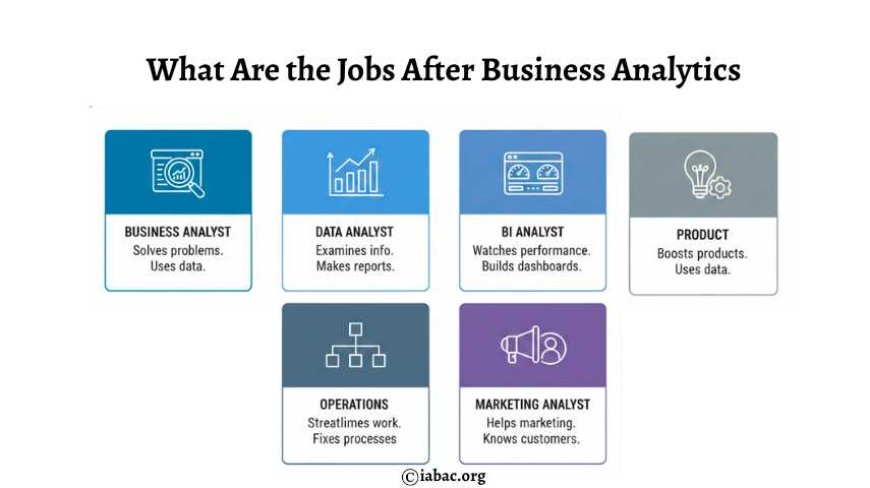
After studying business analytics, you do not get limited to one role. You open the door to multiple career paths, depending on your interest and strengths.
Let’s explore the most common and in-demand roles.
1. Business Analyst
A business analyst acts as a bridge between business needs and data insights. This role focuses on understanding problems and proposing practical solutions.
Key responsibilities include:
- Understanding business requirements
- Analyzing business processes
- Studying data trends
- Creating reports and dashboards
- Communicating insights clearly to stakeholders
Business analysts work closely with management, IT teams, and operations. Their work often influences important decisions, which makes this role highly valued.
2. Data Analyst
Data analysts focus more on working directly with data. They clean, analyze, and visualize data to uncover useful insights.
Responsibilities include:
- Collecting and cleaning datasets
- Identifying trends and patterns
- Creating visual reports
- Supporting business teams with data insights
This role is ideal for those who enjoy working hands-on with data and tools.
3. Business Intelligence Analyst
Business intelligence analysts help companies track performance and progress.
Key responsibilities:
- Creating dashboards and performance reports
- Monitoring key business metrics
- Supporting leadership teams with insights
This role plays a key part in long-term planning and performance management.
4. Product Analyst
Product analysts focus on improving products using data.
Responsibilities include:
- Studying user behavior
- Analyzing product usage
- Measuring feature performance
- Recommending product improvements
This role is common in technology and digital product companies.
5. Operations Analyst
Operations Analysts help businesses improve internal efficiency.
Key tasks include:
- Analyzing workflows
- Identifying bottlenecks
- Improving productivity
- Reducing operational costs
This role is especially valuable in logistics, manufacturing, and service industries.
6. Marketing Analyst
Marketing analysts use data to help businesses reach the right audience.
Responsibilities include:
- Analyzing customer data
- Measuring campaign performance
- Supporting marketing strategies
- Improving customer engagement
This role combines creativity with data-driven decision-making.
What Jobs Can I Do With Business Analytics?
Business analytics gives you career flexibility. You are not locked into one industry or job title.
Some additional roles include:
- Strategy Analyst
- Financial Analyst
- Risk Analyst
- Supply Chain Analyst
- HR Analytics Specialist
- Customer Insights Analyst
Your role may change as you grow, but your core skills remain valuable.
This adaptability is one of the biggest advantages of business analytics careers.
What Jobs Can I Do as a Business Analyst?
A business analyst is often involved in important business conversations. They do not just report numbers—they explain what those numbers mean.
Business analysts work in:
- IT companies
- Consulting firms
- Banks and financial institutions
- Healthcare organizations
- Government projects
- Global enterprises
Typical responsibilities include:
- Gathering and documenting business requirements
- Analyzing data and processes
- Identifying gaps and inefficiencies
- Supporting decision-making
- Improving workflows
With experience, business analysts often move into:
- Senior Business Analyst roles
- Product management
- Business consulting
- Analytics leadership positions
This growth path makes business analytics a long-term career, not just a job.
What Are the 4 Types of Business Analytics?
Understanding the four types of business analytics helps you see how data supports decisions at every stage.
1. Descriptive Analytics – What Happened?
This type focuses on understanding past performance.
Examples include:
- Sales reports
- Website traffic summaries
- Monthly performance dashboards
Descriptive analytics helps businesses understand what has already happened.
2. Diagnostic Analytics – Why Did It Happen?
This type looks deeper to find reasons behind outcomes.
Examples include:
- Identifying reasons for declining sales
- Understanding causes of customer complaints
- Analyzing operational issues
Diagnostic analytics helps businesses learn from the past.
3. Predictive Analytics – What May Happen Next?
This type uses historical data to predict future outcomes.
Examples include:
- Sales forecasting
- Customer churn prediction
- Demand planning
Predictive analytics helps businesses prepare for the future.
4. Prescriptive Analytics – What Should Be Done?
This type suggests actions based on insights.
Examples include:
- Optimizing pricing strategies
- Improving inventory planning
- Recommending marketing actions
Prescriptive analytics helps businesses take the right action at the right time.
Most jobs in business analytics involve a combination of these four types.
Why Business Analytics Certifications Matter
Skills are important, but recognition matters too. Recruiters want proof that your knowledge meets industry standards.
This is where business analytics certifications play a key role.
Certifications help you:
- Stand out in job applications
- Gain structured learning
- Build professional credibility
- Increase job opportunities
- Improve career growth
A recognized certification shows that you understand both theory and real-world applications.
How IABAC Supports Business Analytics Careers
IABAC certifications focus on practical learning and industry relevance. They help professionals:
- Build strong analytics foundations
- Apply analytics concepts to real problems
- Gain global recognition
- Improve employability
For learners aiming to enter or grow in jobs in business analytics, IABAC certifications provide a strong starting point.
Skills Needed for Jobs in Business Analytics
Success in business analytics comes from a balance of skills.
Technical Skills
- Excel and spreadsheets
- SQL for data queries
- Data visualization tools
- Basic statistics
- Analytics platforms
Business Skills
- Problem-solving
- Process understanding
- Strategic thinking
- Decision support
Soft Skills
- Clear communication
- Logical thinking
- Curiosity
- Storytelling with data
These skills grow with time, practice, and experience.
How to Start Your Business Analytics Career
Starting may feel confusing, but the steps are simple:
- Learn Business Analytics basics
- Understand business problems
- Practice with case studies
- Earn a recognized certification
- Build a small project portfolio
- Apply consistently
Confidence grows when effort meets clarity.
The Human Side of Business Analytics
Every career journey has moments of doubt. Everyone feels unsure at the beginning.
But over time, something changes. Data starts making sense. Patterns become clearer. Decisions feel meaningful. You realize your work helps people avoid mistakes and move forward with confidence.
That realization changes everything.
Future Scope of Jobs in Business Analytics
The future is bright. Businesses will continue to rely on analytics to stay competitive.
As data grows, so does the need for professionals who can understand it.
With the right skills and business analytics certifications, professionals can build stable and rewarding careers.
Business analytics is not about numbers alone. It is about understanding people, businesses, and decisions.
If you are looking for:
- Career growth
- Skill relevance
- Industry flexibility
- Long-term opportunities
Then, business analytics is a field worth choosing.
With proper learning, hands-on practice, and globally recognized certifications from IABAC, you can confidently step into the world of jobs in business analytics and build a career that grows with you.