

























































How to Choose the Right AI Consulting Firms for Your Business?
Choose the right AI consulting firms with clear criteria on expertise, ROI, integration, and long-term fit to ensure scalable, business-aligned AI success.

Artificial intelligence has moved from experimentation to execution.
Almost every industry is exploring AI, investing in AI, or feeling pressure to adopt AI.
And that naturally leads to a difficult question:
Which AI consulting firm should you trust with something this critical?
On the surface, the decision seems simple. There are countless AI consulting firms and AI consulting companies, each promising transformation, automation, efficiency, and competitive advantage. But once businesses begin evaluating options, the reality quickly becomes overwhelming.
Capabilities differ. Approaches vary. Pricing models are inconsistent. And the consequences of choosing the wrong partner can be expensive.
Selecting the right AI consulting firm today is not just about technical skills it is about finding a partner that aligns with your business objectives, data maturity, risk tolerance, and long-term strategy.
This guide breaks down how to approach that decision with clarity and confidence.
Why Choosing the Right AI Consulting Firm Matters More Than You Think
Many organizations underestimate how deeply this decision can affect outcomes.
AI initiatives often require significant investment, cross-functional coordination, infrastructure adjustments, and long implementation cycles. Unlike traditional software projects, AI deployments frequently reshape workflows, decision processes, and even business models.
Choosing the wrong consulting partner can lead to:
-
Misaligned solutions that never reach production
-
Inflated costs without measurable returns
-
Integration failures with existing systems
-
Internal adoption challenges
-
Long-term technical debt
AI consulting engagements are rarely isolated experiments. They influence strategy, operations, and competitive positioning.
That makes firm selection a strategic decision, not a vendor selection exercise.
The Hidden Complexity Behind AI Consulting Engagement
One common misconception is that AI projects are plug-and-play.
In reality, AI initiatives involve layers of complexity that are easy to overlook:
-
Data readiness – Many businesses lack clean, structured, or usable data.
-
Infrastructure compatibility – Legacy systems may limit deployment options.
-
Integration challenges – AI models must work within existing workflows.
-
Organizational adaptation – Teams must learn to trust and use AI outputs.
-
Lifecycle management – AI systems require monitoring, retraining, and updates.
This is why some AI projects stall despite promising prototypes.
Strong AI consulting firms understand that success depends not just on model accuracy, but on implementation feasibility and business alignment.
The Reality of the AI Consulting Market
Not all AI consulting firms operate at the same depth or maturity.
Some firms are strategy-heavy, focusing on roadmaps and ideation.
Others are engineering-driven, specializing in data pipelines and deployments.
Some emphasize industry specialization, while others promote broad technical expertise.
Marketing language can also be misleading.
Buzzwords like “AI transformation” “intelligent automation” and “advanced analytics” often obscure important distinctions in capability.
The challenge for businesses is separating:
-
True technical expertise vs presentation-level knowledge
-
Practical deployment experience vs theoretical familiarity
-
Outcome-driven consulting vs tool-driven selling
Understanding these differences is critical for sound evaluation.
How AI Consulting Firms Actually Differ In
Two firms offering “AI consulting” may deliver vastly different value.
Key areas of variation include:
Technical Depth
Some firms excel at advisory work but lack deep engineering capability. Others specialize in building production-ready systems.
Strategy vs Implementation Focus
Certain firms emphasize planning and opportunity identification. Others prioritize execution and integration.
Industry Specialization
Some consulting partners develop strong domain expertise in sectors like healthcare, finance, or manufacturing.
Team Composition
Expertise may range from data scientists and ML engineers to business strategists and change management specialists.
Scalability & Support Models
Post-deployment maintenance, retraining, and optimization capabilities vary significantly.
Recognizing these differences prevents mismatched expectations.
Key Criteria for Evaluating AI Consulting Firms
A structured evaluation framework helps avoid subjective decisions.
When comparing AI consulting firms, it is also useful to understand the range of AI consulting services they actually provide, from strategy development to full-scale implementation.
Technical & AI Expertise
Look beyond high-level claims.
Strong firms typically demonstrate:
-
Experience deploying AI in production environments
-
Data engineering and pipeline development capability
-
Infrastructure and integration knowledge
-
Model lifecycle management practices
-
Familiarity with MLOps and monitoring
Practical deployment experience often matters more than research credentials alone.
Business & Industry Understanding
AI solutions only create value when aligned with business realities.
Effective consulting firms understand:
-
Industry-specific challenges and constraints
-
Operational workflows and decision contexts
-
Value drivers and performance metrics
-
Practical feasibility of AI use cases
Firms that focus solely on technology without business grounding may struggle to deliver measurable impact.
Implementation & Integration Capability
Many AI failures originate here.
Evaluate whether the firm can handle:
-
Compatibility with existing systems
-
API integration and architecture constraints
-
Security and compliance requirements
-
Change management considerations
-
Deployment scalability
Building models is one challenge. Integrating them into live environments is another.
ROI & Outcome Orientation
AI investments should connect to tangible outcomes.
Reliable consulting partners emphasize:
-
Business objectives before model selection
-
Success metrics and KPIs
-
Cost vs impact trade-offs
-
Deployment practicality
-
Long-term value creation
Avoid engagements driven purely by experimentation without clear business goals.
Scalability & Long-Term Fit
AI systems evolve.
Firms should support:
-
Model monitoring and updates
-
Performance optimization
-
Drift detection and retraining
-
Knowledge transfer
-
Scaling strategies
Short-term project success without long-term sustainability can become costly.
Types of AI Consulting Firms You’ll Encounter
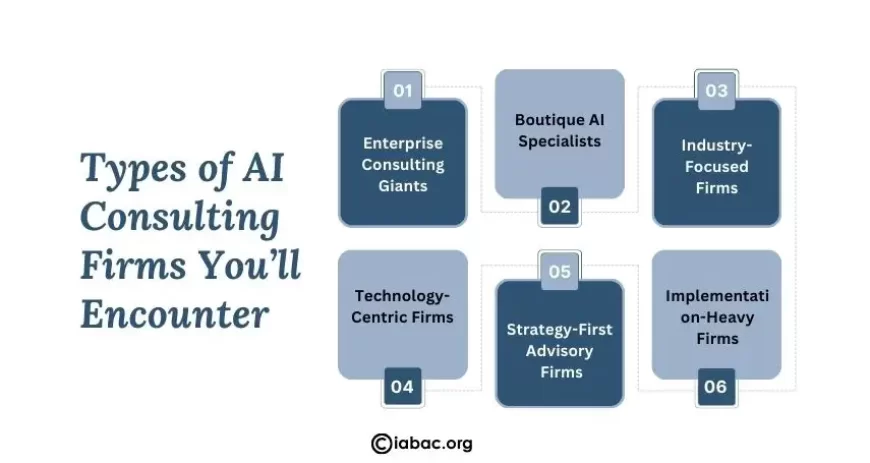
Understanding firm categories simplifies shortlisting.
Different AI consulting firms and specialized AI consultants may offer very different engagement models depending on business size, industry focus, and technical complexity.
Enterprise Consulting Giants
Broad capabilities, strong governance, often higher cost structures.
Boutique AI Specialists
Deep technical expertise, flexible, may offer highly tailored solutions.
Industry-Focused Firms
Domain-specific knowledge, valuable for regulated or complex sectors.
Technology-Centric Firms
Strong platform expertise, useful for stack-specific implementations.
Strategy-First Advisory Firms
Best for exploration and planning phases.
Implementation-Heavy Firms
Ideal for deployment and integration-focused projects.
No category is universally superior, fit depends on business needs.
Warning Signs of Weak AI Consulting Firms
Certain patterns often indicate elevated risk.
-
Unrealistic promises or guarantees
-
Excessive buzzword usage without technical clarity
-
Vague methodologies or processes
-
Lack of deployment examples
-
Tool-first rather than problem-first discussions
-
Poor discovery or requirement analysis
Credible firms typically communicate limitations, trade-offs, and practical constraints transparently.
Critical Questions to Ask Before Hiring
Well-structured conversations reveal maturity quickly.
Examples include:
-
What business outcomes have you delivered?
-
How do you evaluate data readiness?
-
How do you measure success?
-
Who owns models and intellectual property?
-
How do you handle scaling and maintenance?
-
What risks should we anticipate?
The quality of responses often matters more than polished presentations.
How to Match AI Consulting Firms to Your Business Situation
Selection logic varies by organizational context.
Startups & Early-Stage Companies
May benefit from flexible, cost-efficient, experimentation-friendly firms.
Enterprises & Large Organizations
Often require governance, integration depth, and scalability expertise.
Data-Mature Businesses
Can pursue advanced AI initiatives with technically specialized partners.
Data-Limited Organizations
May require firms with strong data engineering and readiness expertise.
Budget-Sensitive Environments
Should prioritize practical ROI-driven engagements.
There is no universal best firm only best alignment.
Common Mistakes Businesses Make
Patterns that frequently derail decisions include:
-
Choosing based on brand recognition alone
-
Ignoring integration complexity
-
Underestimating internal readiness
-
Expecting unrealistic timelines
-
Poorly defining project objectives
-
Skipping technical due diligence
AI consulting success often depends on expectation management as much as technical execution.
A Practical Framework for Choosing the Right Firm
Selecting an AI consulting firm should not rely on brand names or marketing claims alone.
A structured approach helps reduce uncertainty, align expectations, and prevent costly mistakes.
Instead of rushing into comparisons, businesses benefit from evaluating consulting partners through a clear decision process.
Step 1 – Define Your Business Objectives
Start by clarifying why you want to invest in AI.
Identify the problems you want to solve, the opportunities you want to capture, and the outcomes you expect.
Clear objectives give consulting firms the context needed to propose meaningful solutions.
Step 2 – Assess Your Internal Readiness
AI projects are heavily influenced by your existing environment.
Evaluate your data quality, system capabilities, internal expertise, and operational constraints.
Understanding your starting point helps avoid unrealistic project assumptions.
Step 3 – Identify the Expertise You Need
Not all AI consulting firms offer the same strengths.
Some focus on strategy, while others specialize in implementation and integration.
Determine whether your priority is planning, execution, data engineering, or optimization.
Step 4 – Shortlist Firms Based on Relevance
Rather than choosing the most visible providers, focus on firms that align with your industry, technical needs, and budget realities.
Relevance often matters more than reputation.
Step 5 – Evaluate Technical and Business Fit
Engage shortlisted firms in deeper discussions.
Assess their problem-solving approach, technical depth, deployment experience, and understanding of your business context.
Strong alignment typically signals stronger outcomes.
Step 6 – Validate Their Claims
Look for practical evidence instead of polished promises.
Request examples, realistic scenarios, and clear explanations of how solutions would work in your environment.
Credible firms communicate with transparency.
Step 7 – Align Metrics and Expectations
Before finalizing the engagement, define success criteria, timelines, scope boundaries, and responsibilities.
Clear expectations reduce misunderstandings and execution friction.
Why This Process Matters
A systematic selection framework helps businesses make confident, objective decisions.
More importantly, it significantly lowers the risk of misalignment one of the most common causes of AI project failure.
FAQ
Typically, through technical capability, domain understanding, deployment experience, and outcome orientation.
Not always. Some focus primarily on advisory or strategy work.
Timelines vary widely depending on complexity, data readiness, and integration requirements.
Costs differ significantly based on expertise, engagement scope, and firm type.
Yes, particularly with firms specializing in scalable or modular solutions.
Prioritize Fit Over Reputation
The most effective AI consulting relationships are built on alignment, not prestige.
The right firm understands your constraints, adapts to your environment, and focuses on meaningful outcomes rather than impressive terminology.
In AI consulting, practical execution and business relevance consistently outperform hype.
Choose the partner that fits your reality, not just the one with the loudest claims.