




























































How Do You Measure ROI from AI Consulting Projects?
Many AI initiatives fail due to poor ROI evaluation. Understand how to realistically measure AI consulting returns, control risks, and identify true business impact.

Artificial Intelligence has become a serious business consideration for many organizations.
For many businesses, it has become a strategic priority, a competitive necessity, or at the very least, a serious boardroom discussion.
Yet, beneath all the excitement, vendor promises, and industry buzz, business owners and founders tend to ask a far more grounded and practical question:
“What return will we actually get from this investment?”
This concern is not only reasonable, it is essential.
Unlike traditional technology upgrades, AI initiatives often involve significant uncertainty.
Outcomes may not be immediate. Benefits may not be purely financial. Costs are not always obvious. And success is rarely defined by the technology itself.
This complexity becomes even more pronounced when organizations engage external experts.
When a company hires an AI consulting partner, the investment is no longer just about algorithms or tools. It becomes a business decision involving strategy, execution, operational change, and measurable impact.
Naturally, this leads to an important challenge:
How do you measure ROI from AI consulting projects in a way that is realistic, meaningful, and aligned with business goals?
Many organizations struggle with this question.
Some expect rapid financial returns and become disappointed.
Others fail to account for indirect benefits that significantly influence long-term value.
And in many cases, poor measurement frameworks create the illusion that AI initiatives have underperformed even when they have delivered substantial operational or strategic gains.
Understanding ROI in AI consulting, therefore, is not simply a financial exercise.
It is a discipline that shapes expectations, guides investment decisions, and determines how success is evaluated.
For founders and business leaders, getting this right is critical.
Because without a clear view of ROI, AI risks becoming either an overhyped experiment or a misunderstood expense rather than a structured driver of business value.
Why Measuring ROI in AI & Consulting Projects Is Often Challenging
For many business owners, ROI measurement appears straightforward in theory.
An investment is made.
Results are observed.
Returns are calculated.
However, AI initiatives especially those driven through consulting engagements rarely follow such a linear path.
Unlike traditional technology implementations, AI projects influence multiple layers of an organization. Their impact may span operations, decision-making, risk management, customer experience, and long-term strategic positioning. As a result, measuring returns becomes more nuanced than simply comparing costs and revenues.
One of the most common difficulties lies in the timing of value realization.
AI rarely produces immediate, visible gains the moment a solution is deployed.
Benefits often accumulate gradually as models improve, processes adapt, teams gain confidence, and organizational workflows evolve. When expectations are set for instant results, even successful initiatives may be prematurely judged as underperforming.
Another challenge arises from the indirect nature of AI benefits.
Not all value generated by AI appears directly on a financial statement.
For example:
-
Reduced operational errors may prevent losses rather than create revenue
-
Faster decision cycles may improve competitiveness without instant profit spikes
-
Improved forecasting accuracy may reduce waste and inefficiency over time
These outcomes are real and valuable, yet they are frequently overlooked because they do not resemble traditional revenue metrics.
Data maturity further complicates ROI assessment.
Many organizations begin AI initiatives without reliable baseline metrics or consistent performance data. Without a clear understanding of pre-implementation conditions, measuring improvement becomes speculative. In such situations, even genuine progress is difficult to quantify convincingly.
Consulting-driven AI projects introduce additional layers of complexity.
Consultants typically work on:
-
Problem definition
-
Use-case prioritization
-
Data strategy
-
Model development
-
Change management
-
Performance measurement frameworks
Their contributions often shape long-term capabilities rather than produce a single isolated output. The returns, therefore, may extend beyond immediate financial impact into areas such as improved decision quality, operational scalability, and reduced business risk.
Expectations also play a decisive role.
Organizations sometimes evaluate AI investments using standards borrowed from conventional IT projects. This creates misalignment, because AI outcomes are probabilistic, adaptive, and heavily dependent on organizational adoption.
Without adjusting evaluation models, businesses risk misinterpreting outcomes.
Importantly, none of these challenges imply that ROI from AI consulting is impossible to measure.
Rather, they highlight a critical reality:
AI ROI requires structured thinking, realistic timelines, and a broader definition of business value.
Companies that recognize this early tend to make better investment decisions, avoid frustration, and derive clearer insights from their consulting engagements.
Reframing ROI – What Business Owners Should Actually Measure
When business leaders evaluate any investment, the instinctive question is often:
“How much additional revenue will this generate?”
While this logic works for many traditional initiatives, it can be misleading when applied to AI and consulting-driven projects.
AI rarely creates value through a single, easily isolated revenue channel.
Instead, its impact is often distributed across efficiency improvements, cost reductions, decision quality, operational resilience, and long-term strategic advantages.
For business owners and founders, this distinction is critical.
Because measuring ROI exclusively through short-term revenue movements can lead to inaccurate conclusions about project success and may cause organizations to underestimate the true value of their AI investments.
ROI in AI consulting must therefore be viewed through a broader business lens.
1. Cost Efficiency Is Often the First Source of ROI
In many organizations, AI initiatives generate returns by reducing existing inefficiencies, not by immediately creating new income streams.
Examples include:
-
Lower manual processing effort
-
Reduced error rates
-
Decreased operational waste
-
Improved resource utilization
These gains may not always produce dramatic revenue spikes, but they directly improve profitability and financial stability outcomes that matter deeply to founders.
For many businesses, protecting margins is as valuable as increasing revenue.
2. Productivity Gains Drive Hidden Financial Impact
AI consulting projects frequently enhance productivity by enabling teams to operate faster and more effectively.
This may involve:
-
Automating repetitive tasks
-
Accelerating data analysis
-
Improving workflow speed
-
Reducing decision bottlenecks
While productivity improvements may appear operational, their financial implications are significant:
✔ More output with the same resources
✔ Faster turnaround cycles
✔ Better utilization of human expertise
These effects compound over time, strengthening ROI even if immediate revenue changes are modest.
3. Decision Quality Is a Major ROI Driver
For founders and executives, better decisions often deliver more value than isolated cost savings.
AI-driven insights can influence:
-
Demand forecasting
-
Pricing strategies
-
Customer targeting
-
Risk assessment
-
Inventory planning
-
Resource allocation
Improved decision accuracy may prevent losses, reduce misallocation, and unlock opportunities that would otherwise remain hidden.
This type of ROI is rarely captured in simplistic calculations but can transform business performance.
4. Risk Reduction Is Real Economic Value
Many AI consulting engagements improve organizational resilience by reducing risks:
-
Operational risks
-
Compliance risks
-
Forecasting errors
-
Fraud or anomaly exposure
-
Process instability
Avoided losses are economically equivalent to gains.
Yet businesses often fail to include this dimension when evaluating ROI, leading to undervaluation of AI initiatives.
5. Long-Term Strategic Value Must Be Recognized
Some AI investments primarily create capability advantages rather than immediate returns:
-
Scalable decision systems
-
Data-driven culture
-
Competitive differentiation
-
Faster adaptability to market changes
These outcomes strengthen a company’s long-term position a priority for founders thinking beyond quarterly performance.
Where AI Consulting Typically Creates Business Value
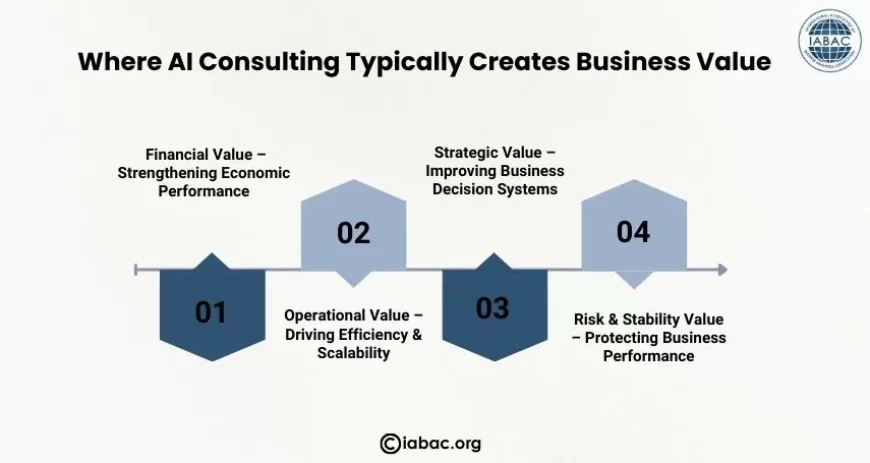
One of the most common misconceptions surrounding AI initiatives is the belief that value appears only through sophisticated models or breakthrough innovations.
In reality, the most meaningful returns from AI consulting engagements often emerge from fundamental business improvements rather than technological complexity.
For business owners and founders, understanding these value areas is essential because ROI is rarely driven by AI itself, but by how AI influences business performance.
AI consulting typically creates impact across four major dimensions.
1. Financial Value – Strengthening Economic Performance
For most businesses, financial outcomes remain the ultimate benchmark of success.
AI consulting can influence financial performance in multiple ways, often without requiring dramatic business model changes.
Common sources of financial value include:
✔ Cost Reduction
AI-driven automation, optimization, and predictive insights frequently reduce operational expenses. This may involve lowering manual effort, minimizing errors, or improving resource allocation.
✔ Margin Improvement
Better forecasting, pricing strategies, and demand predictions help businesses protect or enhance margins by reducing inefficiencies and waste.
✔ Revenue Influence
AI may support revenue growth through improved customer targeting, personalization, conversion optimization, or cross-selling opportunities.
✔ Capital Efficiency
Optimized inventory management, demand planning, and risk analysis can reduce unnecessary capital lock-in.
Importantly, financial ROI is often incremental and compounding, not always immediate or dramatic.
2. Operational Value – Driving Efficiency & Scalability
Many AI consulting projects deliver their most visible gains through operational improvements.
These changes directly affect how work is performed inside the organization.
Typical operational benefits include:
✔ Process Automation
Repetitive, rule-based tasks can be streamlined, allowing teams to focus on higher-value activities.
✔ Time Savings
AI-assisted workflows accelerate analysis, decision cycles, and execution speed.
✔ Error Reduction
Predictive models and intelligent validation mechanisms reduce costly mistakes and inconsistencies.
✔ Resource Optimization
Better planning and forecasting improve utilization of human and technical resources.
For founders, operational efficiency often translates into faster growth without proportional cost expansion, a powerful ROI driver.
3. Strategic Value – Improving Business Decision Systems
Beyond cost and efficiency, AI consulting frequently influences how organizations think and decide.
This dimension is often underestimated yet highly valuable.
AI-enabled decision improvements may involve:
✔ Forecast Accuracy
Better demand, sales, or risk forecasts reduce uncertainty and improve planning quality.
✔ Faster Decision Cycles
Access to timely insights shortens response times and enhances agility.
✔ Pattern & Opportunity Detection
AI uncovers trends, anomalies, and relationships that traditional analysis may miss.
✔ Scenario Evaluation
Organizations gain stronger analytical capabilities for evaluating potential strategies.
For business leaders, better decisions often produce disproportionate value relative to project costs.
4. Risk & Stability Value – Protecting Business Performance
Some of the most powerful ROI effects arise not from growth, but from risk mitigation and performance stability.
AI consulting can help reduce:
✔ Operational risks
✔ Forecasting errors
✔ Fraud & anomaly exposure
✔ Compliance vulnerabilities
✔ Process instability
Prevented losses, avoided disruptions, and improved predictability have real economic impact, even if they are less visible than revenue metrics.
For founders managing uncertainty, this dimension is frequently as important as growth-oriented returns.
The Often Ignored Side of ROI – Understanding Full Investment Costs
When businesses evaluate returns from AI initiatives, attention naturally gravitates toward potential benefits revenue growth, efficiency gains, automation, and innovation.
Yet ROI is fundamentally a relationship between benefits and costs.
And in many AI consulting engagements, the cost side of the equation is misunderstood, underestimated, or incompletely evaluated.
For business owners and founders, this is a critical oversight.
Because even highly successful initiatives may appear disappointing when investment components are poorly defined or hidden expenses emerge later in the project lifecycle.
Understanding ROI, therefore, requires a clear view of total economic commitment, not just visible consulting fees.
1. Consulting Fees Are Only One Part of the Investment
When engaging an AI consulting partner, businesses often anchor their expectations around professional service costs.
These typically include:
-
Strategy & assessment engagements
-
Use-case identification
-
Model development
-
Implementation guidance
-
Performance measurement frameworks
While consulting fees are important, they rarely represent the entire financial footprint of an AI initiative.
Focusing exclusively on them creates a distorted ROI perspective.
2. Infrastructure & Tooling Costs
AI initiatives frequently require supporting technology layers.
Depending on project scope, this may involve:
✔ Cloud services or computing resources
✔ Data storage & processing environments
✔ Analytics or ML platforms
✔ Integration tools
Even when incremental, these expenses contribute directly to ROI calculations and should be acknowledged early.
3. Data Preparation & Readiness Effort
Data is the foundation of AI performance yet preparing it often demands substantial effort.
Organizations may incur costs related to:
✔ Data cleaning & validation
✔ Data consolidation from multiple systems
✔ Labeling & structuring
✔ Governance & quality control
This investment is rarely optional.
Underestimating data readiness is one of the most common causes of budget overruns and perceived ROI challenges.
4. Integration & Deployment Costs
Delivering business value from AI requires embedding solutions into operational workflows.
This may include:
✔ System integration
✔ Process redesign
✔ Workflow adjustments
✔ Testing & validation cycles
Without proper deployment, even well-designed models fail to produce measurable returns.
5. Change Management & Adoption Friction
AI consulting projects often reshape how decisions are made and how teams operate.
Costs may arise from:
✔ Training & capability development
✔ Internal coordination & stakeholder alignment
✔ Process transitions
✔ Temporary productivity dips during adaptation
These factors are rarely captured in initial budgets but have genuine economic impact.
6. Hidden Costs & Expectation Gaps
Some expenses are not strictly financial yet influence ROI perception:
-
Delayed adoption
-
Resistance to change
-
Unrealistic timelines
-
Misaligned success criteria
When expectations diverge from operational realities, projects may be unfairly judged.
A Practical Framework Founders Can Use to Measure ROI
For many business owners, ROI discussions around AI feel abstract, technical, or overly theoretical.
In practice, measuring returns from AI consulting engagements does not require complex financial models or advanced analytics expertise. What it requires is structured thinking, clear objectives, and disciplined evaluation.
A reliable ROI assessment framework should help founders answer a simple but critical question:
“Did this investment create meaningful business value relative to its cost?”
The following model provides a practical approach that aligns with how real businesses operate.
Step 1 – Start With a Business Problem, Not AI
One of the most common causes of weak ROI is beginning with technology rather than need.
AI initiatives generate value when they address specific business constraints, such as:
✔ Operational inefficiencies
✔ High manual workload
✔ Forecasting inaccuracies
✔ Revenue leakage
✔ Customer churn
✔ Risk exposure
Framing the initiative around a measurable business challenge creates a foundation for realistic ROI evaluation.
Without this clarity, success becomes ambiguous.
Step 2 – Define What Success Looks Like
ROI cannot be measured if outcomes are undefined.
Business owners should establish clear performance expectations before implementation.
Examples include:
-
Reduce processing time by X%
-
Improve forecast accuracy by X%
-
Lower operational costs by X%
-
Increase conversion rates by X%
-
Reduce error rates by X%
Well-defined success indicators transform ROI from speculation into measurable comparison.
Step 3 – Establish Baseline Performance Metrics
A surprisingly large number of AI initiatives lack reliable pre-implementation benchmarks.
Without baseline metrics:
❌ Improvement cannot be quantified
❌ ROI becomes perception-driven
❌ Outcomes are easily misinterpreted
Founders should capture current performance indicators such as:
-
Costs
-
Cycle times
-
Error rates
-
Productivity levels
-
Revenue metrics
-
Decision accuracy indicators
This step is essential for credible ROI calculation.
Step 4 – Identify Expected Value Drivers
AI consulting projects rarely produce value through a single channel.
Benefits often arise from multiple drivers:
✔ Cost reduction
✔ Efficiency improvements
✔ Productivity gains
✔ Decision quality enhancements
✔ Risk mitigation
✔ Revenue influence
Recognizing these drivers prevents underestimation of project impact.
Step 5 – Map the Full Investment Commitment
As discussed earlier, investment includes more than consulting fees.
A realistic evaluation considers:
✔ Consulting costs
✔ Infrastructure & tools
✔ Data preparation effort
✔ Integration & deployment
✔ Training & adoption overhead
Incomplete cost mapping distorts ROI conclusions.
Step 6 – Apply Simple ROI Logic
At its core, ROI remains conceptually simple.
ROI = (Total Benefits – Total Costs) / Total Costs
For founders, the objective is not accounting precision but decision clarity.
Even directional estimates often provide meaningful insight when benefits and costs are defined sensibly.
Step 7 – Evaluate ROI Over an Appropriate Time Horizon
AI returns frequently evolve.
Early stages may produce:
-
Learning & calibration effects
-
Gradual efficiency gains
-
Progressive accuracy improvements
Premature evaluation risks undervaluing initiatives that generate compounding benefits.
ROI assessment should align with realistic adoption cycles.
Realistic ROI Scenarios Business Owners Can Relate To
One of the biggest obstacles in evaluating AI consulting investments is the abstract nature of expected returns.
Concepts such as “intelligence,” “automation,” or “optimization” sound promising yet without practical context, they remain difficult to translate into business impact.
Examining realistic scenarios helps clarify how ROI materializes in real organizations.
Scenario 1 – Cost Reduction Through Process Automation
Consider a business where critical operational workflows rely heavily on manual intervention.
Common symptoms may include:
-
High processing effort
-
Frequent delays
-
Repetitive tasks
-
Increased error probability
An AI consulting engagement might redesign and automate portions of this workflow.
Potential outcomes:
✔ Reduced manual effort
✔ Faster processing cycles
✔ Lower error rates
✔ Decreased operational overhead
Even without increasing revenue, the business experiences direct economic gains through lower cost structures and improved margin stability.
For many organizations, this is the earliest and most visible ROI channel.
Scenario 2 – Productivity Improvement Without Headcount Expansion
Growth-stage businesses often face a structural constraint:
Workload increases faster than team capacity.
Instead of expanding headcount immediately, AI-enabled decision support or automation may enhance team productivity.
Possible benefits:
✔ More output per employee
✔ Reduced time spent on low-value tasks
✔ Faster decision cycles
✔ Better resource utilization
Financially, this produces ROI by improving revenue-to-cost ratios and delaying or reducing hiring pressures.
For founders, this type of ROI is particularly valuable because it supports scalability.
Scenario 3 – Revenue Influence Through Better Targeting & Insights
Some AI consulting projects focus on improving how businesses identify, understand, and engage customers.
Examples include:
-
Improved customer segmentation
-
Better demand prediction
-
Enhanced recommendation systems
-
Smarter marketing allocation
Resulting gains may involve:
✔ Higher conversion rates
✔ Better campaign efficiency
✔ Reduced acquisition costs
✔ Improved customer lifetime value
Unlike simplistic revenue expectations, these improvements often produce incremental yet compounding financial effects.
Scenario 4 – Forecast Accuracy Reducing Financial Leakage
Forecasting errors silently erode profitability in many industries.
Inaccurate demand or sales projections can lead to:
❌ Overstocking or stockouts
❌ Inefficient capacity planning
❌ Revenue loss
❌ Excess operational costs
AI consulting interventions that improve predictive accuracy may yield:
✔ Lower waste & inefficiency
✔ Better capital allocation
✔ Reduced volatility
✔ Improved planning confidence
This form of ROI often appears as avoided losses rather than visible gains, yet its financial impact can be substantial.
Scenario 5 – Risk Reduction & Business Stability
Certain AI consulting initiatives primarily enhance resilience.
Examples:
-
Fraud detection
-
Anomaly identification
-
Compliance monitoring
-
Operational risk prediction
Benefits may include:
✔ Fewer unexpected losses
✔ Improved predictability
✔ Lower operational disruptions
✔ Stronger governance
While less dramatic than growth metrics, risk reduction directly influences long-term business survival and valuation.
Why Many Businesses Miscalculate AI ROI
Despite growing investment in AI initiatives, many organizations struggle to evaluate returns accurately.
Interestingly, the problem is rarely the technology itself.
In most cases, ROI confusion arises from expectation errors, measurement gaps, and decision biases that distort how outcomes are interpreted.
For business owners and founders, understanding these pitfalls is essential because miscalculated ROI often leads to flawed strategic conclusions.
1. Expecting Immediate Financial Returns
One of the most frequent mistakes is assuming that AI initiatives behave like traditional revenue-generating investments.
Founders may expect:
✔ Rapid revenue growth
✔ Instant cost reductions
✔ Immediate transformation
In reality, AI-driven value often accumulates progressively as:
-
Systems stabilize
-
Models improve
-
Teams adapt
-
Processes evolve
Premature evaluation can make successful projects appear disappointing.
2. Measuring Only Direct Revenue Impact
ROI assessments commonly focus on visible revenue movements while ignoring indirect yet economically significant effects.
Overlooked value drivers may include:
-
Reduced errors
-
Time savings
-
Better decisions
-
Lower operational risks
-
Improved efficiency
When these dimensions are excluded, ROI calculations underrepresent true business impact.
3. Absence of Baseline Metrics
Without reliable pre-implementation benchmarks, improvement becomes difficult to quantify.
This creates several problems:
❌ Benefits become subjective
❌ Results are debated rather than measured
❌ Perceived value fluctuates
Baseline clarity is foundational for credible ROI evaluation.
4. Underestimating Adoption & Change Dynamics
AI consulting projects often require operational adjustments and behavioral shifts.
Common oversights include:
✔ Training effort
✔ Workflow changes
✔ Stakeholder alignment
✔ Learning curves
When adoption challenges delay visible results, ROI may be misjudged even if long-term value is intact.
5. Treating AI as a Technology Experiment
Organizations sometimes pursue AI initiatives out of curiosity, trend pressure, or competitive fear rather than structured business need.
This leads to:
❌ Weak problem definition
❌ Unclear success criteria
❌ Ambiguous value measurement
Without strategic grounding, ROI becomes inherently unstable.
6. Ignoring Multi-Dimensional Value Creation
AI consulting rarely produces value through a single channel.
Returns often combine:
✔ Financial effects
✔ Operational improvements
✔ Decision enhancements
✔ Risk mitigation
Overly narrow evaluation models fail to capture this layered impact.
How AI Consulting Improves ROI Predictability & Outcomes
For many business owners, uncertainty is the primary barrier to AI investment.
Questions often arise:
-
“Will this actually deliver value?”
-
“How do we avoid wasting resources?”
-
“How do we know what to prioritize?”
-
“How can outcomes be measured realistically?”
While AI technologies are powerful, the success of an initiative rarely depends on algorithms alone.
In practice, structured decision-making and disciplined execution play a far greater role in determining ROI.
This is where consulting engagements frequently create disproportionate value.
1. Clarifying the Right Problems to Solve
One of the biggest threats to ROI is pursuing technically interesting but commercially weak initiatives.
AI consulting helps organizations:
✔ Identify high-impact opportunities
✔ Prioritize based on business value
✔ Avoid low-return experimentation
✔ Align projects with strategic goals
Correct problem selection dramatically improves ROI probability.
2. Establishing Measurable Success Frameworks
Poor measurement models often distort perceived outcomes.
Consultants typically assist in defining:
✔ Clear objectives
✔ Practical KPIs
✔ Baseline metrics
✔ Evaluation timelines
This prevents ambiguity and protects investment credibility.
3. Reducing Costly Execution Errors
AI initiatives involve numerous interdependent decisions:
-
Data strategy
-
Model design
-
Integration approach
-
Workflow alignment
-
Change management
Missteps in any of these areas can erode returns.
Consulting guidance reduces:
✔ Rework & inefficiencies
✔ Misaligned implementations
✔ Unrealistic expectations
✔ Resource misallocation
4. Accelerating Time-to-Value
Time is a critical ROI variable.
Delayed benefits weaken investment perception even when eventual gains are strong.
Experienced consulting partners often help:
✔ Shorten learning curves
✔ Avoid common implementation traps
✔ Streamline deployment paths
✔ Maintain execution momentum
5. Improving Organizational Adoption
Even technically successful AI systems fail without adoption.
Consulting engagements frequently address:
✔ Stakeholder alignment
✔ Change management
✔ Process adjustments
✔ Capability development
Higher adoption → Greater realized ROI.
6. Creating Long-Term Business Capabilities
Some ROI benefits extend beyond immediate project outcomes.
AI consulting often contributes to:
✔ Better decision frameworks
✔ Improved data maturity
✔ Scalable analytical capabilities
✔ Stronger internal expertise
These assets compound value over time.
Practical Advice for Founders Evaluating AI Investments
For business owners and founders, investing in AI consulting is rarely just a technology decision.
It is a capital allocation decision involving risk, uncertainty, and long-term impact.
While AI presents significant opportunities, extracting measurable value requires disciplined evaluation rather than optimism or industry pressure.
The following principles help founders make more informed, lower-risk decisions.
1. Start With Business Constraints, Not Technology Trends
AI initiatives create value when they address genuine business bottlenecks.
Before considering tools or models, clarify:
✔ Where is the business losing efficiency?
✔ Which decisions lack reliability?
✔ Which processes limit scalability?
✔ Where do errors or delays create cost?
Technology should follow business need never the reverse.
2. Define Success in Measurable Terms
Ambiguous objectives weaken ROI clarity.
Founders should articulate expected outcomes such as:
-
Cost reduction targets
-
Efficiency improvements
-
Accuracy enhancements
-
Revenue influence indicators
-
Risk reduction goals
Clear expectations protect investment evaluation later.
3. Recognize That ROI May Be Indirect
Not all returns appear as immediate revenue increases.
High-value gains may include:
✔ Reduced waste & errors
✔ Faster execution cycles
✔ Better decision quality
✔ Lower operational risks
✔ Improved scalability
Ignoring indirect benefits leads to systematic undervaluation.
4. Evaluate Total Economic Commitment
Avoid judging initiatives solely on consulting fees.
Consider:
✔ Infrastructure requirements
✔ Data readiness effort
✔ Integration complexity
✔ Adoption & training overhead
✔ Change management impact
Full-cost visibility prevents distorted ROI conclusions.
5. Adopt Realistic Time Horizons
AI benefits frequently compound over time.
Early phases may involve:
-
Calibration & learning
-
Process adjustments
-
Gradual accuracy improvements
Premature ROI judgment is a common source of frustration.
6. Prioritize High-Impact Use Cases First
Not all AI opportunities are equally valuable.
Early initiatives should target areas with:
✔ Clear measurable gains
✔ High operational friction
✔ Significant cost or risk exposure
✔ Strong data availability
Early wins build organizational confidence and ROI momentum.
7. Avoid Over-Optimistic Vendor Narratives
AI investments are often surrounded by exaggerated claims.
Healthy skepticism is rational.
Focus on:
✔ Business logic
✔ Measurement feasibility
✔ Practical implementation realities
✔ Evidence-based expectations
8. View Consulting as Risk Reduction, Not Expense
For many founders, consulting costs are evaluated purely as expenditure.
However, experienced advisory support frequently reduces:
✔ Costly strategic mistakes
✔ Misaligned implementations
✔ Unrealistic expectations
✔ Delayed value realization
Which directly influences ROI stability.
Measuring AI ROI Is a Strategy Discipline, Not a Formula
For business owners and founders, the question of ROI is both rational and unavoidable.
Every meaningful investment competes for limited resources, managerial attention, and organizational commitment. AI consulting initiatives are no exception.
Yet one of the most important realizations for decision-makers is that ROI in AI projects rarely behaves like traditional investment models.
Returns may not be immediate.
Benefits may not be purely financial.
Value may emerge through efficiency, accuracy, risk reduction, or improved decision systems rather than direct revenue spikes.
This does not make ROI irrelevant it makes how ROI is evaluated far more important.
Organizations that approach AI investments with narrow expectations often encounter confusion or disappointment. Those that adopt structured, multi-dimensional evaluation frameworks typically gain a clearer and more accurate view of outcomes.
Measuring ROI from AI consulting projects is therefore less about complex mathematics and more about disciplined strategic thinking:
✔ Defining meaningful business objectives
✔ Establishing credible baselines
✔ Recognizing diverse value drivers
✔ Accounting for total investment realities
✔ Evaluating outcomes over realistic horizons
When these elements are present, ROI becomes not only measurable, but insightful.
Equally important, successful AI initiatives are rarely driven by technology alone.
They depend on:
-
Problem selection
-
Execution discipline
-
Organizational adoption
-
Measurement clarity
This is precisely why consulting engagements often influence ROI stability and predictability — by reducing avoidable errors, structuring decisions, and aligning initiatives with business priorities.
For founders and business leaders, the core takeaway is simple but powerful:
AI ROI is real, but it is rarely accidental.
It emerges from clarity, structure, and informed decision-making rather than optimism or technological enthusiasm.
When evaluated thoughtfully, AI consulting shifts from being a speculative expense to becoming a deliberate investment in business performance, resilience, and long-term competitiveness.