

























































How to Choose the Right AI Consulting Company?
Find the right AI consulting partner with confidence. Understand selection criteria, risks, and practical decision factors for successful AI projects.

Artificial intelligence is becoming a practical part of everyday business operations. Companies are using AI to improve efficiency, automate repetitive tasks, strengthen decision-making, and better understand customer behavior.
Yet, despite the excitement, many AI initiatives fail, not because AI doesn’t work, but because companies start with the wrong strategy or the wrong partner.
Choosing an AI consulting company is one of the most critical decisions in your AI journey. The right consulting partner can help you identify practical opportunities, avoid expensive mistakes, and turn AI into measurable business value. The wrong one can lead to wasted budgets, unrealistic expectations, and stalled projects.
The challenge is that the AI consulting landscape is crowded. Many firms claim expertise, promise rapid results, and use impressive technical language, making it difficult to distinguish genuine capability from marketing noise.
So how do you actually evaluate an AI consulting company?
What separates a reliable partner from a risky choice?
What factors truly matter beyond sales presentations and buzzwords?
This guide breaks down the decision process in a clear and practical way. Whether you are just starting to explore AI or actively comparing consulting firms, you’ll learn exactly what to look for, what questions to ask, and which red flags to avoid.
What Does an AI Consulting Company Actually Do?
Before evaluating or comparing AI consulting companies, it’s important to understand what these firms are truly responsible for. Many businesses assume AI consultants simply build machine learning models or deploy automation tools. In reality, their role is much broader and far more strategic.
A good AI consulting company does not start with algorithms or technologies. It starts with your business.
Instead of asking, “Which AI model should we use?”, experienced consultants ask questions like:
-
What business problem are we trying to solve?
-
Do we have the right data to support AI initiatives?
-
What outcomes would make this project successful?
-
How will this integrate with existing systems?
This shift in perspective is critical. Artificial intelligence is not a standalone product it is a capability that must align with business objectives, operational workflows, and data realities.
AI Consulting vs AI Development vs Outsourcing
One common source of confusion is the difference between AI consulting, AI development, and AI outsourcing.
AI consulting focuses on strategy, feasibility, planning, and guidance.
AI development focuses on building models or applications.
Outsourcing focuses on delegating technical work.
While there is often overlap, a true consulting partner helps you decide:
✔ Whether AI is even the right solution
✔ Where AI will generate real value
✔ How to minimize risks and costs
✔ How to scale initiatives long-term
Without this strategic layer, many companies invest in AI tools that never deliver meaningful returns.
Typical Services Offered by AI Consulting Companies
Although offerings vary, most credible AI consulting firms provide support across several key areas:
1. AI Opportunity & Strategy Assessment
Consultants analyze your business processes, data environment, and objectives to identify realistic AI use cases. This prevents organizations from pursuing AI simply because it is trending.
Example outcomes may include:
-
Process automation opportunities
-
Predictive analytics use cases
-
Personalization strategies
-
Cost reduction initiatives
2. Data Readiness & Infrastructure Evaluation
AI systems depend heavily on data quality and accessibility. A strong consulting company evaluates:
-
Data availability and structure
-
Data quality issues
-
Integration challenges
-
Infrastructure limitations
Many AI failures originate here, long before models are built.
3. Solution Design & Technology Selection
Rather than forcing a single tool or platform, consultants recommend solutions based on:
✔ Business needs
✔ Scalability
✔ Budget constraints
✔ Technical compatibility
This reduces vendor lock-in and costly redesigns later.
4. Model Development & Implementation Guidance
Some consulting firms also assist with:
-
Machine learning model design
-
Workflow integration
-
Performance validation
-
Deployment planning
Importantly, this stage should follow business and data validation, not precede it.
5. Deployment, Monitoring & Optimization
AI is not a one-time implementation. Models require monitoring, tuning, and sometimes retraining. Good consultants plan for:
-
Performance tracking
-
Error analysis
-
Continuous improvement
-
Business impact measurement
Why This Understanding Matters When Choosing a Partner
Knowing what an AI consulting company actually does helps you avoid a common mistake: selecting firms based purely on technical claims.
AI success is rarely determined by algorithms alone. It depends on:
✅ Problem definition
✅ Data strategy
✅ Business alignment
✅ Execution discipline
A consulting partner should therefore be evaluated not just on coding ability but on their ability to connect AI initiatives with tangible business outcomes.
Before You Start: Define Your Business & AI Needs
One of the biggest mistakes companies make when selecting an AI consulting company happens before they even speak to a consultant.
They start by asking:
❌ “Which AI consulting firm is the best?”
Instead of:
✅ “What exactly are we trying to achieve with AI?”
Artificial intelligence is not a universal solution. Without clearly defined goals, even the most technically capable consulting partner will struggle to deliver meaningful results.
Before evaluating vendors, take a step back and clarify your internal priorities.
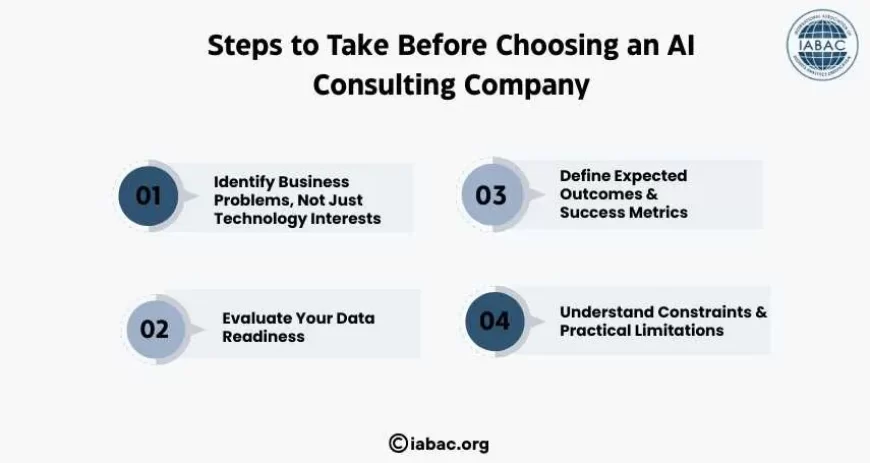
1. Identify Business Problems, Not Just Technology Interests
Many organizations approach AI with vague ambitions like
-
“We want to use AI."
-
“We need machine learning."
-
“Our competitors are adopting AI."
These are not business objectives; they are technology interests.
Strong AI initiatives start with specific operational or strategic challenges, such as:
✔ Reducing manual workload
✔ Improving demand forecasting
✔ Personalizing customer experiences
✔ Detecting fraud or anomalies
✔ Optimizing pricing or inventory
When the problem is clear, solution design becomes far more effective.
A reliable AI consulting company will always prioritize problem definition over tool selection.
2. Evaluate Your Data Readiness
AI systems are fundamentally dependent on data. Yet many businesses underestimate how often data limitations derail projects.
Before engaging consultants, consider:
-
Do we have sufficient historical data?
-
Is our data accurate and consistent?
-
Are datasets accessible and well-structured?
-
Do data silos exist across departments?
Even advanced AI models cannot compensate for poor data quality.
Understanding your data environment helps you:
✅ Set realistic expectations
✅ Avoid misleading vendor promises
✅ Accelerate project timelines
Competent consultants will examine this early, but internal awareness prevents costly misunderstandings.
3. Define Expected Outcomes & Success Metrics
Another frequent source of failure is unclear success criteria.
If you cannot define what success looks like, evaluating consulting proposals becomes nearly impossible.
Useful outcome definitions include:
✔ Cost reduction targets
✔ Efficiency improvements
✔ Revenue growth opportunities
✔ Accuracy improvements
✔ Risk mitigation goals
For example:
-
“Reduce processing time by 40%”
-
“Improve prediction accuracy by 25%”
-
“Lower customer churn rate”
Clear metrics shift discussions from vague innovation to measurable value.
4. Understand Constraints & Practical Limitations
Every AI initiative operates within constraints:
-
Budget limitations
-
Technical infrastructure
-
Regulatory requirements
-
Organizational readiness
-
Change management challenges
Ignoring these factors often leads to overly ambitious strategies that fail in execution.
A good AI consulting company works within business realities, not theoretical possibilities.
Why This Step Significantly Improves Consultant Selection
When your internal priorities are defined, vendor evaluation becomes dramatically easier.
Instead of being influenced by sales presentations or technical jargon, you can assess consulting firms based on:
✅ Relevance to your problems
✅ Practicality of proposed solutions
✅ Realistic timelines & costs
✅ Alignment with business goals
This clarity protects your organization from misaligned partnerships, one of the most common reasons AI investments underperform.
Key Criteria for Choosing the Right AI Consulting Company
Selecting an AI consulting company is not simply a vendor comparison exercise. It is a strategic decision that can directly influence project success, financial outcomes, and long-term technology direction.
While many firms claim expertise, genuine capability reveals itself through a combination of business understanding, technical depth, execution discipline, and transparency.
Below are the factors that truly differentiate reliable consulting partners from risky choices.
1. Industry Expertise & Domain Knowledge
Artificial intelligence is highly context-dependent. Models, predictions, and automation strategies that work in one industry may be inefficient in another.
A consulting company with relevant domain experience will:
✔ Understand your operational challenges
✔ Recognize realistic use cases
✔ Anticipate data limitations
✔ Avoid impractical recommendations
For example, AI strategies for healthcare, retail, and finance differ significantly in regulatory constraints, data structures, and risk considerations.
What to evaluate:
-
Prior projects in your industry
-
Case studies with measurable outcomes
-
Familiarity with sector-specific challenges
A technically strong but domain-naïve consultant often increases experimentation costs and delays.
2. Technical Capabilities & AI Skillset
AI consulting requires more than basic software development skills. Credible firms should demonstrate expertise across multiple technical areas.
Look for depth in:
-
Machine learning & predictive modeling
-
Data engineering & preprocessing
-
Model deployment & monitoring
-
MLOps / scaling practices
-
Relevant subfields (NLP, computer vision, etc.)
Be cautious of firms relying heavily on buzzwords without clear explanations.
A useful test:
Can they explain their technical approach in clear business language?
Strong consultants simplify complexity; they do not hide behind jargon.
3. Proven Track Record & Case Studies
Experience claims mean little without evidence. A reliable AI consulting company should demonstrate past success through real implementations.
Effective case studies describe:
✔ Business problem
✔ Solution approach
✔ Implementation challenges
✔ Measurable outcomes
Avoid being persuaded by generic statements like “We implemented AI solutions for multiple clients.”
What matters: Specificity and results.
4. Strategic & Structured Implementation Approach
AI initiatives fail less due to algorithms and more due to poor planning.
Competent consulting firms follow structured methodologies:
Problem Definition → Feasibility → Proof of Concept → MVP → Production
This staged approach:
✅ Reduces risk
✅ Controls costs
✅ Validates assumptions
✅ Improves stakeholder confidence
Firms that jump directly to full-scale development often create expensive misalignment.
5. Data Strategy & Governance Practices
Data is the foundation of AI. Yet many companies neglect evaluating how consultants handle data risks and responsibilities.
Assess their approach to:
-
Data quality validation
-
Privacy & compliance awareness
-
Bias & fairness considerations
-
Data security practices
-
Governance frameworks
A consulting company that ignores these issues introduces operational and reputational risks.
6. Customization vs Generic Solutions
AI effectiveness depends heavily on business context and data characteristics. Prepackaged solutions rarely deliver optimal results.
Reliable consultants emphasize:
✔ Tailored models
✔ Context-aware strategies
✔ Flexible architectures
Warning sign: identical solutions proposed across unrelated industries.
7. Communication & Collaboration Style
Technical competence alone is insufficient. AI projects require close collaboration between business leaders, technical teams, and stakeholders.
Evaluate whether the consulting firm:
✅ Communicates clearly
✅ Listens to business constraints
✅ Explains trade-offs transparently
✅ Responds promptly
Poor communication is a silent but frequent cause of AI project failure.
8. Pricing Model & Value Alignment
Pricing structures vary widely across AI consulting engagements. The lowest cost option is not always the most economical long-term choice.
Understand:
-
Fixed vs milestone-based pricing
-
Scope assumptions
-
Hidden dependencies
-
Outcome expectations
Be cautious of unrealistic ROI guarantees or unusually vague estimates.
9. Team Composition & Expertise
AI consulting quality depends on who actually performs the work.
Strong firms typically involve:
✔ Data scientists
✔ ML engineers
✔ Domain experts
✔ Solution architects
Avoid firms unable to clearly describe team roles or expertise.
10. Post-Deployment Support & Optimization
AI systems require continuous monitoring and refinement. Models degrade, data shifts, and business needs evolve.
Confirm whether the consultant provides:
-
Performance monitoring
-
Model retraining strategies
-
Issue resolution
-
Long-term optimization
Consultants focused only on initial delivery often leave businesses with unsustainable solutions.
Why These Criteria Matter More Than Marketing Claims
The AI consulting market contains both highly capable experts and aggressively marketed generalists.
By evaluating firms using structured criteria rather than persuasive language, businesses significantly reduce:
❌ Financial risks
❌ Project delays
❌ Unrealistic expectations
❌ Technology misalignment
AI success depends less on promises and more on competence, discipline, and alignment.
Essential Questions to Ask an AI Consulting Company
Once you begin shortlisting potential AI consulting partners, conversations can quickly become dominated by technical language, impressive presentations, and optimistic projections.
The key to making a sound decision is asking the right questions.
Strong AI consulting companies welcome detailed discussions. Weak or inexperienced firms often provide vague, evasive, or overly simplified answers.
Below are critical questions that help reveal genuine capability, working style, and risk factors.
1. How Do You Identify Suitable AI Opportunities?
Not every business problem requires AI. A competent consulting firm should describe a structured evaluation process rather than immediately recommending solutions.
Look for answers involving:
✔ Business problem analysis
✔ Feasibility assessment
✔ Cost vs value considerations
✔ Data availability review
Be cautious if the firm pushes AI before understanding your operations.
2. How Do You Evaluate Data Readiness and Quality?
Many AI initiatives fail due to data limitations. Experienced consultants treat data assessment as a foundational step.
Strong responses typically reference:
-
Data audits
-
Quality checks
-
Missing data challenges
-
Integration obstacles
-
Data preprocessing strategies
A consultant ignoring data risks is a serious red flag.
3. Can You Share Relevant Case Studies or Examples?
Past experience is one of the most reliable indicators of capability.
Useful follow-ups:
-
What was the business problem?
-
What challenges arose during implementation?
-
What measurable outcomes were achieved?
-
How long did the project take?
Avoid being influenced by generic claims without specifics.
4. What Implementation Methodology Do You Follow?
Reliable AI consulting companies rarely rely on ad hoc execution. They follow structured project stages.
Expect references to:
Problem Definition → Proof of Concept → Validation → Deployment → Optimization
This signals disciplined thinking and risk management.
5. How Do You Measure AI Project Success?
Success metrics should extend beyond model accuracy.
Strong consultants discuss:
✔ Business impact metrics
✔ ROI considerations
✔ Efficiency gains
✔ Risk reduction
✔ Performance monitoring
If success is defined only technically, business value may be neglected.
6. How Do You Handle Model Maintenance and Updates?
AI systems require continuous oversight. Data changes, user behavior shifts, and models degrade.
Clarify:
-
Monitoring mechanisms
-
Retraining processes
-
Performance thresholds
-
Support responsibilities
Ignoring lifecycle management often leads to declining results.
7. How Do You Address Data Privacy, Security, and Compliance?
AI projects frequently involve sensitive business or customer data.
A credible consulting firm should demonstrate awareness of:
✔ Data protection practices
✔ Regulatory considerations
✔ Access controls
✔ Risk mitigation strategies
Vague answers here indicate potential operational risks.
8. Who Will Actually Work on Our Project?
Sales teams often differ from delivery teams.
Request clarity on:
-
Team composition
-
Roles & expertise
-
Seniority levels
-
Domain knowledge
Transparency reduces unpleasant surprises later.
9. What Risks or Challenges Do You Anticipate for Our Case?
Strong consultants do not promise effortless success. They openly discuss uncertainties and constraints.
Balanced answers indicate:
✅ Realistic expectations
✅ Experience with failures & mitigation
✅ Strategic maturity
Overconfidence is often a warning sign.
10. How Do You Structure Pricing and Project Scope?
Misaligned expectations frequently originate from unclear commercial terms.
Understand:
✔ Pricing model
✔ Scope assumptions
✔ Change management process
✔ Dependency factors
Ambiguity here often leads to budget disputes.
Red Flags to Watch Out For When Choosing an AI Consulting Company
While many AI consulting firms present themselves as highly capable and results-driven, not all providers possess the expertise, discipline, or transparency required for successful AI initiatives.
Identifying warning signs early can save your organization from costly missteps, delayed projects, and unrealistic expectations.
Below are some of the most common red flags businesses encounter when selecting AI consulting partners.
1. Guaranteed Results or Unrealistic ROI Promises
Artificial intelligence projects involve uncertainty. Data limitations, integration challenges, and operational complexities make rigid guarantees impractical.
Be cautious of statements like
❌ “We guarantee success.”
❌ “You will definitely achieve X% ROI.”
Reliable consultants discuss probabilities, risks, and assumptions, not absolute promises.
2. Lack of Interest in Your Business Model
Competent AI consulting companies begin by understanding your operations, constraints, and objectives.
Warning signs include:
-
Jumping directly to solutions
-
Minimal questions about workflows
-
No exploration of business priorities
AI without business alignment often leads to technically impressive but commercially useless systems.
3. Ignoring Data Quality and Availability
Data is the foundation of AI. Any consulting firm that downplays or bypasses data evaluation introduces serious project risks.
Red flag behaviors:
❌ No data assessment discussions
❌ Overconfidence despite unclear datasets
❌ Vague explanations about data preparation
Even advanced AI models cannot compensate for poor data environments.
4. Excessive Buzzwords Without Clear Explanations
Complex terminology is sometimes used to mask weak expertise.
If consultants rely heavily on jargon but struggle to explain:
-
Practical implementation steps
-
Business implications
-
Limitations & trade-offs
…this often indicates superficial understanding.
Strong experts simplify complexity; they do not hide behind it.
5. No Clear Implementation Framework
AI initiatives require structured planning and staged execution.
Be cautious if the firm cannot clearly describe:
✔ Project phases
✔ Validation checkpoints
✔ Risk controls
✔ Success criteria
Ad-hoc execution frequently leads to budget overruns and misaligned expectations.
6. Vague or Evasive Pricing Structures
Ambiguity in commercial terms often results in disputes later.
Warning indicators:
-
Unclear scope definitions
-
No explanation of change requests
-
Highly inconsistent estimates
-
Hidden dependency risks
Transparency is a strong predictor of consultant reliability.
7. Limited or Non-Verifiable Case Studies
Experience claims should be supported by credible examples.
Red flags include:
❌ Generic project descriptions
❌ No measurable outcomes
❌ Inability to explain challenges faced
Specificity signals genuine experience.
8. Overemphasis on Tools Rather Than Outcomes
Technology is only one part of AI success.
Consultants overly focused on:
-
Specific platforms
-
Proprietary tools
-
Trendy technologies
…without discussing business value may prioritize selling solutions over solving problems.
9. Lack of Post-Deployment Strategy
AI systems require continuous monitoring and adaptation.
A weak consulting partner may:
❌ Treat deployment as the finish line.
❌ Ignore maintenance & retraining
❌ Avoid long-term performance discussions
This often results in degrading system effectiveness.
Why Recognizing Red Flags Matters
Many AI project failures stem not from technology limitations but from poor consultant selection and unrealistic expectations.
By spotting warning signs early, businesses significantly reduce:
✅ Financial risks
✅ Operational disruptions
✅ Strategic misalignment
✅ Project failure probability
A strong AI consulting company demonstrates transparency, realism, structured thinking, and genuine interest in your business outcomes.
Example Scenario: The Difference the Right AI Consulting Partner Makes
To understand why consultant selection matters so much, consider a simplified but very realistic scenario.
The Situation
A mid-sized retail company decides to invest in artificial intelligence to improve sales forecasting and inventory planning.
Their goal is straightforward:
✔ Reduce stockouts
✔ Avoid overstocking
✔ Improve demand predictions
Excited by AI’s potential, they begin searching for an AI consulting company.
The Wrong Choice
The company selects a consulting firm based primarily on:
-
An impressive sales presentation
-
Confident ROI projections
-
Heavy emphasis on advanced algorithms
-
Competitive pricing
However, several problems emerge quickly.
The consultants propose a sophisticated predictive model without thoroughly assessing data quality. Historical sales data contains inconsistencies, missing values, and seasonal distortions.
Instead of addressing these issues first, the firm proceeds directly to model development.
Within months:
❌ Forecast accuracy remains poor
❌ Operational teams lose confidence.
❌ Project costs increase due to revisions.
❌ Internal frustration grows
Technically, a model was delivered. Practically, business value was limited.
What Went Wrong
The failure was not caused by AI technology itself.
It resulted from:
❌ Weak problem framing
❌ Insufficient data assessment
❌ Overconfidence in algorithms
❌ Lack of structured validation
These are classic consequences of choosing a consulting partner based on marketing strength rather than evaluation criteria.
The Right Choice
After reassessing their approach, the company engages a different AI consulting firm.
This time, the process looks very different.
Before proposing solutions, the consultants:
✅ Conduct a detailed data audit
✅ Identify quality gaps & anomalies
✅ Align expectations with data realities
✅ Define measurable success metrics
✅ Recommend phased implementation
Instead of rushing into complex modeling, they prioritize data correction and validation.
Only after stabilizing the data foundation do they design forecasting models.
The Outcome
Over time:
✔ Forecast accuracy improves.
✔ Inventory decisions stabilize.
✔ Teams trust the system.
✔ ROI becomes measurable.
✔ AI initiatives scale gradually
The key difference was not algorithmic complexity; it was strategic discipline and alignment.
Why This Scenario Matters
This example illustrates a common but overlooked truth:
AI project success depends more on decision quality and execution strategy than on model sophistication.
The right AI consulting company:
✅ Challenges assumptions
✅ Addresses risks early
✅ Aligns technology with business realities
✅ Builds sustainable systems
The wrong one often accelerates mistakes.
The Practical Lesson
When evaluating AI consulting partners, businesses should remember:
✔ Strong presentations do not equal strong execution.
✔ Advanced terminology does not guarantee expertise.
✔ Early data assessment is non-negotiable.
✔ Realism is more valuable than overconfidence
Consultant selection is not a procurement step; it is a strategic investment decision.
Choosing an AI Consulting Company with Confidence
After reviewing evaluation criteria, key questions, and common warning signs, the selection process becomes far more structured and less influenced by marketing or hype.
Before making your final decision, use this checklist to ensure you are choosing a consulting partner based on substance rather than surface impressions.
Business Alignment
✔ Have we clearly defined the business problem we want to solve?
✔ Does the consulting firm understand our industry and operational context?
✔ Are proposed solutions tied to measurable business outcomes?
Artificial intelligence initiatives succeed when technology serves business objectives, not the other way around.
Data & Feasibility Awareness
✔ Has the consultant evaluated our data readiness and quality?
✔ Were potential data challenges openly discussed?
✔ Are expectations realistic given our data environment?
Ignoring data constraints is one of the most frequent causes of AI project failure.
Technical & Strategic Capability
✔ Can the firm clearly explain its methodology and approach?
✔ Do they demonstrate both technical depth and strategic thinking?
✔ Is there a structured implementation roadmap?
Effective AI consulting requires more than coding expertise; it requires disciplined problem-solving.
Transparency & Communication
✔ Are explanations clear, practical, and understandable?
✔ Is the pricing structure well-defined and unambiguous?
✔ Does the team communicate openly about risks and limitations?
Transparency is often a reliable predictor of consulting quality.
Proof of Experience
✔ Are case studies specific, relevant, and credible?
✔ Can past projects and outcomes be verified?
✔ Does the firm demonstrate real-world problem-solving experience?
Experience reduces experimentation risks and improves decision accuracy.
Long-Term Support & Sustainability
✔ Does the consultant address post-deployment monitoring and updates?
✔ Are maintenance and optimization responsibilities defined?
✔ Is scalability considered from the start?
AI systems are dynamic and require continuous oversight.
Why This Checklist Matters
AI consulting decisions frequently involve significant investments, strategic implications, and operational changes.
Using a structured evaluation framework helps businesses avoid:
❌ Emotion-driven decisions
❌ Overconfidence traps
❌ Misleading claims
❌ Misaligned partnerships
A strong AI consulting company earns trust through clarity, discipline, and alignment, not persuasive language alone.
Confidence Comes from Structure, Not Assumptions
When businesses combine:
✅ Clear internal priorities
✅ Objective evaluation criteria
✅ Thoughtful vendor discussions
✅ Risk awareness
…the selection process becomes far more predictable and far less risky.
Choosing the Right AI Consulting Company Is a Strategic Decision
Artificial intelligence has the potential to transform how businesses operate, compete, and grow. But the success of any AI initiative depends far less on tools or algorithms and far more on clarity, strategy, and execution discipline.
Selecting an AI consulting company is therefore not just a vendor decision; it is a strategic investment that can shape project outcomes, financial returns, and long-term capabilities.
The right consulting partner helps you:
✅ Identify practical opportunities
✅ Avoid expensive missteps
✅ Work within data realities
✅ Align AI initiatives with business value
✅ Build solutions that remain effective over time
The wrong choice, on the other hand, often results in misaligned expectations, wasted budgets, and stalled projects even when the technology itself is sound.
By approaching consultant selection with structured evaluation criteria, thoughtful questions, and awareness of common red flags, businesses dramatically improve their chances of achieving meaningful and measurable results.
AI success is rarely accidental. It is usually the outcome of well-informed decisions made early.
Choose your consulting partner with the same care you would apply to any long-term strategic initiative because that is exactly what AI represents.