



















































What Skills Are Taught in Data Science Certificate Online
Learn the core skills taught in a Data Science Certificate Online including Python statistics machine learning data visualization and real world projects.

Thinking about building a career in data science?
You’ve probably searched for a data science certificate online and wondered:
What skills will I actually learn?
Is it just coding?
Is it only a theory?
Or does it truly prepare you for real jobs?
Keep reading. This guide explains everything step by step in simple language.
Let’s Start with the Basics
A good data science certificate online program does not begin with complex algorithms. It starts with foundations.
You first learn:
- What data science really means
- The difference between data science and data analytics
- How companies use data to make decisions
- The life cycle of data in organizations
This foundation helps you understand the bigger picture before moving into technical topics.
Now let’s move deeper.
Programming Skills – The Core of Data Science
You cannot work in data science without programming. That’s why most Data Science Certifications focus heavily on coding.
The most commonly taught language is Python.
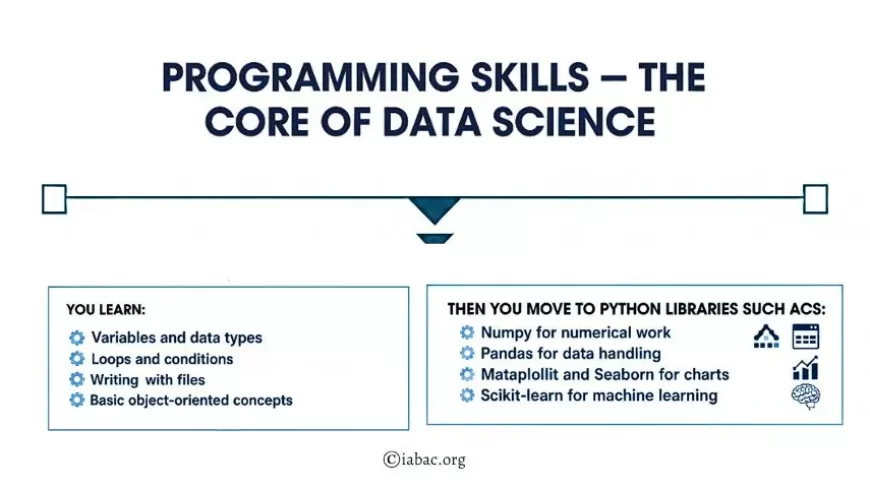
You learn:
- Variables and data types
- Loops and conditions
- Writing functions
- Working with files
- Basic object-oriented concepts
Then you move to Python libraries such as:
- NumPy for numerical work
- Pandas for data handling
- Matplotlib and Seaborn for charts
- Scikit-learn for machine learning
Some programs also teach R programming for statistical analysis.
These tools allow you to work with real datasets confidently.
Continue reading to understand the math behind it.
Mathematics – The Foundation Behind the Models
Many students worry about math. But the truth is, math is what makes data science powerful.
A structured data science certificate online covers math in a practical way.
You learn basic linear algebra.
For example, data is often stored in matrix form:
X=x11x21x31x12x22x32x13x23x33
Each row represents one record.
Each column represents one feature.
You also study:
- Mean
- Variance
- Standard deviation
- Probability
- Correlation
- Regression
For example:
Mean=N∑X
These formulas help you understand patterns in data.
Keep going — this is where things become practical.
Data Cleaning – Fixing Messy Data
Real-world data is not perfect. It often contains problems that can affect analysis and machine learning results.
Common Problems in Real-World Data
1. Missing Values: Data may have empty fields due to incomplete forms, system errors, or data loss. Missing values can distort analysis and model performance if not handled correctly.
2. Duplicate Records: The same record might appear multiple times because of system merges, manual entry errors, or repeated submissions. Duplicates can inflate metrics and bias results.
3. Incorrect Entries: Human errors such as spelling mistakes, wrong formats, swapped columns, or invalid categories can introduce inconsistencies. For example:
- “NY” vs “New York”
- Date formats like DD/MM/YYYY vs MM/DD/YYYY
- Negative values where they are not logically possible
4. Outliers: Extreme values that differ significantly from other observations. While some outliers represent real but rare events, others are caused by data entry mistakes or sensor malfunctions.
What You Learn in Data Cleaning
A strong certification teaches you how to:
Remove Duplicates
Find and delete repeated records.
Handle Missing Data
- Remove rows with too many missing values
- Fill missing values with suitable replacements (mean, median, etc.)
Normalize Values
Make data consistent:
- Same format (dates, text, units)
- Scale numbers properly
Prepare Data for Modeling
- Convert text into numbers
- Select useful features
- Split data for training and testing
Why Clean Data Matters
Clean data:
- Improves model accuracy
- Reduces errors
- Helps make better decisions
- Builds trust in results
Simply put: Better data = Better results.
Presenting Insights
After cleaning the data, the next step is showing the results clearly.
You should be able to:
- Create simple charts and dashboards
- Explain findings clearly
- Connect insights to business goals
- Suggest actions based on data
Good data cleaning leads to reliable insights and smarter decisions.
Data Visualization – Making Data Easy to Understand
Data is useless if no one understands it.
That’s why Data Science Certifications teach visualization skills.
You learn how to create:
- Dashboards
- Charts
- KPI reports
- Business presentations
Tools commonly included:
- Power BI
- Tableau
- Python visualization libraries
- Excel dashboards
Visualization helps managers quickly understand trends and make decisions.
But analysis doesn’t stop there.
SQL and Database Skills
Most company data is stored in databases.
That’s why SQL is a must.
In a data science certificate online, you learn:
- SELECT statements
- WHERE filters
- JOIN operations
- GROUP BY functions
- Aggregations like SUM and COUNT
This allows you to retrieve data directly from databases.
Next comes one of the most exciting parts.
Machine Learning – Teaching Computers to Predict
Machine learning is an important part of Data Science certifications. It focuses on teaching computers how to learn from data and make predictions without being directly programmed for every task.
Supervised Learning
In supervised learning, models are trained using labeled data (data with known answers).
You learn models such as:
Linear Regression: Used to predict continuous values (like price, sales, or temperature).
Logistic Regression: Used for classification problems (like yes/no, spam/not spam).
Decision Trees: Models that split data into branches to make decisions. Easy to understand and interpret.
Unsupervised Learning
In unsupervised learning, data does not have labeled answers. The goal is to find patterns or groups.
K-Means Clustering: Groups similar data points into clusters. Commonly used for customer segmentation and pattern discovery.
Measuring Model Performance
After building a model, you must check how well it works. You learn to use:
- Accuracy: How many predictions are correct overall.
- Precision: How many predicted positives are actually correct.
- Recall: How many actual positives were correctly identified.
- Confusion Matrix: A table that shows correct and incorrect predictions in detail.
Why This Matters
Learning these concepts prepares you for predictive analytics tasks such as:
- Sales forecasting
- Customer churn prediction
- Fraud detection
- Risk analysis
Machine learning helps turn data into future-focused insights and smarter decisions.
Business Skills – Thinking Beyond Code
Technical skills alone are not enough.
Advanced programs, especially those aligned with leadership tracks like Data Science Certified Manager, focus on:
- Understanding business problems
- Measuring return on investment
- Communicating with stakeholders
- Making strategic decisions
This prepares you for senior roles.
Keep reading to understand the difference between beginner and advanced certifications.
Entry-Level vs Advanced Certifications
Not all certifications teach the same level of skills.
Beginner Programs Focus On:
- Python basics
- SQL
- Statistics
- Visualization
Advanced Programs Like Data Science Certified Manager Focus On:
- Strategy and leadership
- Model governance
- Enterprise analytics systems
- Managing data science teams
Your career stage determines which level is right for you.
How Data Science Skills Come Together
Imagine a company wants to predict next quarter’s sales.
A certified data professional would follow these simple steps:
1. Collect Data: Gather past sales data and related information.
2. Clean the Data
- Remove duplicates
- Fix errors
- Handle missing values
Clean data gives better results.
3. Analyze Patterns: Look for trends, seasonal changes, and important factors that affect sales.
4. Build a Regression Model: Use a regression model to predict future sales based on past data.
5. Test Accuracy: Check how well the model performs and improve it if needed.
6. Create a Dashboard: Show results using simple charts and visual reports.
7. Present Recommendations: Explain what the company should do based on the predictions.
Skills Summary – What You Actually Learn
Here’s a simple overview:
|
Area |
Skills Learned |
|
Programming |
Python, R |
|
Mathematics |
Linear algebra, statistics |
|
Data Handling |
Cleaning and preprocessing |
|
Databases |
SQL queries |
|
Visualization |
Dashboards and storytelling |
|
Machine Learning |
Predictive models |
|
Business |
Strategy and communication |
|
Leadership |
Team and project management |
Each area builds on the previous one.
Why Structured Learning Matters
You can try learning everything from random videos online. But structured Data Science Certifications offer:
- Clear progression
- Practical projects
- Assessments
- Recognized credentials
- Career-focused training
A recognized data science certificate online gives direction and credibility.
The Future of Data Science Skills
As we move into 2026 and beyond, programs are including:
- AI integration
- Cloud-based analytics
- Real-time data processing
- Ethical AI practices
Learning does not stop after certification. Continuous improvement is important.
So what skills are taught in a data science certificate online?
You learn much more than coding.
You learn how to:
- Think analytically
- Apply mathematics
- Build predictive models
- Solve real business problems
- Communicate insights clearly
- Lead analytics projects
Whether you aim for entry-level roles or advanced positions like Data Science Certified Manager, the right Data Science Certifications can build strong technical and strategic foundations.
Your growth in data science begins with structured learning, consistent practice, and real-world application.
And it all starts with understanding the skills you are about to gain.