








































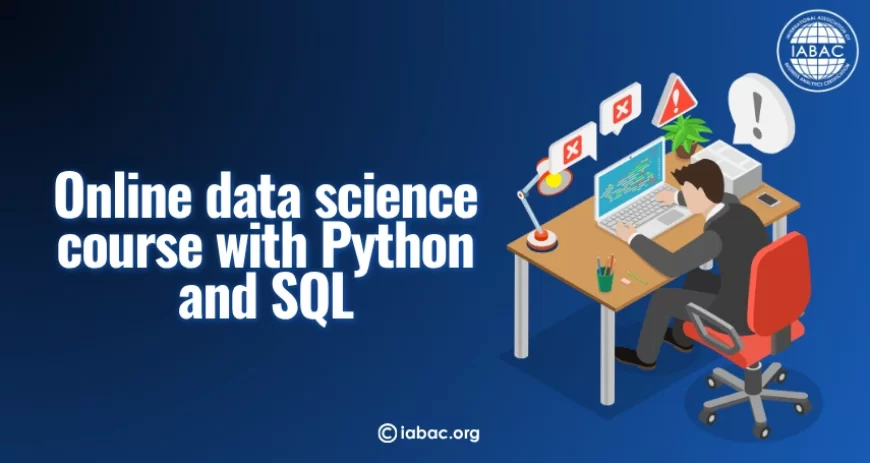
Online data science course with Python and SQL
Confused about data science? Learn Python, SQL & machine learning with a clear roadmap, real projects, and skills that actually get you hired.

You want to get into data science. You have probably spent hours looking at job descriptions, comparing courses, and wondering where to start. The tools are clear: Python and SQL come up in almost every listing. But knowing that is not the same as knowing how to learn them properly.
By the end of this post, you will know exactly how to structure your online data science learning journey from your first line of Python code to job-ready skills without wasting time on the wrong things.
Why is this moment the right one to start?
I have worked in AI and data science long enough to watch the field shift from niche to necessary. Companies that once hired one "data person" now have entire analytics departments. And still, the talent gap keeps widening.
According to McKinsey's 2024 Data Summit survey, 77 percent of companies report that they lack the necessary data talent and skill sets to perform required tasks in mission-critical areas. That number should matter to you; it means employers are not being selective for the sake of it. They genuinely cannot find enough people. If you build the right skills, the door is open.
The growth numbers are just as striking. The U.S. The Bureau of Labor Statistics projects employment of data scientists to grow 34 percent from 2024 to 2034 much faster than the average for all occupations with around 23,400 new openings expected annually over that decade. That is not a short-term spike. That is structural, long-term demand.
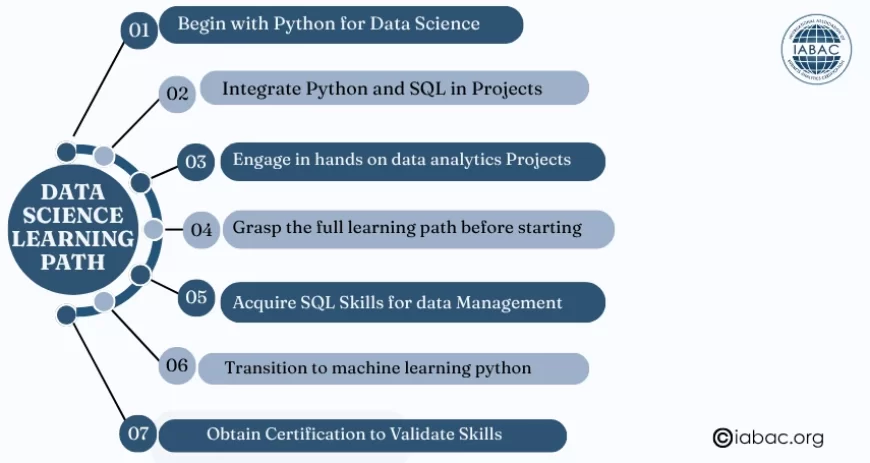
Step:1 Start with Python for data Science
Python is where nearly every data scientist begins. I have seen people try to start with machine learning frameworks before they understood how to manipulate a DataFrame. It does not work. You end up copying code you do not understand and hitting walls you cannot diagnose.
What to learn first:
-
Python fundamentals: variables, loops, functions, and conditions
-
Working with libraries: Pandas for data manipulation, NumPy for numerical operations
-
Basic data visualization using Matplotlib and Seaborn.
Step: 2 Learn SQL for data Science
SQL is the tool that almost every data job requires, regardless of your title. I have interviewed candidates who knew machine learning inside out but could not write a group with a having clause. That is a problem in practice.
In the real world, data does not live in clean CSV files. It lives in databases and SQL is how you reach it.
What to learn:
-
Select, where, Join (Inner, Left, Right)
-
Group by, having, Order by
-
Subqueries and CTEs (Common Table Expressions)
Step: 3 Combine Python and SQL in real projects
This is where most beginners go wrong. They finish a course and wait. They think the course is a skill. It is not. The skill comes from building something with the knowledge.
I always tell people: your first project does not have to be impressive. It has to be real.
Project ideas to start:
-
Pull sales data from a SQL database, clean it in Python, and visualize monthly trends
-
Analyze a public dataset (Kaggle has hundreds) to answer one specific question
-
Build a customer segmentation model using basic clustering.
Step: 4 Move into machine learning with python
Once you are comfortable with Python and SQL, machine learning becomes accessible rather than overwhelming. The concepts are not magic, they are math applied to data.
What to learn:
- Supervised learning: linear regression, logistic regression, decision trees, random forests
- Unsupervised learning: K-means clustering, PCA
- Model evaluation: train/test split, cross-validation, confusion matrix, ROC-AUC
- Python libraries: Scikit-learn for classical ML, XGBoost for gradient boosting
Step: 5 Apply Skills through hands on data analytics projects
Projects with real data are what separate people who learn data science from people who do data science.
Here is what I have observed after mentoring dozens of aspiring analysts: the people who land jobs fastest are not the ones with the most courses on their resume. They are the ones who built things and can talk about them.
What good projects include:
-
A clearly stated business question
-
A messy, real-world dataset (not a pre-cleaned tutorial dataset)
-
Python and SQL working together
-
Visualizations that communicate findings clearly
-
A written or video walkthrough of your thinking
Step: 6 Get Certified to validate what you know
Skills matter. But in a competitive market, a credential from a recognized body signals that your skills have been assessed by a standard beyond your own self-assessment.
This is where IABAC certifications are worth considering. As a global professional body focused on business analytics, data science, and AI, IABAC offers data science certification online that validates competence in a structured, employer-recognized framework. The certification process tests your ability to apply concepts, not just recall them.
Step: 7 Understand the full learning path before you begin
One of the most common mistakes I see is starting without a roadmap. People spend weeks on Python, pivot to SQL because someone online said it was more important, then jump to a machine learning tutorial and feel lost.
Here is how the full path fits together:
Stage | Skills | Tools Foundation | Python basics, data types, control flow | Python, Jupyter Notebook Data Manipulation | DataFrames, cleaning, aggregation | Pandas, NumPy SQL for Data Work | Querying, joining, aggregating databases | PostgreSQL, SQLite Visualization | Charts, dashboards, storytelling | Matplotlib, Seaborn, Tableau Machine Learning | Supervised and unsupervised models | Scikit-learn, XGBoost Project Portfolio | End-to-end real-world case studies | GitHub, Streamlit Certification | Formal validation of skills | IABAC certification
What format of learning actually works?
I want to be direct about this because there is a lot of marketing noise around learning formats.
A data science bootcamp online can work if it includes instructor support, peer accountability, and real projects. Bootcamps that are essentially pre-recorded lectures bundled into a higher-priced package are not meaningfully different from free YouTube content.
Online Python and SQL classes work best when they include:
-
Practice problems you solve yourself (not just watch)
-
Project assignments with real datasets
-
Feedback loops someone or something to tell you when your approach is wrong.
One mistake you cannot afford to make
I have seen this pattern more times than I can count. Someone completes a course, feels confident, starts applying for jobs, and gets nowhere. They cannot answer case study questions in interviews. They freeze when asked to write SQL on a whiteboard.
The reason is almost always the same: they studied passively. They watched videos. They read notebooks. They never wrote code from scratch.
The fix is simple, but it requires discipline. After every concept you learn, close the tutorial and rebuild it from memory. Do not copy-paste. Do not reference your notes until you are stuck. That friction is exactly where real learning happens.
If you follow the steps in this post, you will move from a beginner who knows Python and SQL exist to someone who can pull data from a database, clean and analyze it in Python, build a predictive model, and present findings clearly. That is a job-ready skill set.
The most common mistake people make at this point is stopping after the course and never shipping a project. Do not do that. Start with something small. Ship it. Then build the next thing.