



























































Data Engineer Roadmap: Complete Career Guide for 2026?
Want to become a Data Engineer in 2026? Follow this clear roadmap to learn essential skills, build real projects, and confidently prepare for interviews.

Data engineering is one of the fastest-growing careers in the technology industry. In 2026, companies are not just using data for reports; they are building complete systems that depend on clean, reliable, and well-structured data.
Every app you use, every website you visit, and every online payment you make generates data. But raw data is messy. It comes from different sources. It contains errors. It may arrive late. It may not match across systems.
Someone needs to design systems that collect, clean, organize, and store this data properly.
That person is a data engineer.
If you want to become a data engineer in 2026, this blog gives you a clear and practical roadmap. It explains what to learn, how to learn, how long it may take, what projects to build, and how to prepare for interviews, all in simple words.
Who Is a Data Engineer?
A data engineer builds and maintains data pipelines.
Think of data pipelines as roads. Data analysts and data scientists use the data to create insights. But data engineers build the roads that carry that data safely from one place to another.
A typical company collects data from:
-
Websites
-
Mobile apps
-
Payment systems
-
CRM tools
-
Third-party services
This data must be:
-
Collected
-
Cleaned
-
Transformed
-
Stored
-
Delivered to reporting tools
Data engineers design this entire system.
Without them, dashboards show wrong numbers, reports fail, and business decisions suffer.
Why Data Engineering Is a Good Career in 2026
Here are practical reasons:
1. High Demand
Almost every industry needs data engineers.
2. Strong Salary Growth
The role requires technical depth, which increases value.
3. Career Stability
Data systems are a long-term infrastructure. Companies cannot remove them easily.
4. Clear Growth Path
You can grow into Senior Data Engineer, Lead Engineer, or Data Architect roles.
5. Technical Depth
You work on real systems that handle large volumes of data.
Step-by-Step Data Engineer Roadmap
Let’s break the journey into clear stages.
Follow them step by step.
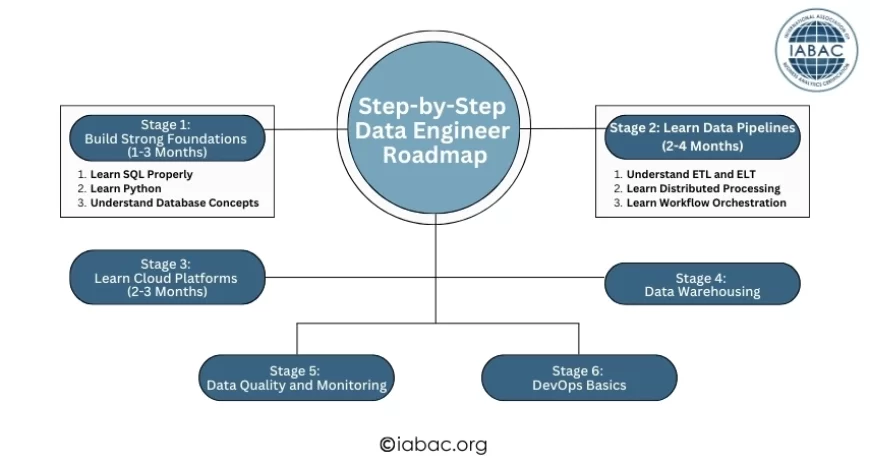
Stage 1: Build Strong Foundations (1-3 Months)
Do not skip this stage.
Many beginners jump directly into advanced tools and get confused.
1. Learn SQL Properly
SQL is the backbone of data engineering.
You must understand:
-
SELECT queries
-
WHERE filters
-
GROUP BY
-
HAVING
-
JOIN operations
-
Subqueries
-
Common Table Expressions (CTEs)
-
Index basics
Practice solving real problems, such as:
-
Calculate monthly revenue
-
Find top customers
-
Remove duplicate records
Strong SQL makes interviews much easier.
2. Learn Python
Python is widely used for building data pipelines and automation.
Focus on:
-
Variables
-
Functions
-
Loops
-
Error handling
-
Reading and writing CSV and JSON files
Write small scripts regularly. Build simple automation tasks.
You do not need advanced topics in the beginning.
3. Understand Database Concepts
Before moving ahead, understand:
-
What is a relational database?
-
What is normalization?
-
What is a primary key?
-
What is indexing?
-
What are transactions?
Also, learn the basic differences between relational and NoSQL databases.
These concepts build your technical clarity.
Stage 2: Learn Data Pipelines (2-4 Months)
Now you enter core data engineering skills.
4. Understand ETL and ELT
ETL stands for:
Extract → Transform → Load
ELT stands for:
Extract → Load → Transform
In modern cloud systems, ELT is more common because cloud warehouses are powerful.
You should understand:
-
Why is transformation necessary
-
When to transform data
-
How incorrect transformations affect business decisions
5. Learn Distributed Processing
When data becomes very large, one machine cannot process it alone.
Distributed systems solve this problem.
A popular framework is Apache Spark.
Learn:
-
What is distributed computing
-
What is parallel processing?
-
How clusters work
-
Basic Spark transformations
You do not need expert-level knowledge immediately. Understand the basics and build one small project.
6. Learn Workflow Orchestration
Data pipelines must run automatically.
Workflow orchestration tools manage scheduling and dependencies.
Common tools include:
-
Apache Airflow
-
Dagster
Understand:
-
Task dependencies
-
Scheduling jobs
-
Failure handling
Choose one tool and practice deeply.
Stage 3: Learn Cloud Platforms (2-3 Months)
In 2026, cloud skills are essential.
Major cloud platforms include:
-
Amazon Web Services
-
Google Cloud Platform
-
Microsoft Azure
You only need to specialize in one.
Focus on:
-
Cloud storage
-
Data warehouse services
-
Access control
-
Basic monitoring
Build at least one complete data pipeline in the cloud. Real hands-on experience matters more than reading theory.
Stage 4: Data Warehousing
Data warehouses store processed data for reporting.
Learn:
-
Star schema
-
Snowflake schema
-
Fact tables
-
Dimension tables
-
Slowly changing dimensions
Modern data teams use tools like dbt to manage transformations inside warehouses.
Understanding warehouse modeling makes you interview-ready.
Stage 5: Data Quality and Monitoring
This is where many beginners fail.
Companies care deeply about:
-
Missing data
-
Duplicate records
-
Delayed pipelines
-
Incorrect calculations
You should learn:
-
How to validate incoming data
-
How to log errors
-
How to create alerts
-
How to monitor performance
This skill makes you stand out from average candidates.
Stage 6: DevOps Basics
Modern engineering teams follow best practices.
You should understand:
-
Git for version control
-
Pull requests
-
Basic CI/CD concepts
-
Docker basics
-
Linux command line
These skills help you work in real production environments.
Realistic Timeline
If you are a beginner:
6-9 months of consistent learning.
If you have a software background:
4-6 months.
If you already work in analytics:
3-4 months.
Consistency is more important than speed.
Projects You Must Build
Projects are critical.
Build:
-
A Python-based ETL pipeline
-
A Spark processing project
-
A Cloud-based data pipeline
-
A Data warehouse modeling project
-
A Monitoring and alerting system
Document everything clearly on GitHub.
Explain:
-
Problem statement
-
Architecture
-
Tools used
-
Challenges faced
Recruiters appreciate clarity.
How to Prepare for Interviews
Prepare in three areas:
Practice advanced queries and optimizations.
System Design
Design:
-
Batch pipelines
-
Real-time pipelines
-
Scalable systems
Scenario Questions
Example:
“What will you do if a pipeline fails at midnight?”
Explain:
-
How do you detect it
-
How do you fix it
-
How do you prevent it
Clear thinking matters more than complex language.
Common Mistakes to Avoid
-
Skipping fundamentals
-
Learning too many tools at once
-
Ignoring cloud
-
Not building projects
-
Avoiding interview practice
-
Ignoring data quality
Stay focused.
Follow one roadmap.
Complete it step by step.
Career Growth Path
Your journey may look like this:
Junior Data Engineer
↓
Data Engineer
↓
Senior Data Engineer
↓
Lead Engineer
↓
Data Architect
With experience, you can move into architecture or leadership roles.
Becoming a data engineer in 2026 is achievable.
You do not need to be extraordinary.
You need:
-
Strong SQL
-
Solid Python
-
Clear understanding of data systems
-
Cloud experience
-
Real projects
-
Interview preparation
Stay patient.
Build strong fundamentals.
Practice consistently.
If you want structured industry recognition, you may also consider the Data Engineer Certification to strengthen your professional profile and credibility.
Start today.
Your data engineering journey begins with one focused step at a time.