




















































Do You Know How Data Scientists Solve Real Problems? Most Don’t
Learn how data scientists solve problems using data, algorithms, and insights, and understand the practical skills needed to deliver business impact.

You have probably heard the term “data scientist” so often that it barely feels clear anymore. It appears in job listings, shows up in meetings, and suddenly someone at work gets promoted for doing something with data. Naturally, you start wondering what they actually did—and whether you could do the same.
The simple answer is yes, you can. But before that, it helps to clearly understand what this role really includes, why it matters so much today, and how you can start building a strong career in it—even from zero.
This is not a short summary. This is a complete, easy-to-understand picture.
So, what exactly is a data scientist?
Here is the most straightforward way to say it: a data scientist is a person whose job is to take large amounts of raw, messy data and turn it into clear answers that help a business make better decisions.
They do not just look at numbers. They ask questions. They look for patterns. They build tools that predict what will happen next. And then — this part is often forgotten — they explain what they found to the people who need to actually do something about it.
A data scientist is one-third detective, one-third engineer, and one-third storyteller. The best ones are all three at the same time.
Think of it this way. Every company collects data — clicks, sales, complaints, delivery times, customer behaviour, employee performance. Most of that data just sits there, untouched. A data scientist is the person who actually looks at it and says: here is what is happening, here is why, and here is what we should do about it.
An example:
An online clothing store noticed their return rate was climbing every month, but nobody knew why. A data scientist looked at three years of order data, delivery records, customer reviews, and product images. They found one specific pattern: customers who bought items shown only with professional models had 3× higher return rates than customers who bought items shown on regular people. The store changed their photography approach. Returns dropped by 28% in two months. That is the work of a data scientist. That kind of impact is not rare. It happens every day, across every industry — healthcare, banking, logistics, education, retail, government, and more.
The real day-to-day work of a data scientist
Here is something most guides get wrong: they describe data science as if it is all about building machine learning models. In reality, building the model is only one small part of the job. Most of the work happens before you even open a coding tool.
Let us walk through the full process, step by step, the way it actually happens in real organisations.
- Understand the real problem: Before opening any tool, they ask: what are we actually trying to fix? This step saves weeks of wasted work.
- Collect and clean the data: This takes up 60–70% of the job and nobody puts it on their resume. Raw data is messy. Fixing it is real work.
- Explore patterns (EDA): Using Python or R, they start "listening" to the data — looking for trends, outliers, and relationships before building anything.
- Build predictive models: This is where AI and machine learning come in. They train models to spot patterns, make predictions, or automate decisions.
- Share findings clearly: A great model that nobody understands is useless. Data scientists translate numbers into stories that move people to action.
Why this work is so valuable right now
We are in the middle of a major shift in how businesses operate. Almost every industry is collecting more data than ever before, investing in AI tools, and trying to make decisions faster and smarter. The professionals who know how to work with data — who can go from raw numbers to clear recommendations — are becoming some of the most in-demand people in the workforce.
data created worldwide annually by 2026 — someone has to make sense of it
Companies are not just looking for people who can code. They are looking for people who can think with data — who can look at a business problem, figure out what information is needed, and come back with an answer that is clear and actionable. That combination of technical skill and business thinking is still rare, and that is exactly why it pays well.
Here is the funny part: companies spend millions collecting data and then leave it sitting untouched in databases because they do not have enough people who know what to do with it. Becoming a data scientist is basically saying "I will be the person who actually uses all that stuff you paid for." Employers love that person.
What skills does a data scientist actually need?
Let us be honest about something. When people list "data science skills," they often make the list sound so long and intimidating that you wonder if you need a PhD in everything simultaneously. You do not. Here is what actually matters, described plainly.
Python or R
Python is the dominant language in 2026. You use it to clean data, run analyses, build models, and automate tasks. R is still used in research and statistics-heavy roles. You do not need to know both — Python alone will take you very far.
Statistics and probability
This is the foundation everything else is built on. You need to understand distributions, hypothesis testing, correlation vs causation, and confidence intervals. You do not need to memorise formulas — you need to understand what the concepts mean and when to apply them.
Machine learning and AI
This covers how you build models that learn from data. You will use libraries like scikit-learn, TensorFlow, or PyTorch depending on the complexity of the problem. The key is understanding which type of model fits which type of problem.
Data wrangling and SQL
Before you can analyse anything, you need to get it into shape. SQL is how you pull data from databases. Pandas in Python is how you clean and reshape it. These are the most-used tools in the entire job, and the ones that make you immediately useful from day one.
Data visualisation
Knowing how to present findings is not optional. You need to turn your results into charts, dashboards, and reports that non-technical people can read and act on. Tools like Matplotlib, Seaborn, Tableau, and Power BI are all used in different organisations.
Business communication
This is the most underrated skill on the list. A data scientist who can explain complex findings in simple language — verbally, in writing, and in presentations — is far more valuable than one who can only talk in technical terms. Practice this from day one.
The good news: every single one of these skills can be learned from scratch, at any age, from any background. Professionals from marketing, finance, engineering, healthcare, operations, and education all make this transition successfully every year.
What does the salary and career growth look like?
Career growth in data science is not a straight line. It follows an exponential curve. The early stage feels slow — you are building foundations, completing certifications, working on your first real projects. Then, once you have that combination of proven skills, a recognised credential, and real experience, things change fast. Salaries jump. Opportunities appear. Roles open up that were not available before.
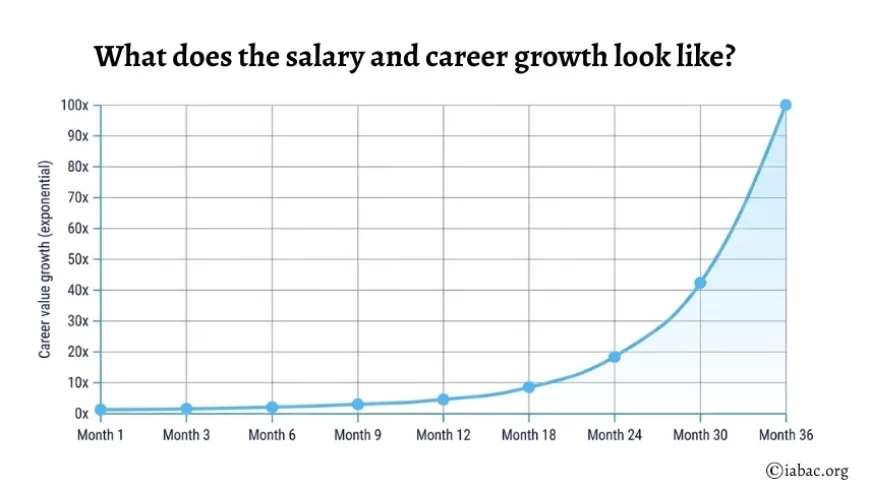
Data science career value growth over time (indexed from baseline)
The chart above shows this pattern clearly. Growth is gradual in months one through six — you are investing in learning. Then around the nine-to-twelve month mark, with the right certification and first real projects behind you, the trajectory changes completely. By month thirty-six, professionals who committed to this path have often doubled or tripled their original earning potential.
Here is what the current salary data shows across experience levels in the Indian market:
- Entry level (0–1 yr): ₹6–9 LPA
- Mid-level (2–4 yrs): ₹12–20 LPA
- Senior (5+ yrs): ₹25–45 LPA
- Data Science Manager: ₹40–80 LPA
Data Science Certifications that actually open doors
Here is a truth worth saying directly: there is a big difference between knowing something and being able to prove you know it. In a job market where hundreds of people apply for the same role, a globally recognised Data Science Certification is often what decides who gets the interview.
Certifications serve three purposes. They give you structure — a clear learning path instead of random YouTube videos. They give you credibility — a credential that hiring managers and clients recognise and trust. And they give you confidence — the kind that comes from completing something rigorous and getting an independent confirmation that your skills are real.
This is where IABAC — the International Association of Business Analytics Certifications — has built a genuine reputation among working professionals. IABAC programs are not built around theory for the sake of it. They are built around real business problems, the kind you will actually face on the job.
The Data Science Certified Manager program
The Data Science Certified Manager is one of IABAC's most career-impactful credentials. It is designed specifically for professionals who want to not just work in data science, but lead data science work — managing projects, communicating with senior stakeholders, and turning analytical output into strategic decisions.
The program covers the full picture: data strategy, machine learning principles, team leadership, ethical AI, and the kind of business communication skills that make a data professional genuinely useful at the senior level. It is recognised globally and sits at the intersection of technical credibility and leadership potential — exactly where the highest-paying roles are.
Whether you are a junior analyst wanting to grow, a mid-career professional looking to pivot, or a senior professional who wants formal recognition of skills you have already been using — this certification gives you a structured, credible, and career-focused path forward.
|
4–6 Months to certify Structured path for working professionals |
150+ Countries recognised Global employer recognition |
3x Avg salary growth For certified professionals who apply skills |
Who should seriously consider data science?
Data science is not only for people with engineering degrees or strong math backgrounds. The field has grown broad enough that people from many different starting points can find a valuable and rewarding place in it.
You are a good fit for data science if you are genuinely curious about why things happen — not just what happened. You like solving problems that do not have obvious answers. You are comfortable sitting with uncertainty and working through it methodically. You want your work to have a clear, measurable impact. And you are willing to keep learning, because the tools and techniques in this field continue to change.
What does a typical data science career path look like?
Most people begin as a data analyst — working with structured data, building reports and dashboards, answering specific business questions. This role builds foundational skills and gives exposure to real data problems across different business functions.
From there, the path usually moves toward a data scientist role, where you take on more complex problems, build and deploy predictive models, and start working more closely with engineering and product teams. This is where most of the machine learning and AI work sits.
Senior data scientists often move toward either a lead or principal data scientist role — where they take ownership of major analytical projects and set technical direction — or toward a Data Science Certified Manager role, where they manage teams, own business outcomes, and connect data strategy to company-level decisions. This second path is increasingly well-compensated and in high demand as companies realise that having technically skilled leaders who also understand business is rare and genuinely valuable.
Beyond that, roles like Chief Data Officer, Head of AI, and VP of Analytics exist for people who combine deep expertise with strong leadership. These are the roles where data professionals become part of setting the direction of entire organisations.
|
Your career in data science starts with one decision. You do not need the perfect background. You do not need to quit your job. You just need to start with the right structure, the right certification, and the right support. IABAC has helped thousands of professionals make exactly this move.
|