













































How to Become an AI Expert in 2026: The Complete Career Roadmap
Discover how to become an AI expert in 2026. Master Agentic workflows, MLOps, and EU AI Act compliance with this industry-aligned IABAC blueprint.

The conversation surrounding artificial intelligence has shifted permanently. The days of earning the title of an AI expert simply by querying an open API or writing basic predictive scripts are over. Entering 2026, the market demands a completely new caliber of professional. Driven by the explosion of autonomous Agentic AI, widespread enterprise deployment via MLOps, and strict global regulatory mandates like the EU AI Act, the definition of expertise has evolved.
Data from the 2026 Stanford HAI AI Index reveals that AI-related skills now appear in roughly 2.5% of all global job listings—a near 300% increase over the past decade—with the demand curve rising 20 times faster than the general job market. Yet, despite this demand, 95% of enterprise AI pilots fail due to a lack of structured competency, data pipeline bottlenecks, and poor architecture design.
For aspiring practitioners, this creates a profound challenge: How do you cut through the tutorial hype and build verified, elite capability?
This comprehensive, research-backed roadmap provides the definitive answer. Whether you are a software engineer transitioning to machine learning, a data analyst looking to specialize, or a business leader aiming for technical mastery, this guide lays out the precise stages, tools, and global frameworks required to become a certified AI expert this year.
What is an AI Expert in 2026? (Definition Block)
AI Expert Definition (2026): An AI expert is a multidisciplinary practitioner capable of designing, optimizing, deploying, and governing intelligent, autonomous systems. This role requires a robust blend of mathematical foundations, deep learning mastery, scalable system engineering (MLOps), and strict adherence to ethical and regulatory compliance frameworks.
Key Takeaways: The 2026 Competency Shift
-
Code is Only Component One: Modern AI expertise requires system orchestration (Agentic workflows) and architecture over simple code generation.
-
Governance is Mandatory: Understanding risk mitigation and compliance (such as transparency metrics under Article 50 of the EU AI Act) is a core technical skill.
-
Validation is Competitive Currency: With the market flooded with self-proclaimed specialists, globally standardized validation—like certifications aligned with the European Commission's EDISON framework—is the key differentiator for top-tier enterprise roles.
Stage 1: Mathematical Foundations & Core AI Literacy
Every advanced neural network is, at its root, an orchestration of mathematical operations. Skipping the foundations is the fastest way to hit an insurmountable learning ceiling.
Mathematical Essentials
To build and debug advanced systems, you must master three mathematical pillars:
-
Linear Algebra: Focus on matrix multiplications, vector spaces, eigenvalues, and eigenvectors. These form the fundamental bedrock of how data is transformed within a neural network.
-
Calculus: Master partial derivatives and gradients. This knowledge is essential for understanding backpropagation—the method by which models minimize error and learn over time.
-
Probability & Statistics: Deepen your knowledge of Bayesian inference, probability distributions, regression models, and hypothesis testing. Real-world AI deals constantly with uncertainty; statistics helps you measure and control it.
Core Data Programming
Python remains the undisputed foundation of artificial intelligence. Your development toolkit must include:
-
NumPy & Pandas: Essential for high-performance vector manipulation and structural data cleaning.
-
SQL: Crucial for querying scalable, production-grade enterprise data warehouses.
The Standardized Launchpad
For professionals entering from a business or non-technical background, immediate coding isn't always the optimal starting line. Building baseline data literacy and understanding how data pipelines flow into corporate environments is a prerequisite. Starting with an introductory benchmark like the Certified AI-Ready Professional (CAIP-RE) establishes this essential baseline before you move into advanced programming environments.
Stage 2: Classical Machine Learning & Advanced Data Analytics
Before attempting to train deep language models, an AI expert must master classical machine learning. Enterprise problems are frequently solved more efficiently using optimized statistical models rather than computationally expensive deep learning architectures.
Algorithmic Mastery
You must be capable of programmatically implementing and adjusting models using frameworks like scikit-learn:
-
Supervised Learning: Linear/Logistic Regression, Decision Trees, Random Forests, Gradient Boosting Machines (XGBoost), and Support Vector Machines (SVM).
-
Unsupervised Learning: K-Means Clustering, Hierarchical Clustering, and Principal Component Analysis (PCA) for dimensionality reduction.
-
Data Engineering Pipelines: Learning how to clean noisy data, handle missing features, and perform balance adjustments on skewed datasets.
Industry-Agnostic Validation
At this stage, generic projects lack market distinction. Real-world authority comes from knowing how to apply machine learning to precise business operations. Validating your abilities through a recognized standard such as the Certified Data Scientist (CDS) track—or specializing directly in sectors like Finance, HR, or Marketing—proves that you can turn raw information into predictable business revenue.
Stage 3: Deep Learning, Computer Vision & Natural Language Processing
Once you have mastered structured tabular data, your roadmap transitions to unstructured data processing: text, audio, images, and video. This is the domain of deep neural networks.
[Input Layer] ──> [Hidden Layers: Convolutions / Transformers] ──> [Optimized Output]
Deep Learning Infrastructure
-
Framework Dominance: PyTorch has become the primary engineering standard for modern AI development, favored heavily for its dynamic computation graphs. TensorFlow remains highly relevant for legacy enterprise production environments.
-
Architectural Literacy: Master Feedforward Neural Networks (FNNs), Convolutional Neural Networks (CNNs) for spatial data, and Recurrent Neural Networks (RNNs/LSTMs) for sequential data.
Specialized AI Tracks
To maximize market premium, an AI expert typically chooses a specialized deep learning vertical:
1. Natural Language Processing (NLP) & Modern LLMs
Understanding the Transformer architecture (Self-Attention mechanisms) is non-negotiable. You must learn how to take foundational base models and customize them for enterprise applications using programmatic APIs (OpenAI, Gemini, Claude) or via open-source model optimization on Hugging Face.
2. Computer Vision
Master object detection, semantic image segmentation, and facial recognition pipelines using frameworks like OpenCV and YOLO architectures.
Professional Specialization Paths
Because these fields are distinct, elite practitioners maintain verifiable specializations. Aligning your portfolio with targeted validations like the Certified NLP Expert or Certified Computer Vision Expert tells enterprise recruiters exactly where your technical strengths lie.
Stage 4: Agentic AI, MLOps, and AI Governance
In 2026, building a model is only half the battle. The highest-compensated AI experts are those who know how to deploy systems to production, orchestrate them to make autonomous decisions, and ensure they don't violate global laws.
Agentic AI and Advanced Architecture
The industry has progressed past static chat boxes. The focus is now on Agentic Workflows—systems that can reason, plan, use tools, and collaborate autonomously to solve multi-step problems.
-
Frameworks: Master orchestration engines like LangChain to build resilient multi-agent systems.
-
Advanced RAG (Retrieval-Augmented Generation): Design semantic search vectors using databases like Pinecone, Milvus, or Chroma to connect foundational models to live, private corporate knowledge bases securely.
MLOps: Moving to Production
An AI model sitting in a local notebook provides no commercial value. You must learn the infrastructure required to run models at scale:
-
Containerization: Wrap your code, dependencies, and environments cleanly using Docker.
-
Orchestration & Clouds: Deploy, scale, and monitor models across major ecosystems (AWS, Google Cloud, Microsoft Azure) using CI/CD pipelines.
AI Governance and Compliance (The 2026 Imperative)
With the legal enforcement of the EU AI Act, compliance has transitioned into a core technical requirement. Under Article 50 transparency mandates, systems deploying generative AI must utilize machine-readable watermarking and precise audit logging.
Furthermore, data from Gartner highlights that global spending on AI-related cybersecurity defenses is projected to hit $2.5 trillion this year. Businesses desperately require architects who understand how to perform bias auditing, defend against prompt injection, eliminate hallucinations, and enforce data privacy boundaries.
The Ultimate Validation
The pinnacle of this career path is achieving comprehensive validation that binds engineering capability with enterprise governance. The Certified Artificial Intelligence Expert designation serves as definitive proof that you can architect, implement, monitor, and legally secure high-impact corporate systems.
Core AI Skills Matrix (2026 Overview)
|
Technical Execution Skills |
Core Frameworks & Tools |
System Governance & Power Skills |
|
• Python, SQL, R Programming |
• PyTorch, Hugging Face, Transformers |
• Critical Thinking & Logic Design |
|
• Prompt Engineering & Tuning |
• Docker, Kubernetes, MLOps Pipelines |
• EU AI Act Compliance & Auditing |
|
• Agentic Workflow Architecture |
• LangChain, LlamaIndex, Vector DBs |
• Data Privacy & Bias Mitigation |
Myth vs. Reality in the 2026 AI Job Market
-
Myth: You need a highly specialized PhD to become a successful AI expert.
-
Reality: While research labs still hire PhDs for theoretical breakthrough modeling, 90% of commercial enterprise roles require Applied AI Engineers and Architects who can take existing models, customize them safely, and construct functional, scalable software pipelines around them.
-
Myth: AI will completely automate code writing, making AI engineering a redundant career.
-
Reality: AI speeds up syntax generation, but it cannot design complex system integration, verify data provenance, or oversee regulatory safety. Microsoft’s 2026 Work Trend Index indicates that 80% of top-tier "Frontier Professionals" utilize AI as a cognitive amplifier to solve highly sophisticated structural problems, rather than using it as a replacement for software logic.
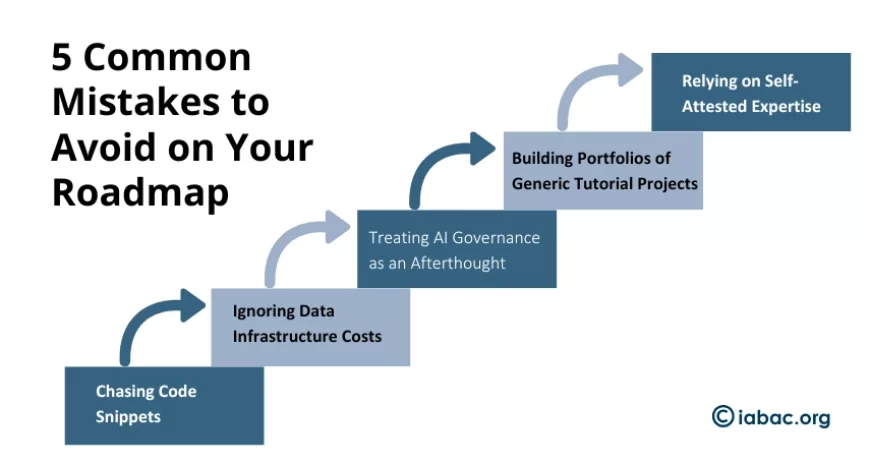
5 Common Mistakes to Avoid on Your Roadmap
-
Chasing Code Snippets Without Learning Fundamentals: Relying entirely on copilots to generate code without understanding the underlying matrix transformations or loss functions makes it impossible to debug models when accuracy drops in production.
-
Ignoring Data Infrastructure Costs: Failing to optimize data queries or ignoring vector storage costs can lead to massive cloud invoices. Efficient data engineering is a key financial skill.
-
Treating AI Governance as an Afterthought: Building an un-auditable, un-logged model can lead to immediate compliance failures, product bans, or legal penalties under modern global frameworks.
-
Building Portfolios of Generic Tutorial Projects: Recruiters are tired of seeing identical MNIST digit classification or basic Titanic survival datasets on resumes. Focus on unique, domain-specific enterprise problems.
-
Relying on Self-Attested Expertise: The market is crowded with surface-level certificates. Lacking standardized, globally recognized credentials based on rigorous data frameworks makes it incredibly difficult to pass initial enterprise HR screening filters.
The Value of an IABAC Certification
When navigating a competitive job market, your credentials must hold definitive authority. The International Association of Business Analytics Certification (IABAC) stands out globally for three fundamental reasons:
-
EDISON Framework Alignment: IABAC certifications are built natively upon the EDISON Data Science Framework, a major initiative funded by the European Commission designed to explicitly map professional skills to real-world industrial mandates.
-
Independent, Rigorous Assessment: IABAC operates strictly as an independent examination body. This ensures your certification is awarded based on unbiased competence, rather than completing a simple video playlist. If you already possess the requisite skills, you can even choose to challenge the exams directly.
-
Cross-Industry Application: Rather than teaching abstract concepts in isolation, IABAC structures its knowledge areas around vertical business applications—ensuring your technical mastery links directly to economic value.
Becoming an AI expert in 2026 requires moving past the superficial layer of technology and building a deep, structured competency framework. By breaking your career development into clear, measurable phases—from mathematical mechanics and core machine learning up to advanced agentic architecture and regulatory governance—you build an incredibly resilient career.
Do not rely on informal, unverified tutorials to anchor your professional future. Validate your technical capability, prove your alignment with global frameworks, and stand out to premium global employers.
Take the definitive next step in your career. Explore the IABAC AI Certification Tracks today and secure your position at the forefront of global technology.
Summary Reference Table
|
Career Phase |
Target Skills |
Key Platforms & Tools |
Recommended IABAC Alignment |
|
Stage 1: Foundations |
Math, Python Fundamentals, Data Entry |
Pandas, NumPy, SQL |
Certified AI-Ready Professional (CAIP-RE) |
|
Stage 2: Core ML |
Predictive Modeling, Data Pipelines |
scikit-learn, Tabular Analysis |
Certified Data Scientist (CDS) |
|
Stage 3: Specialization |
Deep Learning, NLP, Computer Vision |
PyTorch, Hugging Face, YOLO |
Certified NLP / Computer Vision Expert |
|
Stage 4: Advanced Systems |
MLOps, Agentic AI, Governance |
LangChain, Docker, EU AI Act |
Certified Artificial Intelligence Expert |
Frequently Asked Questions
1. How long does it take to become an AI expert in 2026?
Transitioning to an AI expert generally takes 10 to 12 months of structured study for individuals with an existing technical or analytical background. This timeline requires breaking execution down into four distinct phases: mastering mathematical and programming foundations (Months 1–3), learning classical machine learning algorithms (Months 4–6), specializing in deep learning architectures like Transformers (Months 7–9), and mastering production deployment, Agentic workflows, and global governance frameworks (Months 10+).
2. What are the core technical skills needed to become an AI expert?
-
Programming: Advanced Python proficiency, SQL query architecture, and environment management.
-
Data Manipulation Libraries: Deep practical knowledge of NumPy and Pandas.
-
Core AI Frameworks: PyTorch, scikit-learn, and Hugging Face model repositories.
-
Advanced Architectures: Transformer infrastructure, Neural Networks, and multi-agent frameworks like LangChain.
-
Production & MLOps: Container deployment with Docker alongside cloud data pipelines (AWS, Azure, or GCP).
-
Regulatory Compliance: Strict execution of data tracking and compliance matching the EU AI Act framework.
3. Can I become an AI expert in 2026 without a computer science degree?
Yes. Modern enterprise organizations prioritize structured, verifiable portfolios, practical deployment capability, and globally standardized certifications over traditional four-year academic degrees.
4. Why is PyTorch preferred over TensorFlow in modern AI roadmaps?
PyTorch has become the default benchmark across research institutions and modern product environments due to its highly intuitive Pythonic execution style, dynamic graph calculation, and vast ecosystem of open-source models.
5. What exactly is Agentic AI, and why must I learn it?
Agentic AI refers to autonomous systems capable of executing complex, multi-step actions using tools, assessing real-time feedback, and reasoning independently. It represents the primary design paradigm shift for software systems.
6. How does the EU AI Act affect my technical career as an AI expert?
Any system deployed or utilized within the European market must comply with strict safety, privacy, and transparency laws. AI experts who know how to technically design models to pass these compliance filters command a major hiring premium.
7. Can I take an IABAC exam directly if I already have machine learning experience?
Yes. If you have already built practical knowledge through independent work or industry roles, you can register and take IABAC certification examinations directly via their portal without completing a mandatory partner training course.
8. What is the difference between an AI Engineer and a Data Scientist?
Data scientists typically focus on exploring raw information to extract strategic insights and train initial predictive models. AI engineers specialize in taking those models, optimizing their software infrastructure, and integrating them into live, production-scale software applications.
9. Is learning R programming still necessary for AI?
While Python is the global market standard for deep learning and application building, R remains highly valuable for specialized statistical evaluation, academic research, and complex data-centric data analysis.
10. What is Retrieval-Augmented Generation (RAG)?
RAG is an architectural technique that allows a pre-trained Large Language Model to query an external, secure vector database to retrieve up-to-date, real-time, or confidential information before generating a response, drastically minimizing hallucinations.
11. How do I prove my expertise to enterprise employers?
The most effective approach is a dual-layer validation model: maintain an active, documented GitHub repository showing unique, functional AI systems, paired with globally recognized, independent certifications like IABAC to clear corporate HR screening filters.
12. Do I need to learn how to build large language models from scratch?
No. Building massive base frontier models requires millions of dollars in computing power. True expertise lies in knowing how to efficiently download, fine-tune, optimize, and safely integrate open-source models for highly specific corporate tasks.
13. What are the cloud infrastructure requirements for an AI practitioner?
You should be highly comfortable managing compute environments, cloud storage buckets, container systems like Docker, and tracking model versions across platforms like AWS, Microsoft Azure, or Google Cloud Platform.
14. What is model hallucination, and how do experts fix it?
Hallucination occurs when a generative model creates confident but factually incorrect outputs. Experts mitigate this by engineering precise RAG data pipelines, adjusting model hyperparameters like temperature, and writing strict verification guardrails.
15. How does the EDISON framework protect my career value?
Because the EDISON Data Science Framework was funded and designed by the European Commission, your skills are explicitly aligned with uniform, internationally recognized definitions of professional capability, allowing for global career mobility.
16. What are the highest-paying sub-specializations in AI today?
MLOps Engineering, AI Infrastructure Architecture, Agentic System Design, and AI Security/Red-Teaming consistently demand the highest compensation premiums due to their direct impact on enterprise scalability and risk reduction.
17. Can I complete IABAC certification exams from home?
Yes. Most IABAC professional exams are delivered through a secure, proctored online testing engine, allowing you to validate your skills from your personal computer provided your system meets standard technical validation benchmarks.