

















































5 Key Differences Between AI and Human Intelligence
AI vs Human Intelligence: Explore 5 powerful differences in creativity, emotions, learning, and decision-making that still make humans irreplaceable.

I have spent the better part of a decade working at the intersection of artificial intelligence and workforce transformation. And one thing surprises me every time I walk into a room full of professionals — most people are still asking the wrong version of this question.
They ask, "Will AI replace humans?" when the far more useful question is: "Where does AI genuinely outperform humans, and where do humans hold ground that machines simply cannot reach?"
AI vs human intelligence is among the most Googled topics in the tech world, and for good reason.
Organizations worldwide are betting billions on AI systems, while millions of professionals are asking where they fit in.
McKinsey's State of AI report shows 78% of organizations now use AI in at least one core business function, up from just 55% the year prior. What it means for human roles depends entirely on understanding where these two forms of intelligence diverge.
Let's get into it.
What We Mean by AI vs Human Intelligence?
Artificial intelligence refers to software systems, machine learning models, neural networks, and large language models that mimic certain cognitive functions: pattern recognition, prediction, language processing, and decision-making within defined parameters.
Human intelligence is far broader. It encompasses abstract reasoning, emotional awareness, moral judgment, creative synthesis, and the ability to function effectively in unpredictable, ambiguous environments. No machine has replicated this package, not even close.
With that framing, here are the five key differences between AI and Human Intelligence
that actually matters.
1. Speed and Scale: AI Wins, But Context Is Everything
This one is straightforward. AI processes data at speeds and volumes no human team can match.
-
A radiologist reviewing CT scans might examine 50 to 80 images in a day.
-
An AI diagnostic tool processes thousands in the same window.
-
In financial markets, algorithmic trading systems execute thousands of transactions per second, identifying arbitrage opportunities that exist for milliseconds before closing.
But here is what most comparisons miss: speed without judgment creates risk.
In 2010, the US stock market experienced the Flash Crash - algorithmic trading systems, operating faster than any human could intervene, triggered a cascading collapse that wiped nearly $1 trillion in market value within minutes before recovering.
The machines were fast. They were also catastrophically wrong in a way that compounded at machine speed.
AI excels at scale when the rules are clear and the environment is stable. When context shifts, geopolitical tension, cultural nuance, and ethical judgment calls speed without human oversight becomes a liability, not an asset.
|
Speed is an AI advantage that augments human output. It is not a substitute for human oversight in high-stakes, context-dependent situations. |
2. Learning and Adaptability: Two Very Different Processes
This is where the difference between AI and human thinking gets nuanced and where most articles fall short.
AI learns through data, enormous quantities of labeled examples, feedback signals, and parameter adjustments during training.
Once deployed, most AI systems operate within the boundaries of what they were trained on.
When the world changes significantly outside those boundaries (a new virus, a black swan market event, an unprecedented cultural shift), the model often fails or produces unreliable outputs.
Human learning is structurally different.
A child who has never seen snow can watch a short video, ask two questions, and successfully build a snowman the first time they encounter the real thing.
That transfer of learning across radically different contexts, what researchers call generalization, remains a uniquely human strength.
Why This Matters Practically
During the COVID-19 pandemic, AI epidemiological models trained on past flu data dramatically underestimated transmission rates.
Human epidemiologists adapted their frameworks within weeks by reasoning across unrelated domains, including virology, behavioral economics, and logistics. The gap between AI and human adaptability in genuinely novel situations is still substantial.
In rapidly evolving industries, such as healthcare protocols, legal precedent, and crisis management, the human ability to adapt reasoning on the fly remains a decisive advantage over AI.
3. Creativity and Original Thinking: The Gap AI Has Not Crossed
Generative AI can write poems, compose music, and produce marketing copy. I have used these tools myself. They are genuinely impressive, and they are genuinely different from human creativity in one critical way.
AI recombines. It synthesizes patterns from its training data and produces statistically plausible outputs. This can look like creativity, and in some contexts, it is practically useful as creativity. But it is not the same cognitive process.
Human creativity involves breaking from pattern-forming connections across completely unrelated domains, motivated by curiosity, frustration, personal experience, or an emotion the creator cannot fully explain.
For example, the double-helix model of DNA was visualized by Watson and Crick in part because Watson had studied X-ray crystallography patterns and Crick had a background in physics.
That cross-domain leap produced one of the most significant scientific discoveries of the twentieth century.
Ask an AI to do something genuinely unprecedented to conceive of a new scientific paradigm, to invent a new artistic form, to imagine a solution to a problem that has never appeared in any training data, and the limits become visible.
4. Emotional Intelligence and Social Understanding: Humans by a Wide Margin
This difference matters far more than most technology conversations acknowledge.
Human intelligence is deeply social. We evolved in complex group environments where reading emotion, navigating trust, managing conflict, and understanding unstated motivations were survival skills.
Emotional intelligence, the ability to perceive, understand, and manage emotions in ourselves and others, shapes how we communicate, negotiate, lead, and care for one another.
AI has no emotional experience. It can be trained to recognize emotional cues in text or facial expressions, and it can generate responses that appear emotionally attuned. But it has no stake in the interaction. It feels no concern, anxiety, loyalty, or compassion.
Where This Matters Most
A patient receiving a difficult diagnosis needs a doctor who communicates with genuine empathy, reads their fear accurately, and adjusts their approach in real time based on what they observe in the room.
An AI system generating the same clinical information produces an objectively different experience, even if the facts are identical. Trust, in medicine and in leadership, is built through emotional presence that AI cannot manufacture.
The difference between AI and human intelligence in emotional contexts is not a capability gap waiting to close. It is a matter of fundamental design. AI simulates emotion; humans live it.
5. Ethical Reasoning and Moral Judgment: Where AI Needs Human Partnership
This is perhaps the most underappreciated dimension of the AI vs human intelligence debate and the one with the highest stakes.
Ethics involves navigating genuine uncertainty situations where competing values, incomplete information, and real consequences require judgment that cannot be reduced to an optimization function.
Human moral reasoning developed over millennia of social experience, cultural evolution, and philosophical inquiry. It is imperfect. But it is also flexible, contextual, and capable of revision in ways that trained AI systems are not.
AI systems reflect the values embedded in their training data and objective functions. When those values are misaligned even subtly, the consequences can scale at alarming speed. Facial recognition systems trained on non-representative datasets have shown significant bias against certain demographic groups.
Content recommendation algorithms optimized for engagement have, in multiple documented cases, amplified harmful content because it drove user behavior metrics upward.
The Core Issue
Ethical judgment requires an understanding of consequences, of human dignity, of cultural context — a kind of situated wisdom that AI systems currently lack the architecture to develop independently.
This is why AI governance and responsible AI deployment are not just policy discussions. They are operational requirements for any organization whose AI systems touch human lives.
AI vs Human Intelligence
|
Category |
AI |
Human Intelligence |
|
Processing Speed |
Extremely fast at scale |
Slower, but contextually richer |
|
Learning Style |
Learns through massive amounts of training data |
Generalizes from a few examples |
|
Creativity |
Recombines existing patterns |
Generates genuinely novel ideas |
|
Emotional Intelligence |
Simulated, not felt |
Intrinsic and socially evolved |
|
Ethical Reasoning |
Reflects training values |
Adaptive, contextual, and revisable |
|
Energy Consumption |
High (data centers) |
Efficient (~20 watts) |
|
Reliability in Novel Situations |
Degrades without training data |
Adapts through reasoning |
Where Professionals Often Go Wrong
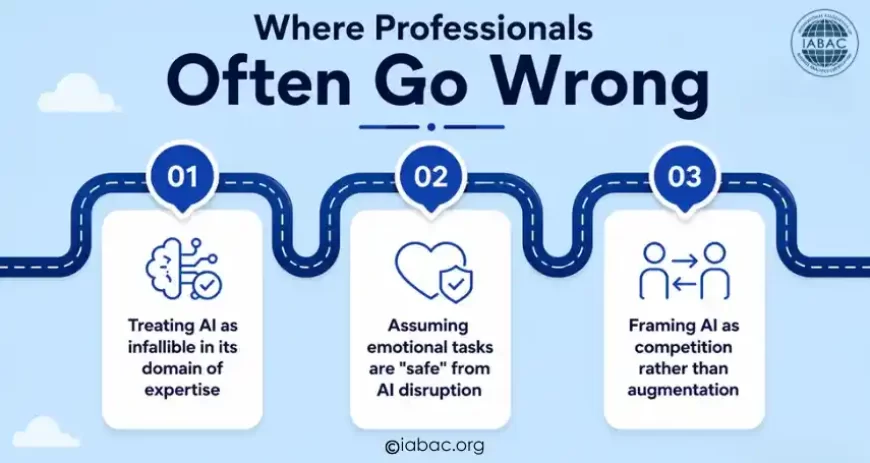
After training thousands of professionals in AI and data science, these are the most common misconceptions I see:
-
Treating AI as infallible in its domain of expertise
AI systems can be confidently wrong. Large language models hallucinate. Computer vision systems misclassify. Anyone deploying AI in a professional context should build in human review checkpoints, especially where the cost of error is high.
-
Assuming emotional tasks are "safe" from AI disruption
AI is already entering mental health support, customer service, and HR screening. The question is not whether AI touches these fields — it is whether humans maintain meaningful oversight and decision authority within them.
-
Framing AI as competition rather than augmentation
The professionals who thrive in the next decade will be those who understand both the limits and the capabilities of AI well enough to direct it effectively. That is a skill set, and it is learnable.
Frequently Asked Questions
1. Can AI replace human intelligence entirely?
No. AI handles specific cognitive tasks well, while human intelligence is adaptive, emotional, and driven by ethical reasoning.
2. What can AI do that humans cannot?
AI can process massive amounts of data, detect patterns quickly, and perform repetitive tasks with consistent accuracy. It also works continuously without fatigue across millions of operations.
3. What can humans do that AI cannot?
Humans can think creatively, adapt across unrelated situations, and respond with genuine emotion and ethical judgment. They also handle unpredictable environments far better than AI.
4. Is AI smarter than humans?
It depends on the task. AI is stronger in narrow, rule-based tasks, while humans lead in creativity, reasoning, emotional understanding, and decision-making.
5. How does understanding AI vs human intelligence help my career?
It helps you identify which human skills will stay valuable in an AI-driven world. Building strengths in creativity, communication, ethical thinking, and problem-solving alongside AI literacy creates a long-term career advantage.
The Right Frame for the Next Decade
The debate around AI vs human intelligence has produced more heat than light, largely because it is often framed as a contest. It is more accurately a question of design — what each form of intelligence was built for, what it does well, and where it falls short.
AI is built for scale, speed, consistency, and pattern recognition within defined boundaries. Human intelligence is built for generalization, creativity, emotional depth, ethical navigation, and meaning-making in ambiguous situations. These capabilities are not interchangeable — they are complementary.
According to OECD's AI capability indicators, current AI equals or exceeds human performance in only 3 of 5 basic cognitive domains assessed. Even in those domains, human judgment remains essential for deployment, interpretation, and oversight
The professionals and organizations that understand this distinction, not superficially, but deeply, will be the ones directing AI rather than being displaced by it.
If you want to build that understanding into a credential that carries weight in the market, explore IABAC's certification programs in AI, data science, and machine learning. The goal is not to compete with AI. It is to be the human intelligence that makes AI work.