















































Why a Data Science Certification for Managers Matters in 2026
Build better business decisions with practical analytics skills, AI knowledge, and leadership training through trusted certification programs.

Picture this: You're sitting in a strategy meeting. Your analytics team has just presented a dashboard full of charts, forecasts, and models. Everyone nods as they understand. But deep down, you're not sure what half of it means — and you're the one who has to sign off on the decision.
Sound familiar? You're not alone.
Today, a data science certification for managers is no longer a "nice to have." It's quickly becoming one of the most powerful career moves a business leader can make in 2026. And the best part? You don't need to become a programmer or a statistician to benefit from it.
This guide will walk you through exactly why this matters, what you'll actually learn, which certifications are worth your time, and how to get started — even if you've never touched a spreadsheet formula in your life.
What Is a Data Science Certification for Managers? (And What It Is NOT)
Let's clear up a common misconception first.
A data science for managers certification is NOT about learning how to write Python code or build machine learning models from scratch. That's for data scientists — not their managers.
What it IS about is teaching you how to:
- Understand what data can and cannot tell you
- Ask the right questions of your analytics team
- Interpret results, charts, and reports without getting lost
- Make smarter decisions backed by evidence instead of gut instinct
- Lead, evaluate, and collaborate with data professionals effectively
Think of it like learning to read a financial report. You don't need to be an accountant, but understanding what "gross margin" or "cash flow" means makes you a sharper business leader. Data literacy works the same way.
Why Data Science for Managers Is Critical in 2026
The business world has changed dramatically. Here's what the landscape looks like right now:
Data is now central to every business function
Marketing uses it to target customers. Operations uses it to reduce costs. HR uses it to predict employee turnover. Finance uses it to forecast revenue. If you manage any of these teams and can't engage with data meaningfully, you're at a disadvantage.
Decision-making speed has increased
Companies that can analyze data quickly and act on it are outpacing competitors. McKinsey research has consistently shown that data-driven organizations are significantly more likely to acquire customers and retain them. Leaders who understand analytics can move faster.
AI tools are everywhere — but they need human judgment.
Tools like ChatGPT, Tableau, Power BI, and automated forecasting software are now standard in most businesses. These tools generate outputs. Managers need to know how to interpret those outputs critically — not just accept them at face value.
The skills gap is widening
There's a growing divide between managers who "get" data and those who don't. According to the World Economic Forum's Future of Jobs reports, analytical thinking and data literacy are consistently ranked among the top skills employers want from future leaders.
A manager data science course bridges exactly this gap — and doing so in 2026 puts you ahead of the curve before it becomes mandatory.
What Data-Savvy Managers Actually Do Differently
Let's make this concrete with three examples.
Example 1 - The Retail Operations Manager
A retail chain is seeing a drop in sales at two specific locations. A manager without data skills might blame "foot traffic" and leave it there. A data-literate manager asks: What does the customer segmentation data show? Are these locations serving different demographics? What does the conversion rate per visit look like? That's a different conversation — and it leads to targeted action.
Example 2 - The HR Director
Employee attrition is rising. A typical response is to run an engagement survey. But a manager trained in business analytics certification concepts knows to look at exit interview patterns, tenure vs. compensation data, and promotion timelines. They can work with their HR analytics team to build a retention model that actually predicts who might leave next — before it happens.
Example 3 - The Marketing Team Lead
Your team ran four campaigns last quarter. All of them "performed well" according to the agency report. But a data-informed marketing manager knows to ask: Which one drove actual revenue, not just clicks?
What was the cost per acquisition? Which audience segment converted the most? Without data literacy, you're trusting someone else's summary instead of the numbers.
In each case, the manager isn't doing the data analysis themselves — they're guiding it, questioning it, and making better decisions because of it.
Who Should Get a Data Science Certification for Managers?
This is a great question — and honestly, the answer is broader than most people expect.
You should consider this certification if you are:
- A business manager or department head who works with analytics teams or data reports
- A project manager who wants to measure project performance more rigorously
- An operations manager trying to improve efficiency using data-driven insights
- A marketing, sales, or product manager who needs to understand campaign data, customer behavior, or product metrics
- An entrepreneur or startup founder who needs to make faster, smarter decisions with limited resources
- A professional transitioning into a leadership role who wants to future-proof their skill set
You do NOT need to be:
- A programmer or developer
- A statistician or mathematician
- Someone with a background in data science or IT
If you can read a bar chart and follow a logical argument, you have enough foundation to begin. Everything else is taught.
What Will You Actually Learn? Core Topics in a Manager-Focused Data Science Course
A good data science manager course doesn't drop you into the deep end with algorithms. Instead, it builds your understanding progressively. Here's what most quality programs cover:
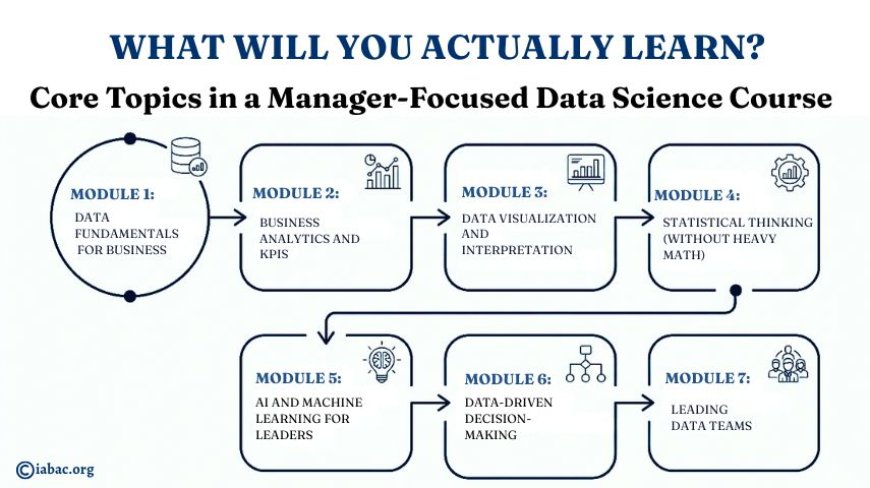
Module 1: Data Fundamentals for Business
What is data? What's the difference between structured and unstructured data? How do businesses collect, store, and use data? This module makes sure you understand the landscape before diving in.
Module 2: Business Analytics and KPIs
How to define the right metrics (KPIs — Key Performance Indicators) for your team. How to distinguish between vanity metrics and metrics that actually drive decisions.
Module 3: Data Visualization and Interpretation
Reading dashboards, interpreting charts, identifying trends, spotting misleading visualizations. This is where most managers see immediate, practical value.
Module 4: Statistical Thinking (Without Heavy Math)
Understanding correlation vs. causation. Knowing when a sample size is too small. Recognizing statistical significance without needing to calculate it yourself.
Module 5: AI and Machine Learning for Leaders
What machine learning models are, what they can and can't do, how to evaluate their outputs, and how to ask the right questions of your data science team.
Module 6: Data-Driven Decision-Making
Frameworks for making decisions using data. How to balance data insights with business intuition. How to present data-backed recommendations to stakeholders.
Module 7: Leading Data Teams
Understanding data science roles (analyst, engineer, scientist). How to evaluate data team performance. How to foster a data culture in your organization.
The Best Data Science Certifications for Managers in 2026
Now let's get to the practical part: which certifications are actually worth your time and money?
Here's a breakdown of the most recognized options in the market today, followed by a comparison table.
1. IABAC — Certified Business Analytics Professional (CBAP) / Data Science for Managers Track
International Association of Business Analytics Certifications offers certifications made for business professionals who want to use data science and analytics in their daily work. These programs are designed for managers, team leaders, analysts, and decision-makers who want to understand data without becoming full-time programmers.
Why IABAC is a good choice for managers
- Courses are created for business professionals, not software developers
- Focus on practical business examples and real company situations
- Accepted across industries such as banking, healthcare, retail, and manufacturing
- Online learning format with guidance from industry experts
- Covers both basic analytics and AI topics for business use
- Recognized by employers in Asia-Pacific, the Middle East, and many other regions
IABAC programs help managers learn how to make better decisions using data, reports, and AI tools. The training is focused on business understanding instead of deep technical coding.
Recommended IABAC certifications for managers
- Certified Business Analytics Professional (CBAP): This certification is suitable for mid-level managers, business analysts, and professionals who work with reports, business performance, and decision-making. It helps learners understand data analysis, business insights, and reporting methods in a simple and practical way.
- Certified Artificial Intelligence Professional (CAIP): This program is useful for managers handling AI-based projects, products, or teams. It explains how AI works in business operations and helps leaders understand AI-driven processes without needing advanced technical skills.
- Certified Data Science Professional (CDSP): This certification is for managers who want a stronger understanding of data science concepts and business analytics. It covers important areas of data science and helps professionals communicate better with technical teams and data experts.
IABAC certifications are a good option for professionals who want to lead with data, improve business decisions, and understand how AI and analytics are used in modern companies.
2. Google Data Analytics Professional Certificate
Offered through Coursera and backed by Google, this is one of the most popular entry-level analytics certifications available. It's thorough but leans more toward hands-on technical skills (spreadsheets, SQL, Tableau), which means it's valuable but requires more time investment from non-technical managers.
3. IBM Data Science Professional Certificate
IBM's certificate is comprehensive and well-regarded. However, it's quite technical — covering Python, machine learning, and data visualization with code. Better suited for those who want to transition into a data science role, rather than managers who want business-focused literacy.
4. MIT Sloan — Data Science and Statistics for Business
A prestigious option from MIT's Sloan School of Management. Excellent content, but it comes at a high cost and requires a higher time commitment. Better for senior executives and those in larger organizations with training budgets.
5. Tableau Desktop Specialist
A tool-specific certification focused on Tableau, a popular data visualization platform. Useful as a supplementary skill, but doesn't provide the broader strategic and analytical framework that a full data science certification for managers offers.
Top Data Science Certifications for Managers
|
Certification |
Provider |
Focus |
Technical Level |
Best For |
Cost Range |
Duration |
|
CBAP / CDSP |
IABAC |
Business |
Low– Medium |
Managers, team |
Affordable |
4–12 |
|
Data Analytics |
Google / Coursera |
Data tools, spreadsheets, |
Medium |
Analysts, junior |
~$200– |
6 months |
|
Data Science |
IBM/ |
Python, ML, |
High |
Career changers, technical roles |
~$300– |
10–12 months |
|
Data Science for Business |
MIT Sloan |
Statistics, |
Medium |
Senior |
$2,000– |
8–12 |
|
Tableau Desktop Specialist |
Tableau |
Data visualization |
Medium |
Dashboard |
~$250 |
Self-paced |
Top Recommended for Managers: IABAC Certifications
IABAC's programs hit the ideal balance for managers: rigorous enough to be credible, practical enough to apply immediately, and affordable enough not to require a corporate training budget. If your goal is to lead smarter — not code smarter — IABAC is the clearest path.
Ready to take the next step? Explore IABAC's certified programs for business professionals and find the track that fits your role and goals. [Learn more about IABAC certifications →]
How to Get Started: A Step-by-Step Roadmap for Managers
Here's a simple, practical roadmap to go from "data curious" to "data confident" as a manager.
Step 1: Audit Your Current Data Literacy (Week 1) Look at the reports, dashboards, and data presentations you encounter weekly. Write down every term, chart type, or concept you don't fully understand. This becomes your personal learning checklist.
Step 2: Set a Clear Goal (Week 1–2) Ask yourself: Why do I want this? Is it to lead my analytics team better? To make sharper strategy calls? To prepare for a promotion? Your goal shapes which certification track is right for you.
Step 3: Choose the Right Certification (Week 2) Based on your role, goal, and time availability, select a program. For most business managers, an IABAC certification provides the best mix of credibility, relevance, and practicality.
Step 4: Build a Study Schedule (Week 3) Most manager-focused programs require 4–8 hours per week. Block this time on your calendar like a meeting. Treat it as non-negotiable.
Step 5: Apply as You Learn (Ongoing) Don't wait until you finish the course to start applying concepts. Each week, take one concept from your learning and apply it to a real situation at work. This accelerates understanding dramatically.
Step 6: Complete Your Certification and Update Your Profile (Final Week) Once certified, update your LinkedIn profile, your resume, and any internal professional development records. Make sure your certification is visible — it signals leadership credibility to colleagues, stakeholders, and future employers.
Step 7: Continue Learning (After Certification) The field evolves quickly. Follow thought leaders on LinkedIn, read analyst reports, and consider an advanced certification 12–18 months after your first. Data literacy is a journey, not a destination.
Career Opportunities That Open Up With a Data Science Certification for Managers
Getting certified doesn't just make you better at your current job. It actively opens new doors.
- Higher-level leadership roles. Organizations increasingly want data-literate leaders at the Director, VP, and C-suite level. A certification signals you're not just experienced — you're forward-thinking.
- Chief Data Officer (CDO) pipeline. The CDO is now one of the fastest-growing executive roles. Many CDOs come from business backgrounds, not technical ones — but they all have strong data literacy. A certification is an early step on that path.
- Management consulting. Consultants who understand data science are in extremely high demand. Firms want people who can bridge the gap between analytics teams and business clients.
- Digital transformation leadership. Companies are transforming their operations with data and AI. Leaders who can guide these transformations — even without coding skills — are commanding premium salaries and titles.
- Entrepreneurship and startups. If you're building or scaling a business, understanding data means you can make evidence-based decisions on product, marketing, and operations without needing to hire a full analytics team from day one.
According to LinkedIn's annual Jobs on the Rise reports, roles requiring analytics leadership and data literacy have consistently grown year-over-year, with no signs of slowing down.
Common Myths About Data Science Certifications for Managers — Debunked
Myth 1
"I need a math background to do this." False. Manager-focused programs are built specifically for people without heavy math backgrounds. You'll learn to interpret statistics, not calculate them.
Myth 2
"I'm too senior for a certification." Actually, the opposite is true. The more senior you are, the more valuable data literacy becomes — because the stakes of your decisions are higher.
Myth 3
"My analytics team will think less of me if I take a beginner course." Wrong. Your team will respect you more when you can engage with their work meaningfully, ask smarter questions, and advocate for the resources they need.
Myth 4
"I'll just learn on the job." On-the-job learning is great — but unstructured. A certification gives you a framework, vocabulary, and credential that ad hoc learning doesn't provide.
Myth 5
"These certifications aren't recognized by employers." Globally recognized programs like IABAC are increasingly cited in job descriptions and performance reviews, particularly in Asia-Pacific and the Middle East markets.
The Manager Who Understands Data Wins
We've come a long way from that boardroom where the manager didn't understand the numbers on the screen.
In 2026, the data science certification for managers isn't about becoming a data scientist. It's about becoming the kind of leader who can ask the right questions, evaluate the right answers, and make decisions that actually hold up.
Every industry is becoming data-driven. Every team — from marketing to operations to HR — is generating insights that could be used to create a competitive advantage. The question is whether the person leading that team can unlock that value.
A certification from a program like IABAC doesn't just add a line to your resume. It changes how you think, how you lead, and how you compete.
The managers who invest in this skill today are the executives who will be making the decisions tomorrow.
Start your journey today. Explore IABAC's business-focused data science certifications and find the program designed for professionals like you. Visit the IABAC certification portal to learn more, compare programs, and enroll. [Explore IABAC Certifications Now →]
Quick-Recap Action Checklist
Use this checklist to move from reading to action:
- Identify the data gaps in your current role (what reports confuse you?)
- Define your personal goal for earning a certification
- Review the certification comparison table above
- Shortlist IABAC, CBAP, CDSP, or CAIP based on your role
- Block 4–6 hours per week for structured learning
- Enroll in your chosen certification program
- Apply one new concept per week at work
- Update LinkedIn and resume once certified
- Plan for an advanced certification in 12–18 months
Reference Links
- World Economic Forum — Future of Jobs Report: https://www.weforum.org/reports/the-future-of-jobs-report-2023
- Google Data Analytics Professional Certificate (Coursera): https://www.coursera.org/professional-certificates/google-data-analytics
- IBM Data Science Professional Certificate (Coursera): https://www.coursera.org/professional-certificates/ibm-data-science
- MIT Sloan Data Science for Business (edX): https://www.edx.org/school/mitsloan
- LinkedIn Jobs on the Rise Report: https://www.linkedin.com/pulse/linkedin-jobs-rise-2024
- McKinsey Global Institute — The Age of Analytics: https://www.mckinsey.com/capabilities/quantumblack/our-insights